
Your new stone patio or concrete driveway is only as good as the dirt underneath it. While a finished project looks great on day one, the real test of a contractor’s skill happens years later when the ground shifts and the rains come. You deserve a beautiful outdoor space that lasts for generations, but it’s natural to worry about hidden costs or structural failure. It’s often difficult to know if a team truly understands the technical demands of Bay Area soil and local building codes.
This comprehensive list of questions to ask a hardscaping contractor helps you expertly vet your next hire for technical skill and local expertise. We’ve built our reputation on integrity and proven results; we believe every homeowner should have the tools to identify a high-quality craftsman. We’ll walk you through fifteen essential queries covering drainage, permits, and engineering to ensure your project is built to stay and provides total peace of mind.
Key Takeaways
- Understand why hardscaping is a permanent structural investment that demands a more rigorous vetting process than simple gardening projects.
- Learn how to verify essential California licensing and insurance specific to masonry and concrete to protect your home and investment.
- Identify the critical questions to ask a hardscaping contractor regarding soil preparation and integrated drainage to prevent future cracking or sinking.
- Gain clear strategies for managing project logistics, from protecting your existing utilities to establishing realistic construction timelines.
- Discover the value of choosing a legacy partner with deep roots in the Bay Area to ensure accountability and long-term durability.
The Stakes of Hardscaping: Why Your Interview Process Matters
Hardscaping is the backbone of your outdoor living environment. It’s a permanent investment that shapes how you use your property for decades. While plants and sod can be easily replaced, structural elements like concrete driveways or retaining walls are much harder and more expensive to fix once they’re installed. This is why the initial screening process is so vital. You aren’t just hiring someone to move dirt; you’re hiring an expert to build a foundation that must withstand time, weather, and the unique geological challenges of the Bay Area.
Many homeowners feel a sense of anxiety when starting a major exterior project. They worry about hidden costs or, worse, structural failure like sinking pavers or cracked concrete. These fears are valid. The cost of “doing it twice” because a contractor skipped a step in the sub-base or drainage plan can be double the original price. Using a structured list of questions to ask a hardscaping contractor is your best defense against these outcomes. It shifts the conversation from aesthetics to technical precision, ensuring your investment is protected from the ground up.
Hardscaping vs. Landscaping: Know the Difference
It’s helpful to distinguish between different types of outdoor work. While landscaping often focuses on soft elements like trees and flowers, Hardscape refers to the “bones” of the yard. This includes your concrete patios, interlocking paver systems, and brick masonry. These projects require specialized masonry skills and heavy equipment that general landscapers often don’t possess. Proper installation involves complex structural engineering, precise grading, and professional grade compaction tools. Without these, even the most expensive stone will eventually shift or crack.
The Long-Term Value of a Vetted Contractor
Quality hardscaping must survive more than just the first rainy season. In our region, local soil shifts can be aggressive. A contractor who understands the specific clay content in Peninsula soil knows exactly how deep a sub-base needs to be for a durable driveway or garden wall. Experience matters here. Since 1979, we’ve seen how different materials react to our local climate over the long haul. A vetted professional provides more than just a finished surface; they provide the peace of mind that your home’s value is enhanced by a structure built to last. Using the right questions to ask a hardscaping contractor helps you find a partner who values integrity and technical excellence over a quick, cheap fix. This level of scrutiny ensures the person you hire is fully accountable for the work they perform on your property.
Verification and Credibility: Essential Business Questions
Trust is the foundation of any successful home improvement project, especially when it involves permanent masonry or concrete structures. Before you sign a contract, you must look past the portfolio photos and verify the business standing of the company. These specific questions to ask a hardscaping contractor will help you separate established professionals from unproven alternatives. You need a partner who is fully accountable to both the law and the local community.
Licensing and Insurance: Non-Negotiables
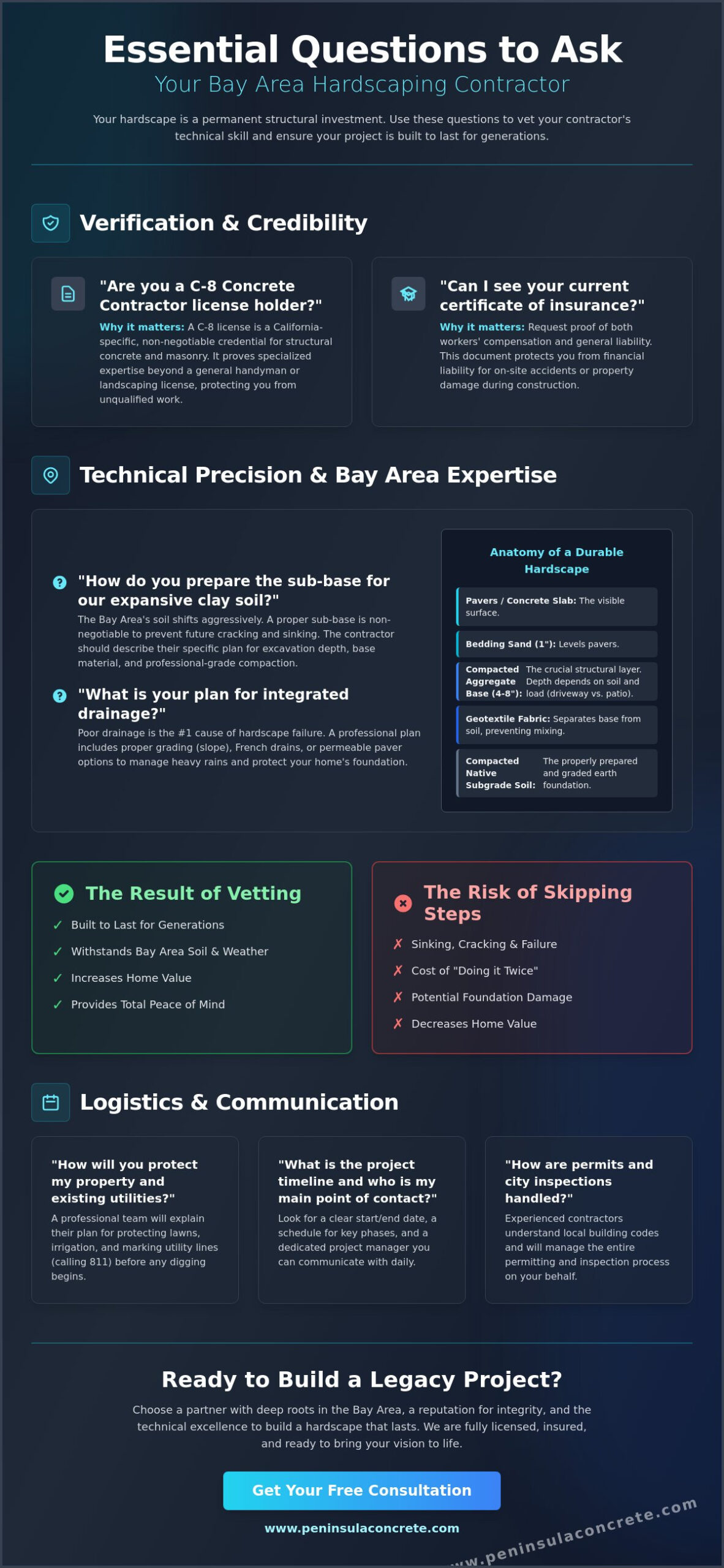
In California, specialized work requires specialized credentials. You should always ask if the contractor holds a C-8 Concrete Contractor license. This specific classification ensures they have the proven expertise to handle structural concrete and masonry work safely. A general handyman license is often insufficient for the technical demands of a new driveway or a structural retaining wall. Hiring an unlicensed individual puts your property at risk and may complicate your homeowners insurance if issues arise.
Insurance is equally critical for your protection. Don’t settle for a verbal “yes” when asking about coverage. Request a current certificate of insurance that clearly shows workers’ compensation and general liability limits. This documentation protects you from being held liable if a crew member is injured on your property or if accidental damage occurs during the build. A reputable company will provide these documents readily, viewing it as a standard part of their professional transparency.
Proven Track Record in the Peninsula
Online reviews offer a snapshot, but local references provide a complete picture. Ask for a list of projects in your area that were completed at least five years ago. This allows you to see how their work survives the test of time and Bay Area weather. You want to know how their interlocking paver systems or brick masonry look after weathering several heavy rainy seasons. A contractor who has been rooted in the community since 1979 will have plenty of local examples that demonstrate their commitment to quality and longevity.
Clear communication is another hallmark of a professional team. Ask who your primary point of contact will be on-site and how they handle the complex permit processes required by cities like Redwood City or Palo Alto. A seasoned craftsman understands that managing local codes and inspections is just as important as the physical construction. If you want to understand more about what sets a top-tier team apart, you can explore why choose Peninsula Concrete Contractors? for your next project. When you’re ready to start your journey with a dependable team, contact us to discuss your vision.
Technical Precision: Questions About Materials, Drainage, and Soil
The surface of your new patio is the only part you see, but the engineering underneath determines if it stays level for the next thirty years. In the Bay Area, our expansive clay soils and seasonal rains create a challenging environment for masonry. If the foundation is weak, your investment will eventually shift, crack, or sink. These technical questions to ask a hardscaping contractor will reveal if they are a seasoned craftsman or simply a surface-level installer.
Ask specifically about sub-base preparation for your project. For a standard concrete driveway, the base should consist of several inches of compacted crushed stone, not just loose dirt. The depth of this base depends on whether you’re installing poured concrete or interlocking pavers. A professional should be able to explain how they compact the soil to prevent future settling. These details are the difference between a project that lasts and one that fails after the first winter.
Solving the Bay Area Drainage Puzzle
Poor drainage is the primary cause of hardscape failure in Northern California. During our heavy winter rains, water that isn’t properly diverted can pool against your home’s foundation or cause retaining walls to buckle. You must ask: “How will you move water away from my house?” A reliable plan often includes integrated surface drains, French drains, or permeable surfaces. For homeowners planning more complex structures, our Retaining Wall Drainage Guide provides a deeper look at managing hydrostatic pressure. This is especially vital for walls over 4 feet, which typically require specific permits and engineering inspections in the Bay Area.
Material Science: Pavers vs. Poured Concrete
The technical requirements change depending on your chosen material. If you prefer interlocking concrete pavers, ask about the edge restraints and joint sand. High-quality installations use polymeric sand to prevent weed growth and heavy-duty edge restraints to keep the system tight. These components ensure the pavers don’t “creep” or spread over time.
For those choosing a solid surface, durability is paramount. Our Bay Area concrete driveways are engineered to withstand local conditions, but you should always verify the technical specs with any contractor. Ask about the PSI (pounds per square inch) rating of the concrete mix. A driveway typically requires at least 3,000 to 4,000 PSI. Additionally, confirm the type of reinforcement planned. We recommend rebar over simple wire mesh for superior structural integrity, especially in seismic zones. Ask for the specific spacing of the rebar grid to ensure it provides the necessary tensile strength. Understanding these details protects you from “thin” pours that crack under the weight of a vehicle.
Managing the Build: Logistics, Timelines, and Communication
A successful project requires more than just technical skill. It requires a managed process that respects your time and your property. While the engineering determines the project’s lifespan, the logistics determine your daily quality of life during the construction phase. When refining your list of questions to ask a hardscaping contractor, you must move beyond the materials and focus on the execution. A professional team will have a clear, documented plan for every stage of the build.
Start by asking how the crew will protect your existing property. Heavy machinery for concrete driveways or stone delivery can easily damage lawns, irrigation lines, or underground utilities if not handled with care. You should also inquire about their plan for neighbor relations. Will they ensure street access remains clear? How will they manage dust and noise? A team with deep roots in the community understands that their reputation is built on how they treat the entire neighborhood, not just the job site.
The Project Timeline: From Excavation to Curing
Hardscaping is a multi-phase process that cannot be rushed. A typical build includes demolition, grading, base preparation, and finally the installation of your interlocking paver systems or poured concrete. Ask for a breakdown of these phases and the total estimated duration. It is particularly important to ask about curing times. For a new concrete driveway, you need to know exactly how long the surface must remain undisturbed before you can safely drive a vehicle on it. Weather is another factor. Ask how they handle rain delays and what steps they take to protect an open excavation site during a Bay Area storm.
Professionalism on the Job Site
You deserve to know who will be on your property every day. Ask if the contractor uses a dedicated, consistent crew or if the team rotates between multiple jobs. This impacts both the timeline and the quality of the finish. Communication is the key to preventing frustration. Establish a rhythm for updates, whether that is a brief daily check-in or a weekly summary of milestones. Finally, address the financial logistics. A trustworthy business will provide a clear payment schedule tied to specific project milestones, such as the completion of the sub-base or the final pour. This ensures that the project’s progress always aligns with your investment.
Handling unexpected soil issues or change orders shouldn’t be a source of stress. A seasoned craftsman will identify potential challenges during the initial assessment and explain the process for any necessary adjustments. If you value a team that prioritizes clear communication and reliable results, contact Peninsula Concrete Contractors today to discuss your upcoming project.
The Peninsula Concrete Contractors Difference: Choosing a Legacy Partner
Selecting a team to transform your property is a significant decision that carries long-term financial and structural implications. While the questions to ask a hardscaping contractor we’ve outlined will help you vet any potential hire, there’s a distinct advantage in choosing a partner with deep local roots. We’ve spent over 40 years perfecting our craft in Redwood City and across the Peninsula. This isn’t just a job for us; it’s a family legacy built on a foundation of integrity and accountability to our neighbors. When you hire a legacy partner, you aren’t just getting a crew; you’re gaining the expertise of a team that has a personal stake in the durability of every driveway and patio they build.
A History of Quality Since 1979
Our company has operated as a multi-generational family enterprise since 1979. This historical longevity provides a perspective that newer, unproven firms simply cannot match. We’ve seen firsthand how our concrete driveways, garden walls, and drainage systems have performed over decades of Bay Area soil shifts and seasonal changes. We don’t just focus on the surface aesthetics. Our commitment to an engineering-first approach means we prioritize the hidden components, like sub-base compaction and hydrostatic pressure management, that ensure your natural stone masonry or interlocking paver systems remain stable for the long haul. Because we’re rooted in this community, we take immense pride in our work, knowing that our reputation is built on the lasting quality we leave behind.
Ready to Start Your Hardscape Project?
We encourage you to take this list of questions to ask a hardscaping contractor and use it during your next project consultation. Whether you’re planning a complex drainage system installation or a new brick masonry walkway, you deserve a contractor who provides transparent, technically sound answers. A professional should be able to explain the “why” behind their methods without hesitation. We invite you to explore our gallery of local projects to see the durable, beautiful results we’ve delivered for homeowners throughout the region. When you’re ready for a partner who values proven expertise and a personal touch, Contact Peninsula Concrete Contractors for a Professional Estimate and let’s discuss how to bring your vision to life with quality that lasts for generations.
Secure the Future of Your Outdoor Living Space
A successful hardscape project depends on technical engineering and professional accountability. By using these questions to ask a hardscaping contractor, you’ve moved beyond surface-level aesthetics to ensure your project survives Northern California’s unique environmental challenges. You now understand the vital role of sub-base preparation, integrated drainage, and the necessity of specialized licensing in protecting your investment.
We’ve served the Bay Area since 1979 with a steadfast focus on durability and integrity. As a family-owned and operated business, we take personal pride in every installation. Our specialized C-8 Concrete and Masonry license provides the technical assurance you need for a project that stands the test of time. Your home deserves a foundation built by seasoned craftsmen who care about your legacy as much as their own.
Get a Professional Hardscaping Estimate from Peninsula Concrete Contractors today. We look forward to helping you build a beautiful, durable outdoor space that your family will enjoy for generations.
Common Questions About Hiring a Hardscaping Contractor
Do I need a permit for a new patio or driveway in the Bay Area?
Permit requirements depend on your specific municipality and the scope of your project. Generally, cities in the Peninsula require permits for new driveways, major grading work, or retaining walls over a certain height. You should always check with your local planning department to ensure your project complies with current building codes and drainage regulations.
What is the most important question to ask a hardscaping contractor?
The most critical inquiry involves their specific plan for sub-base preparation and soil compaction. While many questions to ask a hardscaping contractor focus on the final look, the engineering below the surface determines if the project will sink or crack. A professional should explain how they adjust their base depth to handle the expansive clay soils common in our region.
How can I tell if a hardscape quote is too good to be true?
A quote that is significantly lower than others often suggests that a contractor is skipping essential steps like deep excavation or professional-grade drainage. Look closely at the material specifications and labor hours. If the estimate lacks detail on the PSI of the concrete or the thickness of the crushed stone base, the contractor might be cutting corners to provide a lower price.
Should I hire a general landscaper or a specialized hardscape contractor?
You should hire a specialized contractor for structural masonry and concrete work. While general landscapers are excellent with plants and softscaping, they often lack the heavy compaction equipment and structural engineering expertise required for permanent installations. Specialized teams ensure that your retaining walls and interlocking paver systems are built to withstand decades of use.
What kind of warranty should a hardscaping project come with?
You should ask for a clear breakdown of both the material manufacturer’s warranty and the contractor’s workmanship warranty. Manufacturers often cover defects in pavers or stone, but the contractor should provide a separate guarantee on the installation itself. This protects you against issues like shifting or settling caused by improper base preparation.
How does a contractor handle underground utilities like gas or water lines?
A professional contractor must call 811 to have all underground utility lines marked before any digging begins. This is a mandatory safety step in California that prevents accidental damage to gas, water, or electrical lines. We take this responsibility seriously to protect your property and ensure the safety of our crew and your neighbors.
What is the typical payment structure for a large hardscaping project?
A standard payment schedule includes an initial deposit followed by progress payments tied to verifiable project milestones. For example, you might make a payment after the excavation is complete and another after the sub-base is installed. This structure keeps the project moving forward and ensures that your financial investment matches the work performed on-site.
How long should I wait before using my new concrete driveway?
You should wait at least seven days before driving a standard passenger vehicle on a new concrete surface. While concrete may feel hard to the touch within 24 hours, it takes time to reach its full structural strength. Walking on the surface is usually safe after 24 to 48 hours, but heavy weight must wait until the curing process is sufficiently advanced.