
A cracked, stained, or aging driveway does more than just hurt your home’s curb appeal; it creates uncertainty. You see the problem every day, but the right solution can feel overwhelming. Do you need a minor repair or a costly full replacement? How can you budget for the project without worrying about surprise charges or confusing quotes from contractors? As a family-owned business that has built a reputation for quality work in the Bay Area since 1979, we believe in providing clear, honest answers.
That’s why we created this straightforward 2026 pricing guide. Here, we will give you a transparent look at the typical concrete driveway resurfacing cost in our local market. We’ll help you determine if your driveway is a good candidate for this durable, high-quality solution, compare the expense against a complete tear-out and replacement, and give you the knowledge you need to approach your project with confidence. Let’s get you the information you need to make a smart, informed decision for your home.
Key Takeaways
- Learn if concrete resurfacing is the right, cost-effective solution for your driveway’s minor cracks, stains, and general wear.
- Get a realistic budget estimate with our breakdown of the average concrete driveway resurfacing cost per square foot in the Bay Area.
- Discover the five critical factors, from surface preparation to custom finishes, that will influence your final project quote.
- Understand the essential steps in a professional resurfacing process that ensure a high-quality, long-lasting result for your home.
What is Concrete Resurfacing & Is It Right for Your Driveway?
Before exploring the details of concrete driveway resurfacing cost, it’s essential to understand what the process involves and if your property is a suitable candidate. Concrete resurfacing is a proven method for restoring the look and function of your existing driveway without the expense and disruption of a complete tear-out and replacement.
The process involves applying a thin, durable layer of a specialized cement-based overlay directly onto your existing concrete slab. This is far more than a simple coat of paint; it’s a high-quality, polymer-modified topping that bonds powerfully to the old concrete, creating a brand-new surface. As one of many professional concrete pavement restoration techniques, resurfacing effectively repairs minor damage, covers imperfections, and gives you the opportunity to update the color or texture of your driveway.
Good Candidates for Resurfacing
Resurfacing is an ideal solution when the underlying concrete slab is still structurally sound. If your driveway exhibits mainly surface-level problems, it is likely a strong candidate for this cost-effective restoration. Look for these signs:
- Surface-level or hairline cracks (less than a quarter-inch wide).
- Stains from oil, rust, or other spills that won’t come clean.
- Minor spalling, pitting, or discoloration from age and weather.
- A desire to update the look with a stamped or colored finish without a full demolition.
When Replacement is the Only Smart Option
While resurfacing is a fantastic tool, it cannot fix foundational problems. Applying an overlay to a failing slab is a temporary fix at best and a waste of money in the long run. Full replacement is necessary if your driveway has significant structural issues, such as:
- Deep, wide cracks that indicate the sub-base has failed.
- Major heaving, sinking, or shifting sections of concrete.
- Widespread, deep crumbling or spalling where large chunks of the surface are flaking away.
- Severe damage caused by freeze-thaw cycles or tree roots.
Breaking Down the Average Cost of Driveway Resurfacing in the Bay Area
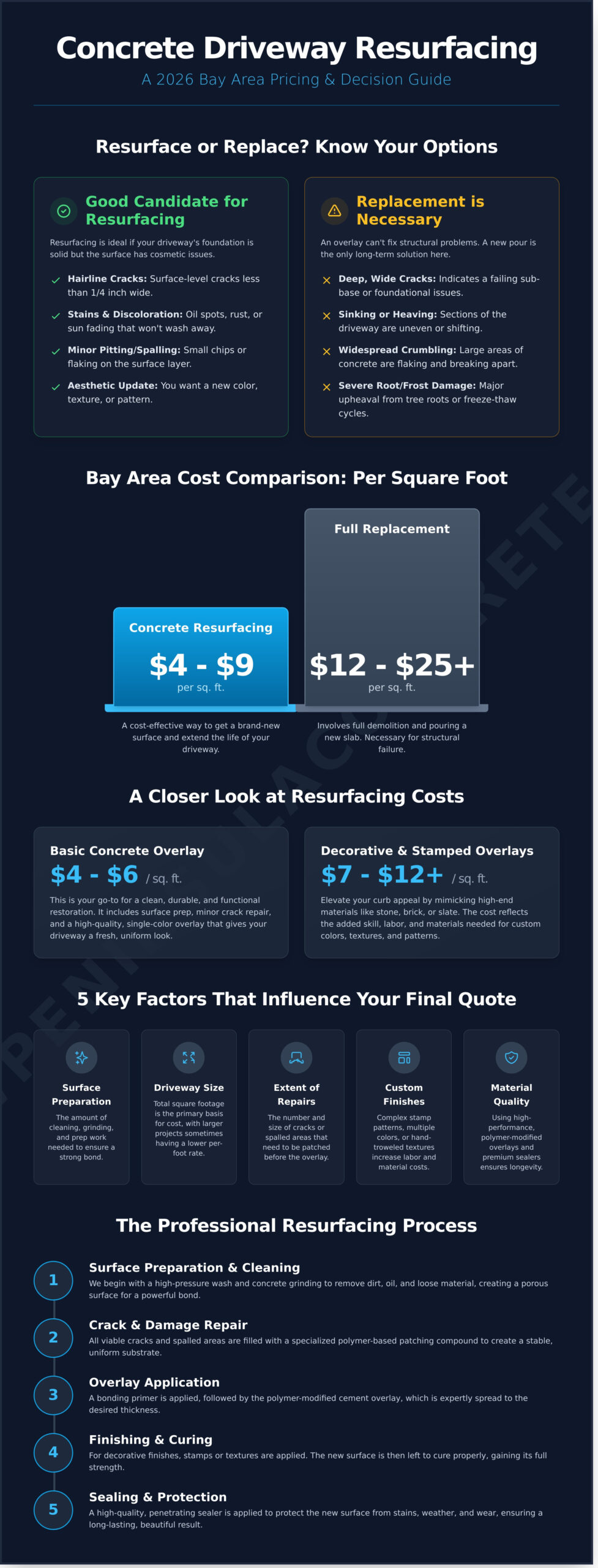
Understanding the concrete driveway resurfacing cost in the Bay Area begins with knowing that projects are typically priced per square foot. This method ensures you only pay for the area being renewed. Generally, homeowners can expect to invest between $4 and $9 per square foot for a professional, high-quality resurfacing job.
This investment offers significant savings compared to a full demolition and replacement, which often runs from $12 to $25 or more per square foot. By choosing to resurface, you can achieve a brand-new look and extend the life of your driveway for a fraction of the cost of a complete tear-out.
Cost for a Basic Concrete Overlay
For a clean, functional restoration, a basic concrete overlay is the most budget-friendly choice, typically ranging from $4 to $6 per square foot. This service includes essential surface preparation, minor crack repair, and the application of a durable, single-color overlay. Proper execution is key to longevity, which is why our process adheres to the established methodology for concrete maintenance and repair to ensure the substrate is sound before any new material is applied.
Cost for Decorative and Stamped Overlays
If you want to enhance your home’s curb appeal, decorative options provide stunning results. The cost for stamped, textured, or multi-colored overlays generally falls between $7 to $12+ per square foot. These advanced techniques can mimic the appearance of high-end materials like natural stone, brick, or slate. The increased price reflects the greater skill, intricate labor, and specialized materials required to create these custom designs.
Sample Project Costs
To help you visualize the potential investment, here are some common estimates based on driveway size. The final concrete driveway resurfacing cost will depend on the specific condition of your driveway and the finishes you select.
| Driveway Size (Approx.) | Estimated Basic Overlay Cost | Estimated Decorative Cost |
|---|---|---|
| 500 sq. ft. (Standard 2-Car) | $2,000 – $3,000 | $3,500 – $6,000 |
| 800 sq. ft. (Large 2-Car / Small 3-Car) | $3,200 – $4,800 | $5,600 – $9,600 |
| 1200 sq. ft. (Expanded or Long Driveway) | $4,800 – $7,200 | $8,400 – $14,400+ |
Disclaimer: These figures are for estimation purposes only. Every project is unique, and we provide a detailed, firm quote after an on-site evaluation.
5 Key Factors That Influence Your Final Resurfacing Quote
While an average price per square foot provides a useful baseline, it’s important to understand that it is only a starting point. Every driveway is unique, and a professional assessment is essential to determine the true scope of work. The final concrete driveway resurfacing cost is determined by the specific labor and materials required for a durable, high-quality result. A reputable contractor’s estimate will always account for these variables, guided by industry best practices for the proper selection and application of materials to ensure a long-lasting finish.
Here are the five key factors that will shape your final quote.
1. The Condition of Your Existing Concrete
The integrity of the underlying slab is the most critical factor. A driveway with only minor surface imperfections will require minimal preparation. However, extensive issues like deep, structural cracks, significant spalling, or heaving sections demand more intensive labor and specialized repair materials before any resurfacing can begin. Likewise, contaminants like oil stains or failing old sealants must be completely removed to ensure the new overlay bonds properly, adding to the preparation time and cost.
2. Size and Complexity of the Area
While a larger driveway will have a higher total cost, the price per square foot often decreases as the project size increases due to efficiencies in labor and material delivery. The complexity of the layout also plays a significant role. A simple, rectangular slab is straightforward to resurface. In contrast, a driveway with sweeping curves, multiple sections, steep grades, or intricate edges around landscaping and walkways requires more detailed work and precision, increasing labor hours.
3. Choice of Finish and Design
Your aesthetic vision directly impacts the final price. The complexity of the design determines the level of artistry and materials needed, creating a wide cost range. Your options typically fall into these categories:
- Basic Finish: A standard broom finish or a simple spray-down texture is the most cost-effective choice, focused purely on function and a clean look.
- Decorative Stains & Patterns: Adding a single color stain or a basic stamped concrete pattern like cobblestone or brick will increase the cost.
- Custom & High-End Designs: The most expensive options involve multi-color staining, intricate stamped patterns, hand-troweled textures, or custom-scored designs and borders.
4. Site Accessibility and Preparation
The logistics of the job site can affect the project timeline and labor costs. A driveway with easy, open access for equipment like concrete mixers and grinders is more efficient to work on. If the area is hard to reach, situated on a steep hill, or requires materials to be transported by wheelbarrow over long distances, the labor component of your quote will be higher. Extensive pressure washing or diamond grinding to prepare the surface also adds to the project’s duration and overall expense. Get a precise quote based on your driveway’s condition.
The Resurfacing Process: What Quality Work Looks Like
A beautiful, long-lasting finish doesn’t happen by accident. It is the direct result of a meticulous, multi-step process performed by experienced professionals. While some contractors may cut corners to offer a lower price, this often leads to peeling, cracking, and premature failure. Understanding what quality work entails helps you appreciate the value behind the concrete driveway resurfacing cost and ensures you receive a durable surface that enhances your home’s curb appeal for years to come.
A professional process guarantees that the new overlay bonds permanently to the existing slab, creating a single, solid surface ready to withstand traffic and weather.
Step 1: Thorough Surface Preparation
This is the most critical stage for ensuring a successful resurfacing project. Without proper preparation, even the best overlay material will fail. The goal is to create a clean, solid, and porous surface that the new material can lock onto.
- Deep Cleaning: The process begins with a high-pressure power wash to remove all dirt, oil stains, grime, and failing paint or sealers.
- Grinding: We then use a concrete grinder to open up the pores of the concrete. This creates a rough texture, known as a “surface profile,” which is essential for a strong mechanical bond.
- Damage Repair: All significant cracks and spalled areas are filled and repaired using specialized, high-strength patching compounds that move with the concrete.
Step 2: Applying the Concrete Overlay
Once the foundation is perfectly prepared, the transformation begins. The overlay, a polymer-modified cementitious product, is applied with precision and skill. First, a primer or bond coat is applied to the existing concrete, acting as a powerful adhesive. The resurfacing material is then mixed and spread evenly across the entire driveway to the correct thickness. Our craftsmen trowel it to a smooth finish or apply stamps, stencils, or textures to achieve your desired decorative look.
Step 3: Curing and Sealing
The final steps are all about protection and patience. The new surface must cure properly to gain its full strength. This period is vital for long-term durability. After the initial cure, we apply a high-quality, commercial-grade sealer. This protective layer shields your new driveway from moisture, UV rays, stains, and de-icing salts. As a general guide:
- Foot Traffic: Safe after 24-48 hours.
- Vehicle Traffic: Ready in approximately 5-7 days, depending on weather conditions.
This commitment to a proven process is what defines quality work and justifies the concrete driveway resurfacing cost for a result that truly lasts. For a project built on honesty and expertise, contact our team today.
Partner with the Bay Area’s Trusted Concrete Experts
As we’ve explored, driveway resurfacing is a durable and highly effective way to restore your home’s curb appeal without the high price of a full replacement. Understanding the key factors-from the current condition of your driveway to the decorative finishes you desire-is crucial for estimating your total concrete driveway resurfacing cost. While this guide provides a solid overview, the best way to get an accurate price is through a professional assessment.
When you’re ready for a precise quote, trust the team at Peninsula Concrete Contractors. As a 2nd-generation, family-owned business, we have proudly served the Peninsula with quality work since 1979. Our A+ BBB rating and reputation are built on honesty and high-quality results. For your complete peace of mind, we are fully licensed, bonded, and insured.
Request a Free, No-Obligation Estimate for Your Driveway Project and take the first step toward a beautiful, long-lasting driveway you can be proud of.
Frequently Asked Questions
How long does concrete resurfacing last in the Bay Area?
A professionally installed concrete resurfacing can last anywhere from 8 to 15 years, and often longer. In the Bay Area, the durability of the overlay depends on the quality of the preparation and materials used. Our mild climate is less harsh than areas with freeze-thaw cycles, but proper sealing is essential to protect the surface from rain and UV exposure. With proper care, your resurfaced driveway will provide lasting value and curb appeal for years to come.
Can you resurface an asphalt or badly damaged concrete driveway?
Concrete resurfacing is only suitable for existing concrete surfaces, not asphalt. For concrete driveways with severe damage-such as large, deep cracks, crumbling sections, or significant heaving-resurfacing is not the correct solution. An overlay is a new surface layer, not a structural repair. In these cases, a full replacement is necessary to ensure a safe and durable result. We only recommend resurfacing for driveways that are structurally sound but have surface-level imperfections.
Is resurfacing a driveway a good return on investment?
Absolutely. Resurfacing provides an excellent return on investment by restoring your driveway’s appearance for a fraction of the price of a full replacement. This significantly boosts your home’s curb appeal and can increase its market value. When you consider the overall concrete driveway resurfacing cost compared to the expense and disruption of a complete tear-out and repour, it stands out as a smart, high-value home improvement project that delivers impressive, long-lasting results.
How much thicker will my driveway be after resurfacing?
A standard concrete overlay adds minimal thickness to your existing driveway, typically ranging from 1/8 to 1/4 of an inch. The exact thickness depends on the specific resurfacing product used and the condition of the original concrete surface. This thin application is strong enough to create a durable new surface that resists traffic and weather without significantly altering the driveway’s height, garage door clearance, or adjacent walkways.
Do I need a permit for concrete driveway resurfacing in my city?
In most Bay Area cities, a permit is not required for a simple concrete resurfacing, as it is considered a repair rather than new construction. However, regulations can vary by municipality. If your project involves expanding the driveway’s footprint, altering the approach, or changing the curb, a permit will almost certainly be necessary. As an experienced local contractor, we can advise you on the specific requirements for your city and ensure all work is fully compliant.
How do I maintain my newly resurfaced driveway?
Maintaining your newly resurfaced driveway is simple and key to its longevity. Regularly sweep away debris and rinse it with a hose to prevent dirt buildup. Clean up oil, gasoline, or other chemical spills immediately to avoid staining and damage. We also recommend having the surface resealed every 2-3 years. This protective layer helps it resist moisture, UV rays, and stains, keeping your driveway looking its best and protecting your investment for many years.