
Last January, a homeowner in San Mateo watched as a 10 foot section of their backyard hillside began to bulge after just three days of heavy rain. It’s a terrifying sight that many Bay Area residents face when the soil becomes saturated and heavy. You’ve likely felt that same knot in your stomach during a California atmospheric river. It’s stressful to see water pooling behind your hardscaping or notice new cracks in a wall that cost thousands to install. You deserve expert retaining wall drainage solutions that actually work, not just another contractor giving you a different opinion.
Since 1979, Peninsula Concrete Contractors has seen how hydrostatic pressure can move thousands of pounds of earth in a single night. We know you want a landscape that lasts for decades and provides peace of mind when the storms hit. This article explains the professional drainage strategies that prevent wall failure and protect your property from soil erosion. We’ll break down the technical requirements for backfill, weep holes, and pipe placement so you can ensure your landscape stays stable for the next 40 years.
Key Takeaways
- Understand the physics of hydrostatic pressure and why trapped water poses a greater threat to your wall’s structural integrity than soil alone.
- Discover the essential components of professional retaining wall drainage solutions, including the proper use of clean crushed stone and perforated pipes.
- Master specialized techniques for managing aggressive grading on steep Peninsula hillsides, even when there is no direct connection to a storm drain.
- Learn how to evaluate an aging structure to determine if supplemental weep holes can save the wall or if a complete tear-out is required.
- Explore why our family-owned approach has prioritized integrated drainage to protect Bay Area properties with quality work since 1979.
What is Hydrostatic Pressure and Why Does It Kill Retaining Walls?
Hydrostatic pressure is the primary force that destroys even the most robust masonry. At Peninsula Concrete, we’ve seen how 45 years of Pacific storms can turn a beautiful backyard into a major liability. Hydrostatic pressure is the constant, heavy force exerted by stagnant water trapped behind a structure. When rain falls on the San Francisco Peninsula, it doesn’t always disappear into the ground. Instead, it sits against your wall, pushing with an immense weight that the structure wasn’t designed to hold alone.
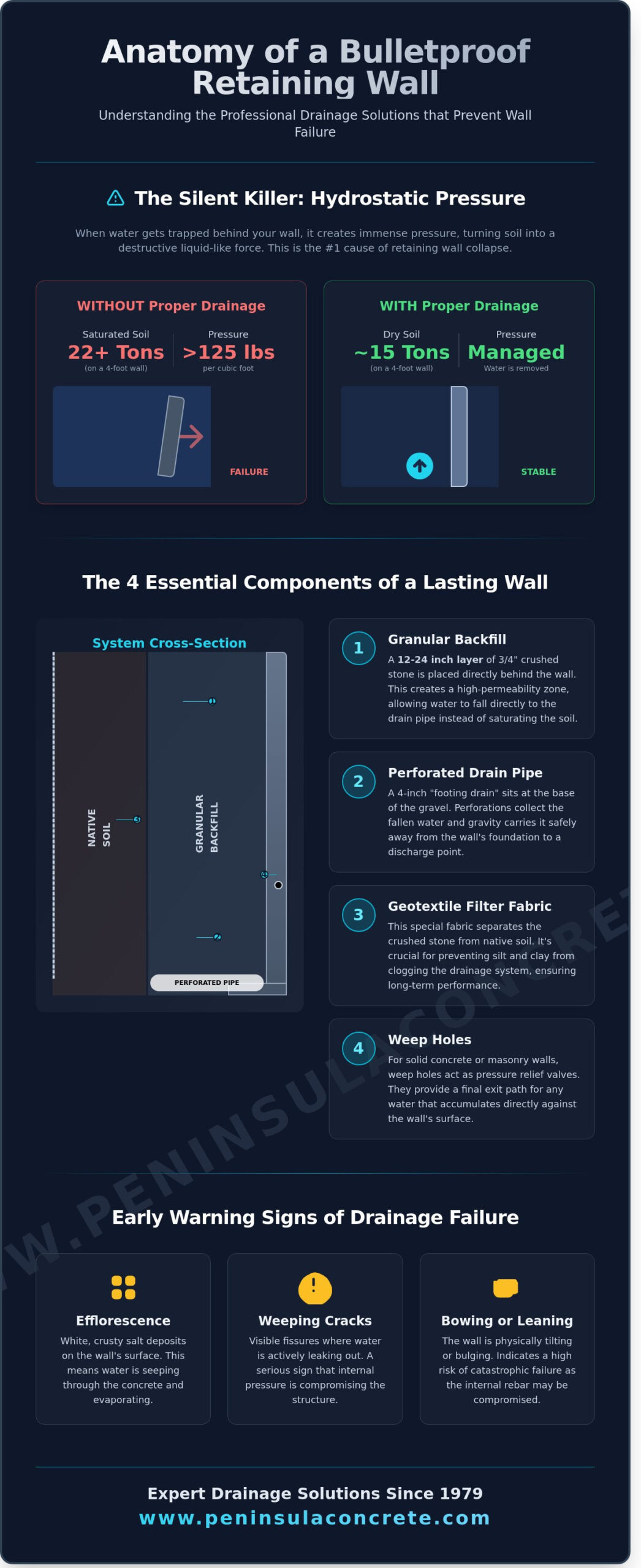
Saturated soil behaves differently than dry earth. While dry soil has internal friction that helps it stand, water-logged soil acts more like a liquid. This transition increases the lateral earth pressure exponentially. Water weighs exactly 62.4 pounds per cubic foot. When soil becomes fully saturated, it combines this weight with its own mass, creating a lateral load that can exceed 125 pounds per cubic foot. A standard 4-foot wall might safely hold back 15 tons of dry soil, but that same soil can weigh over 22 tons once a heavy storm hits. Without functional retaining walls that include integrated retaining wall drainage solutions, that extra 7 tons of force pushes directly against the concrete face.
Efflorescence is often the first warning sign of a drainage failure. These white, crusty salt deposits form when water seeps through the concrete, evaporating on the surface and leaving minerals behind. If you see these stains, it means water is already living inside your wall. Weeping cracks are even more serious. These are small fissures where liquid water actively leaks out during or after a rain event. It’s a sign that the internal pressure has found the weakest point in the structure. If the wall begins to lean or “bow” in the center, the internal rebar may already be compromised.
The Silent Killer of Hardscapes
California rain events often arrive in back-to-back cycles. During the 2023 atmospheric rivers, many local walls failed because the ground never had a chance to dry out between storms. A wall might look strong, but without a clear path for water, the pressure builds until the footing shifts. We distinguish between cosmetic damage, like minor surface scaling, and structural failure, where the wall has rotated more than 5 degrees from its original vertical position. Even a reinforced concrete wall will eventually snap if the water has nowhere to go.
Soil Expansion vs. Water Weight
Adobe clay in our region expands significantly when wet. This heavy soil can double the total load on a wall compared to the sandy soil found in coastal regions. Hydrostatic pressure is the #1 cause of retaining wall collapse. For homeowners with sloped yards in Redwood City, calculating the load-bearing capacity is vital. Our team has provided durable retaining wall drainage solutions since 1979, ensuring that the 2,000 pounds of pressure per linear foot exerted by wet clay doesn’t result in a total collapse. Proper engineering accounts for both the weight of the water and the physical expansion of the Peninsula soil.
The 4 Essential Components of Effective Retaining Wall Drainage
Building a wall that lasts requires more than just high-quality blocks or poured concrete. Since 1979, Peninsula Concrete has focused on building structures that stand the test of time by prioritizing what happens behind the visible surface. If water cannot escape, it creates hydrostatic pressure that can push a wall forward or cause a total collapse. Implementing the right retaining wall drainage solutions ensures your property stays stable through every season. These four components are the foundation of any professional drainage system:
- Granular Backfill: You must use 12 to 24 inches of clean, 3/4-inch crushed stone directly behind the wall. This stone creates a high-permeability zone where water can drop straight down to the drain pipe rather than soaking into the soil. It’s a non-negotiable step for any wall over 3 feet tall.
- Perforated Drain Pipe: Often called a footing drain, this 4-inch pipe acts as the highway for water removal. It sits at the base of the gravel backfill, just above the footing. The perforations allow water to enter the pipe, where gravity carries it to a safe discharge point away from the structure.
- Geotextile Filter Fabric: This fabric acts as a permanent barrier between the drainage stone and the native soil. Without it, fine silt and clay particles will eventually migrate into your clean stone and clog the system. We use a non-woven needle-punched fabric to ensure long-term water flow.
- Weep Holes: For masonry or solid concrete walls, weep holes are the final pressure-relief valve. These are 2-inch openings placed every 4 to 6 feet along the base of the wall. They provide an immediate exit point for moisture that might otherwise get trapped between the wall face and the backfill.
Selecting the Right Aggregate and Pipe
Never use native soil or “dirt” as immediate backfill. Soil particles are too small and trap water, which increases the weight against your structure by up to 60 pounds per cubic foot. For the Peninsula’s unique soil conditions, we recommend 4-inch perforated PVC pipe over flexible corrugated options. PVC is rigid and won’t “belly” or trap sediment over decades of use. Our 2nd-generation team always uses the “burrito wrap” method, where geotextile fabric completely encloses the drainage stone. This ensures your effective retaining wall drainage system stays clear of debris and functions exactly as designed.
Surface Drainage vs. Subsurface Drainage
Effective retaining wall drainage solutions require managing water on the surface before it ever reaches the backfill. We often install shallow grass swales or concrete V-ditches 3 feet behind the wall to catch runoff. You should also connect your 3-inch or 4-inch gutter downspouts to a solid drain line that exits at least 10 feet away from the wall’s foundation. Finally, we seal the top cap of the wall with high-strength masonry adhesive. This prevents water from entering the interior of the wall during heavy rain. If you’re planning a new landscape project, our experienced team can design a custom drainage plan that protects your investment for the long haul.
Solving Complex Drainage Challenges in the San Francisco Peninsula
Building on the San Francisco Peninsula requires more than just stacking blocks or pouring concrete. The steep hills in neighborhoods like Belmont or San Carlos often feature grades exceeding 25%. This creates massive pressure behind any structure. We design multi-tiered walls to break up the vertical load; however, each tier needs its own dedicated system to prevent the upper wall from saturating the lower one. Implementing tiered retaining wall drainage solutions ensures that water doesn’t pool on the flat “benches” between walls, which is a common cause of slope creep in our area.
Local codes are strict about where that water goes. Redwood City Municipal Code Chapter 27 requires specific drainage plans for any wall over 4 feet. San Mateo County has similar requirements for managing stormwater on-site. You can’t simply dump runoff onto a neighbor’s lot or the public street. As a 2nd-generation, family-owned business, we’ve spent decades learning the specific soil conditions of every zip code from Burlingame to Palo Alto. We know how to satisfy inspectors while protecting your property.
Gravity provides the most reliable fix through the “daylight” method. We run a solid 4-inch PVC pipe from the base of the wall to a lower point on the property where the pipe “daylights” or opens up. We often hide these exits with decorative river rock or landscape features. This method is the gold standard for reliability because it doesn’t rely on mechanical pumps.
The No-Drain Dilemma: Dry Wells and French Drains
If your property lacks a connection to a city storm drain, we build a dry well. This is a 4-foot by 4-foot pit filled with clean 1.5-inch crushed rock that allows water to soak back into the ground naturally. French drains are also essential for intercepting “sheet flow.” This is surface water that flows from uphill neighbors during heavy February rains. Managing this discharge responsibly prevents “neighbor disputes” and potential legal liabilities. Research from the U.S. Department of Transportation confirms that effective retaining wall drainage systems are the primary factor in preventing long-term structural failure and soil saturation.
Clay Soil Management
Peninsula soil is often heavy “fat clay.” It expands when wet and exerts incredible force. We use 12-inch to 18-inch wide drainage chimneys filled with clean rock behind our walls. Standard 6-inch chimneys often clog in local clay. For properties with limited space, we integrate pervious concrete or permeable pavers at the top of the wall to capture water before it ever reaches the backfill.
In May 2021, we saved a 60-foot leaning wall in San Carlos that had moved 4 inches due to poor retaining wall drainage solutions installed by a previous contractor. We excavated the failing soil, replaced it with 22 tons of clean drain rock, and installed a new pipe system. The wall hasn’t moved a millimeter since. We’ve provided quality work since 1979 by focusing on these technical details that others overlook. Our “Concrete Thinking” approach ensures your wall stays upright for decades.
Retrofitting Drainage into an Existing Retaining Wall
Most homeowners realize they have a drainage problem when they see white salt deposits, known as efflorescence, or notice a slight bulge in their masonry. We’ve seen these red flags since 1979. If your wall is bowing, don’t panic yet. A wall with cracks wider than 0.25 inches or a tilt exceeding 5 degrees usually requires a full tear-out. However, if the masonry remains sound, you can implement retaining wall drainage solutions without starting from scratch. Retrofitting involves drilling 2-inch diameter weep holes every 4 to 6 feet along the base of the structure. Our team uses specialized diamond core bits to prevent cracking the existing face during this process.
For more intensive fixes, we excavate the “heel” or the soil directly behind the wall. This involves digging a 12-inch wide trench down to the footing level. We then install a drainage chimney consisting of clean 0.75-inch crushed stone and a perforated PVC pipe. This method is effective but labor-intensive. Our family-owned business prides itself on honesty; we won’t tell you to replace a wall that only needs a drainage upgrade. Repairing an existing system typically costs 30% of the price of a full replacement. For a 50-foot wall, this could mean a savings of $10,000 or more. We always evaluate the footing stability first. If the base has settled more than 2 inches, a repair is just a temporary bandage on a permanent problem.
When faced with such extensive and costly repairs, some homeowners find it more practical to sell the property as-is. If you’re curious about that process, you can see how specialized real estate investors operate; for one example, you can check out Peregrine REI.
Can You Add Drainage After the Fact?
Modern technology makes retrofitting easier than it was when we started in 1979. Vertical wick drains, or prefabricated geocomposite drains, allow us to provide relief without removing every cubic yard of soil. These systems use a plastic core wrapped in geotextile fabric to create a path for water. We typically install these at 5-foot intervals. If the wall shows signs of rotation, we bring in a structural engineer to verify the center of gravity hasn’t shifted beyond the middle third of the base. Choosing the right retaining wall drainage solutions early protects your landscape from sudden collapse.
Maintenance: Keeping Your System Clog-Free
Routine checks keep your investment standing. We recommend inspecting the discharge points after every 3-inch rainfall event. Use a stiff bottle brush or a low-pressure garden hose to clear sediment from weep holes twice a year. If you notice a 20% decrease in water flow compared to previous seasons, it’s a sign that silt has bypassed your filter fabric. Prompt action prevents hydrostatic pressure from reaching the 60 pounds per cubic foot threshold that causes structural cracking. Our 2nd-generation team has found that 15 minutes of annual maintenance can extend a wall’s life by two decades.
If you’re worried about a leaning wall or clogged drains, contact our experienced team for an honest assessment of your project.
Quality Work Since 1979: The Peninsula Concrete Difference
Since 1979, Peninsula Concrete has shaped the landscape of the San Francisco Peninsula. We’re a 2nd-generation, family-owned business that treats every project as a testament to our family name. Over the last 45 years, we’ve seen countless walls fail because contractors ignored what’s happening behind the stone. We don’t make that mistake. Our team integrates comprehensive retaining wall drainage solutions into every single design by default. We understand that a wall is only as strong as its ability to shed water.
Our heritage of 40-plus years means we’ve developed a deep understanding of local conditions. Soil profiles in the Bay Area vary significantly from one block to the next. In Burlingame, homeowners often face heavy adobe clay that expands and exerts massive pressure when wet. Move down to Palo Alto, and the soil challenges shift toward different drainage requirements. We’ve spent decades studying these local variations. This local expertise ensures your wall stands the test of time, resisting the hydrostatic pressure that destroys lesser builds. We’ve built a reputation for honesty and high-quality work that spans generations of local residents.
We believe in “Concrete Thinking,” which means we plan for the worst-case weather scenarios. While California has dry spells, our winter storms can dump inches of rain in hours. Our designs account for these extremes. We don’t just build a barrier; we build a system. This approach is why we’re a trusted name for homeowners who value proven expertise over risky, unproven alternatives. Your property is a major investment, and we provide the peace of mind that comes with a structure built by seasoned craftsmen.
Built to Last: Our Construction Standards
Our construction standards are designed to exceed basic building codes. We use 4,000 PSI high-strength concrete and premium interlocking paver systems that are unsurpassed in strength and flexibility. Our crew refuses to cut corners on the components you can’t see. We use heavy-duty perforated pipes, high-quality filter fabrics, and clean 3/4-inch crushed stone for backfill. These elements are the heart of effective retaining wall drainage solutions. You can See our Retaining Wall Gallery to witness the durability and aesthetic quality we bring to every Bay Area home.
- High-Strength Materials: We only use industrial-grade concrete and pavers.
- Superior Filtration: We use professional-grade geotextiles to prevent soil clogging.
- Proven Techniques: Our methods have been refined over four decades of local service.
Start Your Project with a Local Expert
Every successful build starts with a professional on-site drainage assessment. We evaluate your property’s specific slope, soil type, and existing runoff patterns to create a custom plan. Our team also handles the complex permitting and engineering process for you. We’ve worked with local building departments for 45 years, so we know exactly what’s required to get your project approved quickly. Let us help take your project from the planning stage to a successful finish. Contact Peninsula Concrete for a Professional Estimate Today and ensure your new wall is built to stay.
BUILD A LANDSCAPE THAT STANDS THE TEST OF TIME
Don’t let hidden hydrostatic pressure compromise your property’s value or safety. Effective retaining wall drainage solutions require a precise combination of filter fabric, clean gravel, and strategic weep holes to manage water flow. These components are especially vital in the heavy clay soils and steep hillsides found throughout the San Francisco Peninsula. Since 1979, Peninsula Concrete has specialized in navigating these unique regional challenges with proven engineering. We’re a 2nd-generation, family-owned business that understands exactly how local weather patterns impact structural integrity.
We’ve spent over 45 years perfecting the art of hillside drainage to ensure your walls remain stable for decades. Whether you’re planning a new installation or need to retrofit an existing structure, our team provides the technical expertise your home deserves. We take pride in our heritage of honesty and high-quality craftsmanship. Let’s protect your landscape with a solution built to last. Get a Free Estimate for Your Retaining Wall Project today and see why Bay Area homeowners have trusted us for over four decades. Your property is in good hands with our experienced crew.
Protecting your property is a key part of overall home safety. For homeowners who extend that principle to personal security, having the right equipment is essential. If you’re looking for reliable concealment options, you can discover a range of solutions from trusted brands.
Frequently Asked Questions
Do all retaining walls need a drainage system?
Almost every wall over 2 feet tall requires a dedicated system to manage water pressure. Without proper retaining wall drainage solutions, hydrostatic pressure can increase the load on your structure by 100 percent during a heavy 24 hour rainstorm. We’ve seen 45 years of local projects where drainage was the single factor that determined if a wall lasted 50 years or failed in under 5.
How much does it cost to add drainage to a retaining wall?
Adding drainage typically costs between $10 and $25 per linear foot for standard residential installations. This price includes 4 inch perforated pipe, filter fabric, and 3/4 inch clean crushed stone. For a 50 foot wall, you should budget approximately $500 to $1,250 for these specific components. It’s a small investment compared to the $15,000 average cost of replacing a collapsed masonry structure.
What is the best type of pipe for retaining wall drainage?
Rigid PVC pipe, specifically SDR 35, is the superior choice for long term durability and strength. Unlike thin corrugated tubing, rigid PVC won’t collapse under the weight of 12 inches of gravel and backfilled soil. It features a 3,000 pound crush strength that ensures your water path stays clear for decades. We use 4 inch perforated PVC to ensure maximum flow and easy maintenance.
Can I use a French drain for my retaining wall?
A French drain is the primary component of most effective retaining wall drainage solutions used in modern construction. It consists of a perforated pipe buried in a 12 inch wide column of clean gravel directly behind the wall. This setup intercepts water before it reaches the back of your blocks or concrete. At Peninsula Concrete, we’ve used this method since 1979 to protect our clients’ structural investments.
How do I know if my retaining wall drainage is clogged?
You’ll notice water pooling at the base or white, powdery salt stains called efflorescence on the wall’s face. If you see 1/8 inch cracks forming or the wall leaning more than 1 inch off center, the drainage has likely failed. Check your exit pipes after a 1 inch rainfall. If they’re dry while the surrounding soil stays soggy, a clog is blocking the 4 inch pipe.
Does a 3-foot wall need weep holes?
A 3 foot wall needs weep holes spaced every 4 to 6 feet along the bottom edge. These 2 inch openings allow water trapped behind the wall to escape directly through the face rather than building up pressure. For walls built with 8 inch masonry blocks, we recommend placing a weep hole in every third or fourth block. This prevents the 60 pounds per cubic foot of pressure that wet soil exerts.
What happens if I don’t put gravel behind my retaining wall?
Without a 12 inch layer of gravel, soil stays saturated and exerts 50 percent more weight against the structure. Dirt eventually clogs the drainage pipe and prevents water from reaching the weep holes entirely. This leads to frost heave in winter, where expanding ice pushes the wall forward by 2 or 3 inches. We always use 3/4 inch clean stone to ensure 100 percent drainage efficiency.
Can I connect my retaining wall drain to the city sewer?
You can’t connect your wall drain to the city sanitary sewer in 95 percent of municipalities. Most local codes require you to discharge water into a storm drain or a designated dry well on your own property. Check your local building department’s 2024 regulations before you begin digging. Connecting to the wrong line can result in $500 fines and expensive plumbing corrections that require total excavation.