
In June 2024, a Redwood City family looked at their sloped, 400-square-foot lot and saw nothing but wasted space and cracked, 45-year-old concrete. They wanted a functional patio but felt paralyzed by the high labor costs that often define San Francisco Peninsula renovations. You likely agree that your outdoor space should be an asset, not a source of stress or a drainage nightmare. Achieving a high-impact backyard transformation on a budget is entirely possible when you stop viewing your yard as a problem and start seeing it as a strategic investment.
As Peninsula Concrete Contractors, a 2nd-generation, family-owned business, we’ve provided quality work since 1979. We’ve learned that the most successful projects balance DIY creativity with professional-grade foundations. This guide promises to show you how to blend those elements to create a stunning, high-ROI backyard without overspending. We’ll preview 2026’s top trends for small yards, including permeable solutions that can boost property value by 12 percent and materials built to survive California’s specific weather cycles. It’s time to take your project from a rough plan to a lasting success.
Key Takeaways
- Learn how to prioritize high-ROI foundational hardscaping over temporary decor to ensure every dollar adds lasting value to your property.
- Discover the “Anchor Strategy” for a backyard transformation on a budget, using professional concrete foundations to support your DIY creative projects.
- Compare the long-term durability and maintenance costs of stamped concrete versus interlocking pavers to choose the most cost-effective material for your home.
- Follow a proven, phased implementation plan that starts with essential drainage and site prep to protect your investment from the ground up.
- See how partnering with a local, 2nd-generation family business ensures your project meets specific Peninsula soil standards and regional building codes.
Defining the Budget Backyard Transformation: Value Over Volume
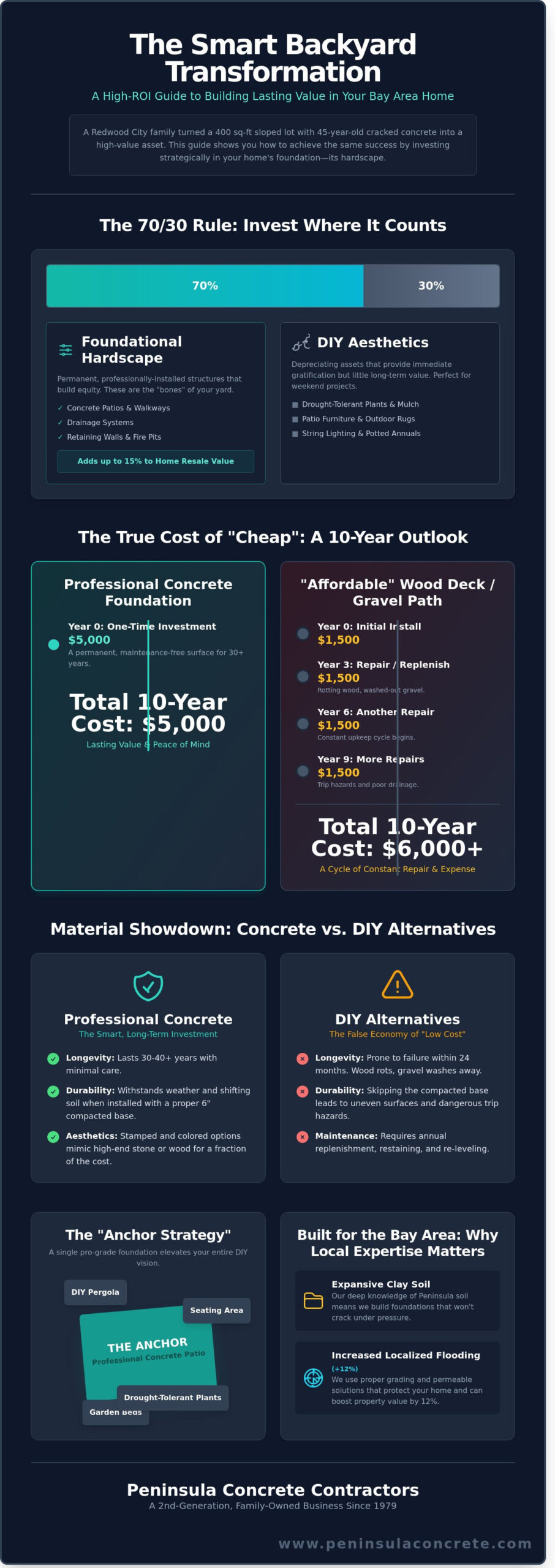
Achieving a successful backyard transformation on a budget in 2026 requires a shift in perspective. Most homeowners mistake “budget” for “low cost,” but true value is measured by the return on investment over a ten-year period. Since 1979, Peninsula Concrete has helped Bay Area residents understand that a $5,000 investment in a permanent concrete foundation is cheaper than spending $1,500 every three years to replace rotting wood decks or shifting gravel paths. We’ve built our reputation on this honesty. Quality work doesn’t just look better; it lasts longer.
There is a clear line between disposable decor and foundational hardscape. While colorful pillows and solar lanterns provide immediate gratification, they are depreciating assets. To build real equity, you must prioritize the “bones” of the yard. By following established landscape design principles, you can create a functional floor plan that anchors your outdoor living space. This approach validates the weekend warrior spirit for the finishing touches while acknowledging that the heavy lifting requires professional precision to survive the shifting soil conditions of the Peninsula.
The 70/30 Rule of Outdoor Budgeting
We recommend a 70/30 split for your project funds. Allocate 70% of your total budget to permanent, professionally installed structures like stamped concrete patios, retaining walls, or interlocking pavers. These elements are unsurpassed in strength and flexibility. The remaining 30% should go toward DIY aesthetics such as drought-tolerant plants, mulch, and furniture. This ratio protects your investment because the hardscape accounts for up to 15% of a home’s total resale value in markets like San Mateo or Palo Alto.
- High-Impact Upgrades (70%): Concrete patios, permanent walkways, drainage systems, and structural fire pits.
- Low-Impact Upgrades (30%): Potted annuals, string lighting, outdoor rugs, and decorative bark.
Why “Cheap” Can Often Be Expensive
Choosing the lowest-priced materials often leads to a cycle of constant repair. Gravel and mulch might seem affordable at $40 per cubic yard, but they migrate, wash away during heavy rains, and require annual replenishment. In contrast, a professionally poured concrete slab provides a maintenance-free surface for 30 years or more. Poorly laid DIY pavers often skip the necessary 6-inch compacted base. This oversight leads to uneven surfaces and dangerous trip hazards within just two seasons. Professional concrete work prevents these costly drainage issues by ensuring water flows away from your home’s foundation.
In the expansive clay soil of Redwood City, choosing thin DIY pavers without a 6-inch compacted base is a false economy that leads to trip hazards and cracked surfaces within 24 months. Our team at Peninsula Concrete focuses on durability because we know local climate shifts are becoming more extreme. We’ve seen a 12% increase in localized flooding events over the last five years; this makes proper grading and pervious surfaces more critical than ever for a backyard transformation on a budget. Trusting a 2nd-generation, family-owned business ensures your project is built to handle these specific local challenges from day one.
The “Anchor Strategy”: Investing in Permanent Hardscape Foundations
A successful backyard transformation on a budget relies on a concept we call the “Anchor Strategy.” Instead of spreading a small budget thin across dozens of cheap DIY projects, you invest in one high-quality, permanent hardscape foundation. This anchor, usually a professional concrete patio or a structured walkway, defines the entire layout of your outdoor space. Since 1979, we’ve seen how a single well-placed slab can elevate the perceived value of an entire property. It provides a level, durable surface that makes even the most affordable patio furniture look intentional and high-end.
Concrete offers a level of aesthetic versatility that other materials can’t match for the price. While natural stone or high-end pavers often cost $25 to $40 per square foot, stamped or colored concrete provides a similar look for a fraction of that investment. You can choose patterns that mimic slate, cobblestone, or even wood planks. Unlike wood decks that require restaining every 24 months and eventually rot, a concrete anchor is a one-time investment. A professionally poured slab can last 40 years or more with basic cleaning. Data from Better Homes and Gardens Real Estate suggests that functional outdoor living spaces like these offer the best return on investment when compared to complex features like backyard ponds or swimming pools.
Small-Scale Patios with Big Impact
You don’t need a massive terrace to change how you use your yard. A 10×10 or 12×12 patio creates a dedicated “room” in a previously neglected corner. These dimensions provide enough space for a four-person dining set or a cozy lounge area. For a modern and minimalist look, we often recommend a simple broom finish. It’s clean, slip-resistant, and fits perfectly with contemporary home designs. If you have an existing porch or a small concrete step, we can often integrate the new patio with these structures to save on excavation costs, making your backyard transformation on a budget even more efficient.
Walkways: Connecting the Budget Elements
Walkways are the glue that holds a landscape together. Without them, DIY elements like fire pits or raised garden beds can feel scattered and disorganized. A professional concrete path creates a clear transition between different zones of your yard. It keeps feet dry during rainy seasons and prevents the “goat paths” that form when people walk over grass repeatedly. These defined paths also reduce maintenance by acting as a permanent edging for mulch or gravel beds. If you’re ready to lay the groundwork for your dream yard, our team can provide the concrete installation services needed to turn your vision into a reality.
- Durability: Concrete doesn’t warp, splinter, or harbor termites like wood structures.
- Maintenance: A simple power wash and reseal every 3 to 5 years keeps the surface looking brand new.
- Stability: Heavy items like pizza ovens or large grills require the rock-solid base that only a professional pour provides.
Choosing a family-owned, 2nd-generation business ensures your anchor is built to last. We focus on proper sub-base preparation and reinforcement, which are the most common steps skipped by fly-by-night contractors. When the foundation is right, every other part of your budget transformation falls into place perfectly.
Concrete vs. Pavers: Which Material Offers the Best ROI?
Return on investment isn’t just about the initial check you write; it’s about how much you’ll spend over the next 15 to 20 years. Standard broom-finish concrete remains the most affordable entry point for a backyard transformation on a budget, typically costing between $8 and $12 per square foot. It provides a clean, functional surface that lasts for decades. However, standard slabs are rigid. In California’s shifting soil, even the best-poured concrete can develop hairline fractures over time. Our team has provided quality work since 1979, and we’ve found that while concrete is cost-effective today, you must account for the long-term visual wear.
Interlocking pavers usually require a higher upfront investment, ranging from $15 to $25 per square foot. Despite the higher price tag, they offer superior “repairability.” If a large tree root lifts a section of your patio, you don’t have to jackhammer the entire slab and start over. You simply pull up the affected stones, trim the root, regrade the sand base, and reset the original pavers. This process saves homeowners approximately $800 to $2,000 in demolition and replacement costs compared to traditional concrete repairs. For the long-term owner, pavers often represent the better financial choice.
Drainage is another critical factor for Peninsula homes. Many local properties struggle with runoff during heavy winter rains. Permeable paver systems allow 100% of rainwater to filter directly back into the ground through the joints. This prevents standing water and reduces the pressure on your home’s foundation. While the specialized gravel base for permeable systems adds about 15% to the labor cost, it eliminates the need for expensive French drains or complex area drains that can cost thousands of dollars.
- Standard Concrete: Lowest upfront cost; best for large, flat areas with stable soil.
- Stamped Concrete: Mid-range cost; provides high-end aesthetics without the price of natural stone.
- Interlocking Pavers: Highest upfront cost; offers the best long-term durability and easiest repair process.
Interlocking Pavers for the Budget-Conscious
We believe Interlocking Paver Systems are unsurpassed in strength and flexibility for California’s seismic activity. Because the joints between pavers allow for subtle movement, they won’t crack during minor tremors. You can keep your backyard transformation on a budget by using pavers strategically. Focus your budget on a 150-square-foot “feature area” for dining and use lower-cost materials like crushed granite for secondary paths. This hybrid approach gives you the durability of a 2nd-generation, family-owned installation where it matters most while keeping total costs down.
The Aesthetic Value of Stamped Concrete
Stamped concrete allows you to mimic the look of expensive Italian slate or Ashlar stone at a fraction of the masonry price. Most homeowners save 40% to 60% by choosing stamped patterns over hand-laid natural stone. Popular patterns like wood plank or European fan provide a high-end look for Peninsula backyards without the premium labor costs. Professional sealing is the secret to longevity here. A high-solids sealer applied every 36 months can make budget-friendly concrete look like premium masonry for 25 years. This “Concrete Thinking” approach ensures your investment retains its curb value long after the project is finished.
Phased Implementation: How to Build Your Dream Yard in Budget-Friendly Stages
Achieving a high-impact backyard transformation on a budget requires a strategic timeline. You don’t need to write one giant check to see results. By breaking your project into manageable phases, you can invest in quality materials and professional labor where it matters most while tackling simpler tasks yourself. Our 2nd-generation, family-owned business recommends a five-step approach to ensure your outdoor space is both beautiful and structurally sound. We’ve built a reputation for honesty and high-quality work, and that starts with a plan that respects your wallet and your property.
Phase 1: Prioritizing Drainage and Grade
Skipping the drainage system is the most expensive mistake a homeowner can make. Since 1979, we’ve seen countless DIY projects fail because water pooled against the foundation or washed away expensive landscaping. Proper grading requires a minimum 2% slope away from your home to prevent structural water damage. Peninsula Concrete integrates custom drainage solutions into every paving project. This ensures that your new patio doesn’t become a pond during the next heavy rain. Establishing this “invisible” infrastructure first protects every dollar you spend in later phases. It’s the foundation of a durable yard.
Before moving to excavation, it’s essential to handle any necessary site clearing, which often involves tree care. Whether you need to remove a tree to make space for a new patio or prune branches to improve sunlight, this step ensures your new hardscape has a clean slate. For professional guidance on integrating tree work into a larger renovation, you can visit CDA TREE AND UTILITY.
Phase 2: The Professional “Heavy Lifting”
Professional excavation and concrete pouring are the anchors of your yard. While you might be tempted to rent a mixer, a professional crew completes in two days what often takes a DIYer two weeks of back-breaking labor. Hiring a reputable contractor for the foundation hardscaping, like a 12×12 anchor patio or a main walkway, ensures a level, durable surface that won’t crack under pressure. You can maximize your budget by bundling services. For instance, combining a small patio pour with a necessary retaining wall can reduce mobilization fees by approximately 15%. This creates a high-quality “floor” for your outdoor room. Start your project today with a professional consultation to lock in your foundation.
- Step 3: DIY Softscaping. Once the hardscaping is set, handle the planting yourself to save on labor costs. Focus on native California flora like Ceanothus or Manzanita. These plants are 70% more likely to survive local climate shifts compared to non-native species. A single cubic yard of mulch costs between $35 and $50 and can cover 100 square feet, providing an instant, clean look.
- Step 4: Vertical Elements. Add privacy and depth to your backyard transformation on a budget. You can build DIY trellises for climbing vines for under $100. If your yard has significant elevation changes, consider professional garden walls. Just remember that walls over 3 feet tall typically require specific engineering and permits to ensure safety.
- Step 5: Lighting and Finishing Touches. This is your weekend makeover phase. Install solar-powered LED path lights and comfortable seating. High-quality outdoor lighting can increase perceived home value by up to 20% while making the space usable after dark. These small additions provide an immediate visual boost for a relatively low investment.
A successful backyard transformation on a budget relies on this specific sequence. You handle the aesthetic finishes, and we provide the “Quality Work Since 1979” that keeps your yard functional for decades. This phased approach turns a daunting renovation into a series of achievable, high-impact victories. It’s about thinking long-term while acting in the present. By starting with the heavy lifting and finishing with the details, you create a space that’s as reputable and durable as the concrete it’s built upon.
Professional Hardscaping in Redwood City: The Peninsula Concrete Difference
Since 1979, Peninsula Concrete has served as the bedrock for residential projects throughout the Bay Area. We’re a 2nd-generation, family-owned business that understands a home is more than just a building; it’s a legacy. When you’re executing a backyard transformation on a budget, your primary goal is to balance upfront costs with long-term longevity. We’ve built a reputation for honesty and high-quality work by providing hardscape foundations that don’t need to be replaced every five years. Our team focuses on creating a heritage of quality for your property, ensuring every slab and paver adds real value to your home equity. We’ve completed over 3,500 local projects, and each one benefits from 45 years of refined craftsmanship.
Choosing a professional for your heavy lifting is the smartest way to manage a backyard transformation on a budget. While DIY projects are great for mulch and plantings, concrete requires a level of precision that prevents costly failures down the road. Our interlocking pavers are unsurpassed in strength and flexibility, often reaching a compressive strength of 8,000 PSI. This durability ensures your patio remains level and crack-free for decades. We take pride in being a reputable and dependable partner for homeowners who want their outdoor space to look fantastic without the stress of “fly-by-night” contractor issues.
Why Local Expertise Matters in the Bay Area
Navigating the specific requirements of Redwood City and San Mateo County permits is a complex task for any homeowner. We’ve spent 45 years learning the nuances of local building codes to ensure every project is fully compliant. Our team manages the paperwork and inspections, saving you from potential fines that can reach thousands of dollars. We also apply what we call “Concrete Thinking” to every job site. This involves analyzing the unique soil profiles of the Peninsula, where clay-heavy earth can expand and contract significantly. Without this local knowledge, a standard concrete pour might fail within 24 months. Our specialized techniques account for these soil shifts, providing a stable base that protects your investment.
Being a local, family-owned business means we’re accountable to our community. We don’t use high-pressure sales tactics or flashy, modern jargon. Instead, we rely on the same grounded, professional approach that has sustained us since 1979. We use high-quality materials and proven methods to ensure your walkways, driveways, and patios stand up to the Bay Area’s unique climate. Our reputation for being “as good as it gets” comes from a commitment to treating every backyard like it’s our own.
Ready to Transform Your Backyard?
The most successful outdoor renovations combine professional structural work with personal DIY creativity. By hiring us to install a high-quality concrete patio or paver foundation, you create a durable anchor for the rest of your vision. You can then focus your budget on “awesome” aesthetic upgrades like custom seating or drought-tolerant landscaping. This strategy ensures the most difficult parts of the project are handled by seasoned craftsmen. We invite you to view our project gallery to see how we’ve helped your neighbors achieve high-impact results with professional hardscaping.
Contact Peninsula Concrete Contractors for a free estimate on your budget-friendly hardscape anchor.
Start Your 2026 Outdoor Upgrade Today
Achieving a stunning backyard transformation on a budget doesn’t mean cutting corners on quality or design. By focusing on the anchor strategy and choosing high-ROI materials like interlocking pavers or custom concrete, you’re building a foundation that lasts for decades. Since 1979, Peninsula Concrete has helped homeowners navigate these choices to maximize every dollar spent. We specialize in phased implementation plans that allow you to reach your 2026 goals without overwhelming your current finances. As a 2nd-generation family-owned and operated business, we take personal pride in every square foot we pour or pave. We specialize in interlocking pavers and custom concrete solutions that provide unsurpassed strength and flexibility for our neighbors. You’re not just hiring a contractor; you’re partnering with a local team that’s built its reputation on honesty and durable craftsmanship for over 45 years. Don’t wait for another season to pass by. Let’s turn those planning stages into a finished reality that adds tangible value to your Redwood City property. Get Your Free Hardscape Estimate Today and see the Peninsula Concrete difference for yourself. We’re ready to help you build something that lasts.
Frequently Asked Questions
How much does a small concrete patio cost in the Bay Area?
A basic 10×10 concrete patio in the Bay Area typically costs between $1,500 and $2,500 for professional installation in 2024. These prices cover site preparation, materials, and labor for a standard 4-inch slab. Costs can increase by 30 percent if you add decorative finishes like stamping or staining. Since 1979, we’ve found that investing in a solid foundation prevents cracking and saves you money on long-term repairs.
Can I lay pavers myself to save money?
You can lay pavers yourself to save roughly 50 percent on labor costs, but it requires physical labor and precision. A 200-square-foot project often takes an inexperienced homeowner 40 to 60 hours to complete correctly. If the base isn’t compacted to 95 percent density, the pavers will shift within 2 years. Our 2nd-generation team uses industrial equipment to ensure your backyard transformation on a budget doesn’t fail due to shifting soil.
What is the cheapest way to transform a sloped backyard?
Terracing with pressure-treated timber or gravity-block walls is the most cost-effective way to manage a slope. These materials typically cost $15 to $25 per square foot of wall face, which is 40 percent cheaper than poured concrete retaining walls. Creating flat tiers allows you to use 100 percent of your yard space for seating. This approach is a staple for any backyard transformation on a budget because it prevents soil erosion effectively.
Does a concrete patio increase my home value in Redwood City?
A well-installed concrete patio in Redwood City provides an average return on investment of 8 percent to 12 percent. Local real estate data from 2023 shows that outdoor living spaces are a top priority for 75 percent of Peninsula homebuyers. A durable, high-quality slab creates an outdoor room that increases your home’s perceived square footage. It’s a reliable way to boost market appeal without the high maintenance costs of wood decking. For a broader perspective on how such upgrades impact home valuations across California, you can visit County Properties for insights from the competitive Southern California market.
For property owners, maximizing the value of such an investment often involves professional oversight. To see how upgrades like these are managed to boost rental appeal in another competitive California market, you can visit True Property Management for an Orange County perspective.
How can I fix my backyard drainage on a budget?
Installing a French drain or a dry creek bed is the most affordable way to solve standing water issues. Professional installation for a French drain averages $20 to $30 per linear foot, while DIY materials cost about $10 per foot. You’ll need a 2 percent slope to move water effectively away from your foundation. Since 1979, we’ve seen how proper grading prevents 90 percent of common hardscape failures caused by water pressure.
Are pavers or concrete better for the SF Peninsula climate?
Interlocking pavers are generally better for the SF Peninsula because they offer 15 percent more flexibility during seismic shifts than solid concrete. Our local clay soil expands and contracts, which can cause standard slabs to crack over 5 to 10 years. Pavers allow for minor movements without showing damage. High-quality pervious concrete is another excellent alternative that manages heavy winter rains by allowing water to soak directly into the ground.
How long does a professional backyard hardscape installation take?
A professional installation for a 500-square-foot hardscape project typically takes 3 to 7 business days. This timeline includes 1 day for excavation, 2 days for base preparation, and 2 days for the final layout or pour. Larger projects or those requiring complex drainage systems can extend the schedule by 48 to 72 hours. We pride ourselves on clear communication so you know exactly when your project will move from planning to success.
Do I need a permit for a small patio in San Mateo County?
You generally don’t need a permit in San Mateo County for a patio under 400 square feet that doesn’t involve more than 18 inches of fill. If your project exceeds this size or changes the existing grade significantly, you must file for a site development permit. Regulations vary by specific city, so checking with the Redwood City or San Mateo building department is a necessary step. We’ve navigated these local codes since 1979.