
What if the most expensive part of your new driveway isn’t the stone itself, but the $15,000 fine for failing to meet San Francisco Peninsula drainage mandates? Estimating the permeable pavers cost Bay Area homeowners can expect in 2026 is a challenge because labor rates and C.3 municipal requirements shift every season. You already know that living in the Peninsula means paying a premium for quality labor and navigating some of the strictest environmental codes in California. Dealing with heavy clay soil in the flatlands only adds another layer of complexity to your landscaping plans.
At Peninsula Concrete Contractors, we’ve built our reputation on honesty since 1979. We believe you deserve a transparent breakdown of current pricing before you break ground. You’ll discover the real-world costs of materials, specialized sub-base layers, and the long-term ROI of smart stormwater management. This guide covers everything from local labor benchmarks to the specific engineering needed for poor-draining soil so you can plan your project with confidence.
Key Takeaways
- Understand the 2026 market rates for professional installation across San Mateo and Santa Clara counties, including what to expect for full-service project management.
- Learn how local factors like “Bay Mud” and specialized labor rates influence the permeable pavers cost Bay Area homeowners should expect to pay for a durable installation.
- Discover why up to 70% of your project’s value is hidden beneath the surface and how proper sub-base engineering prevents common drainage failures.
- Find out how permeable interlocking concrete pavement helps you comply with the C.3 Stormwater Mandate while potentially bypassing the need for expensive detention tanks.
- See how the “Quality Work Since 1979” philosophy of a 2nd-generation, family-owned business ensures your hardscaping investment stands the test of time.
What Are Permeable Pavers and Why Do They Cost More in the Bay Area?
Peninsula Concrete has provided quality work since 1979, and we’ve seen how the What Are Permeable Pavers question has evolved from a niche environmental request into a local building requirement. Permeable interlocking concrete pavement (PICP) is a sustainable hardscaping system that manages 100% of surface runoff. Unlike traditional surfaces that shed water into the street; these systems allow rain to filter through the joints and into the ground. This process recharges local groundwater and prevents the heavy pollutants found on driveways from reaching the San Francisco Bay.
Protecting the Bay is a multi-faceted effort. While our work focuses on managing land-based runoff, other specialists tackle marine-based pollution. For example, the advanced, non-toxic hull coatings from Seacoat SCT, LLC are essential for preventing contamination directly from the boats and ships that use our waters.
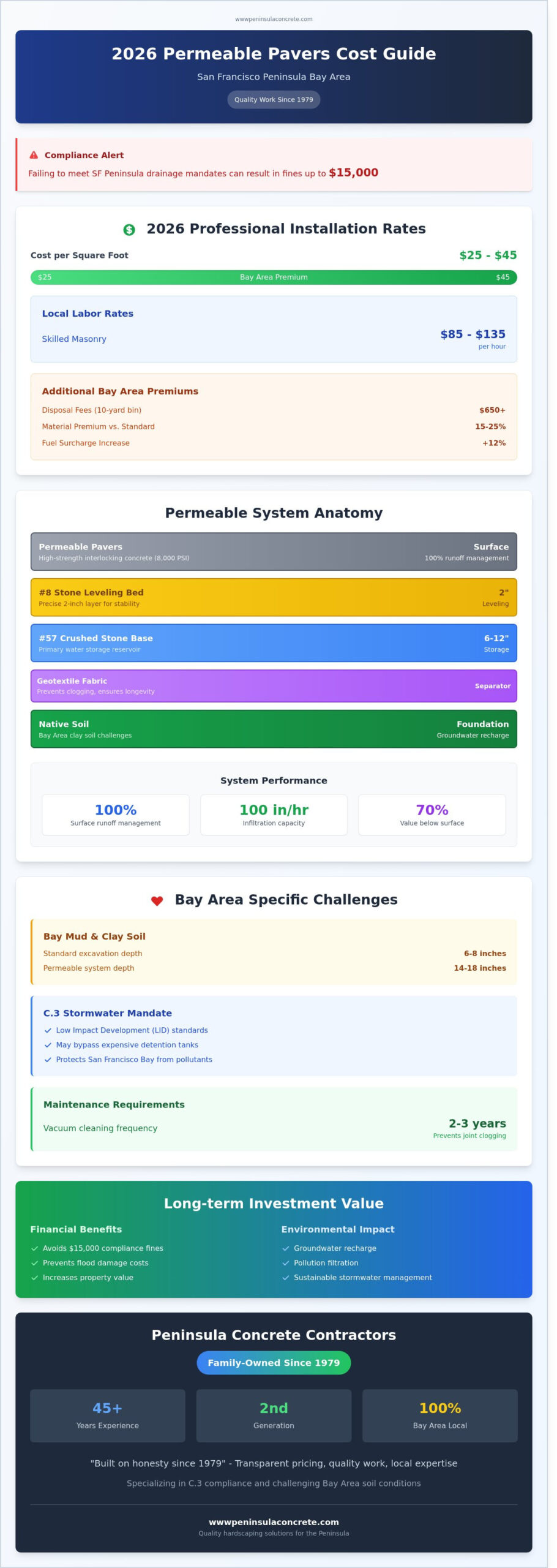
The permeable pavers cost Bay Area homeowners face is higher than the national average for several specific reasons. Local labor rates for skilled masonry currently range between $85 and $135 per hour. Disposal fees at regional facilities have also climbed; hauling away a single 10-yard bin of old concrete now costs upwards of $650 in cities like Palo Alto or San Jose. By 2026, new Low Impact Development (LID) standards will require even more precise engineering for residential driveways, which adds to the initial investment. As a 2nd-generation, family-owned business, we focus on getting these details right the first time to avoid future compliance issues.
The Anatomy of a Permeable System
A PICP installation isn’t just a surface treatment; it’s a structural drainage reservoir. It starts with a base of #57 crushed stone, usually 6 to 12 inches deep, which provides the primary water storage capacity. Above that, we place a 2-inch layer of #8 stone as a leveling bed. High-strength geotextile fabric separates these layers from the native soil to prevent clogging. This multi-stage approach ensures the system remains stable under vehicle loads while processing up to 100 inches of rain per hour. The wider joints between the pavers are filled with small aggregates rather than sand, allowing water to pass through instantly.
Permeable vs. Standard Paver Costs
When you compare quotes, you’ll see that material prices for permeable units are typically 15% to 25% higher than standard interlocking pavers. This is due to the specialized shapes and wider integrated spacers required for infiltration. Understanding the permeable pavers cost Bay Area residents pay requires looking at the labor-intensive excavation process. A standard driveway requires a simple four-inch compacted sand base; a permeable system requires deep excavation to accommodate the three distinct layers of rock. This extra digging and stone volume accounts for the majority of the price gap.
- Material Premiums: Permeable stones cost about $1.50 to $3.00 more per square foot than standard versions.
- Excavation Depth: We typically dig 14 to 18 inches for permeable systems compared to 6 to 8 inches for standard pavers.
- Maintenance Needs: Permeable systems require vacuuming every 2 to 3 years to prevent sediment from clogging the joints.
Standard pervious concrete is another option, but it lacks the aesthetic versatility and 8,000 PSI compressive strength of interlocking pavers. We’ve built a reputation for honesty since 1979, and we tell our clients that while the upfront cost is higher; the long-term value in flood prevention and compliance is unmatched. Supply chain shifts heading into 2026 have increased fuel surcharges for stone delivery by 12%, making local expertise more valuable than ever for keeping projects on budget. Let us help take your project from planning to success with the reliability of a seasoned crew.
2026 Price Breakdown: Square Foot Rates for Bay Area Hardscaping
The 2026 market for hardscaping in San Mateo and Santa Clara counties reflects both high demand and the specialized nature of sustainable drainage systems. For a full professional installation, the permeable pavers cost Bay Area homeowners encounter generally ranges from $25 to $45 per square foot. This price isn’t just for the stones on top; it covers the entire engineered system, including deep excavation, geotextile fabrics, and multiple layers of open-graded crushed stone. At Peninsula Concrete, we’ve seen how these costs distribute across different project types since we started our family-owned business in 1979.
Scale plays a massive role in your final quote. A 1,500 square foot driveway in San Carlos allows our crews to use larger equipment and move material efficiently, which often pulls the price toward the lower end of the $25 to $30 range. Small residential projects in the Peninsula, like a 200 square foot garden path, face a different reality. Most reputable contractors now require a “Minimum Job Fee” to cover overhead and mobilization. In 2026, this minimum typically ranges from $8,500 to $11,000. If your project is very small, your effective price per square foot will naturally be higher to meet this baseline.
Cost by Material Type
Standard concrete permeable pavers are the most cost-effective professional option, usually landing between $25 and $32 per square foot. These units are manufactured for high compressive strength and consistent dimensions. For a premium aesthetic, natural stone permeable systems using granite or basalt setts can push costs to $45 or $55 per square foot. Turf blocks, or grass pavers, offer a “green” look for secondary parking. These systems cost between $22 and $29 per square foot and are frequently used to meet California stormwater mandates while preserving a soft landscape feel.
Labor and Equipment Costs in the Peninsula
Labor is the most significant portion of your investment. Specialized hardscape crews in Palo Alto and Redwood City currently command hourly rates between $95 and $135 per man-hour. This reflects the precision required to install permeable bases that won’t clog or sink over time. Our 2nd-generation expertise ensures these systems are built to last, but the expertise of a seasoned crew comes at a market-clearing price.
- Mobilization Fees: Expect to pay $750 to $1,500 for equipment transport, especially for tight-access lots in older Peninsula neighborhoods.
- Site Preparation: Removing old concrete or asphalt adds $4 to $7 per square foot to the base labor rate.
- Prevailing Wage: For projects tied to commercial-grade residential developments, labor costs can jump by 35% due to state-mandated wage requirements.
Equipment needs for permeable jobs are more intensive than traditional paving. We use specialized vibratory plate compactors and narrow-access excavators to protect your existing landscape. If you’re planning a renovation, you can view our past projects to see how we handle these complex logistics. Every dollar spent on proper labor and equipment ensures the system actually drains as intended, preventing puddling and protecting your home’s foundation from runoff. Our reputation for honesty means we provide these numbers upfront so there are no surprises during your build.
Beyond the Surface: Why Sub-Base Preparation Drives Pricing
Most homeowners focus on the stone’s color or pattern, but 60% to 70% of your total project investment stays hidden beneath the surface. For a typical permeable pavers cost Bay Area installation, the engineering of the sub-base dictates the final quote. We’ve seen projects fail because contractors cut corners on the foundation. Peninsula Concrete doesn’t do that. Quality work since 1979 means we build for the long haul, ensuring the “reservoir” layers can handle heavy NorCal rainfall without shifting.
The San Francisco Bay Area presents unique geological hurdles. We often deal with “Bay Mud” or heavy expansive clay. These soils don’t drain well naturally. While standard pavers only need a 6-inch base, permeable systems require 12 to 18 inches of depth to create a functional storage area for runoff. If your soil contains 30% clay or higher, we must dig deeper to ensure water doesn’t pool and buckle the surface. We source specialized open-graded aggregates like No. 57 and No. 2 stones from local Northern California quarries. These clean, crushed rocks allow water to flow through the gaps, unlike the compactable “class 2” road base used in traditional driveways.
Integrating perforated drainage pipes also adds to the total project estimate. These pipes act as an overflow system during atmospheric river events. Adding these components typically increases labor and material costs by $3.00 to $5.00 per linear foot. Understanding these environmental and cost benefits helps justify the higher upfront price compared to traditional concrete or asphalt. Our 2nd-generation, family-owned business prioritizes this “invisible” work because it prevents the expensive sinking and cracking that plagues cheaper installations.
Excavation and Soil Disposal Fees
In 2026, hauling dirt to local landfills like Newby Island or Vasco Road is more expensive than ever. Disposal fees now range from $50 to $85 per cubic yard depending on the travel distance. Since permeable systems require moving three times the volume of earth as a standard patio, these fees can represent 18% of your total bill. We always require a Perc Test (percolation test) before finalizing a quote. These tests cost between $450 and $900 but prevent drainage failures that could damage your home’s foundation.
Long-Term Maintenance Expenses
Proper care protects your investment from the fine silt and Bay Area dust that settles into the joints. You’ll need to vacuum the joints every 18 to 24 months to maintain high infiltration rates. We also recommend replenishing the No. 8 or No. 9 joint stone every 3 to 5 years to keep the pavers locked in place. Professional maintenance typically costs $1.50 per square foot annually. This small recurring expense prevents the system from clogging and becoming a solid, non-permeable surface over time.
- Excavation Depth: 12-18 inches for permeable vs. 6 inches for standard.
- Soil Type: High clay content requires deeper aggregate reservoirs.
- Specialized Stone: Open-graded aggregates (No. 57, No. 2, No. 8) are required.
- Disposal: 2026 landfill rates impact the bottom line for high-volume dirt removal.
Local Factors: Soil, Stormwater Mandates, and Permitting
The total permeable pavers cost Bay Area homeowners face isn’t just about the stones and the labor. Local regulations in San Mateo and Santa Clara counties play a massive role in the final invoice. Since 1979, we’ve seen municipal codes evolve from simple drainage rules into complex environmental mandates. The most significant of these is the C.3 Stormwater Mandate. This regulation requires many residential projects to manage 100% of their runoff on-site rather than letting it flow into the city’s storm drains.
A holistic approach to on-site water management often starts with the largest surface area of a home: the roof. Before water even reaches your driveway, it’s collected and channeled by your roofing system. While we specialize in ground-level solutions here in the Bay Area, it can be helpful to see how experts in other regions handle the first line of defense against rainfall. For example, you can visit Transition Roofing to see how professionals approach modern roofing and drainage in a different climate.
Understanding the permeable pavers cost Bay Area residents pay requires looking at the hidden savings in municipal compliance. For many Peninsula residents, installing permeable pavers is a strategic financial move. A traditional concrete driveway often requires a subterranean detention tank to comply with modern codes. These tanks can cost between $12,000 and $22,000 depending on the soil composition. Because permeable systems store water in their 12-inch to 18-inch aggregate base, they effectively replace the need for these expensive tanks. You’re essentially buying your drainage system and your finished surface in one package.
Permit fees vary by city but remain a fixed cost to consider. In Redwood City, a standard encroachment permit for driveway work typically starts around $850. In Menlo Park and Atherton, the process is more rigorous. These cities often require a drainage plan signed by a civil engineer if you exceed specific “Impervious Surface” limits. Most Peninsula lots have a coverage limit between 35% and 55%. By using permeable pavers, you can often maximize your buildable lot area for a pool or home addition because these surfaces are frequently classified as pervious; this means they don’t count against your hardscape cap.
Navigating Peninsula Municipal Codes
If you’re replacing a driveway over 500 square feet, expect a higher level of scrutiny from the building department. Many cities now offer “Green Infrastructure” credits for homeowners who choose pervious materials. Our team helps you secure these credits by providing the technical specs required by local planners. It’s vital to hire a licensed C-27 or Class A contractor for this work. As a 2nd-generation, family-owned business, we’ve maintained the certifications necessary to sign off on these municipal documents, ensuring your project meets the 2015 Municipal Regional Permit standards.
Geographic Challenges: Slopes and Hillsides
Building in Woodside or Belmont introduces topographic complexities. On slopes exceeding 5%, a standard permeable installation won’t work because the water will simply run to the bottom of the base. We install “check dams” or terraced sub-bases to solve this. These internal baffles slow the water down and force it into the ground. Engineering costs for these hillside projects are higher, often requiring a geotechnical report that adds $3,000 to $5,000 to the budget, but it’s the only way to prevent base washout and ensure long-term stability.
Investing in Quality: The Peninsula Concrete Contractors Advantage
Choosing the right team for your hardscaping project is just as critical as the materials you select. At Peninsula Concrete, we’ve operated under a simple philosophy: QUALITY WORK SINCE 1979. This isn’t a marketing slogan; it’s a standard that has guided our 2nd-generation, family-owned business for over 45 years. While corporate franchises and national chains focus on volume and speed, we focus on the sub-base. We know that the longevity of your driveway or patio depends entirely on what lies beneath the surface. A poorly installed base leads to sinking and clogging within 24 months, making any initial savings irrelevant.
Our deep roots in the Peninsula mean we understand the local geography better than anyone else. We’ve spent decades working with the heavy, expansive clay soils common in cities like Palo Alto, Menlo Park, and Redwood City. These soils expand when wet and contract when dry, which can wreak havoc on rigid structures. We solve this by integrating advanced drainage systems with high-end masonry. We don’t just lay pavers; we engineer a system that manages water runoff effectively while maintaining structural integrity for decades. This local expertise ensures that your permeable pavers cost Bay Area investment remains a permanent asset to your property.
Craftsmanship That Lasts
We’ve refined a specific 5-step installation process designed specifically for the challenges of Northern California terrain. This method prevents the shifting and “pumping” of soil that often ruins lesser installations. Our process includes:
- Deep Excavation: We remove 12 or more inches of soil to create room for a proper reservoir.
- Soil Stabilization: We use high-quality geotextile fabrics to keep the clay from mixing with your clean stone base.
- Multi-Layered Sub-Base: We install three distinct layers of open-graded, crushed stone to ensure maximum water storage.
- Precision Bedding: A final layer of fine aggregate is laser-leveled for a perfectly flat finish.
- Joint Stabilization: We use specific #8 or #9 stone to ensure water flows at a rate of 100+ inches per hour.
Because we’ve been a local fixture for 45 years, our warranty actually means something. We don’t disappear after the final payment. We’re part of this community, and we take personal pride in every driveway and walkway we finish. You can see our gallery of Peninsula Paver Projects to witness the level of detail we bring to every home. We’ve built a reputation for honesty, and we’re ready to bring that same dedication to your backyard.
Start Your Project with an Accurate Estimate
Understanding the total permeable pavers cost Bay Area homeowners face requires more than a “ballpark” figure over the phone. Every property has unique slopes, soil densities, and existing drainage challenges. Our on-site consultation includes a comprehensive drainage assessment to identify potential issues before they become expensive problems. We look at your roof runoff, property grading, and utility locations to build a plan that works for your specific lot.
We believe in transparency. Our quotes are provided as detailed, line-item documents so you know exactly where your money is going. There are no “hidden fees” or surprise “change orders” halfway through the job. We provide a clear roadmap from the first shovel in the ground to the final cleanup. Let us help take your project from the planning stage to a successful reality. Request your free permeable paver estimate today and experience the difference that 45 years of local experience makes.
Secure Your Investment with Expert Installation
Investing in your home’s exterior requires more than just picking a beautiful stone. In 2026, the permeable pavers cost Bay Area homeowners expect includes critical engineering for stormwater compliance and the deep sub-base excavation needed for local clay soil. Most successful projects require 12 to 18 inches of specialized aggregate to ensure proper drainage. Cutting corners on these hidden layers often leads to settling issues within 3 years. Since 1979, Peninsula Concrete has helped residents across the region navigate these technical requirements. As a 2nd-generation, family-owned business, we understand the specific soil conditions from Palo Alto to San Mateo. We focus on durability because high-quality work pays for itself over decades of use. Our team handles the complex local permitting and site preparation so your new driveway remains level for the next 40 years. We’re ready to bring our 45 years of local expertise to your next hardscaping project.
GET A FREE QUOTE ON YOUR BAY AREA PAVER PROJECT
We’re excited to help you transform your outdoor space into a functional and beautiful asset that lasts.
Frequently Asked Questions
Are permeable pavers more expensive than regular pavers in the Bay Area?
Permeable pavers generally cost 25% more than standard interlocking pavers due to the specialized base materials and excavation depth required. While standard pavers use a sand setting bed, permeable systems require 12 to 18 inches of crushed aggregate to manage water runoff. This added labor and material cost reflects the long term durability and environmental compliance of the system. We’ve provided this high quality work since 1979 to ensure every installation meets local drainage standards.
Do permeable pavers require a lot of maintenance in the California climate?
You only need to perform maintenance once every 12 to 18 months to keep the system functioning at 100% capacity. In the dry California climate, dust and debris can settle in the joints, so we recommend a quick vacuum or power wash to clear the aggregate. This prevents clogging and ensures your driveway handles the heavy 3 inch rain events we see during winter months. It’s a simple process that protects your investment for decades.
Can I use permeable pavers for a high-traffic driveway in Redwood City?
Permeable pavers are an excellent choice for high traffic Redwood City driveways because they offer a compressive strength of 8,000 PSI. This is roughly double the strength of standard poured concrete. Our 2nd generation team has installed these systems for heavy SUVs and delivery trucks without seeing any structural shifting. They provide a durable, slip resistant surface that stands up to daily use while meeting local city permeability requirements.
How much does the C.3 stormwater mandate affect my project cost?
The C.3 stormwater mandate typically adds $3,500 to $6,000 to a residential project if your new or replaced impervious surface exceeds 2,500 square feet. This regulation requires specific engineering to manage runoff on site rather than sending it to the Bay. By choosing permeable pavers, you often satisfy these requirements without needing separate bio-retention planters or expensive drainage pipes. It’s a smart way to combine compliance with beautiful curb appeal.
Do permeable pavers add value to a Bay Area home?
Installing permeable pavers can increase your home’s resale value by 7% based on 2024 Bay Area real estate trends. Buyers prioritize sustainable features and infrastructure that already meets environmental codes. Because we’ve built a reputation for honesty since 1979, we tell clients that the permeable pavers cost Bay Area homeowners pay is often recouped through lower flood risk and improved aesthetic appeal. It’s an investment that pays off during a sale.
How long do permeable paver systems last before needing repair?
A professionally installed permeable paver system lasts 35 to 50 years before requiring any major structural repairs. Unlike asphalt which cracks every 5 to 10 years, these individual units move with the earth’s natural shifts. This flexibility is vital in our seismic region. If a single paver gets stained or damaged, you can replace just that piece for under $60 rather than tearing up the entire driveway. It’s built for the long haul.
Can I install permeable pavers over existing concrete to save money?
You cannot install permeable pavers over existing concrete because the solid slab prevents water from draining into the soil. To function correctly, we must excavate the old concrete and install a 12 inch sub-base of open graded stone. Skipping this step leads to standing water and structural failure within the first 12 months. Our family owned business focuses on doing the job right the first time to ensure your drainage works perfectly.
What is the average cost per square foot for permeable pavers in San Jose?
The average permeable pavers cost Bay Area residents see in San Jose ranges from $28 to $42 per square foot. This price includes demolition of old surfaces, deep excavation, and the specialized multi-layered rock base. Factors like site accessibility and the specific paver style will influence the final number. We provide detailed, honest quotes to help you plan your project from start to success without any hidden fees or surprises.