
In the hills of Redwood City, the ground beneath your feet isn’t just dirt; it’s a moving force that exerts roughly 45 pounds of pressure per cubic foot against your property’s foundation. This constant weight makes a professional concrete retaining wall design essential for any homeowner dealing with the Peninsula’s steep slopes and expansive clay soil. You’ve likely worried if your backyard will survive the next heavy rain or if a new structure will actually pass a strict San Mateo County inspection. Since 1979, our 2nd-generation family business has seen how these unique local conditions can challenge even the most ambitious landscaping projects.
We agree that your property should be a source of pride and safety, not a constant worry about soil erosion. This guide will help you master the technical requirements and aesthetic choices needed to build a wall that stands the test of time. We’ll walk you through seismic safety standards, local permit processes for Redwood City, and the specific drainage techniques that prevent wall failure in our unique coastal environment.
Key Takeaways
- Understand how to leverage the intersection of engineering and local topography to protect your Peninsula landscape from erosion.
- Compare the mechanics of cantilever and gravity walls to identify the most stable structural solution for Redwood City and Woodside hillsides.
- Learn why managing hydrostatic pressure and expansive “Bay Area Clay” is the single most important factor in preventing long-term wall failure.
- Navigate local building codes in San Mateo and Santa Clara Counties, including when your concrete retaining wall design requires a professional engineer’s stamp.
- Discover how to customize your project with decorative finishes that seamlessly match your existing interlocking pavers and patio style.
Understanding Concrete Retaining Wall Design in the Bay Area
Quality work since 1979 has taught us that successful concrete retaining wall design is a precise balance between structural engineering and landscape architecture. In regions like Redwood City and Woodside, homeowners face unique geological challenges, including expansive clay soils and shifting tectonic plates, that require more than just a stack of blocks. These structures must withstand immense lateral earth pressure while transforming steep, unusable hillsides into level, productive ground. A retaining wall is a structure designed to restrain soil to a slope that it would not naturally keep to, typically used to manage the 10-30% slopes common in San Mateo County.
Our team at Peninsula Concrete understands that a wall isn’t just a barrier; it’s a foundation for your outdoor lifestyle. When we approach concrete retaining wall design, we calculate the exact weight of the soil, the moisture retention of the specific adobe clay in your yard, and the necessary drainage systems to prevent failure. We’ve seen how poorly planned walls fail under the pressure of the Peninsula’s varied terrain. This is why we prioritize a “measure twice, pour once” philosophy that has served our local clients for over 45 years. As a 2nd-generation, family-owned business, we take pride in building structures that last for decades, not just seasons.
Why Design Matters for Peninsula Properties
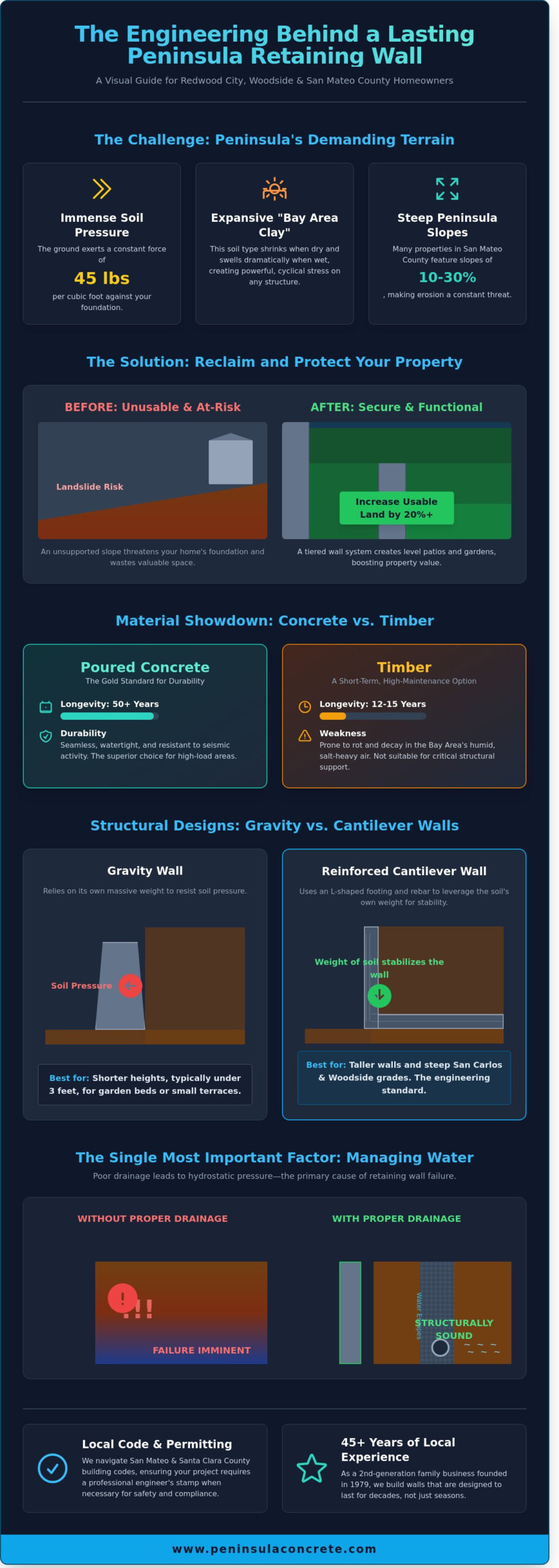
Proper design is the first line of defense against soil creep and sudden landslides, especially during heavy California rain seasons like the record-setting storms of January 2023. Without a professional design, saturated soil becomes heavy and fluid, putting thousands of pounds of pressure on your home’s foundation. By installing a tiered wall system, we turn “dead” hillside space into functional patios or gardens, often increasing a property’s usable square footage by 20% or more. This structural investment protects your home and significantly boosts market value in competitive Bay Area real estate markets where every square foot of level land is a premium asset.
Creating a stable, level surface is the foundation for many high-end landscape features. While the focus here is on retaining walls, the principles of site preparation and specialized concrete work are essential for complex projects like post-tension concrete tennis court construction, which also transforms challenging terrain into a valuable recreational asset.
Understanding the return on investment for such structural improvements is crucial. While this article focuses on Bay Area properties, the principle of increasing a home’s market value through smart, durable landscaping is universal across California. For those interested in a professional real estate perspective on how these upgrades are valued, you can learn more about Cardenas & Company Real Estate Group, a team that helps homeowners understand and maximize their property’s potential.
Concrete vs. Other Materials
Poured concrete is the gold standard for durability on the Peninsula. While timber walls might look appealing initially, they often rot within 12 to 15 years due to the humid, salt-heavy air coming off the Bay. In contrast, a well-engineered concrete wall lasts 50 years or longer with minimal maintenance. We specialize in two primary types of wall structures to meet your specific needs:
- Gravity Walls: These rely on their own massive weight to hold back the soil, perfect for shorter heights under 3 feet where the mass of the concrete provides the necessary resistance.
- Reinforced Cantilever Walls: These use an L-shaped “boot” design and internal rebar to resist high-load scenarios on steeper Woodside grades, using the weight of the soil itself to help hold the wall in place.
Our family-owned business recommends poured concrete for high-load areas because it provides a seamless, watertight barrier that dry-stack stone simply cannot match. This level of longevity ensures your investment remains stable through decades of seismic activity and seasonal shifts. We’ve built a reputation for honesty and high-quality work by helping homeowners choose the right structural path for their specific lot, ensuring the final product is as beautiful as it is strong.
Structural Designs: Cantilever vs. Gravity Walls for Peninsula Slopes
Choosing the right structural approach for a concrete retaining wall design depends entirely on the vertical rise and the pressure of the soil behind it. In the Bay Area, we primarily see two types of structures: cantilever and gravity walls. Gravity walls are the traditional choice for shorter heights. They rely on pure mass and weight to resist the lateral pressure of the earth. If the wall is heavy enough, the soil cannot push it over. These are often used for garden borders or terracing where the height stays below 3 feet.
For the steep, challenging grades found in Emerald Hills and San Carlos, cantilever designs are the gold standard. A cantilever wall uses an “L” or “T” shaped footing that extends deep into the hillside. This design leverages the weight of the soil itself to provide stability. The earth sits on top of the internal “boot” or footing, which actually pins the wall down and prevents it from tipping. This mechanical advantage allows us to build much taller and thinner walls than a gravity design would permit. Since 1979, we’ve seen how these structures handle the unique hydrostatic pressure of local clay soils during heavy winter rains.
Engineering these walls requires strict adherence to state standards to ensure long-term safety. The Caltrans standard practice for retaining walls provides a technical foundation for these designs, especially regarding soil load-bearing ratios. Following these guidelines ensures that the wall won’t just hold back dirt, but will also withstand the specific geological stresses of the Peninsula.
The Anatomy of a Reinforced Concrete Wall
The footing is the most critical component of any reinforced wall. While California doesn’t face the deep freeze-thaw cycles of the Midwest, we still set footings 12 to 18 inches below grade to reach stable, undisturbed soil. Within the concrete stem, rebar placement is a science. We place steel reinforcement in the tension zones where the concrete is most likely to pull apart under pressure. For most residential projects, an 8-inch wall thickness is our starting point to ensure durability and enough room for proper rebar coverage.
Seismic Design Considerations
Living near the San Andreas Fault means every concrete retaining wall design must account for ground movement. We don’t build walls to be perfectly rigid; we build them to be resilient. This involves using a “batter,” which is a slight backward lean of about 1 inch for every 12 inches of height. This lean increases structural stability and compensates for the visual illusion that a perfectly vertical wall is tipping forward.
In high-risk seismic zones, overbuilding is the only responsible path. We often increase the rebar density by 15 percent beyond the minimum code requirements to provide an extra margin of safety. This ensures the wall can flex and settle during a tremor without catastrophic failure. If you’re planning a project on a steep lot, you can consult with our team to determine which reinforcement schedule fits your specific topography. Our 2nd-generation family-owned business treats every hillside project as a legacy build, prioritizing structural integrity above all else.
Managing Hydrostatic Pressure: Drainage and Soil Considerations
In the Bay Area, water is the number one cause of retaining wall failure. It isn’t the weight of the dirt itself that causes a collapse. It’s the hydrostatic pressure built up by trapped moisture. Since we began providing quality work in 1979, we’ve repaired many walls that failed because the original builder ignored local soil conditions. When water saturates the ground, it adds roughly 62.4 pounds of pressure per cubic foot. This weight pushes against the back of the structure with immense force. Without a professional concrete retaining wall design, that pressure will eventually win.
The failure cycle is a predictable but destructive process. It begins during a heavy rainstorm when water penetrates the soil. If the wall lacks an exit path for this moisture, the soil becomes a heavy, semi-liquid mass. This mass exerts lateral pressure that the concrete wasn’t built to hold. You’ll first notice small cracks or a slight lean. Once the wall shifts even half an inch, it creates more space for water to pool, which increases the pressure further. This cycle repeats until the structural integrity is completely compromised. Our experience as a 2nd-generation, family-owned business has taught us that preventing this cycle is much cheaper than fixing a collapsed hillside.
The Drainage Toolkit
We use a specific set of tools to keep your wall dry and stable. Weep holes are the most basic requirement. These are 2 to 3-inch openings placed at the base of the wall, typically spaced every 4 to 6 feet. They allow water to escape before pressure builds. We also install 4-inch perforated pipes, often called French drains, at the footer level. These pipes collect subsurface water and direct it away from the foundation to a safe discharge point. Backfill selection is equally critical. We never use native soil for backfill. Instead, we use 12 to 18 inches of clean, 3/4-inch crushed stone. This creates a porous zone where water can flow freely down to the drainage pipes.
Dealing with Expansive Clay
Redwood City and the surrounding Peninsula are famous for “adobe” clay. This soil is notoriously difficult because it expands by as much as 10% when wet. This expansion creates a horizontal “shove” that can snap poorly reinforced concrete. To combat this, we construct a drainage chimney. This is a vertical column of gravel placed directly behind the wall that separates the concrete from the expansive clay. We also wrap the gravel in a heavy-duty geotextile filter fabric. This fabric is essential. It prevents fine clay particles from migrating into your gravel and clogging the drainage system over time. A concrete retaining wall design that accounts for these Peninsula soil quirks will remain standing for decades while others fail after a single wet winter.
Proper drainage isn’t just an add-on; it’s the most important part of the engineering process. By focusing on the specific challenges of Bay Area clay and using high-quality components, we ensure your investment stays exactly where it belongs. We’ve built a reputation for honesty and high-quality work since 1979 by never cutting corners on what’s behind the wall.
Permitting and Engineering Requirements in San Mateo and Santa Clara Counties
Navigating the legalities of concrete retaining wall design in the Bay Area requires local knowledge and a respect for safety codes. In San Mateo and Santa Clara Counties, the 4-foot rule is the standard threshold for most residential projects. This measurement starts from the bottom of the concrete footing, not just the visible portion of the wall above the soil. If your project exceeds this height, the 2022 California Building Code mandates a formal building permit and a wet stamp from a licensed structural engineer. Building without these approvals in cities like Palo Alto or Menlo Park can lead to expensive stop-work orders and significant fines. Beyond the height rule, any wall built on a slope steeper than 2:1 requires professional engineering regardless of its height to ensure the hillside remains stable.
The surcharge rule is another factor that often surprises homeowners. A surcharge is any extra weight placed on the soil behind the wall. If you have a driveway, a swimming pool, or even a heavy fence within a distance equal to the wall’s height, the design must account for that lateral pressure. These surcharged walls face significantly higher loads than a standard garden wall. We’ve seen 3-foot walls fail because they weren’t designed to handle the weight of a parked SUV or a neighbor’s nearby foundation. In these cases, city inspectors will require engineering calculations to prove the wall can withstand the specific load requirements of your property.
Local variances also play a role in your project timeline. Palo Alto has strict tree protection zones that might require specialized footing designs to avoid damaging heritage oaks. In Menlo Park, projects near the San Francisquito Creek watershed often trigger additional environmental reviews. For those in Redwood City, a successful permit application typically requires a specific set of documentation:
- Two copies of a detailed site plan showing property lines and existing structures.
- Structural engineering calculations based on a 2024 soils report.
- Detailed cross-sections showing the wall, footing, and reinforcement steel.
- A comprehensive grading and drainage plan to manage water runoff.
When to Hire a Structural Engineer
You must hire a structural engineer for any wall that supports a structure, a public right-of-way, or sits directly on a property line. These are considered critical walls where a failure could result in property damage or injury. A professional engineer doesn’t just provide a stamp; they optimize your concrete retaining wall design to use the exact amount of steel and concrete needed. This precision often saves money on material costs and prevents the liability risks associated with DIY designs that might shift or lean over time.
For owners of high-value properties, this focus on mitigating risk often extends beyond the landscape. Comprehensive safety planning can also include personal security, and for those exploring this area, it’s useful to see the standards set by leading agencies. As a benchmark for high-level risk management, you can review specialized offerings like executive protection services georgia.
The Peninsula Concrete Process
As a 2nd-generation, family-owned business, we’ve built a reputation for honesty and quality work since 1979. We coordinate directly with local engineers to ensure your site plan is code-compliant from day one. Our “Concrete Thinking” approach involves analyzing the entire landscape to identify potential issues before we pour. A major part of this is integrating drainage systems into the initial design phase. Proper drainage is the only way to prevent hydrostatic pressure from destroying a wall, and we’ve mastered this process over 45 years of local service.
Ready to start your project? Schedule a professional site consultation with our experienced team today.
Custom Concrete Finishes: Integrating Function with Bay Area Style
Many homeowners assume a retaining wall has to be a dull, gray box that detracts from their landscape. That’s a mistake. Modern concrete retaining wall design allows for a level of customization that transforms a structural necessity into a focal point. We’ve seen projects where the wall becomes the most talked-about feature of the yard. By using decorative finishes, you ensure your wall complements your home’s architecture instead of clashing with it.
Achieving a cohesive look means matching your wall to existing features like interlocking pavers or concrete patios. We recommend using integral color for this process. Unlike topical stains or paints that might peel or fade within 4 to 6 years, integral color is mixed directly into the concrete. This creates a uniform hue throughout the entire structure. If the wall ever chips, the color remains consistent underneath. It’s a durable solution that keeps your property looking sharp for decades.
Aesthetic Design Options
Stamped concrete is a versatile choice for homeowners who want the look of natural stone or wood without the high maintenance costs. We can use heavy-duty mats to press textures into the wet surface, mimicking slate, flagstone, or even cedar planks. For a classic Bay Area aesthetic, exposed aggregate is a top-tier option. This finish reveals the natural stones within the concrete mix, providing a slip-resistant texture and a timeless, earthy look that has been popular in California landscapes for over 50 years.
If your home features a Mid-Century Modern or contemporary style, board-formed concrete is the way to go. This technique leaves the impression of wood grain from the timber forms used during the pour. It creates a sophisticated, architectural finish that highlights the raw beauty of the material. It’s a clean look that emphasizes the structural integrity of your concrete retaining wall design.
The Final Touches
Functionality doesn’t stop at holding back soil. Adding a wide cap stone or a flat concrete ledge at an 18-inch height turns a standard wall into extra seating for guests. This is a smart way to maximize space in smaller San Mateo or Santa Clara county backyards. We also suggest integrating low-voltage LED lighting into the wall stem. A 12-volt system provides safety for walkways and creates a warm, inviting ambiance after the sun sets.
Choosing a contractor for these high-end finishes requires a team with a proven track record. Peninsula Concrete is a 2nd-generation, family-owned business that has been serving the community for over 45 years. We take personal pride in every pour. Our team understands the local soil conditions and aesthetic preferences of the Bay Area better than anyone else. We’ve built our reputation on honesty and high-quality results. Trust the experts who have provided Quality Work Since 1979 to bring your vision to life.
BUILD A LASTING FOUNDATION FOR YOUR BAY AREA LANDSCAPE
Designing a wall that withstands the unique pressures of the Peninsula requires more than just pouring cement. You’ve learned that balancing structural integrity with proper drainage is the only way to manage hydrostatic pressure and protect your property. Whether your project involves a cantilever wall for a steep San Mateo slope or a gravity wall in Santa Clara County, meeting local engineering codes is a non-negotiable step for safety. These structures must be built to handle both the weight of the soil and the seismic activity common to our region.
A successful concrete retaining wall design combines these technical requirements with aesthetic finishes that match your home’s style. Since 1979, our family-owned team has specialized in seismic-ready solutions that handle the Bay Area’s specific soil conditions. We bring 2nd-generation expertise to every job, ensuring your investment is as durable as it is functional. Don’t leave your landscape to chance when you can rely on 45 years of local experience and proven craftsmanship.
This commitment to lasting value and quality construction is a universal principle in desirable real estate, from local landscape enhancements to major international developments like Vela Bay in Singapore.
Start your Bay Area retaining wall project today with a free estimate
We look forward to helping you transform your property with quality work that stands the test of time.
Frequently Asked Questions
Do I need a permit for a 3-foot retaining wall in Redwood City?
You don’t need a building permit in Redwood City for a retaining wall under 4 feet tall, provided it doesn’t support a surcharge like a driveway or a steep slope. Our team has navigated these local codes since 1979 to ensure every project stays compliant. If your wall exceeds 48 inches, we’ll help you secure the necessary city approvals before we break ground.
How much does a concrete retaining wall design cost in the Bay Area?
Professional concrete retaining wall design in the Bay Area typically costs between $2,500 and $6,000 for standard residential projects. This price covers site surveys, soil reports, and structural engineering stamps required by local municipalities. We’ve found that investing in a precise design upfront prevents costly structural failures that can run upwards of $15,000 in repairs later.
What is the best type of concrete for a retaining wall near the coast?
Type V sulfate-resistant concrete is the best choice for retaining walls within 5 miles of the Pacific coast. This specific mix protects the structure from salt air and moisture that cause standard concrete to spall and degrade. We use a 4,000 PSI mix with a low water-to-cement ratio of 0.45 to ensure your wall withstands the harsh coastal environment for decades.
How thick should a 4-foot concrete retaining wall be?
A standard 4-foot concrete retaining wall should be at least 8 inches thick to provide proper structural stability. For walls in San Mateo or Palo Alto with heavy clay soil, we often increase this to 10 or 12 inches. This thickness allows for the placement of #4 or #5 rebar with the 3 inches of concrete cover required by California building codes.
Can I build a retaining wall on a property line in San Mateo County?
You can build a retaining wall on a property line in San Mateo County, but you must keep the entire structure, including the underground footing, within your boundary. Most local codes require a 1-foot to 3-foot setback if the wall changes the natural flow of water onto a neighbor’s lot. We recommend a joint boundary agreement if the wall sits directly on the line to avoid legal disputes.
How long does a poured concrete retaining wall last compared to wood?
A professionally poured concrete retaining wall lasts 50 to 100 years, while a pressure-treated wood wall typically fails within 12 to 15 years. Wood eventually rots and attracts termites in our damp coastal climate. Since 1979, we’ve replaced hundreds of failing timber walls with durable concrete that offers a much higher return on investment for homeowners throughout the Peninsula.
What happens if my retaining wall doesn’t have weep holes?
Retaining walls without weep holes will eventually crack or collapse because of extreme hydrostatic pressure. Water trapped behind the wall weighs approximately 62 pounds per cubic foot, which creates thousands of pounds of force against the concrete. We install 2-inch diameter weep holes every 4 to 6 feet to ensure proper drainage and protect the structural integrity of your concrete retaining wall design.
Does insurance cover a retaining wall failure after an earthquake?
Standard California homeowners insurance policies do not cover retaining wall failure caused by an earthquake. You must have a separate earthquake policy, and even then, coverage for detached structures is often limited to 10% of the main dwelling’s limit. We build our walls with reinforced footings and heavy-duty rebar to minimize the risk of failure during a seismic event in the Bay Area.