
In the Bay Area, a patio that looks perfect on day one can become a $30,000 liability by year three if the expansive clay soil isn’t properly addressed. You’re likely already concerned about the steep cost of local labor and the confusing maze of California licensing requirements. Because of these high stakes, knowing how to choose a hardscape contractor is the most important decision you’ll make for your property this year. We understand that pressure. Our 2nd-generation, family-owned business has been building high-quality, durable foundations since 1979.
This 2026 checklist provides the professional framework you need to find a specialist who handles every permit and structural detail with absolute precision. We’ll walk you through the five essential questions for every candidate, the red flags in local bids, and the specific ways to verify a contractor’s reputation for honesty. You’ll gain the confidence to hire a partner who ensures your driveway or patio survives California’s climate and shifting ground without a hitch. By the end of this guide, you’ll have a clear path to a beautiful outdoor space that stands the test of time.
Key Takeaways
- Distinguish between softscape and hardscape to ensure you hire a dedicated specialist for structural elements like masonry, patios, and driveways.
- Learn how to choose a hardscape contractor by verifying California-specific C-8 and C-27 licenses and vetting references for projects that have stood the test of time.
- Protect your investment by identifying common red flags and navigating the complex permitting requirements unique to the San Francisco Peninsula.
- Use our professional 5-step checklist to find a local partner who offers the personal accountability and high-quality work of a 2nd-generation family business.
What is a Hardscape Contractor vs. a Landscaper?
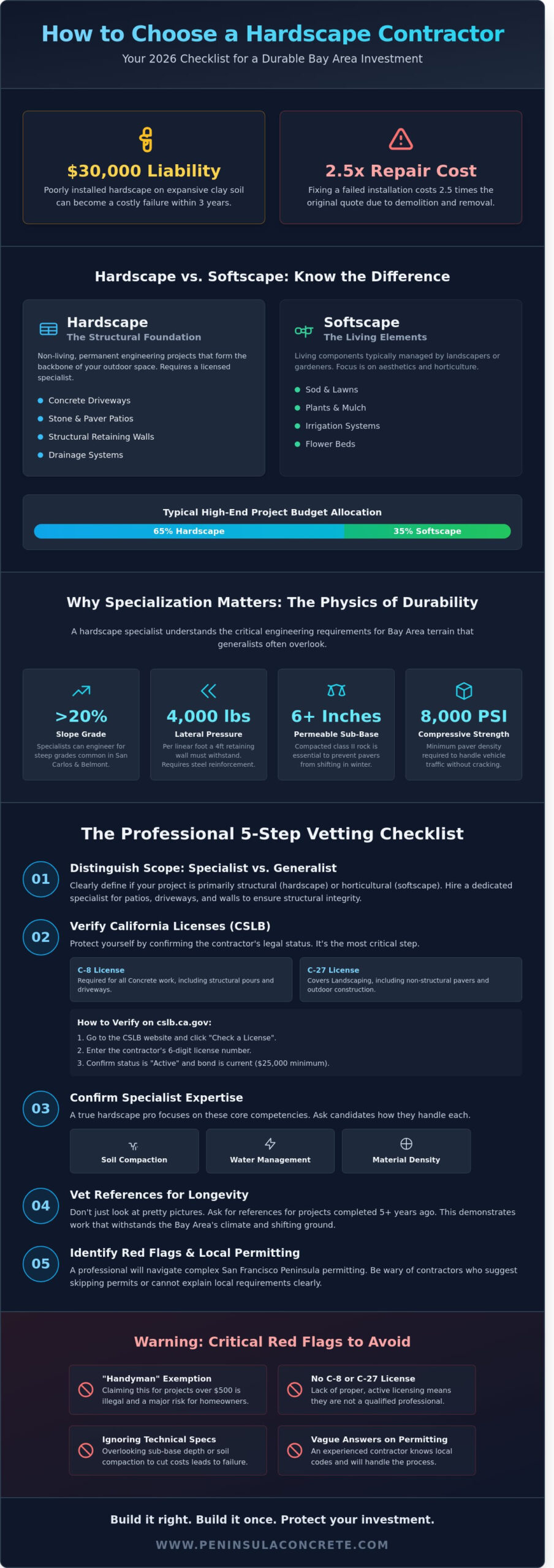
Understanding the distinction between a gardener and a builder is the first step in learning how to choose a hardscape contractor. While a landscaper typically manages the “softscape,” which includes living elements like sod, mulch, and irrigation systems, Hardscape refers to the heavy, non-living structures that form the foundation of your property. This includes your concrete driveway, stone patios, and masonry walls. In the Bay Area, where property values are high, these installations aren’t just decorative; they’re permanent engineering projects that determine how water moves across your land. Most high-end outdoor renovations in San Mateo County allocate 65% of the total budget to these structural elements because they provide the framework for everything else.
Why Specialization Matters for Peninsula Homes
Homes in cities like San Carlos or Belmont often sit on grades exceeding a 20% slope. A standard gardener might plant a beautiful hedge, but they aren’t equipped to calculate the lateral earth pressure on a structural retaining wall. A wall that’s only four feet high must withstand roughly 4,000 pounds of soil pressure per linear foot. Professional hardscapers prioritize structural integrity by using steel-reinforced concrete and engineered drainage layers. Interlocking pavers require a compacted sub-base of at least six inches of class II permeable rock to prevent shifting during our rainy winters, a technical requirement that generalists often overlook to save on labor costs.
The Risks of Hiring a Generalist for Structural Work
Hiring a general laborer instead of a specialist often leads to catastrophic failures like sinking pavers or cracked concrete within the first 24 months. Repairing these mistakes is expensive; industry data shows that fixing a failed installation costs 2.5 times more than the original quote because it requires professional demolition and debris removal before the real work begins. You don’t want to pay for the same patio twice. A hardscape specialist is a professional focused on load-bearing outdoor installations. When you research how to choose a hardscape contractor, look for a team that treats your backyard like a construction site, not a garden. Specialists focus on these key areas:
- Soil Compaction: Using heavy machinery to ensure the ground won’t settle under 10 tons of concrete.
- Water Management: Installing French drains and catch basins to protect your home’s foundation.
- Material Density: Selecting pavers with a compressive strength of at least 8,000 psi to handle vehicle traffic.
Choosing a specialist ensures that your investment survives the Bay Area’s unique geography and seismic activity. Since 1979, we’ve seen that the best results come from those who understand that hardscaping is a trade rooted in physics and masonry, not just aesthetics.
Vetting Bay Area Qualifications: Licenses, Insurance, and Local Knowledge
Selecting a partner for your outdoor renovation requires more than just looking at a portfolio. Knowing how to choose a hardscape contractor in Northern California means verifying their legal standing and technical expertise before the first shovel hits the dirt. Since 1979, our team has seen how local soil conditions and seismic activity can ruin a poorly planned project. Quality work isn’t just about the finish; it starts with the credentials that protect your investment.
Verifying the California State License Board (CSLB) Status
Every legitimate hardscape project in the Bay Area requires a specific license. A C-8 (Concrete) license is vital for structural pours and driveways, while a C-27 (Landscaping) license covers broader outdoor construction and pavers. You can verify these credentials by following a few simple steps:
- Visit the CSLB website and select “Check a License.”
- Enter the contractor’s six-digit license number.
- Confirm the status is “Active” and the expiration date hasn’t passed.
- Check that the contractor maintains a $25,000 surety bond.
When a license is “Active and in Good Standing,” it means the contractor has passed state trade exams and maintains the required bond. Avoid any individual claiming a “handyman” exemption for projects exceeding $500. This is a significant legal risk for homeowners. For more details on these requirements, consult California’s official contractor guide to ensure you’re hiring a professional who follows state law.
Insurance: Protecting Your Bay Area Property
General liability insurance and Workers’ Compensation are two distinct but equally vital protections. General liability covers damage to your home or yard, while Workers’ Compensation protects you from being held liable for medical bills if a crew member is injured on your property. Always ask for an insurance certificate that lists you as “additionally insured.” This provides a direct line of protection for your specific project. In high-density areas like Redwood City, where tight property lines and utility easements are common, this coverage is essential. If a machine clips a neighbor’s fence or hits a buried line, the contractor’s policy must handle the claim, not your own homeowner’s insurance.
Soil and Seismic Expertise
The Bay Area is famous for expansive clay soils, often called “Bay Mud” or “Adobe.” These soils expand when wet and shrink when dry, which can crack concrete that isn’t reinforced correctly. A reputable contractor understands that 4-inch slabs need proper sub-base preparation and steel reinforcement to survive these shifts. Additionally, seismic considerations are mandatory. Retaining walls over 3 feet tall usually require engineered plans to meet California Building Code standards for earthquake resilience. If you’re ready to build something that lasts, start your project today with a 2nd-generation team that understands local conditions.
The 5-Step Evaluation Checklist for Your Hardscape Project
Finding the right partner for your outdoor transformation requires more than a quick search. Since 1979, we’ve seen how a detailed plan separates a lasting patio from one that cracks after two winters. When you’re learning how to choose a hardscape contractor, you need a systematic way to vet both their technical skill and their business stability. This process starts long before the first shovel hits the dirt.
Analyzing the Portfolio for Quality and Style
Don’t just look at the colors in the photos. Focus on the geometry. A reputable contractor shows clean lines where pavers meet a pool coping or a retaining wall. If you own a 450-square-foot urban lot in San Francisco, don’t just look at 5-acre estate photos. You need to see how they handle tight transitions and complex drainage in smaller spaces. Look for evidence of natural stone work or specific stamped concrete patterns that match your home’s architecture. High-quality portfolios should also show “work in progress” shots that reveal the hidden layers of the build.
Beyond the structural work, the finishing materials you choose for surfaces like covered patios or outdoor feature walls define the final aesthetic. If you’re exploring high-end options for these areas, you can check out Nature Living Floor for premium flooring and wall panels that complement a well-built hardscape foundation.
The Essential Questions to Ask Every Hardscaper
Technical expertise is non-negotiable in the Bay Area’s expansive clay soils. Ask these three specific questions to gauge their depth of knowledge:
- “How deep do you excavate for the sub-base in our specific soil type?” A standard 4-inch base might work in some regions, but local clay often requires 6 to 8 inches of compacted Class 2 aggregate to prevent shifting.
- “What is your plan for surface water runoff and site drainage?” Every 1,000 square feet of hardscape can shed 620 gallons of water during a 1-inch rainstorm. They must explain how they’ll move that water away from your foundation.
- “Who will be on-site managing the crew every day?” You want a dedicated project manager, not a salesperson who disappears after the deposit is paid.
Beyond the interview, check their supplier relationships. Reputable firms work with top-tier brands like Belgard or Basalite. These manufacturers provide 25-year or lifetime warranties on pavers, which adds long-term value to your property. We also recommend asking for a reference from a project completed 5 or 6 years ago. This proves their work stands up to the test of time and California’s wet-dry cycles.
Finally, evaluate their communication during the “Concrete Thinking” phase. This is the critical 14-day planning window where every utility line and slope is mapped out. If a contractor rushes this phase, they’ll likely rush the installation too. Knowing how to choose a hardscape contractor means choosing the one who values preparation as much as the final aesthetic.
Red Flags and Local Permitting in the San Francisco Peninsula
Selecting the right professional requires a sharp eye for warning signs that often hide in plain sight. When you’re learning how to choose a hardscape contractor, start by looking at their physical prep work. 90% of hardscape failures in the Bay Area stem from poor sub-base preparation. If a contractor plans to save you money by skimping on the 4 to 6 inches of compacted class II baserock required for a stable patio, walk away. Professional outfits like Peninsula Concrete have seen these shortcuts lead to cracked pavers and shifting slabs within 24 months. Avoid anyone demanding cash-only deals or pressuring you to buy materials today to lock in a price. These are hallmarks of fly-by-night operations that lack the heritage of a 2nd-generation, family-owned business.
- Cash-Only Pressure: Legitimate businesses don’t avoid paper trails.
- Vague Timelines: A lack of a start and end date suggests poor project management.
- Missing Equipment: Contractors who need to borrow your tools aren’t prepared for the job.
Navigating Bay Area Building Codes
Permitting in the Peninsula is notoriously complex. In cities like Palo Alto and Menlo Park, green building codes often mandate the use of permeable pavers to manage stormwater runoff. If your retaining wall exceeds 3 feet in height, California law requires a structural engineer’s stamp and a formal building permit. Redwood City has strict setback requirements that dictate exactly how close a new driveway or patio can sit to your property line. A reputable contractor handles this red tape for you. They ensure your project meets every local ordinance so you don’t face fines later.
Financial Red Flags to Avoid
Protect your investment by knowing the law. California Business and Professions Code 7159 limits down payments to 10% of the total project price or $1,000, whichever is less. Never exceed this amount. Be wary of allowances in a contract. These are vague price estimates for materials that often result in 20% to 30% cost overruns once the work begins. A professional quote should be line-itemed and detailed, reflecting the honest standards we’ve maintained since 1979. This transparency ensures you know exactly where every dollar goes.
This kind of financial transparency is key, and it’s leading to different business models globally. For instance, some homeowners now work with a Direct Renovation Contractor Singapore to manage project costs by eliminating the expensive middleman layer entirely.
Ready to work with a team that respects local codes and your budget? Contact Peninsula Concrete for a detailed project consultation today.
Why Peninsula Concrete is the Bay Area’s Trusted Choice Since 1979
Experience isn’t just a number. It’s a track record of surviving shifting soil and changing architectural trends. Since 1979, Peninsula Concrete has served Redwood City and the surrounding Bay Area with a relentless focus on durability. We’re a 2nd-generation, family-owned business. This means our family name is attached to every yard of concrete we pour. We don’t hide behind a corporate shield; we stand by our work with personal accountability. If you’re researching how to choose a hardscape contractor, look for a team that has remained in the same community for 45 years. Our reputation for honesty is built on thousands of successful installs, ranging from sleek modern driveways to intricate estate masonry.
Our expertise covers the full spectrum of outdoor construction. We provide a breadth of services designed for the unique California climate:
- Interlocking Pavers: These systems are unsurpassed in strength and offer the flexibility needed for local seismic zones.
- Pervious Concrete: We offer sustainable solutions that manage stormwater runoff effectively.
- Complex Drainage: We build essential systems that protect your home’s foundation from hydrostatic pressure.
- Architectural Concrete: Our team delivers high-quality finishes that immediately increase property value.
We view “Quality Work Since 1979” as a strict operational standard. It guides every decision we make on the job site.
Our Process: From Planning to Success
Success starts underground. We evaluate your specific site conditions, including the heavy clay content common in Bay Area soil, before the first pour occurs. This prevents the cracking and settling that often ruins projects handled by less experienced crews. We’ve spent 45 years building deep relationships with local suppliers to ensure our clients receive the highest grade materials available. To ensure the longevity of your investment, Peninsula Concrete integrates drainage systems into every hardscape design to prevent future damage. We treat your land as a complete ecosystem rather than just a flat surface.
Start Your Bay Area Project Today
Don’t leave your property investment to chance. When you evaluate how to choose a hardscape contractor, prioritize proven results and local roots. You can browse our project gallery to see local inspiration and examples of how we’ve transformed homes in your specific neighborhood. We’re ready to bring that same level of craftsmanship to your front door. Contact Peninsula Concrete for your free hardscape estimate and a professional site evaluation. Let’s build a landscape that lasts for the next 45 years.
TRANSFORM YOUR OUTDOOR LIVING SPACE
Your outdoor space is a significant investment in your home’s value and your family’s daily lifestyle. Selecting the right partner requires more than a quick search; it demands a team that understands the San Francisco Peninsula’s unique seismic requirements and clay-heavy soil conditions. By following our 5-step checklist, you’ve learned that verifying a valid Class A or C-8 license and confirming comprehensive liability insurance are the first steps toward a successful build. Understanding how to choose a hardscape contractor means looking for a legacy of local success and technical precision.
Peninsula Concrete has provided QUALITY WORK SINCE 1979. As a 2nd-generation, family-owned and operated business, we don’t just pour concrete. We build foundations that withstand Northern California’s specific environmental challenges. We’re specialists in seismic-resilient installations and soil-specific drainage solutions tailored to the Bay Area. Don’t settle for a generic landscaper when your project demands specialized engineering and 45 years of proven expertise. Start your Bay Area hardscape project with a free estimate from Peninsula Concrete and see why we’ve been the region’s trusted choice for decades. We look forward to helping you take your project from the planning stages to a beautiful, lasting success.
Frequently Asked Questions
Do I need a permit for a new paver patio in Redwood City?
You generally need a permit in Redwood City if your new patio exceeds 500 square feet or if you’re altering existing drainage patterns. The city’s Engineering and Building Departments regulate these projects to ensure proper runoff management. We recommend checking the 2024 Redwood City Municipal Code for specific zoning setbacks. Our team handles these filings to ensure your 2026 project meets every local safety standard and code requirement.
How long should a professional hardscape installation last in the Bay Area?
A professional hardscape installation should last between 25 and 50 years when built with high-quality materials. Interlocking pavers are especially durable because they flex with the Bay Area’s seismic activity. We’ve seen our 1980s installations still looking fantastic today. Regular maintenance, like sealing every 3 to 5 years, extends this lifespan. Choosing the right materials ensures your investment stands up to the California sun and soil shifts over many decades.
What is the difference between a C-8 and C-27 contractor license?
A C-8 license is a Concrete Contractor classification, while a C-27 license is for Landscaping Contractors. The C-8 allows for specialized structural concrete work, including foundations and heavy-duty flatwork. C-27 licenses cover broader outdoor projects like plants and irrigation. Knowing this distinction helps you understand how to choose a hardscape contractor with the specific technical skills for your project’s structural requirements. We’ve held our specialized licenses since 1979.
How do I know if my hardscape contractor is properly insured?
You verify insurance by requesting a Certificate of Insurance (COI) sent directly from the contractor’s insurance agent to your email. Don’t just accept a printed photocopy from the contractor’s folder. A valid COI must show at least $1,000,000 in general liability coverage and current workers’ compensation for all employees. This protects you from lawsuits if an injury occurs on your property. We always provide updated digital proof before any work begins.
Why is drainage so important for hardscaping on the Peninsula?
Drainage is critical on the Peninsula because our heavy clay soils expand and trap water during winter storms. Without a 2% minimum slope and dedicated French drains, water pools against your foundation. This leads to costly structural damage or basement flooding. We design every project with integrated surface drains and catch basins. Proper water management ensures your patio doesn’t turn into a pond during a typical January downpour or heavy rain event.
Can a hardscape contractor help with driveway replacement and pavers?
Yes, a qualified hardscape contractor can replace your old concrete driveway with modern interlocking pavers. Pavers offer an 8,000 PSI compressive strength, which is nearly double that of standard poured concrete. This makes them ideal for heavy SUVs and daily traffic. We’ve replaced hundreds of cracked driveways across the Bay Area since 1979. It’s a smart way to boost curb appeal while solving long-term cracking issues common in California’s shifting soil.
What is the typical down payment for a hardscape project in California?
The legal maximum down payment for a home improvement project in California is 10% of the total price or $1,000; whichever is less. This is a strict rule set by the California Contractors State License Board (CSLB). If a company asks for 30% or 50% upfront, it’s a major red flag. Understanding these legal limits is a key step in how to choose a hardscape contractor who operates ethically and follows state law.
How do I verify a contractor’s references effectively?
Verify references by calling at least three clients from the last 18 months and asking specific questions about their schedule and cleanup. Ask if the final price matched the initial bid. If possible, drive by a project completed 5 years ago to see how the work is aging. We provide a list of local Peninsula homes where you can see our quality work firsthand. Real conversations with past customers provide the most honest feedback.