
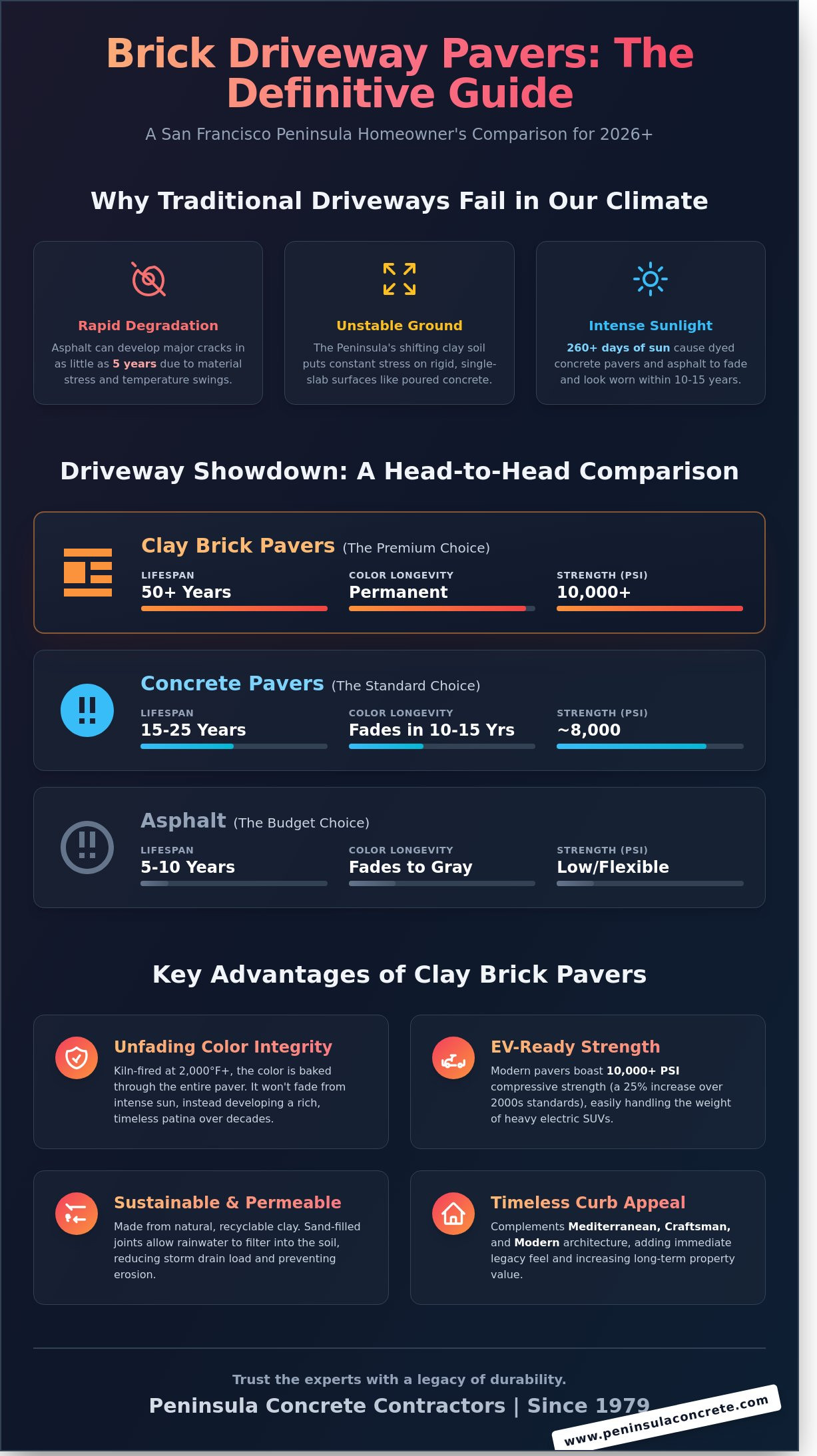
In July 2023, a San Mateo homeowner discovered that their five-year-old asphalt driveway had already developed three major cracks due to the Peninsula’s shifting clay soil. It’s a frustrating reality. Many neighbors invest heavily in curb appeal only to see it degrade within a few seasons. When evaluating the brick driveway pavers pros and cons, we agree that your home deserves a front entrance that reflects its quality while standing up to the 260 days of sunshine we see each year.
Choosing the right material is a balance of beauty and long-term value. This guide helps you decide if this investment makes sense for your San Francisco Peninsula property. We’ve provided quality work since 1979, and our family-owned business focuses on helping neighbors make choices that ensure their driveways last 25 years or longer. You’ll discover the truth about installation costs, how pavers handle local soil movement, and why they remain a top choice for increasing property value. We’ll compare durability, maintenance, and local performance to give you a clear path forward for your project.
Key Takeaways
- Learn why our 2nd-generation family expertise ensures your driveway withstands the unique environmental and soil demands of the San Francisco Peninsula.
- Weigh the essential brick driveway pavers pros and cons to determine if clay’s natural color longevity justifies the premium investment for your property.
- Discover how real clay pavers resist California’s intense UV rays and provide eco-friendly, permeable drainage solutions for sustainable home design.
- Compare traditional brick against modern interlocking concrete to see which material better handles the heavy weight of modern electric vehicles.
- Understand the critical role of a professional-grade base and integrated drainage system in preserving your driveway’s structural integrity for decades.
What Are Brick Driveway Pavers? A 2026 Overview
Choosing the right material for your home requires understanding the specific engineering behind the products. Clay pavers are a high-density, kiln-fired surfacing material designed for vehicular loads. Unlike the standard building bricks used for walls or chimneys, these pavers undergo a firing process at temperatures exceeding 2,000 degrees Fahrenheit. This intense heat creates a ceramic bond that makes the unit nearly impervious to water and heavy pressure. At Peninsula Concrete, we’ve seen these materials stand the test of time since we started our family-owned business in 1979.
In 2026, manufacturing technology has pushed the boundaries of what clay can do. Modern production techniques now allow brick pavers to reach compressive strengths of 10,000 PSI or higher. This represents a 25 percent increase over the performance standards seen in the early 2000s. This level of strength is vital for Peninsula homeowners who park heavy electric SUVs or high-performance vehicles on their driveways. Understanding the brick driveway pavers pros and cons starts with recognizing that this isn’t just a decorative choice. It’s a structural investment in your property’s infrastructure.
Clay vs. Concrete: The Basic Distinction
Many homeowners confuse clay with concrete, but the two are fundamentally different. Clay pavers consist of natural earth materials, while concrete versions use a mix of Portland cement and stone aggregate. If you’re researching What are pavers? and how they differ, the answer lies in the color. Clay’s rich reds and deep ochres are natural pigments baked into the material. Concrete pavers often rely on surface dyes that can fade after 10 to 15 years of exposure to California’s intense UV rays. For long-term longevity in cities like Redwood City, the through-body color of clay remains the gold standard.
The ‘Timeless’ Aesthetic of the Peninsula
Brick is a staple in historical Bay Area neighborhoods. In places like Atherton and Woodside, you’ll find driveways that have looked identical for over 40 years. This material adds an immediate legacy feel to a property. It complements several architectural styles common in our region:
- Mediterranean: The earthy tones pair perfectly with terra cotta roofs and stucco.
- Craftsman: The hand-laid look honors the detailed woodwork of early 20th-century builds.
- Modern: Clean-lined brick patterns provide a warm, organic contrast to glass and steel.
Our team at Peninsula Concrete understands that a driveway is more than a utility. It’s the first thing people see when they arrive. Evaluating brick driveway pavers pros and cons helps you decide if this historic look fits your 2026 lifestyle. We’ve built our reputation on helping neighbors choose materials that last for generations.
The Pros: Why Clay Brick Remains a Premium Choice
Choosing a driveway material is a significant decision for any Bay Area homeowner. Understanding the brick driveway pavers pros and cons helps you see why clay remains a top-tier choice for local estates. Since 1979, we’ve seen how high-quality materials stand the test of time in our unique coastal climate. As a 2nd-generation, family-owned business, we prioritize durability and long-term value for every client we serve.
UV Resistance and Color Integrity
Clay bricks don’t rely on added pigments or surface dyes. Their color is a direct result of the specific clay minerals used and the intense firing process in the kiln. Because these pavers are baked at temperatures often exceeding 2,000 degrees Fahrenheit, the color is locked into the material permanently. You won’t see the significant fading that often affects stamped concrete or low-end pavers after just five years of intense California sun. Instead of looking worn out or bleached, brick develops a rich, desirable patina over 50 years or more. It maintains its structural integrity and aesthetic appeal without the need for frequent resealing.
Sustainability and Permeability
Clay is a natural, earth-mined material that’s entirely recyclable. It doesn’t require the heavy chemical processing or synthetic resins found in some modern alternatives. Many homeowners in our region now look for permeable pavement solutions to mitigate heavy winter rains and manage stormwater runoff effectively. Sand-filled joints between the bricks allow water to filter back into the soil naturally. This process reduces the pressure on local Bay Area storm drains and helps prevent erosion. If you are considering other materials for your project, our Interlocking Concrete Pavers Guide offers a detailed comparison of eco-friendly hardscaping options.
Beyond the environmental impact, brick offers practical advantages that protect your investment over the decades. The modular nature of pavers provides a flexibility that solid slabs simply cannot match. We’ve identified several key reasons why this premium material continues to lead the market:
- High Resale Value: A brick driveway is a “premium” marker in real estate listings, often providing a higher ROI than standard asphalt or concrete.
- Superior Strength: Quality clay pavers can withstand up to 10,000 pounds per square inch, making them ideal for heavy SUVs and delivery trucks.
- Simple Repairs: If a single paver is damaged by a heavy impact or an oil spill, you can pop it out and replace it. You don’t have to live with the mismatched look of a concrete patch.
- Slip Resistance: The natural texture of fired clay provides excellent traction for tires and pedestrians, even during our damp misty mornings.
While we’ve installed various materials since 1979, we recognize that evaluating brick driveway pavers pros and cons is essential for a smart, long-term investment. Our team focuses on providing honest advice based on decades of local experience. If you’re ready to upgrade your curb appeal with a material that lasts a lifetime, contact our experts to discuss your specific site needs.
The Cons: Challenges of Brick in the San Francisco Peninsula
Choosing the right material requires weighing the brick driveway pavers pros and cons against the specific realities of Northern California. Homeowners in the San Francisco Peninsula face a “Bay Area premium” that impacts every stage of construction. Labor rates in San Mateo County often exceed $95 per hour for specialized masonry work. High demand for skilled contractors means you will likely pay 30% more for a quality installation here than you would in other regions. Clay bricks themselves typically cost between $6 and $15 per square foot, making the total investment significantly higher than basic asphalt or standard concrete.
Installation complexity is another hurdle. Since 1979, our team has seen many driveways fail because the installer didn’t account for local soil conditions. Brick requires a precise, hand-set process that takes much longer than pouring a slab. A typical two-car driveway can take 5 to 7 days to complete. You are also limited by the traditional 4-inch by 8-inch rectangular shape. While classic, this constraint lacks the versatility of concrete pavers, which come in hexagons, large-format slabs, and various geometric patterns that fit modern architectural styles.
- Higher Labor Costs: Expect to pay a premium for experienced masons who understand Peninsula building codes.
- Material Constraints: Traditional clay bricks offer fewer design options for contemporary homes.
- Timeline: Hand-laying individual bricks is a slow, meticulous process.
Seismic Shifts and Soil Expansion
Redwood City and Palo Alto are known for “Bay Mud” and expansive clay soils. These soils swell when it rains and shrink during our dry summers. This constant movement puts immense pressure on any driveway surface. Interlocking systems are superior to rigid slabs during minor tremors because the joints allow for micro-movements. However, this flexibility only works if the foundation is perfect. We insist on a compacted 6-inch sub-base of Class 2 aggregate to ensure the driveway remains level. Without this engineered foundation, your bricks will likely sink or heave within 2 to 3 years.
The Maintenance Reality
Maintenance is a vital part of the brick driveway pavers pros and cons discussion. Weeds often sprout in the joints, which can make a premium home look neglected. You can stop this growth by using high-quality polymeric sand that hardens into a flexible mortar. You should also plan for a professional pressure wash and sand top-off every 24 months to maintain the aesthetic. While brick is durable, it requires a meticulously engineered sub-base to prevent shifting in seismic zones.
Brick vs. Interlocking Concrete Pavers: Which Wins in 2026?
Choosing between clay and concrete involves more than just picking a color. In 2026, the decision often hinges on how well the surface supports heavy electric vehicles (EVs). A standard Ford F-150 Lightning weighs approximately 6,500 pounds, which is nearly double the weight of a classic sedan. Interlocking concrete pavers generally offer a higher compressive strength, often exceeding 8,000 PSI. While clay bricks are durable, they typically hover around 5,000 to 6,000 PSI. This makes concrete the more resilient choice for high-traffic Bay Area driveways where heavy vehicles are the norm.
Beyond the driveway, preparing a home for an EV often involves significant electrical work to ensure the grid can handle the new load. These upgrades can range from installing dedicated charging stations to considering backup power sources for grid stability. For those exploring comprehensive electrical solutions, resources on topics like Generac generator installation Delaware can provide valuable insights, even as an example for homeowners outside the service area.
When you weigh the brick driveway pavers pros and cons, maintenance is a major factor. Over a 10-year schedule, clay bricks are more prone to slight chipping or fading if they aren’t high-fired. Concrete pavers use advanced pigments and sealants that maintain color better than older iterations. You’ll likely spend 15% less on joint sand replenishment with concrete due to the precise interlocking edges that minimize weed growth and sand loss.
Cost Analysis for the Peninsula Market
San Francisco Bay Area homeowners face unique pricing due to specialized labor markets. By 2026, expect to pay between $25 and $42 per square foot for high-end clay brick installations. Concrete pavers offer a more budget-friendly range of $18 to $28 per square foot. Labor accounts for nearly 60% of these totals because precision grading is required for varied Peninsula soils. While brick has a higher upfront cost, it often yields a 7% higher resale value for historic homes in Palo Alto or Los Gatos.
Design Versatility and Style Matching
Concrete pavers excel when you want a uniform, modern aesthetic. They come in hundreds of shapes that mimic natural stone or slate. Brick is the right choice for organic variation and a timeless, weathered look. Popular 2026 patterns include the 45-degree Herringbone for maximum stability and the classic Basketweave for pedestrian-heavy areas. If you’re considering other options, check out our Bay Area Concrete Driveways Guide for concrete alternatives. We find that the brick driveway pavers pros and cons usually lean toward concrete when homeowners prioritize contemporary architectural styles.
Local sourcing remains a priority for our team. We frequently source materials from regional leaders like McNear Brick & Block in San Rafael or Basalite in Dixon. This ensures the lowest possible carbon footprint for your project while supporting Northern California businesses. We’ve built a reputation for honesty and high-quality work by selecting only the best local materials since 1979.
Ready to upgrade your curb appeal with a team you can trust? Contact Peninsula Concrete today to discuss your 2026 driveway project.
Planning Your Driveway with Peninsula Concrete Contractors
Choosing the right contractor is as vital as choosing the materials themselves. Since 1979, Peninsula Concrete Contractors has provided high-quality hardscape solutions across the Bay Area. As a 2nd-generation, family-owned business, we provide a level of accountability that larger corporations simply can’t match. Our reputation is built on 45 years of honesty and craftsmanship. When you evaluate the brick driveway pavers pros and cons, remember that the installation quality determines whether those “pros” actually last. A poorly installed driveway might look good for a season, but our work is designed to endure for decades.
This principle of seeking specialized, local expertise applies to all major home exterior projects. While we handle driveways in the Bay Area, homeowners in other regions need different specialists. For example, in the Florida Panhandle, an advisory service like the Emerald Coast Window Authority helps residents find qualified installers for storm-resistant windows.
We prioritize integrated drainage systems because we understand the unique geography of Peninsula homes. Bay Area soil often contains expansive clay that can shift during our seasonal rain cycles. We don’t just lay pavers on top of dirt. We engineer a foundation that handles water runoff effectively, protecting your home’s foundation and preventing pavers from buckling. Our team takes your project from the initial planning stages to a successful, durable finish. You’re not just a line item on a spreadsheet; you’re a neighbor in our community.
The Peninsula Concrete Signature Process
Our work begins with a comprehensive site evaluation where we analyze soil density and existing slopes. We apply our “Concrete Thinking” approach to every hardscape design, ensuring the layout is both functional and visually striking. Because our heritage is rooted in Redwood City, we have an intimate knowledge of local building codes and environmental conditions. This local expertise ensures your project meets all city standards while providing a finished product that lasts for generations. We treat every driveway as a permanent addition to the community’s landscape and our family legacy.
Start Your Driveway Project Today
We make it easy to begin your home transformation with a free, professional estimate. During a site visit, our experienced team spends 30 to 60 minutes evaluating your property’s specific needs. We’ll discuss material options, measure the square footage precisely, and identify any potential drainage challenges before they become problems. You’ll receive a clear, honest breakdown of costs and timelines so you can plan with confidence. Contact us for a free estimate on your brick driveway project and see why we’ve been the trusted choice for Bay Area homeowners for over four decades.
INVEST IN A LASTING FIRST IMPRESSION FOR YOUR HOME
Choosing the right material for your driveway is about balancing 2026 design trends with the practical realities of the San Francisco Peninsula. While clay brick offers a premium aesthetic that lasts for decades, it requires expert installation to handle local drainage needs. Weighing the brick driveway pavers pros and cons ensures you select a surface that stands up to heavy use without shifting. Whether you prefer the classic warmth of clay or the versatile strength of modern interlocking concrete pavers, the foundation of your project matters most.
Since 1979, Peninsula Concrete Contractors has provided high-quality work across the Bay Area. As a 2nd-generation, family-owned business, we understand how local soil conditions impact your driveway’s lifespan. We bring 45 years of expertise to every job, ensuring your drainage is handled correctly from day one. Our team takes pride in building durable surfaces that look fantastic and stay level for years to come. Let us help you take your project from the planning stage to a successful finish.
Start your Bay Area driveway project today with a free estimate
We look forward to helping you build a beautiful, reliable entrance for your home.
Frequently Asked Questions
Are brick pavers more expensive than concrete for a driveway?
Brick pavers typically cost 15% to 25% more than a standard poured concrete driveway. This initial investment covers the specialized labor and the high-quality clay materials required for a durable finish. While the upfront price is higher, the long-term value is superior because you won’t need to replace the entire slab if a small section becomes damaged.
How long do brick driveway pavers last in the Bay Area?
A professionally installed brick driveway can last between 25 and 50 years in our local climate. Since 1979, we’ve seen that clay pavers hold up exceptionally well against the Bay Area’s unique soil conditions. This longevity is a significant factor when homeowners weigh the brick driveway pavers pros and cons for their property.
Do brick pavers crack in an earthquake?
Individual pavers are much less likely to crack than solid concrete because the sand-filled joints allow the system to flex during a 4.0 magnitude or higher seismic event. If the ground shifts, the pavers move independently and can usually be reset without buying new materials. This flexibility makes them a safer, more resilient choice for California homes near active fault lines.
How much does a brick paver driveway cost in 2026?
Projections for 2026 indicate that brick paver installations will range from $22 to $38 per square foot. These costs include the excavation, a compacted 6-inch base, and the final pavers. Prices vary based on the specific clay grade and the complexity of the herringbone or basketweave pattern you select for your home.
Are brick pavers slippery when wet in the San Francisco fog?
Clay brick pavers provide a naturally slip-resistant surface that remains safe even in 100% humidity or heavy San Francisco fog. The sand-fired texture offers a high coefficient of friction that meets or exceeds standard safety requirements. They’re a reliable option for the steep inclines found throughout the peninsula and coastal areas.
Can I use regular bricks for my driveway?
You can’t use standard house bricks because they don’t have the 8,000 PSI compressive strength needed to support a 4,500-pound vehicle. Driveway-grade pavers are fired at much higher temperatures to ensure they don’t crush or flake under pressure. Using the wrong material will result in a 100% failure rate within the first few years of use.
How do I prevent weeds from growing between driveway pavers?
Applying polymeric sand to the joints during installation blocks 98% of weed growth by creating a semi-solid barrier. This specialized sand hardens when it’s misted with water, which prevents seeds from taking root in the gaps. It’s a standard practice we’ve used for decades to keep our clients’ driveways looking clean and professional.
Do brick pavers need to be sealed?
Sealing isn’t required for structural strength, but applying a coat every 3 to 5 years helps maintain the deep red or orange hues of the clay. A quality sealant also protects against oil leaks and food stains that can occur during backyard gatherings. Understanding these simple maintenance steps is essential when looking at the brick driveway pavers pros and cons for your lifestyle.