
A $15,000 quote for a stamped concrete patio in the Midwest might build a backyard palace, but on the San Francisco Peninsula, that same budget often barely covers the mobilization costs and specialized labor required for a premium finish. Understanding the stamped concrete patio cost Bay Area homeowners actually face in 2026 requires looking past generic national averages to account for our unique local economy. It is frustrating when three different contractors provide quotes that vary by $8,000 or more for the same square footage. You are likely worried about whether a lower price means cut corners on the steel reinforcement needed for our seismic zones or the proper subgrade prep for our expansive clay soils.
Since 1979, our 2nd-generation family-owned business has built a reputation for honesty and high quality work. We want to ensure you have a realistic, transparent breakdown of pricing to plan your next project with confidence. This guide details current material rates, labor factors, and the specific engineering requirements that ensure your durable, high end patio increases your home value without the fear of hidden change orders.
Key Takeaways
- Get a realistic breakdown of 2026 pricing tiers for the Peninsula, ranging from $18 to over $30 per square foot based on design complexity.
- Discover how site-specific challenges like San Carlos hillsides or narrow Menlo Park access can impact your total stamped concrete patio cost Bay Area quote.
- Evaluate the long-term maintenance and investment benefits of stamped concrete versus interlocking pavers to make an informed choice for your home.
- Learn why “Concrete Thinking” starts with essential site preparation, including drainage and professional demolition, to ensure a durable finish.
- Use our contractor verification checklist to avoid common pitfalls and find an experienced, licensed team that prioritizes quality and reliability.
The Reality of Stamped Concrete Patio Costs in the Bay Area (2026)
National cost estimators often fail to reflect the economic reality of the San Francisco Peninsula. While a generic home improvement site might suggest a price of $12 per square foot, that figure doesn’t account for the unique pressures of our local market. In 2026, the stamped concrete patio cost Bay Area homeowners encounter is shaped by high labor demand, strict environmental regulations, and significant fuel surcharges for material delivery. We’ve provided quality work since 1979, and we’ve seen how regional factors like the 5.2% increase in raw material transport costs over the last year directly impact project bids.
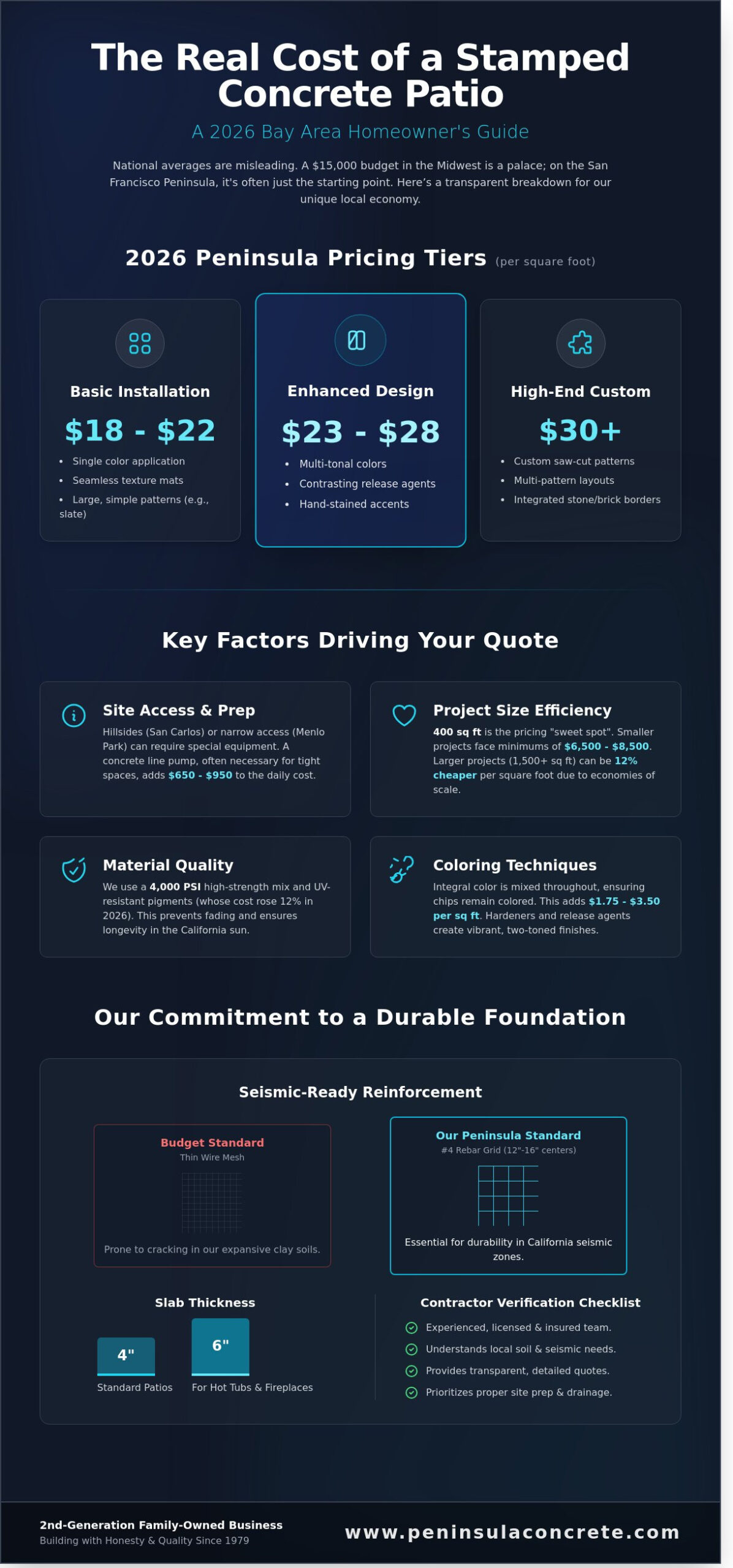
Choosing a contractor based on the lowest initial pour price often leads to heartbreak. Cheap concrete lacks the reinforcement and proper mix design required to survive the Bay Area’s soil shifts. Our pricing reflects a commitment to longevity. We use 2nd-generation expertise to ensure your patio doesn’t just look good on day one, but remains structural and vibrant for decades. For 2026, you should budget within these three primary price brackets:
- Basic Installations: $18 to $22 per square foot.
- Enhanced Designs: $23 to $28 per square foot.
- High-End Custom Work: $30+ per square foot.
The Three Tiers of Stamped Design
Design complexity is the biggest variable in your stamped concrete patio cost Bay Area estimate. Basic tiers focus on single-color applications using seamless texture mats or large slate patterns. Enhanced designs move into “multi-tonal” territory, utilizing integral colors combined with contrasting release agents and hand-stained accents. The high-end tier is for homeowners seeking a true masonry look. This includes custom saw-cut patterns, multi-pattern layouts, and integrated stone or brick borders that require days of meticulous detail work.
Square Footage vs. Project Minimums
Project size significantly impacts contractor efficiency. A 400 square foot patio is currently the “sweet spot” for pricing. At this size, the cost of moving heavy equipment and specialized stamping tools is spread across enough area to keep the per-square-foot rate reasonable. For smaller urban lots in Redwood City or San Carlos, be aware of project minimums. Most reputable contractors now set a minimum project fee between $6,500 and $8,500 to cover mobilization and overhead. However, larger projects offer an economy of scale. A 1,500 square foot pool deck typically costs 12% less per square foot than a 500 square foot backyard patio because the crew can maximize the volume of a single concrete truck delivery.
Breaking Down the Price: Factors That Drive Your Bay Area Quote
Estimating your stamped concrete patio cost Bay Area requires looking beyond a simple per-square-foot number. Site logistics play a massive role in the final tally. In Menlo Park, narrow side-yards often prevent truck access, which forces us to use a line pump. This equipment rental typically adds $650 to $950 to the daily labor bill. San Carlos hillsides present similar challenges where grade shifts require extra excavation and retaining work before the first yard of concrete arrives.
Material quality is another variable that dictates your investment. We utilize a 4,000 PSI high-strength mix as our baseline to ensure longevity. In 2026, the price for specialized UV-resistant pigments has risen by 12 percent, but these are necessary to prevent the California sun from fading your patio. Our reinforcement standards are also more rigorous than industry averages. While budget contractors might use thin wire mesh, our 2nd-generation family-owned team installs #4 rebar on 12-inch or 16-inch centers. This heavy-duty schedule is essential for California seismic zones. We typically pour a 4-inch slab for standard lounging areas, but we increase this to 6 inches for patios designed to support heavy hot tubs or stone outdoor fireplaces.
Coloring Techniques and Their Costs
We offer three primary ways to achieve your desired look. Integral color mixes the pigment through the entire batch, which ensures the color stays even if the surface chips. This adds roughly $1.75 to $3.50 per square foot. Color hardeners are dusted on top to create a denser, more vibrant surface that resists wear. Finally, release agents provide the antique, two-toned finish that mimics natural slate or cobblestone. Combining these methods creates the depth and realism seen in our most successful projects.
Labor and Craftsmanship Premiums
The stamping process is a high-stakes race against the clock. Once the concrete reaches the right consistency, a crew of 5 skilled finishers must work in unison to apply patterns. There are no do-overs once the surface hardens. We spend extra hours on hand-tooling edges and detailing joints to remove the small imperfections left by the stamps. Post-pour care is just as vital. We return after the initial cure to power wash the surface and apply a high-solids solvent-based sealer. You can view our portfolio to see how this meticulous attention to detail transforms a standard pour into a lasting architectural feature.
Stamped Concrete vs. Pavers: Which Investment Wins for Peninsula Homes?
Choosing between a solid slab and interlocking concrete pavers is a pivotal decision for any San Francisco Peninsula landscape. Both materials offer durability, but they serve different functional and financial goals. In our experience serving local homeowners since 1979, we’ve found that stamped concrete provides a more seamless, architectural finish that many modern Bay Area designs require. While pavers are flexible, the stamped concrete patio cost Bay Area residents pay is typically 30% to 50% lower than high-end paver installations, which often reach $40 per square foot.
Maintenance realities also differ between the two. Paver systems rely on sand-filled joints that eventually invite weed growth and ant hills, requiring consistent power washing and sand replenishment. Stamped concrete eliminates these “living joints.” Aside from a quick wash and a fresh coat of sealer every few years, the surface remains uniform and weed-free. For busy professionals in Palo Alto or San Mateo, this reduction in weekend chores is a significant selling point.
Seismic performance is a unique concern for our region. While pavers can shift individually during ground movement, a professionally reinforced concrete slab is designed with strategic control joints. These joints act as intentional “weak points” that guide where the concrete cracks, ensuring the structural integrity of the patio remains intact even when the ground moves. This engineering approach has allowed our installations to withstand decades of local geological activity.
Long-Term ROI Analysis
A professionally installed stamped slab offers a life expectancy of 25 years or more. The cost of ownership is predictable, consisting mainly of resealing every 3 to 5 years to maintain the UV resistance and moisture barrier. When you compare this to natural stone or brick masonry, which can cost $50 per square foot or more, stamped concrete provides a 60% savings on initial capital. This makes it an efficient way to increase property value without over-capitalizing on the hardscape. Peninsula buyers consistently reward clean, low-maintenance outdoor spaces that look expensive but don’t require a full-time gardener to maintain.
Aesthetics and Customization
Homeowners can achieve the premium look of Ashlar Slate or Flagstone without the heavy price tag of quarried stone. Stamped concrete offers superior “flow” for contemporary architectural styles, allowing for curved edges and custom borders that are difficult to execute with rigid pavers. It’s also the best way to complement existing Bay Area concrete driveways, creating a unified aesthetic from the front curb to the backyard pool deck. We use specialized color hardeners and release agents to mimic the natural variegation of stone, ensuring your patio looks like a bespoke masonry project rather than a standard utility slab.
Beyond the Slab: Site Preparation, Drainage, and Permitting Costs
At Peninsula Concrete, our “Concrete Thinking” philosophy dictates that the most critical part of your project is the part you never see. A beautiful finish cannot hide a poor foundation. If your backyard currently has a cracked slab or old asphalt, demolition and hauling fees typically range from $3 to $7 per square foot. These early labor costs are a significant factor in the total stamped concrete patio cost Bay Area residents must budget for before the first yard of new concrete is poured. We take care of the heavy lifting, ensuring the site is cleared down to the virgin soil before we begin the buildup.
Native Bay Area clay soils are notorious for high expansion rates. Without proper preparation, your investment will crack during the first major heatwave or rain cycle. We excavate and replace soft soil with 4 to 6 inches of compacted Class 2 road base. This stable sub-base is what allows us to stand behind our work as a 2nd-generation, family-owned business. We’ve provided quality work since 1979, and we know that cutting corners on the sub-base is the fastest way to ruin a premium finish.
Managing Water in the Peninsula
Proper grading is the difference between a dry home and a flooded crawlspace. We engineer every patio with a minimum 2% slope, which equals a 1/4-inch drop for every foot of length, to direct runoff away from your foundation. Sometimes, gravity isn’t enough for the heavy winter rains we see in Northern California. Integrating a professional drainage system installation is a smart move for properties with poor natural runoff. We install surface drains or French drains to capture water before it pools. The cost of ignoring drainage is high; skipping a $2,000 drain system often results in $15,000 in foundation repairs after a single wet season.
Permits and Local Regulations
Navigating the building departments in Redwood City or Palo Alto requires local expertise. These cities often have strict limits on impermeable surfaces to prevent urban flooding. If your project exceeds 50% of your lot’s total coverage, you might need pervious concrete options or specialized runoff plans to meet city code. For sloped yards, you may need to hire retaining wall contractors to create a level building site. These structural additions and permit fees are vital components of the stamped concrete patio cost Bay Area homeowners encounter during the planning phase. We handle the technical details so your project stays compliant with local 2026 standards.
Choosing a Bay Area Contractor: Why Experience Since 1979 Matters
The Bay Area construction market is notoriously volatile. New contractors appear every spring, often offering the lowest bid to win work quickly. This “Chuck in a truck” pricing model is a dangerous trap for homeowners. A low-ball estimate usually means the contractor is cutting corners on subgrade preparation or lacks proper insurance. When calculating the total stamped concrete patio cost Bay Area residents should look beyond the initial quote. If a patio fails due to poor structural integrity, the real cost doubles because you will pay for demolition and a complete re-pour within five years.
Don’t settle for verbal promises. Always verify a contractor’s California State License Board status and ensure they carry active workers’ compensation. Without this coverage, you are personally liable for any on-site injuries. Peninsula Concrete has maintained an impeccable record for over 45 years. As a local, 2nd-generation, family-owned business, our reputation is our most valuable asset. We have seen over 200 local competitors disappear since 1979, leaving homeowners with no warranty support or recourse for failed work.
Questions to Ask Your Concrete Estimator
Ask for technical specifics to separate true craftsmen from amateurs. A quality installer should use at least 3,000 to 4,000 PSI concrete for residential patios to ensure long-term durability. Inquire about rebar spacing; we typically install #3 rebar on 18-inch centers to prevent shifting. Ask how they handle expansion joints within stamped patterns. These must be strategically placed to prevent random cracking without ruining the visual flow. Finally, ask to see a local project completed at least five years ago. This proves their work stands up to Northern California’s unique soil movement over time.
The Peninsula Concrete Guarantee
Our team lives by the motto “Quality Work Since 1979.” We provide transparent quoting that accounts for the specific geography of the Peninsula and South Bay. We don’t surprise you with hidden fees for “difficult” soil or tight access issues halfway through the project. We manage every detail from the initial site excavation to the final high-grade seal. Our goal is a patio that looks as vibrant in 2045 as it does on the day we finish the pour. Get a Free Estimate for Your Bay Area Project to start your backyard transformation with a team that has a proven heritage of excellence.
INVEST IN YOUR BAY AREA OUTDOOR LIVING SPACE
Investing in your home is a major decision that requires clear, reliable information. Your stamped concrete patio cost Bay Area reflects more than just the square footage of the project. It accounts for the 2026 market rates for specialized labor, the complexity of your site drainage, and the specific finish you select for your Peninsula home. We’ve seen design trends evolve over the decades, but the value of a professionally engineered outdoor space remains constant. Since 1979, Peninsula Concrete has provided homeowners with durable solutions that withstand the unique soil conditions of our region. As a 2nd-generation, family-owned business rooted in our Redwood City heritage, we prioritize honesty and high-quality work. You don’t have to navigate the permitting or planning process alone. Let our team take your project from the initial concept to a successful completion. We’re ready to help you build a functional, beautiful patio that your family will enjoy for years to come. Start your patio project today with a professional quote from a team you can trust.
Frequently Asked Questions
How much does a 500 sq ft stamped concrete patio cost in the Bay Area?
A 500 square foot stamped concrete patio cost in the Bay Area typically ranges from $9,500 to $14,500 in 2026. This price includes professional excavation, a compacted sub-base, and high-quality 4000 PSI concrete. Complex patterns or multiple color accents can increase the total to $18,000. We’ve provided these transparent, competitive estimates to local homeowners since 1979 to ensure project success.
Does stamped concrete crack more easily in California due to earthquakes?
Stamped concrete isn’t more prone to cracking during seismic events if the installer uses proper reinforcement and control joints. We place expansion joints every 8 to 10 feet to allow the slab to move without visible damage. In our 45 years of local experience, we’ve found that rebar-reinforced slabs withstand California’s ground movement significantly better than unreinforced alternatives.
Is stamped concrete cheaper than pavers in Redwood City?
Stamped concrete is usually 20% to 30% more affordable than high-end interlocking pavers in Redwood City. While pavers require intensive manual labor for individual placement, we pour and stamp concrete in larger, efficient sections. You’ll typically save between $6 and $9 per square foot. Our family-owned business focuses on delivering this premium look while keeping your budget on track.
How long does it take to install a stamped concrete patio from start to finish?
A standard installation requires 5 to 7 business days depending on the weather and project complexity. We spend the first 2 days on site preparation and formwork. The actual pour and stamping happen on day 3. After the concrete cures for 48 hours, we return to perform the final wash and apply a protective sealer to lock in the color.
Do I need a permit for a new concrete patio in San Mateo County?
You don’t need a permit in San Mateo County for flatwork patios that are under 500 square feet and don’t involve structural walls. However, projects exceeding this size or those that change the property’s drainage patterns require official city approval. We’ve navigated these local building codes since 1979; we can help you determine the exact requirements for your specific address.
Can I put stamped concrete over an existing cracked patio to save money?
You shouldn’t pour new concrete over an existing cracked slab because the old cracks will eventually transfer to the new surface. We recommend a full demolition and removal of the old material to create a stable foundation. While a thin overlay might save 15% on initial costs, it often fails within 24 months. We prefer doing the job right the first time.
What is the best time of year to pour concrete in the Bay Area?
The ideal window for pouring concrete in the Bay Area is between April and October when the weather is consistently dry. Temperatures between 55 and 80 degrees provide the most reliable curing conditions for a durable finish. During the winter months, we monitor 7-day satellite forecasts to ensure we have a clear 48-hour window for the concrete to set properly.
How often should I reseal my stamped concrete patio to maintain the color?
You should reseal your stamped concrete every 2 to 3 years to keep the colors vibrant and protect the surface. Patios with heavy foot traffic or constant southern sun exposure might need attention every 24 months. Using a high-solids acrylic sealer prevents the 10% to 15% color fading that can occur from UV rays. This simple maintenance step preserves your investment for decades.