
During the heavy 2024 winter storms, several Redwood City homeowners watched their sloped yards migrate toward their neighbors’ property lines. It’s a stressful experience to realize your home’s foundation depends on the stability of shifting soil. Investing in a retaining wall for hillside stabilization is more than a simple landscape upgrade; it’s a necessary shield for your property. Since 1979, our 2nd-generation family-owned team has helped neighbors navigate these high-stakes structural challenges with honest, durable engineering that stands the test of time.
You’re likely aware that securing permits in San Mateo County is a complex process that demands absolute precision. It’s a significant hurdle, but getting the details right means you won’t have to worry when the next seismic event occurs. This guide provides the expertise you need to master the engineering and design essentials required to secure your Bay Area hillside and protect your property investment. We’ll walk through local code compliance, modern drainage requirements, and how to turn a steep grade into functional yard space that adds real value to your home.
Key Takeaways
- Learn how to protect your property from the San Francisco Peninsula’s unique soil movement and the increasing threat of “Atmospheric River” events.
- Discover why a professional retaining wall for hillside stabilization is the essential defense against hydrostatic pressure, the primary cause of wall failure.
- Compare high-performance materials to find out why poured-in-place concrete remains the industry standard for durability and Bay Area aesthetics.
- Simplify the permitting process by understanding the “4-foot rule” and specific engineering requirements for hillside projects in Redwood City.
- Gain insights into combining structural engineering with luxury hardscaping to secure your hillside while elevating your home’s long-term value.
Why Hillside Stabilization is Critical for Bay Area Properties
The San Francisco Peninsula contains some of the most challenging residential terrain in the United States. In cities like Redwood City and Woodside, property lines often extend across steep grades that exceed a 35 percent slope. Since 1979, Peninsula Concrete has helped local families secure these landscapes against the region’s unique geological threats. A professional retaining wall for hillside stabilization serves as the primary defense against land movement that can threaten the very foundation of a home.
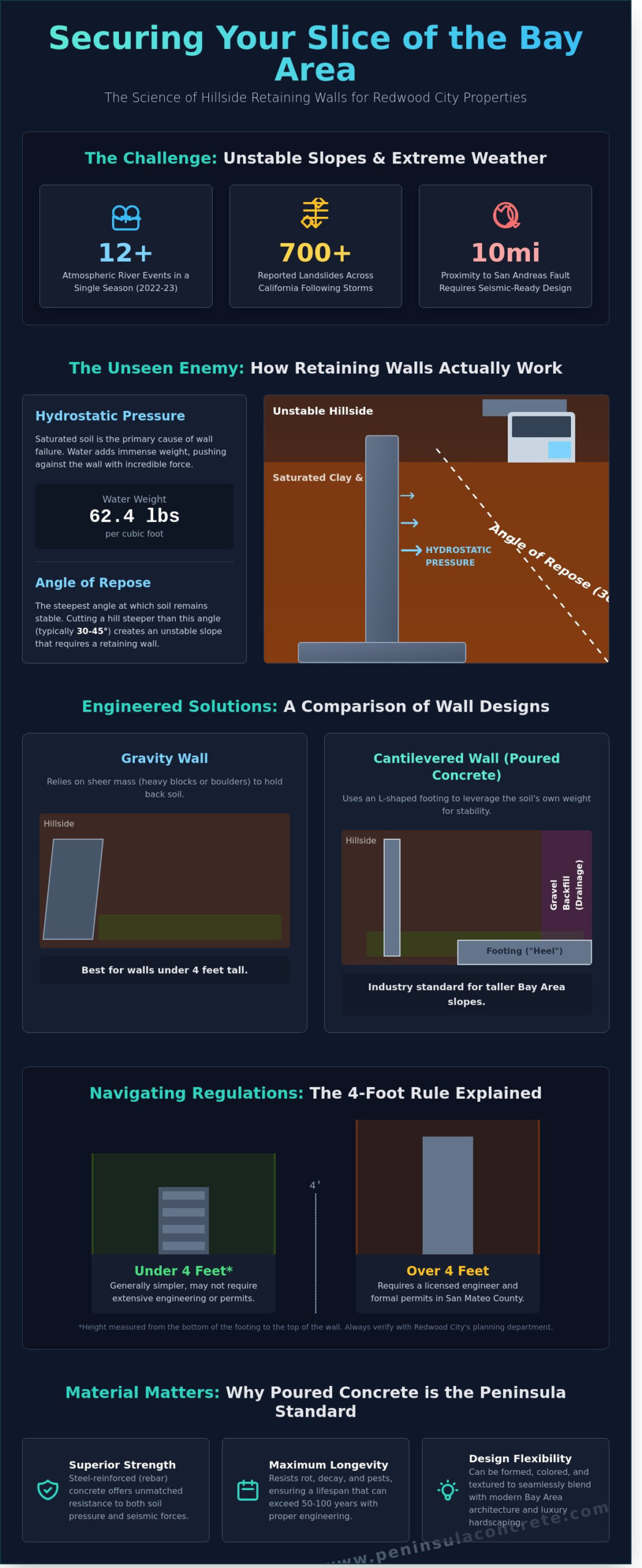
Recent weather patterns have made these structures more vital than ever. Between December 2022 and March 2023, the Bay Area experienced over 12 distinct atmospheric river events. These storms saturated the ground, leading to more than 700 reported landslides across the state. Unmanaged slopes quickly become liabilities when the soil reaches its saturation point. This isn’t just about aesthetics. Structural erosion can devalue a Woodside estate by 10 to 15 percent if the land is deemed unstable by insurers or inspectors. You must distinguish between a decorative garden wall and a structural stabilization system. One is a visual accent; the other is an engineered solution designed to hold back thousands of tons of earth.
These powerful storms don’t just threaten hillsides; they frequently cause widespread power outages, adding another layer of vulnerability for homeowners. Securing a property against these events is a comprehensive task that goes beyond structural support to include energy resilience. While based in a different region, you can learn more about Texas Engineered Solar LLC to see how integrated solar and standby generator systems provide this kind of security.
Similarly, comprehensive estate protection often requires professional personnel to mitigate risks during emergencies or high-profile events. For homeowners seeking the highest level of physical safety, Stone Security Services provides executive protection and off-duty police security to safeguard your property and family.
The Role of Peninsula Soil Composition
Our local soil is rarely consistent. Many properties sit on expansive clay that swells significantly when wet, exerting massive pressure on any buried structure. Other areas feature “Bay Mud” or fractured rock that requires specialized footings. Surface-level fixes like basic landscaping often fail during a typical Northern California winter because they don’t address the deep-seated movement of the earth. We’ve built our reputation on understanding these subterranean shifts to ensure every retaining wall for hillside stabilization we pour remains standing for decades.
Seismic Considerations for Retaining Walls
Living within 10 miles of the San Andreas Fault means every structure must be built with movement in mind. A wall that’s too stiff will simply snap during a tremor. Proper engineering accounts for the active pressure behind the wall, which increases during seismic activity. We focus on managing the lateral forces that a Bay Area quake generates. By using reinforced concrete and specific drainage patterns, we ensure your wall can withstand both the weight of the hill and the inevitable shifts of the earth. It’s the difference between a temporary fix and a 2nd-generation legacy of quality work.
The Mechanics of Hillside Stabilization: How Walls Actually Work
Building a retaining wall for hillside stabilization isn’t just about stacking blocks or pouring concrete. It’s an exercise in managing physics. The primary force we fight is hydrostatic pressure. Water weighs approximately 62.4 pounds per cubic foot. When heavy Bay Area rains saturate the soil, that weight pushes against the back of your wall with immense force. If a wall isn’t engineered to handle this pressure, it will eventually lean, crack, or collapse. At Peninsula Concrete, we’ve used “Concrete Thinking” since 1979 to ensure the engineering behind the wall is as strong as the face you see.
Every soil type has a natural “Angle of Repose.” This is the steepest angle at which soil remains stable without sliding. For most local clay and sandy soils, this angle sits between 30 and 45 degrees. When a hillside is cut steeper than this limit to create a flat yard or a driveway, the soil becomes inherently unstable. We design walls to bridge that gap. A successful wall relies on three critical components:
- The Footing: A wide concrete base buried deep enough to prevent the wall from sliding or tipping.
- The Stem Wall: The vertical section that resists the lateral pressure of the earth.
- The Backfill: Specific gravel or crushed stone placed behind the wall to allow water to move freely.
Gravity Walls vs. Cantilevered Walls
Gravity walls rely on sheer mass to do the heavy lifting. They use heavy boulders or massive interlocking blocks to pin the soil back. These are typically best for shorter walls under 4 feet. For steeper Bay Area grades, we often build cantilevered walls. These use an “L” or “T” shaped design. The weight of the soil itself sits on the wall’s “heel,” which actually helps hold the wall in place. On slopes exceeding 15 feet, we might integrate geogrid reinforcement. This high-strength mesh stabilizes the soil layers themselves, creating a reinforced soil mass that works in tandem with the concrete structure.
The use of advanced, high-strength materials like geogrid mesh is a principle shared with industrial engineering. In that field, specialized plastic extrusions and guide rails are designed to handle constant stress in heavy machinery. To see examples of these durable industrial components, you can learn more about Slideways, Inc..
The Anatomy of a Drainage System
Water is the most common reason for wall failure. Every professional retaining wall for hillside stabilization requires a dedicated drainage system to relieve pressure. We install perforated pipes at the base of the wall, wrapped in filter fabric to prevent silt from clogging the system. Weep holes are placed at regular intervals to allow trapped moisture to escape from behind the concrete. These components must integrate with your existing drainage systems to move water safely away from your home’s foundation. If you’re concerned about how your slope handles heavy runoff, you can ask our team for a site evaluation to see which drainage strategy fits your landscape.
Comparing Retaining Wall Materials for Peninsula Slopes
Selecting the right material for a retaining wall for hillside stabilization involves balancing engineering requirements with the unique aesthetic of the Peninsula. Since 1979, we’ve helped homeowners navigate these choices by focusing on long-term performance. A wall that looks great today but fails after a heavy winter is a poor investment. We evaluate every project based on the slope’s vertical rise and the lateral earth pressure it exerts. Our goal is to ensure your property remains secure for the next 50 years.
Structural Poured Concrete Walls
Poured-in-place concrete remains the industry gold standard for high-pressure stabilization. It provides a solid, monolithic barrier that handles massive loads better than any other material. This is particularly vital in the Bay Area. The USGS 2023 reports indicate a 72% probability of a major seismic event in the next 20 years, making structural resilience a top priority. While the initial labor requirements for formwork and steel reinforcement are higher, the durability is unmatched.
- Pros: Maximum structural strength, superior seismic resilience, and a clean, modern look.
- Cons: Higher initial installation costs and longer curing times.
- Customization: You can finish these structures with colored or stamped concrete to complement your home’s exterior palette.
Interlocking Paver Systems
For many Bay Area properties, interlocking concrete pavers are unsurpassed in flexibility. These segmented block walls are designed to “give” during minor earth movements. Unlike rigid structures, they allow for slight shifting during ground tremors or seasonal soil expansion without developing structural cracks. This adaptability is a significant benefit in our local climate, where soil moisture levels fluctuate significantly between dry summers and wet winters.
Modern manufacturing allows for a massive variety of aesthetics. You can choose blocks that mimic the look of hand-hewn weathered stone or select sleek, smooth textures for a contemporary finish. These systems also feature built-in drainage channels, which are essential for a successful retaining wall for hillside stabilization. They effectively manage hydrostatic pressure by allowing water to weep through the joints naturally.
Natural Stone and Masonry
Natural stone and traditional masonry are best suited for lower-height terraced garden walls. These materials offer a timeless, organic appearance that blends into the local landscape beautifully. We typically recommend stone for decorative or secondary terracing rather than primary structural support on steep hillsides. For any wall exceeding 3 feet in height, the engineering requirements usually favor the reinforced strength of concrete-based solutions. Using stone for shorter, tiered sections allows you to create a lush, multi-level garden while keeping the primary slope secure.
Permitting and Engineering: Navigating Bay Area Regulations
Building a retaining wall for hillside stabilization in the Bay Area requires more than just heavy machinery and high-quality concrete. It requires a deep understanding of local codes. In Redwood City and throughout San Mateo County, the “4-foot rule” is the standard. If your wall is 4 feet or higher, measured from the bottom of the footing to the top of the wall, a building permit is mandatory under the 2022 California Building Code. Even shorter walls require permits if they support a “surcharge,” which includes uphill driveways, swimming pools, or steep slopes that exert extra pressure on the structure.
Engineering isn’t a luxury for hillside projects; it’s a safety requirement. Most slopes in our region consist of expansive clay or unstable fill that shifts during heavy winter rains. A professional engineer calculates the lateral earth pressure to ensure the wall won’t lean or fail under the weight of saturated soil. We’ve seen many DIY walls fail because the owner didn’t account for the 1,000+ pounds of pressure per square foot that a wet hillside can generate.
The Engineering Process
The process begins with a site survey and soil analysis. Engineers look for the “angle of repose” to determine how the soil naturally sits. Next, they calculate the surcharge. If a neighbor’s garage or a public sidewalk sits above your wall, the design must be reinforced with additional steel rebar and deeper footings. Finally, the design must include a robust drainage path. Without clear discharge points, water builds up behind the wall, creating hydrostatic pressure that can snap concrete. Our team works closely with retaining wall contractors who understand these technical blueprints and translate them into a durable reality.
These core engineering principles are applied by specialists worldwide. For instance, professional groundworks companies in the UK like GCS Contractors Ltd also specialize in managing complex soil and drainage challenges, demonstrating the universal nature of these solutions for both residential and commercial projects.
Working with Redwood City and San Mateo County
Navigating the local bureaucracy is often the most stressful part of a project. You’ll deal with two main entities: the Planning Department and the Building Department. Planning reviews the wall’s location and aesthetics to ensure it meets setback requirements. The Building Department focuses on the structural integrity. To get your final sign-off, you must pass three critical inspections:
- The Footing Inspection: Conducted after the trench is dug and steel is tied, but before concrete is poured.
- The Drainage and Steel Inspection: Verifies that the perforated pipe and gravel backfill are correctly placed.
- The Final Inspection: A walkthrough to ensure the finished product matches the approved engineered drawings.
Peninsula Concrete has provided quality work since 1979. We handle the complex paperwork and coordination with city officials so you don’t have to. We’ve spent decades building a reputation for honesty and code compliance in the Peninsula. We ensure your retaining wall for hillside stabilization is legal, safe, and built to last for generations.
Ready to start your hillside project with a team you can trust? Contact our local experts today to discuss your engineering and permitting needs.
The Peninsula Concrete Approach: Quality Work Since 1979
At Peninsula Concrete, our heritage is built into the very foundations of the Bay Area. We are a 2nd-generation, family-owned business that has served this community for over 45 years. Since 1979, we have focused on a single mission: providing honest, high-quality work that stands the test of time. We don’t just pour concrete. We build for keeps. Our team understands that a retaining wall for hillside stabilization is a critical investment in your home’s safety and longevity. We combine the heavy-duty requirements of structural engineering with the refined aesthetics of high-end hardscaping.
Our deep experience with Peninsula terrain prevents the common failures seen in DIY or inexperienced builds. We know the local soil profiles, from the expansive clays of Menlo Park to the rocky inclines of San Carlos. We take your project from the initial engineering blueprints to the final decorative finish. This comprehensive approach ensures that your wall isn’t just a barrier, but a functional part of your landscape. We’ve built a reputation for reliability because we treat every backyard as if it were our own.
- Structural Integrity: We use reinforced steel and high-strength concrete mixes designed for seismic resilience.
- Local Expertise: Our history in the region means we anticipate drainage issues before they become disasters.
- End-to-End Service: We handle the heavy lifting, from permit navigation to the final aesthetic success.
Case Study: Stabilizing a Steep Redwood City Slope
A homeowner in Redwood City contacted us regarding a failing timber wall on a 30-degree incline. The old wood was rotting, and the hillside was beginning to creep toward the main structure. We designed a tiered cantilevered concrete system. This solution included an integrated drainage network to manage hydrostatic pressure during heavy winter storms. The project was a total success. Beyond securing the slope, we created 500 square feet of new usable level ground. The homeowner gained both a beautiful patio space and total peace of mind.
Start Your Hillside Project Today
Timing is everything when dealing with slope stability. Waiting until the rainy season, which typically runs from October to April in the Bay Area, can significantly increase your costs. Saturated soil is heavier, harder to move, and more prone to sudden failure. We recommend scheduling a comprehensive site evaluation during the dry months. Our team will assess your terrain, check for signs of erosion, and provide a detailed estimate for a permanent solution. Choosing a professional retaining wall for hillside stabilization now prevents expensive emergency repairs later. Ready for a permanent solution? CONTACT US to get started on your project today.
SECURE YOUR PROPERTY WITH PROVEN ENGINEERING
Protecting a Bay Area home from soil movement requires a specialized approach to drainage and structural integrity. Since 1979, Peninsula Concrete has provided the technical expertise needed to manage complex slopes and meet rigorous seismic standards. Our 2nd-generation, family-owned team understands that a retaining wall for hillside stabilization is a critical investment in your property’s safety. We focus on high-quality concrete and engineered drainage to ensure your land stays exactly where it belongs, even during heavy rain seasons.
We’ve built our reputation on honesty and reliable craftsmanship over 45 years of local service. Don’t wait for the next storm to test the stability of your hillside. Our team is ready to help you navigate the permitting process and deliver a durable solution that stands the test of time. Let’s start planning a project that brings safety and value to your home today.
Request a Free Hillside Stabilization Estimate
We look forward to helping you build a foundation for the future with confidence.
Frequently Asked Questions
How much does a retaining wall for hillside stabilization cost in the Bay Area?
Costs for a retaining wall for hillside stabilization in the Bay Area typically range from $60 to $200 per square foot depending on site accessibility and soil conditions. According to 2024 industry data from Angi, complex hillside projects often require additional engineering fees that can add 10% to 15% to the total budget. Local labor rates and the high cost of materials in Northern California drive these figures above national averages.
Do I need a permit for a 3-foot retaining wall in Redwood City?
You don’t need a building permit for a wall under 4 feet in Redwood City, provided it doesn’t support a surcharge like a driveway or a steep slope. However, the Redwood City Building Division requires a permit if the wall is located near a property line or involves specific drainage redirects. Always verify your site plan with the city’s 2024 guidelines to ensure your project remains compliant with local safety codes.
What is the longest-lasting material for a hillside retaining wall?
Reinforced poured concrete is the longest-lasting material for stabilizing a slope, often lasting 50 to 100 years with proper maintenance. This material offers superior resistance to the lateral earth pressure common in the Bay Area’s hilly terrain. Unlike timber which rots within 15 years, or dry-stack stone that can shift, concrete provides a solid, monolithic barrier. It’s the standard our family-owned business has relied on for high-quality work since 1979.
Can I build a retaining wall on a hillside myself?
Building a retaining wall on a hillside is not a recommended DIY project due to the complex engineering required to manage soil pressure. Structural failure on a slope can lead to catastrophic landslides or significant property damage. Professional installers use specific calculations for drainage and reinforcement that most homeowners can’t replicate. We’ve seen many DIY attempts fail within 2 years, leading to much higher repair costs than a professional installation.
How do I know if my existing hillside wall is failing?
Look for visible leaning, horizontal cracking, or bulging in the wall’s face. If you notice a lean of more than 5 degrees or cracks wider than 0.25 inches, the structure is likely failing. Water pooling at the base or soil eroding from behind the wall are also red flags. These signs indicate that the original retaining wall for hillside stabilization can no longer handle the weight of the saturated earth during heavy rains.
What happens if a retaining wall is built without a permit in San Mateo County?
San Mateo County can issue “Stop Work” orders and triple the standard permit fees as a penalty for unpermitted construction. If the wall doesn’t meet the 2022 California Building Code, the county may require you to demolish the structure entirely. This creates a permanent cloud on your property title. It often prevents a sale or refinancing until the violation is cleared by a certified engineer and the county inspector.
Because a clear title is essential for any transaction, homeowners should stay informed about how property conditions affect their financing eligibility. To learn more about navigating the California mortgage market, visit Integrity Estates Realty.
How does drainage affect the stabilization of a slope?
Proper drainage is the most critical factor because it prevents hydrostatic pressure from building up behind the wall. Water-logged soil can weigh up to 120 pounds per cubic foot, which is double the weight of dry soil. By installing perforated pipes and 12 inches of gravel backfill, we direct water away from the structure. This keeps the hillside stable and prevents the wall from buckling during heavy Northern California winter rains.
Will a retaining wall increase my property value in the Bay Area?
A well-constructed retaining wall can increase property value by up to 15% by creating usable flat land on a sloped lot. In the 2023 Remodeling Impact Report, landscaping projects like these showed a high return on investment for homeowners. Beyond the aesthetics, a professional wall provides peace of mind by protecting the home’s foundation. It transforms a steep, unusable hill into a functional backyard or garden space.
This newfound stability can also open the door for larger projects like home additions or accessory dwelling units (ADUs). For inspiration on how reclaimed land can be transformed, you can discover Regulus Construction and see examples of their work, even if you’re in a different region.