

Imagine hosting a dinner party where you aren’t worried about guests tripping on cracked concrete or chairs sliding down a subtle Peninsula slope. For homeowners in areas like San Mateo and Burlingame, the dream of a perfect outdoor space often hits a wall of drainage issues and seismic concerns. Mastering backyard patio design for entertaining requires more than just picking out furniture. It’s about building a foundation that stands up to the unique demands of Northern California’s terrain.
We understand that your outdoor space should be an extension of your home’s quality and heritage. Since 1979, our 2nd-generation, family-owned business has helped local residents transform difficult landscapes into functional retreats. You probably already know that a standard slab isn’t enough for the Bay Area’s shifting soil. This guide will show you how to navigate the complexities of sloped yards and material selection to create a durable, multi-zone entertaining area. We will break down the technical side of drainage and stability so you can move forward with confidence and build a space that lasts for decades.
Key Takeaways
- Learn how to transform your outdoor space into a functional extension of your home by prioritizing guest flow and avoiding common design bottlenecks.
- Master the “Three-Zone Rule” to create a balanced backyard patio design for entertaining that accommodates dining, lounging, and social focal points.
- Compare the durability and heat absorption of premium hardscape materials to ensure your patio remains comfortable and resilient under the California sun.
- Discover how to integrate high-performance features like outdoor kitchens and fire pits that are specifically tailored to the Bay Area climate.
- Understand the importance of local expertise in navigating regional building codes and permitting for a seamless, high-quality construction process.
What Makes a Backyard Patio Design Effective for Entertaining?
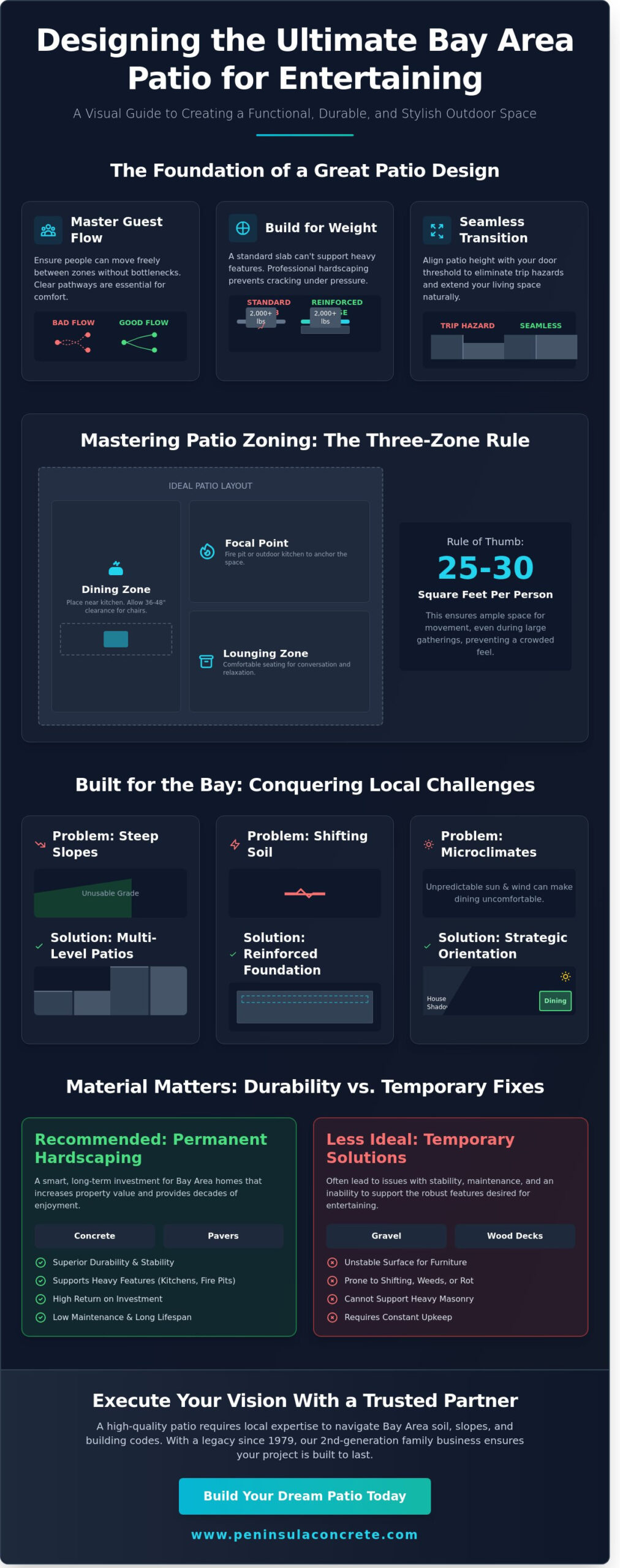
An effective backyard patio design for entertaining acts as a multi-functional extension of your indoor living room. Since 1979, Peninsula Concrete has helped homeowners transform simple yards into vibrant social hubs that feel like a natural part of the home. A successful layout focuses heavily on “Guest Flow,” which ensures people can move between the kitchen, seating areas, and fire features without hitting bottlenecks. If your guests are constantly squeezing past each other, the space fails its primary purpose. Professional hardscaping creates clear pathways and designated “rooms” that guide movement naturally.
When you research What is a Patio?, you find it’s defined as an outdoor space used for dining or recreation, typically paved. Choosing permanent hardscaping over temporary solutions like gravel or wood decks is a smart investment for Bay Area property value. High-quality concrete and pavers provide a level of permanence and stability that buyers recognize. Durability is also a technical requirement. When planning a backyard patio design for entertaining, you must account for the weight of heavy features. A standard outdoor kitchen or a custom masonry fire pit can weigh over 2,000 pounds; a professional design ensures the foundation won’t crack or sink under that pressure.
The Indoors-Outdoors Connection
Assessing Your Bay Area Space
Bay Area microclimates require specific planning for sun and wind patterns. A patio that’s perfect in San Mateo might be too windy in South San Francisco without proper orientation. We analyze where the shadows fall at 5 PM to ensure your dining area remains comfortable. Many Peninsula yards also deal with significant slopes. Instead of a single flat slab, consider multi-level patios to create distinct zones for lounging and eating. If your yard has a steep grade, you’ll benefit from Hiring Retaining Wall Contractors to carve out flat, usable areas that maximize your square footage. This structural approach turns a difficult hillside into a premium entertaining venue.
Mastering Patio Zoning: Designing for Flow and Guest Comfort
Effective backyard patio design for entertaining starts with a clear plan for movement. We use the Three-Zone Rule to organize spaces into dining, lounging, and focal point areas. This prevents your guests from feeling crowded or lost in a single, vast expanse of concrete. Since 1979, Peninsula Concrete has helped homeowners identify the best flow for their specific property lines. We typically recommend allocating 25 to 30 square feet per person based on your average guest count. This ensures that even during a large graduation party or holiday gathering, the space remains functional and comfortable.
Visual cues are just as important as physical space. You can use hardscape borders, such as a change in paver color or a decorative concrete finish, to signal where one room ends and another begins. This technique utilizes professional landscape design principles to create “outdoor rooms” without the need for restrictive walls. Additionally, you should place your cooking area where the host can remain part of the conversation. Tucking the grill too far away isolates the cook; keeping it at the edge of the dining zone keeps the party connected.
The Dining Zone: More Than Just a Table
When planning your dining area, don’t just measure the table itself. You must account for chair movement by leaving 36 to 48 inches of clearance on all sides. This allows guests to get up and move without disturbing others. We recommend positioning this zone as close to your indoor kitchen as possible to make food transport efficient. For smaller Bay Area lots where every inch counts, consider built-in concrete seating. This can increase your usable floor space by up to 15 percent because it eliminates the need for bulky, standalone chairs.
The Conversation Pit and Focal Points
The lounge area should feel like a destination. Centering your seating around a fire pit or a water feature creates a natural gathering point for guests after dinner. It’s also smart to design intimate nooks within the larger layout. These smaller spots allow groups of two or three people to have private conversations while a larger party happens around them. If your Peninsula home has a view of the bay or the coastal range, ensure your focal points don’t block the sightlines. Low-profile fire tables are often better than tall outdoor fireplaces for preserving these views. If you’re ready to start your project, our family-owned team can help you map out the perfect layout for your home.
Choosing the Right Hardscape Materials for High-Traffic Entertainment
Selecting the right surface is the foundation of any successful backyard patio design for entertaining. Your choice impacts how guests move, how your furniture sits, and how much work you’ll do over the next decade. High-traffic zones require materials that withstand the weight of heavy grills and large dining sets without cracking or shifting. When planning functional outdoor living areas, you must balance visual appeal with the practical realities of the Northern California climate. Since 1979, we’ve seen how different materials perform under the unique stresses of the Bay Area, from the intense afternoon sun to the occasional seismic tremor.
The Case for Interlocking Pavers
Interlocking pavers are unsurpassed in strength and flexibility, making them a premier choice for our local geography. Because the Bay Area is a known seismic zone, the ability for a surface to shift slightly without cracking is a major advantage. Pavers distribute weight across the entire system, easily supporting heavy cast-iron furniture or outdoor kitchens. Maintenance is straightforward; if a single stone is damaged by a dropped heavy object or stained by grease, you can replace that specific piece. This is much more efficient than trying to patch a solid slab. To learn more about these benefits, read our Interlocking Concrete Pavers Guide.
Custom Concrete and Stamped Finishes
Custom concrete offers a seamless, high-end look that mimics natural slate, granite, or flagstone at a more accessible price point. We use “Concrete Thinking” to select pigments and textures that blend your patio with the local landscape, such as the earthy tones of the Peninsula hills. While stamped concrete provides a beautiful aesthetic for your backyard patio design for entertaining, safety remains the priority. We apply broom finishes to provide essential traction for guest safety, particularly in areas where drinks might spill or near pool edges. Over a 10-year period, stamped concrete is incredibly durable, though it requires a fresh coat of sealer every 2 to 3 years to protect the color from UV fading.
Consider these factors when comparing materials for your project:
- Heat Absorption: Lighter-colored pavers and concrete can stay up to 20 percent cooler than dark materials under the California sun, protecting bare feet.
- Slip Resistance: Textured stamped concrete and the joints between pavers provide the necessary grip to prevent accidents during lively gatherings.
- Durability: Both materials handle high-traffic loads well, but pavers are less likely to show structural cracks if the ground settles over time.
- Long-term Care: Pavers may require occasional joint sand refills, while concrete requires periodic sealing to maintain its “like-new” appearance.
As a 2nd-generation, family-owned business, we focus on building surfaces that last for decades. Whether you choose the modular flexibility of pavers or the elegant continuity of stamped concrete, the goal is a reliable space where you can host friends and family without worry.
Essential Entertaining Features: Fire, Food, and Bay Area Climate
Creating a successful backyard patio design for entertaining requires more than just picking out high-end furniture. In the Bay Area, the “Peninsula Factor” means a 75-degree afternoon can drop to 60 degrees the moment the sun dips behind the Santa Cruz Mountains. To keep guests comfortable, your design must integrate heat sources and windbreaks. A built-in fire pit serves as a natural social hub, while a full masonry fireplace can act as a structural barrier against evening gusts. Pairing these with 2,700K warm-toned LED lighting ensures your space remains inviting long after dark.
Outdoor Kitchen Engineering
Drainage and Weatherproofing
The atmospheric rivers of January 2023 reminded every homeowner that water management is the most critical part of any patio. Quality Work Since 1979 means we never overlook the 1% to 2% slope required to move water away from your foundation. Without integrated drainage, heavy rains cause pooling that can undermine your hardscape and damage your landscaping. We often install hidden trench drains or permeable drainage layers to handle runoff efficiently. This technical “Concrete Thinking” ensures your backyard patio design for entertaining remains a dry, stable asset for decades, not just for one season. We focus on protecting your investment against the heaviest winter storms through precision grading and high-quality materials.
Don’t leave your outdoor project to chance; work with a team that understands local conditions. Start your project today with the experts at Peninsula Concrete.
Executing Your Vision with a Trusted Bay Area Hardscape Partner
Selecting the right contractor is the final, most critical step in realizing a high-end backyard patio design for entertaining. Homeowners often mistake a general landscaper for a hardscape construction specialist. While a landscaper excels at horticulture and softscapes, a hardscape specialist focuses on the structural engineering of your outdoor living space. This distinction is vital when your project involves heavy concrete pours, intricate paver patterns, or integrated outdoor kitchens that require precise utility connections.
Local experience is a non-negotiable asset in the Bay Area. Building codes in cities like Palo Alto or San Jose are notoriously strict regarding drainage runoff and seismic stability. We’ve provided quality work since 1979, which means we understand how to navigate local permitting offices and ensure your project meets every municipal requirement. As a 2nd-generation, family-owned business, we provide a level of personal accountability that larger corporations lack. Our heritage is built on honesty and durable results that stand the test of time.
A major patio installation follows a structured timeline to ensure longevity. You can typically expect the process to span three to six weeks depending on the complexity. This includes:
- Site Preparation: Clearing debris and establishing proper grading for drainage.
- Excavation and Sub-base: Digging to the required depth and installing compacted rock.
- Forming and Pouring: Setting the boundaries and laying the concrete or pavers.
- Curing and Finishing: Allowing the material to reach its full structural strength.
Professional Design vs. DIY
The temptation to treat a patio as a weekend DIY project often leads to costly failures. The most common pitfall is improper sub-base preparation. Without at least 4 inches of Class II baserock compacted to 95% density, a patio will shift, crack, or settle unevenly within two years. Professional installation ensures the foundation is sound. A warrantied patio from a reputable contractor offers a significant return on investment; professional hardscaping can increase a home’s value by 10% to 12% according to industry estimates. Learn more about our standards by reading Why Choose Peninsula Concrete Contractors.
Starting Your Project Today
Preparation is the key to a successful first consultation. Before meeting with a hardscape contractor, define your primary goals for your backyard patio design for entertaining. Think about how many guests you typically host and whether you need dedicated zones for cooking or lounging. Visualizing your space is easier when you have a reference point. We encourage you to browse our project gallery to see how different textures and layouts function in real Bay Area backyards.
Ready to transform your outdoor space into the neighborhood’s favorite gathering spot? Our team is standing by to bring over four decades of expertise to your home. Contact Peninsula Concrete for a free estimate on your entertaining patio and start your journey toward a beautiful, durable backyard today.
Start Building Your Dream Outdoor Gathering Space
A successful backyard patio design for entertaining relies on clear zoning and resilient materials that handle heavy foot traffic. You’ve learned how to map out flow for guest comfort and why selecting high-durability concrete or interlocking pavers is vital for our local climate. These choices transform a simple yard into a functional extension of your home.
Peninsula Concrete Contractors brings over 45 years of expertise to every project. We’ve delivered quality work since 1979, establishing ourselves as a trusted 2nd-generation, family-owned local business. Our team specializes in interlocking pavers that offer unsurpassed strength, ensuring your investment stands the test of time. We take pride in our heritage of honesty and dependable craftsmanship.
It’s time to turn your vision into a reality. We’re ready to help you create a professional outdoor space where your friends and family will gather for years to come.
Frequently Asked Questions
How much space do I need for a backyard patio for entertaining?
You need approximately 25 square feet of space per guest to create a comfortable dining and lounging area. A standard backyard patio design for entertaining 12 people should measure at least 300 square feet. This size allows for a large table, chairs, and 3 feet of clearance for walking. If you plan to add a grill station or a fire pit, add 100 square feet to ensure guests can move safely without feeling crowded.
Which is better for a Bay Area patio: pavers or concrete?
Interlocking pavers are generally better for San Francisco Peninsula homes because they handle soil movement and seismic activity without cracking. Unlike solid slabs, pavers are flexible and easy to repair if a single piece shifts over time. We’ve found that pavers provide a 25 percent better return on investment over 10 years because they require fewer structural repairs than traditional poured concrete. They also offer superior slip resistance for coastal climates.
Do I need a permit for a new patio in the San Francisco Peninsula?
You typically need a permit for any patio that exceeds 120 square feet in San Mateo County or Santa Clara County. Local building codes require professional drawings to ensure proper drainage and specific setbacks from property lines. Since 1979, we’ve helped homeowners navigate these local regulations to ensure every project meets the 2022 California Building Standards Code. Skipping this step can lead to fines and issues when you sell your home.
How long does it take to install a professional hardscape patio?
A professional hardscape installation usually takes 5 to 10 business days to complete from start to finish. This timeline includes 2 days for excavation and base preparation, followed by 3 days for laying materials and finishing. Larger projects with custom features like seat walls or outdoor kitchens can extend the timeline to 15 days. Weather conditions in the Bay Area rarely delay our team, but we always plan for a 10 percent time buffer.
What are the best low-maintenance patio materials for entertaining?
High-quality interlocking pavers and pervious concrete are the best low-maintenance options for a backyard patio design for entertaining. These materials resist staining from food spills and don’t require the annual sealing that wood decks or natural stone might need. You’ll spend about 2 hours per year on basic cleaning with a garden hose. This durability is why our 2nd-generation family-owned business has focused on these materials for over 4 decades.
Can I build an outdoor kitchen on an existing concrete patio?
You can build an outdoor kitchen on existing concrete if the slab is at least 4 inches thick and free of structural cracks. Most standard patios support 40 pounds per square foot, but heavy masonry pizza ovens require a reinforced footing for safety. We inspect the integrity of your current foundation to ensure it can handle the 500 to 1,000 pounds of a typical kitchen island. If the slab is too thin, we can reinforce specific sections.
How do I handle drainage for a large paved entertaining area?
Every large paved area must have a 2 percent slope to direct water away from your home’s foundation. We install French drains or catch basins in low spots to manage heavy rainfall during Bay Area winters. Using permeable pavers allows 100 percent of surface water to filter back into the ground naturally. This prevents puddling during parties and meets local stormwater management requirements. It’s a critical step for protecting your landscape and home.
What is the best way to light a patio for evening parties?
Use a layered approach with low-voltage LED lights to create a safe and inviting atmosphere for evening guests. Install path lights every 6 feet for safety and use 2,700K warm white bulbs to keep the mood relaxed. Adding task lighting over the grill area and accent lights in nearby trees provides depth to the space. This modern setup uses 80 percent less energy than traditional halogen systems and lasts for 50,000 hours of use.