
Imagine walking out to your patio after a heavy storm in January 2026 only to find your beautiful landscape submerged under three inches of standing water. It’s a frustrating reality for many in the Bay Area, where poor drainage can quickly turn a lush lawn into a muddy swamp and send water creeping toward your home’s foundation. At Peninsula Concrete, we’ve spent the last 47 years helping local families protect their properties. We know that solving backyard water problems requires more than just a quick fix; it demands a professional approach that addresses the unique soil and topography of our region.
You deserve a backyard that remains dry and functional throughout the entire year, not just during the summer months. This guide provides the expert insights you need to identify, manage, and permanently resolve drainage issues to safeguard your property value. We’ll explore the most effective modern techniques, from high-quality permeable pavers to strategic grading, ensuring your outdoor space stays beautiful for decades to come.
Key Takeaways
- Understand why the Bay Area’s unique “Adobe” clay soil prevents natural drainage and how to identify early warning signs before they threaten your home’s foundation.
- Learn why the French drain remains the gold standard for subsurface water management and how it integrates with professional hardscaping to protect your landscape.
- Discover the “1/4-inch per foot” grading rule, a critical professional standard for solving backyard water problems by strategically directing runoff away from your property.
- Explore “green” hardscaping solutions like permeable interlocking pavers that offer a durable, modern way to manage water while returning it safely to the earth.
- Find out how to avoid common DIY drainage pitfalls, such as incorrect pitch and clogged pipes, by leveraging over 45 years of local professional expertise.
Identifying the Root Causes of Standing Water in Bay Area Yards
Yard drainage is the strategic movement of water away from your home’s foundation and usable outdoor spaces. It isn’t just about aesthetics. It’s about protecting your property’s structural integrity. For many homeowners, solving backyard water problems is a seasonal struggle that becomes a year-round headache if left unaddressed. Since 1979, our team has seen how the unique geography of the San Francisco Peninsula creates specific challenges that require more than just a quick fix. We’ve built a reputation for honesty by helping families understand exactly why their land holds onto water.
The Bay Area Clay Factor: Why Your Soil Isn’t Draining
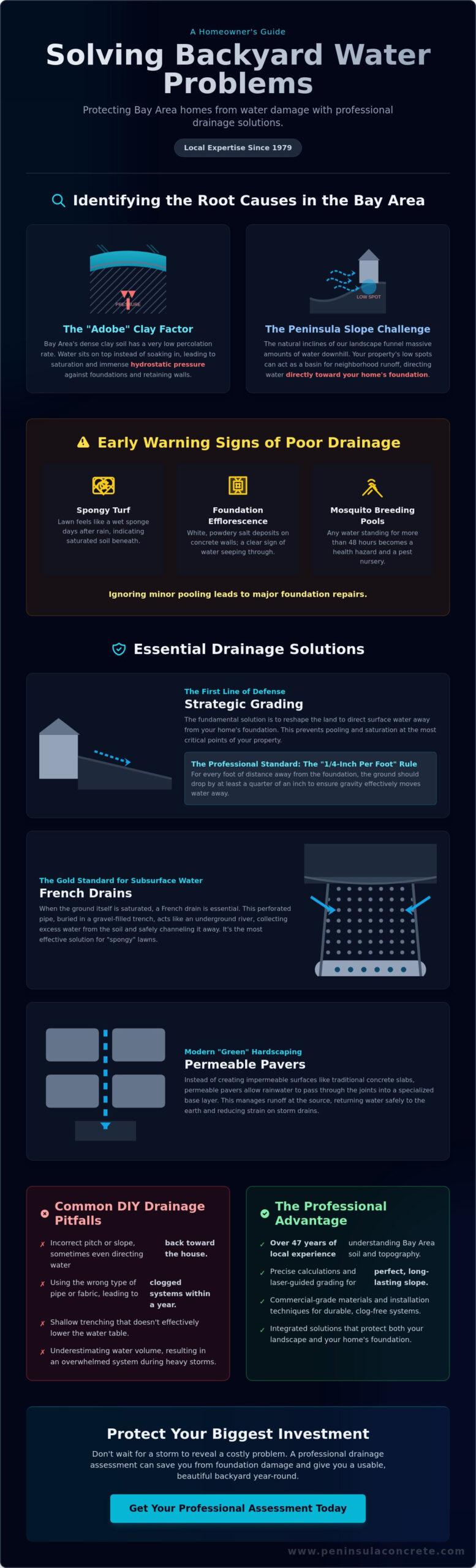
The Peninsula is famous for its “Adobe” clay soil. This material is incredibly dense and has a very low percolation rate. This means water sits on top of the soil rather than soaking into the ground. You’ll often see two distinct issues: surface runoff and subsurface saturation. When clay becomes fully saturated, it creates hydrostatic pressure. Hydrostatic pressure is the physical force exerted by stagnant water against a structure, and it’s the primary cause of cracks and failures in local retaining walls. Because the clay doesn’t breathe, the water has nowhere to go but against your concrete.
Topography and the SF Peninsula Slope Challenge
Our local landscape isn’t flat. The natural inclines of the Peninsula funnel massive amounts of water toward home foundations. These “low spots” act as natural basins for neighborhood runoff. Your yard might be dry, but if your neighbor’s property sits at a higher elevation, their water becomes your problem. Without proper storm drain systems, this volume can overwhelm even the best-maintained lawns. As a 2nd-generation, family-owned business, we’ve spent decades mapping these local runoff patterns to help homeowners redirect the flow effectively.
Identifying the trouble early saves you from the massive expenses of structural failure. Look for these common signs of a failing drainage system:
- Spongy turf: If your grass feels like a wet sponge three days after a rain, the soil is saturated.
- Foundation efflorescence: This is the white, powdery salt deposit that appears on concrete when water seeps through.
- Mosquito breeding pools: Any water standing for more than 48 hours is a health hazard.
Ignoring minor pooling now leads to costly foundation repairs in the future. Water is persistent. It will find every microscopic crack in your concrete and expand it over time. Proactive solving backyard water problems ensures your home remains a safe, dry environment for decades to come. Quality work since 1979 has taught us that a small investment in drainage today prevents a foundation disaster tomorrow.
Essential Drainage Solutions for San Francisco Peninsula Properties
The gold standard for subsurface management is the French drain. This system uses a perforated pipe buried in a trench filled with clean gravel and wrapped in filter fabric. It doesn’t just move water; it lowers the water table in your yard by giving saturated soil an easy path to exit. For roof runoff, downspout diversion is equally critical. A single inch of rain on a 2,000-square-foot roof generates over 1,200 gallons of water. We pipe this runoff directly to a dry well or the street, ensuring it stays away from your footings. Our team ensures every installation aligns with California’s stormwater regulations to maintain local environmental standards and prevent erosion.
French Drains vs. Trench Drains: Which Do You Need?
Choosing the right drain depends on where the water is coming from. French drains are subsurface tools. If your lawn feels “marshy” or “spongy” days after the rain stops, you likely have a high water table that requires a French drain. Trench drains, or channel drains, are surface-level gated systems. These are the long, narrow grates you see at the end of a driveway or a garage entry. They’re designed to catch “sheet flow” before it enters a building. We often install trench drains along low-lying walkways to keep pedestrian paths safe and dry during the wet season.
Catch Basins and Area Drains for Patios
Catch basins are the primary defense against standing water on hard surfaces like interlocking concrete pavers. These basins act as a collection point where debris can settle at the bottom while clear water exits through a side pipe. We size these basins based on the specific square footage of your patio. For a standard 500-square-foot entertaining area, a 12-inch basin is typically sufficient to handle peak flow. To keep the system working, you’ll need to clear the grates of Bay Area debris like oak leaves or eucalyptus pods every autumn. If you want to ensure your property stays dry this winter, ask our experts to evaluate your current drainage capacity.
The Role of Grading and Retaining Walls in Water Management
Solving backyard water problems starts with a fundamental understanding of gravity. In the Bay Area, where steep hillsides meet flat coastal plains, “the pitch” of your land is the single most important factor in any drainage solution. If the ground doesn’t encourage water to move, it will sit, saturate, and eventually damage your foundation. For all concrete installations, Peninsula Concrete follows the industry standard of a 1/4-inch per foot slope. This precise decline ensures that rain moves efficiently across patios and driveways rather than pooling in the center.
Effective grading is the most reliable method for solving backyard water problems before they reach your back door. When we evaluate a site, we look for a 1 percent to 2 percent minimum slope away from the home. This creates a clear path for runoff to reach the street or a designated collection point. Without this intentional design, even the most expensive drainage pipes can fail because the water has no natural momentum to enter the system.
Professional Yard Grading and Sloping
Precision matters when you’re moving earth. Our team uses laser-leveling technology to map the contours of your yard, ensuring every square inch contributes to a dry property. We focus on creating “positive grading,” where the soil or hardscape highest point sits against the house. “Negative grading” is a common issue in older Bay Area neighborhoods where the ground has settled over decades. This tilt sends water directly into crawlspaces or basements. To get the best results, it’s vital to work with experts who understand local soil expansion. You can read our guide on hiring landscape contractors to ensure your site preparation meets these critical standards.
Retaining Walls as a Drainage Defense
Retaining walls are more than just aesthetic upgrades; they’re structural barriers that manage the force of moving water. On sloped lots, we use walls to terrace the land. This breaks the momentum of downhill runoff, preventing erosion and flash flooding. This strategy aligns with Low Impact Development principles by controlling the flow and allowing for better management of peak storm events.
A wall without proper drainage is a liability. Hydrostatic pressure from saturated soil can weigh thousands of pounds, leading to “blowouts” or structural leaning. To prevent this, we install 3/4-inch crushed gravel backfill and perforated drainage pipes behind the wall. We also include “weep holes” every few feet along the base. These small openings allow trapped moisture to escape safely. For more on these structural requirements, consult our retaining wall contractors guide. Quality work since 1979 means building walls that stand the test of time and the pressure of a California winter.
Permeable Pavers and Pervious Concrete: Modern Solutions for Runoff
Traditional hardscaping creates a barrier that forces rainwater to slide off into gutters and city streets. In the Bay Area, this often leads to overwhelmed storm drains and localized flooding. Solving backyard water problems requires a shift toward green hardscaping. These modern systems allow water to return to the earth naturally, recharging the local groundwater instead of contributing to erosion. Peninsula Concrete has focused on these sustainable methods for years, ensuring your property remains dry and compliant with local standards.
Local regulations in cities like San Jose and Palo Alto have become increasingly strict. Many municipalities now limit non-permeable surface coverage to between 35% and 45% of a total lot. If you exceed these limits, you may face permit delays or required mitigation fees. Choosing permeable materials helps you stay within these legal boundaries while protecting your landscape from standing water. We’ve provided quality work since 1979, helping homeowners balance aesthetics with functional drainage requirements.
The Benefits of Permeable Interlocking Pavers
Permeable interlocking paver systems (PICP) differ from standard pavers because of their specialized installation. Instead of tight sand joints, these systems use wider joints filled with small, high-quality aggregates. These gaps allow water to flow straight through the surface into a crushed stone sub-base. This design can reduce peak runoff rates by over 90% during heavy California winter storms. It effectively turns your entire patio or walkway into a drainage tool.
Durability is a major advantage for East Bay and Peninsula homes sitting on expansive clay soil. Clay expands when wet and shrinks when dry, which often causes solid concrete slabs to crack or heave. Permeable pavers are flexible. The individual units move slightly without breaking the bond, maintaining a level surface for decades. As a 2nd-generation, family-owned business, we recommend these systems for their unsurpassed strength and long-term reliability in our unique climate.
Pervious Concrete for Eco-Friendly Driveways
Pervious concrete is a unique mix that leaves out the fine sands found in traditional batches. This creates a “popcorn” texture with a void content between 15% and 25%. This structure allows for an incredible flow rate, often draining between 3 to 8 gallons per square foot per minute. It acts as a giant filter for your property. Integrating this material into a Bay Area concrete driveway project ensures that even the heaviest downpours don’t pool near your garage or foundation.
Maintenance is straightforward but necessary to keep the system functioning at peak capacity. You must vacuum the surface once or twice a year with a specialized industrial vacuum to remove fine sediment and debris from the pores. This prevents clogging and ensures the water continues to reach the soil below. Solving backyard water problems becomes much easier when your driveway does the heavy lifting for you.
Ready to upgrade your property with high-quality, sustainable hardscaping? Contact our team for a site evaluation and see how our experience can work for you.
Professional Drainage Installation: Protecting Your Bay Area Investment
Solving backyard water problems requires more than a shovel and a free weekend. Many homeowners attempt DIY drainage only to find their yards flooded during the first major Bay Area storm. A common mistake involves using incorrect pitch. If a trench doesn’t have a consistent downward slope of at least 2 percent, water remains stagnant, creating a breeding ground for pests. Even worse, redirected water can lead to heated disputes with neighbors if runoff isn’t managed according to local municipal codes. Professional installation ensures that water moves away from your home’s foundation without affecting surrounding properties.
At Peninsula Concrete Contractors, we’ve focused on QUALITY WORK SINCE 1979. We don’t treat drainage as an afterthought. Instead, we integrate water management into the blueprint of every patio, driveway, and retaining wall we build. A professionally engineered system offers a high return on investment by preventing foundation settlement. Foundation repairs in the Bay Area can easily exceed $40,000, making a robust drainage system a smart, cost-effective insurance policy for your property.
The Peninsula Concrete Difference: 2nd-Generation Expertise
Our 2nd-generation, family-owned business has spent over 45 years mastering the unique soil conditions of the Peninsula. We’ve seen how expansive clay soils can shift and destroy poorly planned hardscapes. Our process starts with a precision site assessment using laser levels to map your lot’s topography. We prioritize longevity by using Schedule 40 PVC pipe for all our installations. Unlike the thin, corrugated “black pipe” often sold at hardware stores, Schedule 40 PVC is rigid and resists crushing under the weight of soil or vehicles. It also features smooth interior walls that prevent debris from snagging, which significantly reduces the risk of clogs over time. We finish every project with thorough compaction and flow testing to ensure the system performs under pressure.
Start Your Backyard Transformation Today
It’s best to address drainage issues before the next atmospheric river hits the coast. Waiting until you see standing water against your siding often means the damage has already started. We provide homeowners with a comprehensive evaluation of their lot to determine the best path for runoff. Whether you need a French drain, a catch basin, or permeable paving solutions, we can help take your project from planning to success. Contact Peninsula Concrete Contractors for a professional drainage assessment and protect your home for the long term.
PROTECT YOUR SAN FRANCISCO PENINSULA INVESTMENT TODAY
Your property is a major investment that deserves long-term protection from the unique environmental challenges found in Northern California. Successfully solving backyard water problems in our region requires a deep understanding of dense clay soil and the specific topography of the Peninsula. We’ve found that combining modern permeable pavers with professional grading is the most effective way to manage runoff and protect your foundation. Since 1979, Peninsula Concrete has provided the high-quality craftsmanship needed to handle these complex drainage issues.
As a 2nd-generation, family-owned business, we take pride in our reputation for honesty and reliability. We’ve spent over 45 years mastering Bay Area clay soil management to ensure every project stands the test of time. Our team focuses on durable results that give homeowners peace of mind during even the heaviest winter storms. It’s time to stop worrying about standing water and start enjoying a functional, dry outdoor space. Let us help you take your project from the planning stage to a complete success.
Request a Free Estimate for Your Bay Area Drainage Project
We look forward to helping you build a safer and more beautiful home environment for your family.
Frequently Asked Questions
How do I know if my yard drainage problem is serious?
Standing water that remains for more than 48 hours after a Bay Area storm is a clear sign of a serious issue. You should also look for foundation cracks wider than 1/8 inch or visible mold on crawl space joists. If water pools within 5 feet of your home’s perimeter, it threatens the structural integrity of your foundation. Solving backyard water problems early prevents long-term damage that can decrease property values by 10 to 15 percent.
Will a French drain ruin my landscaping?
A professionally installed French drain is nearly invisible once the turf or decorative gravel is replaced. We use narrow trenches, typically 12 inches wide, to minimize the impact on your lawn. Most yards recover fully within 14 to 21 days after the project is completed. Our team prioritizes clean work sites to protect your existing plants and hardscaping. We ensure the final grade blends naturally with your current garden design.
Does the city of San Francisco or San Mateo require permits for drainage work?
Yes, both San Francisco and San Mateo County require permits for major drainage alterations or connections to municipal systems. In San Francisco, the Department of Building Inspection (DBI) regulates any work that impacts the city’s combined sewer system. San Mateo homeowners must comply with C.3 Regulated Projects requirements if they create or replace more than 2,500 square feet of impervious surface. We stay current with all 2026 local building codes to ensure your project is fully compliant.
Can I just use a sump pump to solve my backyard water issues?
A sump pump is a useful tool for removing water from low points like basements, but it’s rarely a standalone solution for surface water. Effective water management requires a system that captures water at the source before it reaches your foundation. Relying only on a pump without proper grading or catch basins often leads to mechanical failure during peak storm events. We recommend a comprehensive approach that uses gravity whenever possible.
How much does a professional yard drainage system cost in the Bay Area?
Costs for drainage systems depend on soil composition, pipe length, and project complexity. According to 2024 industry data from HomeAdvisor, the national average for professional drainage installation ranges from $2,000 to $6,000. It’s important to note that Bay Area labor and material costs typically sit 20 to 30 percent higher than national averages. We provide detailed, transparent quotes after a site inspection to ensure you receive an accurate price for your specific property.
What is the best type of pipe for a backyard drainage system?
Rigid PVC pipe, specifically SDR-35 or Schedule 40, is the industry standard for long-term durability. While corrugated black plastic tubing is common, it often collapses or clogs within 5 to 10 years. Rigid PVC handles the weight of soil and foot traffic without deforming. It also features a smooth interior that prevents debris buildup. Choosing high-quality materials is a vital step in solving backyard water problems for the next 30 years.
Can I install a drainage system myself, or should I hire a contractor?
You can handle minor projects like downspout extensions, but complex grading and trenching require professional expertise. Improper DIY installation can lead to legal liabilities if you accidentally divert water onto a neighbor’s property. Peninsula Concrete has provided quality work since 1979, ensuring every trench is pitched at a minimum 1 percent slope for proper flow. Our 2nd-generation experience protects you from the common mistakes that lead to system failure.