
What if your backyard could mimic the elegance of hand-laid European slate for a fraction of the cost while outlasting the shifting clay soils of the San Francisco Peninsula? It’s a common frustration for homeowners who feel stuck with a boring, grey slab that turns into a skating rink whenever the fog rolls in. Choosing the right concrete patio finishes is about more than just looks; it’s a critical decision for the safety and longevity of your home.
We understand that you want an outdoor space that looks premium but doesn’t require constant repairs after a single rainy season. You’ll discover the perfect balance of style, safety, and durability with our comprehensive guide to modern finishes designed specifically for our local microclimates. We’ll break down which textures handle Bay Area moisture best and which styles provide the highest return on investment for your property. As a 2nd-generation, family-owned business, we are sharing the same expertise that has defined our quality work since 1979.
Key Takeaways
- Learn why selecting the right concrete patio finishes is the most critical decision for balancing your home’s curb appeal with long-term safety.
- Discover how to achieve the high-end look of natural slate or cobblestone at a fraction of the cost through professional stamping and texturing.
- Identify the “gold standard” for slip-resistant surfaces to ensure your pool deck or sloped walkway remains safe for your family and guests.
- Understand how specialized engineering and finish choices protect your investment against the Peninsula’s unique clay soil and shifting terrain.
- Compare the long-term flexibility and repairability of traditional concrete slabs versus interlocking pavers to find the best fit for your property.
Choosing the Right Concrete Patio Finish for Your Bay Area Home
A concrete patio finish is the final texture and color treatment applied to either a wet or cured slab. It is the most critical decision a homeowner makes during a landscape remodel. This choice determines the slip-resistance of the surface during a foggy morning and the immediate curb appeal of the property. In the San Francisco Peninsula, we have observed a significant shift in homeowner preferences over the last 15 years. People are moving away from the “standard grey” broom finish of the past. At Peninsula Concrete, we call this “Concrete Thinking.” It is our professional philosophy where we balance sophisticated design with the long-term structural integrity your home requires.
Choosing the right finish involves understanding how light and shadow interact with the surface. A smooth finish might look sleek, but it can be hazardous near a pool or on a sloped walkway. Conversely, a heavily textured finish provides safety but might be harder to clean. We help you find the middle ground that fits your lifestyle. Our team has built a reputation for honesty and high-quality work since 1979, ensuring your choice is both beautiful and practical for your specific lot.
The Aesthetic Value of Architectural Concrete
Specific concrete patio finishes complement the Mid-Century Modern architecture found in Palo Alto or the Mediterranean styles prevalent in Woodside and Atherton. Color pigments play a vital role in this process. These pigments react with various textures to create visual depth that mimics natural materials. By utilizing advanced decorative concrete techniques, we can achieve a high-end look that matches your home’s personality. Decorative concrete serves as a cost-effective alternative to premium natural stone like slate or flagstone. It provides the same luxury feel at a fraction of the material cost.
Durability and Longevity in Coastal Climates
The Bay Area’s coastal air contains salt and moisture that can degrade unprotected concrete over time. The right finish acts as a protective barrier, preventing moisture penetration and surface scaling. We have provided quality work since 1979, and we know that a finish only stays beautiful if it is applied with precision. If a finish flakes or fades within a few years, it is often a sign of poor craftsmanship. However, a finish is only as durable as the sub-base and drainage beneath it. Our 2nd-generation, family-owned team focuses on the foundation first. We ensure every project is built to withstand the unique soil conditions of the Peninsula.
Stamped and Textured Concrete: Replicating High-End Stone
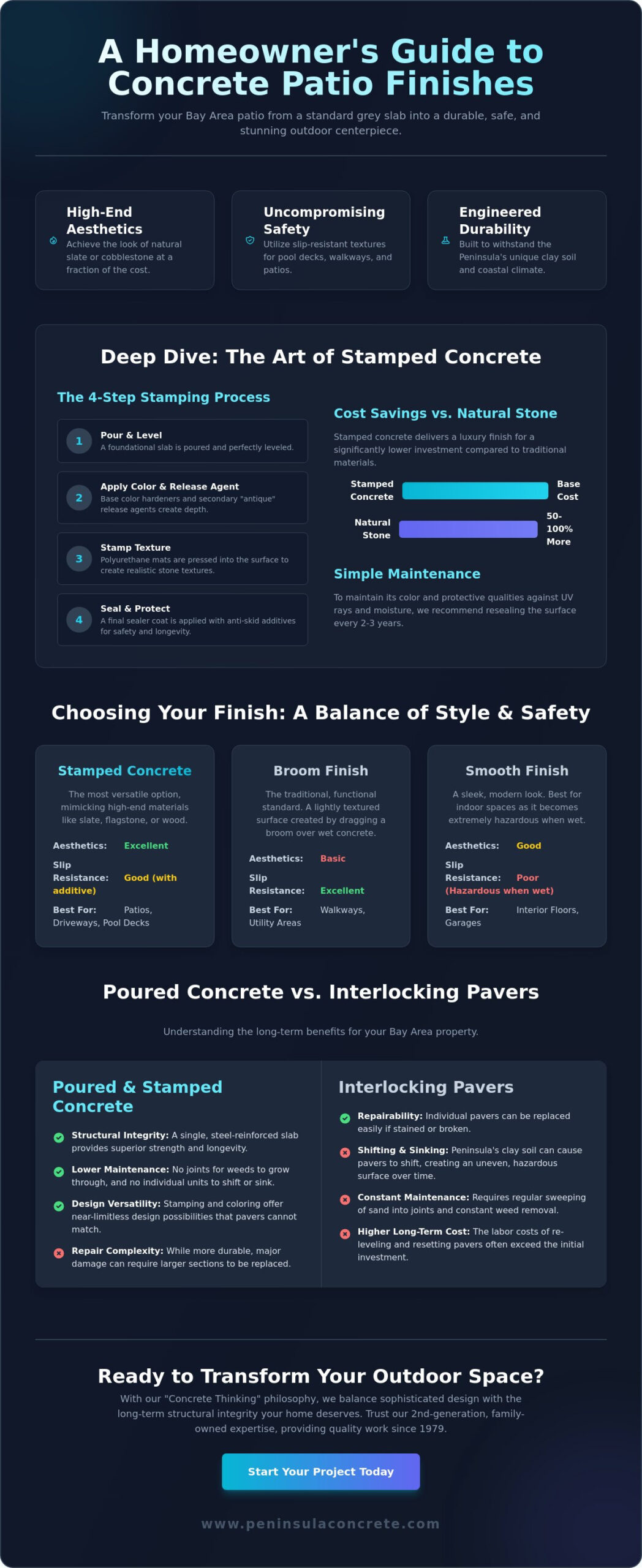
Quality work since 1979 requires staying ahead of installation techniques that offer both beauty and durability. Stamped concrete is a specialized process where our crew presses heavy-duty polyurethane mats into the surface while the concrete is still in its plastic state. This creates deep, realistic impressions that mimic expensive natural materials. Before stamping begins, we apply a color hardener and a liquid or powder release agent. These products prevent the mats from sticking and add the secondary “antique” colors that give the surface its authentic, three-dimensional look. It’s one of the most versatile concrete patio finishes available for homeowners who want a custom look without the custom price tag.
When comparing costs, stamped concrete offers a clear financial advantage over natural materials. According to 2023 industry data from HomeAdvisor, installing natural flagstone or slate can cost 50% to 100% more per square foot than high-quality stamped concrete. Because we pour the patio as a single, continuous slab, you also avoid the long-term labor costs associated with resetting individual stones that have shifted over time. To ensure the highest standards of installation, we follow technical guidelines established by the Decorative Concrete Council, which helps us maintain consistency in pattern alignment and color distribution.
Safety is a priority for any backyard project. Many homeowners worry that stamped surfaces become slippery when wet. We solve this by incorporating translucent anti-skid additives into the final sealer coat. These micronized polymer beads provide essential traction without dulling the color or changing the texture. To keep the finish looking its best, we recommend resealing the surface every 2 to 3 years. This periodic maintenance protects the integral pigments from UV fading and prevents moisture from penetrating the slab. If you’re ready to transform your backyard, start your project today with our 2nd-generation, family-owned team.
Popular Stamped Patterns for Peninsula Patios
Ashlar slate and seamless textures are currently the most requested concrete patio finishes for modern homes in the Bay Area. These patterns provide a clean, contemporary aesthetic with minimal grout lines. For those seeking a warmer look, wood-plank stamping replicates the appearance of a rustic timber deck. It’s a smart choice for our local climate because it won’t rot, splinter, or require the heavy staining that real wood demands. We also offer stenciled borders, which add architectural “Bands” to the perimeter, giving the patio a finished, professional frame.
The Pros and Cons of Stamped Finishes
- Pros: High level of customization, lower material cost than natural stone, and a weed-free surface since there are no open joints for seeds to take root.
- Cons: Can be slippery if anti-skid treatments aren’t applied, requires resealing to maintain color, and may show visible seams if the pattern isn’t planned correctly by an experienced installer.
We advise clients to consider the environment of their yard when choosing a pattern. In heavily shaded areas or North-facing lots, we recommend shallower textures. Deeply embossed patterns can sometimes trap standing water or organic debris like oak leaves, which may lead to staining if not swept away regularly. Our experienced team helps you select a pattern that balances your style goals with the practical realities of your property’s drainage and sun exposure.
Functional and Slip-Resistant Finishes for Safety
Safety is the most critical factor for any outdoor living space, especially in the Bay Area where hillside properties and pool decks are common. While aesthetics draw the eye, the technical performance of your surface keeps your family and guests safe. Choosing the right concrete patio finishes involves more than just picking a color; it requires selecting a texture that provides reliable traction under various conditions. Following OSHA safety standards for walking surfaces is a smart baseline for residential projects to ensure areas remain slip-resistant even when wet or sloped.
For homeowners in warmer micro-climates like the Tri-Valley or South Bay, the salt finish is a highly effective and popular choice. This technique involves pressing coarse rock salt into the wet concrete and washing it away after the slab has partially cured. The process leaves behind a series of small, shallow indentations. These pits create a beautiful, weathered texture that naturally breaks up the surface tension of water, making it an ideal choice for pool surrounds where barefoot traction is a priority.
Since 1979, Peninsula Concrete has emphasized that the success of these functional finishes depends entirely on the installer’s timing. If the texture is applied too early or too late, the result is an uneven surface that can trap debris or fail to provide grip. As a 2nd-generation, family-owned business, we prioritize a uniform finish across the entire slab to ensure your patio is as safe as it is durable.
Broom Finish: The Reliable Classic
A broom finished concrete texture remains the most cost-effective and dependable option for large residential areas. It’s versatile enough to match almost any architectural style. We offer several grades of this finish to suit specific needs:
- Fine Broom: Best for patios where guests will be walking in bare feet or light sandals.
- Medium Broom: The standard for most backyard spaces, balancing comfort and grip.
- Heavy Broom: Reserved for steep walkways or ramps where maximum traction is required to prevent slips.
To give this classic look a custom feel, we often suggest adding colored borders or “picture framing.” By using a smooth-troweled edge in a contrasting tone, you get the durability of a broom finish with a sophisticated, high-end design.
Exposed Aggregate: Beauty in the Stones
Exposed aggregate is often called the gold standard for concrete patio finishes because it’s virtually indestructible and naturally slip-resistant. We create this look by stripping away the top layer of cement “cream” to reveal the decorative stones embedded within the mix. This finish is excellent for high-traffic areas because the stones hide dirt, footprints, and minor wear that might show on a smoother surface.
The final look of your patio depends on the aggregate you choose. Small pea gravel provides a traditional, rounded texture in warm earth tones. Crushed granite offers a contemporary, salt-and-pepper aesthetic with superior hardness. For a more unique look, recycled glass can be seeded into the surface to add subtle pops of blue or green that catch the sunlight. This variety allows you to customize your patio’s color palette while maintaining a rugged, safe walking surface.
Engineering for the Peninsula: Drainage and Climate Factors
The most common question we hear from homeowners in Belmont and San Carlos is whether their concrete will crack during a tremor or shift in the local clay soil. It’s a valid concern. The Peninsula’s geography features expansive soil that swells when wet and shrinks when dry. Your choice of concrete patio finishes isn’t just a style preference; it’s a functional decision that impacts how your investment handles these movements. We’ve built a reputation for honesty and high-quality work by addressing these geological realities head-on rather than ignoring them.
On the sloped lots common throughout San Mateo, improper water management is the primary cause of patio failure. If water isn’t directed away from the slab, it can undermine the subgrade or create hydrostatic pressure that leads to structural cracks. We integrate custom drainage systems directly into every design to ensure runoff moves efficiently away from your foundation. In complex landscapes, we often coordinate with retaining wall contractors to manage soil pressure and protect the longevity of your patio surface.
Managing Bay Area Moisture and Fog
The persistent San Francisco fog creates a unique microclimate where moisture lingers long after the sun comes up. This constant dampness can lead to moss or mildew growth on heavily textured concrete patio finishes if they aren’t treated correctly. To prevent this, we use specific penetrating sealers that allow the concrete to “breathe” while repelling liquid water. For homeowners looking to meet local environmental runoff codes, we offer pervious concrete options. These systems allow water to pass directly through the slab into the soil, reducing the load on municipal storm drains by up to 100% during light rain events.
Seismic Resilience and Joint Placement
Since 1979, we’ve refined our techniques to handle the Bay Area’s seismic zones. We don’t just pour concrete; we engineer it for resilience. This involves several key steps:
- Strategic Control Joints: We hide these joints within the lines of your decorative patterns so the concrete can flex during ground movement without creating random, ugly cracks.
- Reinforced Infrastructure: We use a grid of reinforced rebar and high-strength 4,000 PSI concrete mixes to provide the internal tension needed to stay together.
- Expert Subgrade Preparation: A 2nd-generation family-owned business knows that the secret to a lasting finish is the 4 to 6 inches of compacted base rock underneath it.
Our experience with local geological quirks ensures your patio remains as durable as it is beautiful. We’ve spent over 40 years mastering the balance between aesthetic appeal and structural integrity.
Concrete vs. Interlocking Pavers: Which is Right for You?
Choosing between a poured slab and interlocking concrete pavers depends on your long-term goals for your outdoor space. Traditional concrete offers a sleek, monolithic appearance that many homeowners find appealing for minimalist designs. However, pavers provide unmatched flexibility. They’re designed to shift slightly with the ground; this is a vital feature in the Bay Area where soil movement and seismic activity are common. Consider these primary differences:
- Structural Flexibility: Pavers move independently to prevent surface cracks.
- Maintenance Needs: Slabs are easier to clean, while pavers may require occasional joint sand refreshing.
- Visual Impact: Concrete provides a continuous, seamless plane; pavers offer intricate patterns and textures.
Repairability is a major differentiator between the two. If a tree root grows under a concrete slab, the surface will eventually crack. Fixing it usually requires a patch that rarely matches the original pour. With pavers, you can lift individual units, address the root or pipe issue, and set the same stones back in place. While the upfront investment for pavers is typically higher than standard concrete, the long-term value often exceeds the initial cost because you won’t need to replace the entire patio if underground damage occurs.
When to Choose a Custom Concrete Finish
Custom concrete patio finishes are the best choice for homeowners who want a perfectly flat surface for outdoor kitchens or modern furniture. You can achieve high-end looks on a budget compared to natural stone. Matching your patio to your bay area concrete driveway creates a cohesive look across your property. Peninsula Concrete specializes in both materials. We provide an unbiased recommendation based on your specific site conditions and design goals.
The Peninsula Concrete Quality Standard
We’ve provided Quality Work Since 1979. As a 2nd-generation, family-owned business, we understand the local climate and soil conditions. Our team practices “Concrete Thinking,” which means we look at the long-term durability of every project we touch. Our planning process starts with a detailed estimate and covers everything from ground preparation to the final sealant application. We don’t cut corners. We ensure your concrete patio finishes are durable and beautiful for years to come. Contact Peninsula Concrete Contractors for a free estimate on your patio project.
UPGRADE YOUR BAY AREA BACKYARD TODAY
Peninsula Concrete has provided quality work since 1979. As a 2nd-generation, family-owned business, we take pride in being specialists in San Francisco Peninsula hardscaping. We’ve built our reputation on honesty and high-quality craftsmanship that Bay Area homeowners have trusted for over 40 years. We’re ready to help you navigate the planning process and deliver a durable, beautiful patio you’ll love for decades. Let’s get started on your home’s transformation.
Start your Bay Area patio project today with a free estimate from Peninsula Concrete!
Frequently Asked Questions
What is the most durable concrete finish for a patio in the Bay Area?
A broom finish is the most durable of all concrete patio finishes for the Bay Area’s varied climate. Our team has used this technique since 1979 because it’s nearly impossible to wear down. It provides a slip-resistant surface that handles both the summer heat and winter rains without losing its structural integrity or requiring frequent repairs.
Is stamped concrete slippery when wet, especially in foggy conditions?
Stamped concrete can be slick when wet, but we solve this by mixing anti-skid additives into the final sealer. Bay Area fog often leaves a fine mist on surfaces during the early morning hours. By adding a 40 mesh polymer grit to the coating, we increase the coefficient of friction to ensure your patio remains safe for foot traffic even in damp conditions.
How often do I need to reseal my decorative concrete patio?
You should reseal your decorative patio every 2 to 3 years to maintain its protection and color. High UV exposure in Northern California breaks down the protective acrylic layer over time. Regular maintenance every 24 months prevents the color from fading and stops moisture from penetrating the surface, which preserves our high-quality work for decades.
Can I change the color of my existing concrete patio with a new finish?
You can definitely change the look of an existing slab using professional-grade stains or translucent dyes. We apply penetrating stains that reach 1/8th of an inch into the concrete pores. This process allows homeowners to update their concrete patio finishes to a modern charcoal or earth tone without the cost or mess of a full demolition and replacement.
How long does it take to install a finished concrete patio from start to finish?
A standard installation takes approximately 5 to 7 business days from the initial excavation to the final seal. Our crew spends the first 2 days on site preparation, grading, and reinforcement. After the pour, the concrete needs 48 hours of drying time before we apply the finish, though it takes a full 28 days to reach its maximum structural strength.
Will a concrete patio finish crack during a minor earthquake?
Concrete is a rigid material, so minor seismic shifts can cause hairline fractures despite the best installation practices. We mitigate this risk by installing control joints every 8 to 10 feet according to industry standards. These joints act as pre-planned break points that guide the movement and prevent random cracks from spidering across your finished surface.
Which is cheaper: stamped concrete or interlocking pavers?
Stamped concrete is generally more cost-effective than interlocking pavers due to significantly lower labor requirements. A professional crew can pour and stamp a 500 square foot area in a single day. In contrast, installing individual pavers takes 50 percent more man-hours because each stone must be leveled and set by hand on a compacted sand base.
What is the best finish for a concrete patio near a swimming pool?
An exposed aggregate or salt finish is the best choice for pool decks because of their superior grip. These textures expose the natural stones or create small pits that prevent hydroplaning when the surface is wet. We’ve recommended these specific textures for over 40 years to ensure family safety and long-term durability around backyard water features.