
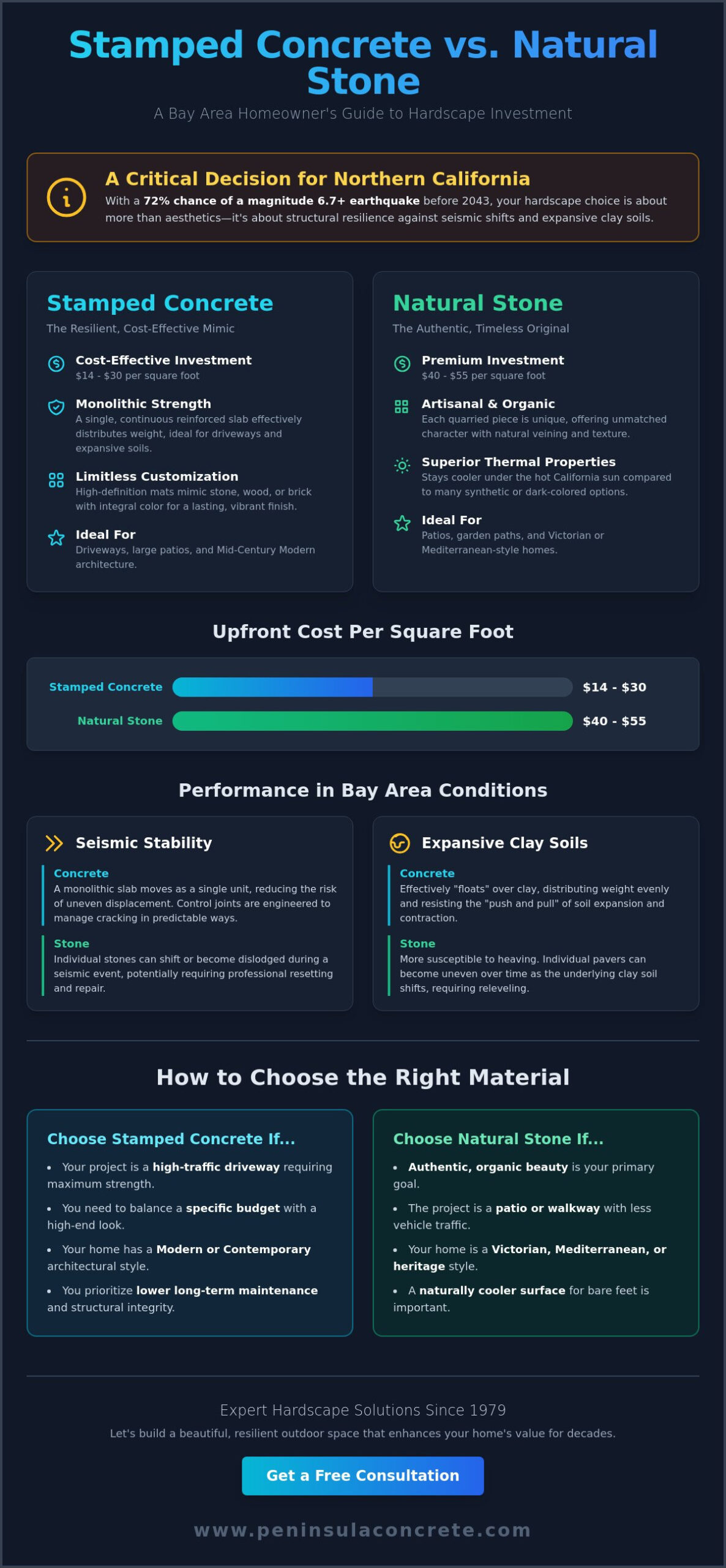
With the U.S. Geological Survey estimating a 72% chance of a magnitude 6.7 earthquake hitting the Bay Area before 2043, your choice of hardscape isn’t just a design preference; it’s a structural investment. You want an outdoor space that reflects the high value of your Peninsula home, yet the fear of concrete cracking or high maintenance costs often leads to decision paralysis. We understand that you need a solution that looks authentic and stands up to the unique seismic demands of Northern California. Choosing between stamped concrete vs natural stone involves balancing a $14 to $30 per square foot investment against the $40 to $55 per square foot price tag of premium masonry.
We’ve built a reputation for honesty and quality work since 1979, and we know that the right choice depends on your specific property goals. You’ll discover how these materials perform under the 2026 Title 24 building code updates and which provides the best long term ROI for your home. We’ll preview the critical differences in durability, maintenance requirements, and aesthetic finishes to ensure your new patio or driveway remains a source of pride for decades to come. Let’s find the perfect fit for your architectural style.
Key Takeaways
- Compare the monolithic strength of a textured concrete pour against the timeless, organic beauty of hand-laid materials like slate and travertine.
- Evaluate stamped concrete vs natural stone to see which material better handles the “push and pull” of the San Francisco Peninsula’s expansive clay soils.
- Learn how to calculate the total cost of ownership by weighing upfront installation labor against long-term requirements like resealing cycles and stone resetting.
- Identify the best hardscape material for your home’s specific architectural era to ensure your investment increases property ROI and matches local aesthetic heritage.
Defining the Contenders: Stamped Concrete vs. Natural Stone Basics
Since 1979, our family-owned business has helped San Francisco Peninsula homeowners make informed decisions about their hardscapes. We’ve built a reputation for honesty and high-quality work, and that starts with clear definitions. The choice between stamped concrete vs natural stone isn’t just about the final look; it’s about the engineering beneath your feet. While one is a manufactured, monolithic surface, the other is a collection of individual, quarried elements. Understanding these fundamentals is the first step toward a project that lasts for decades.
What Is Modern Stamped Concrete?
Stamped concrete is a single, continuous pour of high-strength concrete. In 2026, we use integral color mixed throughout the entire batch, ensuring the hue remains consistent even if the surface is chipped. During the pour, our craftsmen use high-definition mats to press textures into the wet surface. This creates a seamless, durable finish that mimics expensive materials without the gaps or joints found in traditional masonry.
The Timeless Appeal of Natural Stone
Natural stone consists of materials like Arizona Flagstone, Bluestone, or Travertine that are harvested directly from the earth. Each piece is unique in its mineral composition and thickness. Our 2nd-generation team hand-sets these stones into place, creating an artisanal pattern that manufactured products can’t perfectly replicate. These materials offer excellent thermal properties, staying cooler under the California sun than many dark-colored synthetic alternatives.
The “hybrid” reality of modern construction has blurred the lines between these two options. With the implementation of the 2026 Building Standards Code (Title 24) on January 1, 2026, the focus has shifted toward materials that offer both beauty and structural resilience. Modern concrete mats now feature “ultra-cloned” textures taken directly from real stone slabs. These mats capture the deep clefts and organic ridges of slate and granite, allowing you to achieve a high-end look with the structural benefits of a reinforced concrete slab.
Initial suitability often comes down to the specific project type on your property. For heavy-duty applications like driveways, the monolithic strength of concrete is often superior. It distributes the weight of vehicles more effectively across the Bay Area’s expansive clay soils. For intimate patios or garden paths, the organic variation of natural stone adds a level of sophistication that complements the architectural heritage of the San Francisco Peninsula. When choosing between stamped concrete vs natural stone, we look at your home’s existing style and your long-term maintenance goals to ensure the best possible ROI.
Aesthetic Showdown: Mimicking Texture vs. Organic Beauty
Choosing between stamped concrete vs natural stone often comes down to a choice between precision and soul. Your home’s architectural style on the San Francisco Peninsula dictates which direction provides the best visual ROI. While stamped concrete offers a controlled, uniform palette, natural stone provides a level of organic randomness that reflects the rugged beauty of the California coast. Our team has helped homeowners balance these aesthetics since 1979, ensuring the final product complements the existing structure perfectly.
Customization with Stamped Concrete
Modern stamping technology allows for a level of detail that was impossible a decade ago. We use high-definition mats to create textures that mimic everything from weathered wood planks to reclaimed brick. This versatility is ideal for Mid-Century Modern homes where clean lines and specific color palettes are essential. We can create custom borders in contrasting shades or apply multi-tonal antique finishes to add depth. Integral color represents the most durable method for ensuring color consistency because the pigment is blended through the entire concrete volume. This ensures that even with the heavy use a driveway or patio sees, the color remains vibrant and true to your original vision.
The Unmatched Character of Stone
Natural stone offers a “perfect imperfection” that no man-made product can fully replicate. Each piece of flagstone or slate features unique veining, mineral deposits, and textures shaped over millions of years. This organic variation creates a sense of heritage that suits Victorian or Mediterranean-style homes. Unlike concrete, which uses straight-cut control joints to manage cracking, natural stone uses hand-filled grout lines that follow the stone’s natural shape. This artisanal approach creates a softer, more integrated look in garden settings. When you’re ready to see how these textures look on your property, our team can help you plan your outdoor space with a focus on authentic materials.
Visual longevity is where these two contenders diverge most sharply. Over the first five years, stamped concrete maintains its “just-installed” sharpness, provided it receives a fresh seal every two to three years. Natural stone, however, begins to develop a patina. It settles into the landscape, with colors often deepening or mellowing as the stone is exposed to the elements. For many Bay Area homeowners, this aging process is a desirable trait that adds character to the property. Whether you prefer the crisp, tailored look of concrete or the evolving character of stone, the goal is a finish that looks intentional and high-quality for decades.
Durability in the Bay Area: Seismic Shifts and Soil Stability
The Bay Area’s unique geography presents challenges that contractors in other regions rarely face. While national guides focus on winter frost, our local soil conditions require a different level of expertise. The San Francisco Peninsula is dominated by expansive clay soils that breathe, expanding when wet and shrinking during dry spells. This constant movement, combined with the 72% probability of a major seismic event before 2043, makes durability the top priority when comparing stamped concrete vs natural stone. Quality work since 1979 has taught us that a hardscape is only as good as the ground preparation beneath it.
Managing Cracks and Movement
Concrete is a rigid material, but it’s engineered to move. We integrate strategic expansion joints in Bay Area concrete driveways to control where the material relieves pressure. These joints act as intentional “weak points” that prevent random cracking during tremors. In contrast, natural stone installed on a compacted sand base is inherently flexible. If the ground shifts, individual stones can move independently and often “self-heal” by settling back into place. Repairing a cracked concrete slab usually involves specialized patching and color-matching; a shifted stone simply requires lifting the piece and leveling the base material.
Climate Factors: UV Rays and Drainage
The California sun is relentless. High-exposure patios require UV-stable sealants to prevent colors from fading over time. High-quality sealants also act as a barrier against moisture, which prevents efflorescence, the white, powdery salt deposits that can mar both stone and concrete surfaces. Proper water management is equally critical for longevity. Experienced retaining wall contractors always prioritize drainage systems to prevent hydrostatic pressure from undermining your hardscape during heavy winter rains.
Safety is the final piece of the durability puzzle. For sloped Redwood City driveways or pool decks, surface texture is vital for traction. Stamped concrete can be finished with a non-slip additive to provide extra grip when wet. Natural stone varies significantly by type; while tumbled travertine offers great traction, certain slate finishes can become slick. When you weigh the long-term performance of stamped concrete vs natural stone, you must account for the specific maintenance cycles each requires. Stamped concrete typically needs resealing every two to three years, while natural stone requires periodic weed management in the joints to maintain a clean, professional appearance.
Comparing Total Cost of Ownership and Property Value ROI
Comparing stamped concrete vs natural stone requires looking beyond the initial invoice. In the high-stakes San Francisco Peninsula real estate market, your hardscape serves as a financial asset. We’ve helped homeowners navigate these investments since 1979, and we know that the “cheaper” option isn’t always the one that yields the highest return. Understanding the balance between upfront labor and long-term maintenance is essential for protecting your home’s equity.
Installation Labor and Material Costs
The “prep work” phase for both materials is nearly identical in cost. Whether we’re pouring concrete or laying stone, we must excavate the site, manage drainage, and compact a structural sub-base. The price divergence happens during the finishing phase. Stamped concrete installation in the Bay Area typically ranges from $14 to $30 per square foot, as it involves a monolithic pour that our crews can texture relatively quickly. Natural stone installation costs significantly more, often between $40 and $55 per square foot. This premium reflects the labor hours required to hand-cut and set individual pieces of flagstone or travertine. Site accessibility also plays a role; in hilly neighborhoods like San Carlos or Belmont, the difficulty of transporting heavy stone slabs can further increase the final project total.
Maximizing Your Home Investment
Investment returns for these materials vary based on your property’s market tier. Stamped concrete patios are highly efficient, often providing a return on investment between 80% and 90%. For many homeowners, recouping 30% to 60% of the project cost upon resale is a standard expectation. While decorative concrete has a typical lifespan of 25 to 30 years with proper care, natural stone is a “forever” material that can last 50 years or more. This longevity appeals to luxury buyers on the Peninsula who value authentic, permanent materials. If you find the cost of stone prohibitive but want more durability than a standard slab, we recommend exploring interlocking concrete pavers as a high-ROI middle ground.
Total ownership costs must include the maintenance cycle. Stamped concrete requires resealing every two to three years to protect the color and surface, which costs approximately $3 to $5 per square foot. Natural stone avoids this specific expense but may require occasional stone resetting if the ground shifts. If you’re ready to see which material fits your budget and long-term goals, you can contact our team for a professional estimate. We’ll provide a clear breakdown based on your specific site conditions and architectural needs.
The Verdict: How to Choose the Right Material for Your Project
The decision finally comes down to the specific role the hardscape plays in your daily life. While we’ve discussed costs and durability, the practical “job description” of your outdoor space is the ultimate tie-breaker. Choosing between stamped concrete vs natural stone isn’t just about picking a texture; it’s about matching the solution to your property’s unique demands. We’ve helped Peninsula residents make these choices for over 40 years, ensuring the final result serves both the home’s architecture and the family’s lifestyle.
Mid-Century Modern homes, common in Palo Alto and Menlo Park, often benefit from the clean, geometric possibilities of stamped concrete. It allows for a minimalist aesthetic that doesn’t compete with the home’s architecture. Conversely, a Victorian home in San Francisco or a Mediterranean villa in Atherton often demands the organic, historical weight of natural stone. Your lifestyle also plays a part. If you want a low-maintenance, “set it and forget it” surface, the monolithic nature of concrete is hard to beat. If you view your patio as an evolving, organic outdoor living room, the character of stone is worth the extra investment.
Selection Framework by Use Case
For driveways, we almost always recommend concrete. It provides the load-bearing strength necessary for heavy vehicles and is much easier to pressure wash. Pool decks require a different priority list. You need a surface that stays cool under the sun and offers high slip resistance. While certain stones are excellent for this, stamped concrete with a specialized finish is a popular, cost-effective alternative. For walkways, safety and a level walking surface are paramount. If you’re dealing with existing trip hazards, our expertise in sidewalk repair ensures your paths are both beautiful and compliant with local safety standards.
The Importance of Quality Craftsmanship
A “cheap” installation is the most expensive mistake a homeowner can make. In the Bay Area, poor ground prep or incorrect concrete mix ratios lead to structural failure within just a few seasons. We’ve seen many “discount” projects require complete demolition and replacement, which effectively doubles the original cost. Whether you choose stamped concrete vs natural stone, the quality of the base and the precision of the install determine your long-term ROI.
Our “Quality Work Since 1979” heritage isn’t just a tagline; it’s a guarantee of durability. As a 2nd-generation, family-owned business, we have a personal stake in every yard of concrete we pour and every stone we set. We understand the local soil, the seismic requirements, and the aesthetic standards of our community. When you’re ready to invest in your property, Contact Peninsula Concrete Contractors for a professional site evaluation. We’ll help take your project from planning to a successful, high-quality reality.
Secure Your Property Investment with Proven Expertise
Choosing between stamped concrete vs natural stone is a significant step toward enhancing your property’s value and safety. We’ve established that while concrete offers superior load-bearing strength and high ROI, natural stone provides a timeless, organic character that remains durable for over 50 years. With the U.S. Geological Survey predicting a 72% chance of a major earthquake before 2043, your project requires more than just surface-level beauty. It needs the structural integrity provided by specialists who understand the San Francisco Peninsula’s expansive clay soils.
As a 2nd-generation, family-owned business, we’ve provided quality work since 1979. We take pride in helping our neighbors build outdoor spaces that stand the test of time. Don’t leave your hardscape to chance or unproven contractors. Let our experienced team evaluate your site and provide a solution tailored to your home’s unique architectural heritage. We’re ready to help you navigate the 2026 Title 24 building code updates to ensure your investment is safe and compliant.
Request Your Free Hardscape Estimate Today
We look forward to helping you take your project from the planning stages to a successful, high-quality reality.
Frequently Asked Questions
Does stamped concrete crack more easily than natural stone in the Bay Area?
Stamped concrete is more likely to show surface cracks because it is a rigid, monolithic slab. We manage this by placing expansion joints every 8 to 12 feet to guide the concrete as it settles. Natural stone is inherently flexible when set on a sand base, allowing it to shift during minor tremors without breaking. With the 72% chance of a major earthquake before 2043, stone’s ability to “self-heal” after ground movement is a distinct advantage.
Is natural stone too slippery for a pool deck compared to stamped concrete?
Certain natural stones like honed marble are slippery, but tumbled travertine or flagstone provide excellent natural grip. Stamped concrete is highly customizable for safety because we can add non-slip grit to the final sealer. This makes it a reliable choice for sloped Redwood City driveways or pool areas where traction is a priority. We’ll help you select the specific texture that balances comfort for bare feet with necessary slip resistance.
How often do I need to reseal stamped concrete in the California sun?
You should plan to reseal your surface every two to three years. The high UV exposure on the San Francisco Peninsula can break down protective coatings, leading to color fading or moisture penetration. Professional resealing typically costs between $3 and $5 per square foot. This simple maintenance cycle protects your investment and keeps the textures looking as sharp as the day we finished the pour.
Can I drive a car on a natural stone driveway?
You can drive on natural stone only if it is installed over a 4 inch reinforced concrete base. The individual stones must be at least 2 inches thick to withstand the weight of a vehicle without cracking. Stones set only on sand or gravel will shift and sink under the pressure of a car. For most homeowners, a stamped concrete driveway provides a more stable, cost-effective solution for high-traffic areas.
Which material is better for sloped properties in the San Francisco Peninsula?
Stamped concrete is generally the better choice for steep slopes in hilly neighborhoods like San Carlos or Belmont. It creates a continuous, reinforced structural slab that anchors firmly into the hillside. Individual stones can migrate or settle unevenly on sharp inclines over time, especially during heavy winter rains. A monolithic concrete surface ensures a consistent, safe path for both pedestrians and vehicles on a grade.
Does stamped concrete look fake next to real stone elements?
Modern high-definition mats used in 2026 capture textures from real stone slabs with incredible accuracy. When we combine these textures with integral color and hand-applied antiquing agents, the result is difficult to distinguish from the real thing. Natural stone still offers 100% unique mineral veining and organic variations that concrete can’t perfectly replicate. We often use stamped concrete for large areas and real stone for focal points to balance budget and authenticity.
How long does the installation take for natural stone vs. stamped concrete?
A standard 500 square foot stamped concrete project usually takes 3 to 5 days from excavation to the final seal. A natural stone project of the same size can take 10 to 14 days because every piece must be hand-cut and fitted. If you have a tight timeline for a graduation party or summer event, the faster turnaround of concrete is a major benefit. Our 2nd-generation team ensures that speed never comes at the expense of quality.
What is the price difference between flagstone and stamped concrete?
Choosing stamped concrete vs natural stone usually results in a 40% to 60% difference in the final invoice. Stamped concrete in the Bay Area ranges from $14 to $30 per square foot. Natural stone, such as flagstone or travertine, typically costs between $30 and $55 per square foot. This price gap reflects the significant labor hours required for the artisanal hand-setting of individual stones compared to a monolithic concrete pour.