
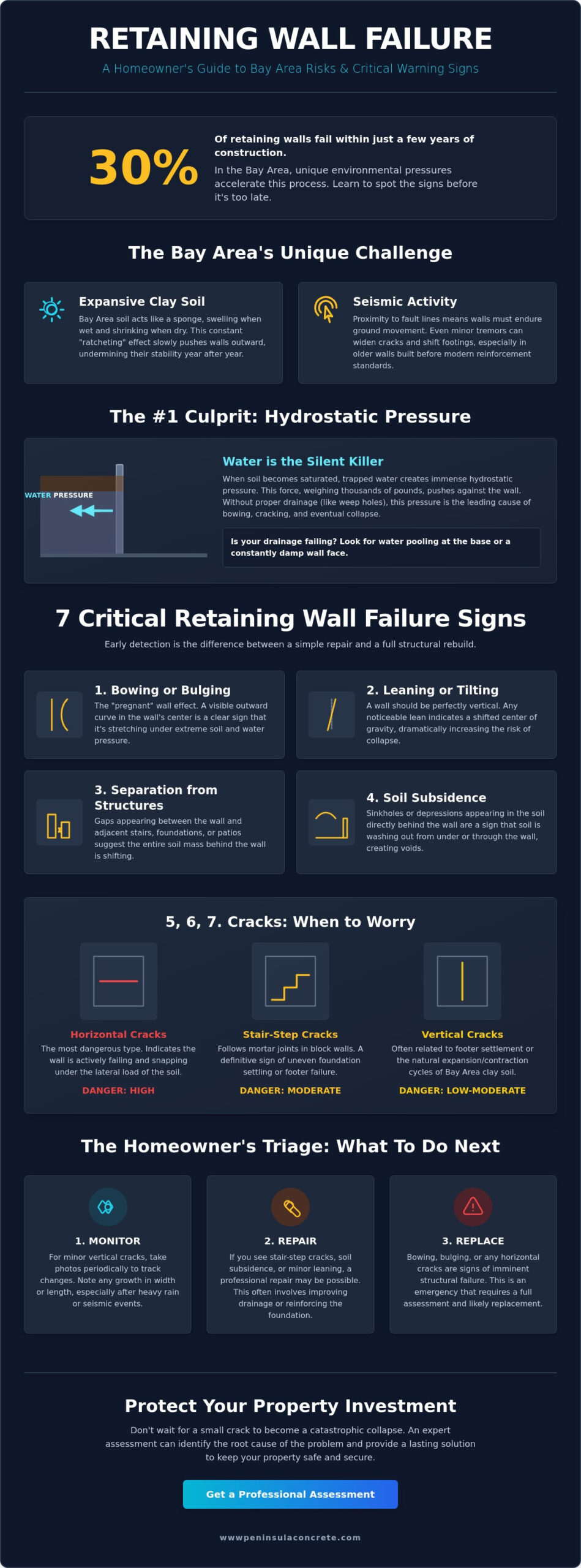
Did you know that approximately 30% of retaining walls fail within just a few years of construction? In the Bay Area, our unique mix of expansive clay soil and seismic activity puts constant pressure on every stone and concrete block. It’s natural to feel anxious when you spot a new crack or notice soil shifting near your foundation. You’ve invested deeply in your property, and the last thing you want is the fear of a sudden collapse or the confusion of technical jargon like hydrostatic pressure.
You deserve to feel confident in the strength of your landscape. This guide will help you accurately identify common retaining wall failure signs so you can protect your home and avoid expensive structural disasters before they start. We’ll walk through the seven most critical red flags and explain the exact steps you should take to ensure your property remains safe and secure for generations to come.
Key Takeaways
- Recognize the physical warnings, such as bulging or leaning, that signal your wall can no longer safely hold back the soil.
- Understand how the San Francisco Peninsula’s unique geography and drainage issues impact the lifespan of your masonry.
- Learn to spot the early retaining wall failure signs that distinguish a simple repair from a total structural collapse.
- Discover the triage steps every homeowner should take to monitor wall health and protect their property investment.
Understanding Retaining Wall Failure in the Bay Area
A retaining wall is much more than a decorative boundary. It is a critical piece of engineering designed to resist the immense lateral pressure of the earth. Failure occurs when the structure can no longer withstand the weight and movement of the soil it supports. On the San Francisco Peninsula, this task is particularly difficult due to our unique geography. From the steep ridges of San Carlos to the rolling hills of Woodside, the land is under constant gravitational stress. Our hills want to move downward, and your retaining wall is often the only thing stopping them.
Redwood City and its neighbors sit on expansive clay soils. This type of earth acts like a physical sponge. It swells significantly when wet and shrinks as it dries. This creates a “ratcheting” effect against your masonry. Each season, the soil pushes against the wall and then pulls away, slowly undermining the structure’s stability over decades. In 2026, our weather patterns have shifted toward more intense, concentrated rainfall. This sudden saturation puts extreme loads on older walls that were not designed for such volume. Recognizing retaining wall failure signs early is the only way to prevent a catastrophic collapse during a heavy winter storm.
The Science of Hydrostatic Pressure
Water is the silent killer of most hardscape structures. When soil becomes saturated, the water trapped behind a wall creates hydrostatic pressure. This isn’t just moisture; it is a heavy, physical force that can weigh thousands of pounds. A properly built wall must include a dedicated drainage system to relieve this stress. Weep holes are the most important feature you might never notice. They allow water to bleed through the wall rather than pushing it over. If you see water pooling at the base of your wall or notice the face of the wall is constantly damp, your drainage may be failing. Understanding the difference between surface-level cosmetic wear and deep structural failure is essential for maintaining your property’s value.
Seismic Considerations for Local Walls
Our proximity to active fault lines means our walls must do more than just hold back dirt. They must survive the earth’s movement. Even minor tremors can widen existing hairline cracks or shift a wall’s footing. Walls built before the 1990s are at a much higher risk because they often lack the internal steel reinforcement found in modern masonry. These older, rigid designs don’t handle vibration well. They are far more likely to exhibit retaining wall failure signs after even a small seismic event. Today, we focus on designs that offer both strength and a degree of flexibility to ensure your property remains protected regardless of what happens underground.
7 Critical Retaining Wall Failure Signs to Watch For
Early detection is the difference between a simple drainage adjustment and a full structural rebuild. While some minor movement is expected over decades, certain retaining wall failure signs indicate that the structure is reaching its breaking point. Homeowners often overlook these subtle shifts until a heavy rain makes them impossible to ignore. If you notice these changes, consulting with experts in retaining and garden walls can help you determine if the damage is cosmetic or structural.
Bowing or bulging is perhaps the most visible red flag. Often called the “pregnant” wall effect, this occurs when the middle of the wall curves outward. It is a clear signal that the internal reinforcement or the wall material itself is stretching under the weight of saturated soil. Following Caltrans’ standards for retaining walls ensures that modern structures are built to withstand these specific pressures, but older walls often lack the necessary depth or reinforcement to resist these forces. Other critical signs include:
- Leaning or Tilting: A wall should be perfectly plumb. If you notice a lean of even one or two degrees, the center of gravity has shifted, making a collapse more likely.
- Separation from Adjacent Structures: When a wall pulls away from your home’s foundation, outdoor stairs, or a connecting fence, it suggests the entire soil mass is moving.
- Soil Subsidence: Look for “sinkholes” or depressions in the dirt directly behind the wall. This indicates that soil is being washed out through the drainage system or under the footer.
Cracks: When to Worry
Not all cracks are created equal. Horizontal cracks are the most dangerous because they suggest the wall is literally snapping under the lateral load of the soil. Vertical cracks are often related to footer settlement or the natural expansion of Bay Area clay. Stair-step cracks are a definitive sign of uneven foundation settling where one section of the wall’s base is sinking faster than the rest. Identifying these retaining wall failure signs early allows for targeted repairs rather than total replacement.
Visual Misalignment and Movement
Sometimes the failure starts at the very bottom. A “kick-out” occurs when the base of the wall slides forward while the top remains in place, often due to a lack of proper “keying” into the ground. At the top of the wall, missing or popped capstones are a precursor to total collapse. These heavy stones are often held in place by gravity and mortar; if they begin to loosen, it means the underlying structure is shifting its shape. You can use a standard four-foot level to check for subtle tilting before it becomes obvious to the naked eye. Catching a lean early provides a much wider window for professional intervention.
The Root Cause: Why Most Bay Area Walls Fail
Behind every leaning stone or cracked concrete block lies a specific structural cause. While identifying retaining wall failure signs is the first step, understanding the “why” allows for a permanent solution rather than a temporary patch. In the San Francisco Peninsula, the primary culprit is almost always poor water management. Industry experts estimate that inadequate drainage is responsible for up to 90% of all retaining wall failures. When water cannot escape, it turns the soil into a heavy, semi-liquid mass that the wall simply wasn’t designed to hold.
Beyond water, the physical foundation or “footing” of the wall is a common point of failure. If a wall has inadequate footings, it lacks the necessary anchor to resist the lateral push of our local expansive clay. A shallow foundation might work in sandy soil, but in the Bay Area, it leads to inevitable tilting. Material choice also plays a role. We often see timber walls from the 1980s that have succumbed to dry rot, while older concrete may suffer from spalling. Spalling occurs when the internal rebar rusts and expands, causing the surface to flake away. Recognizing these signs of retaining wall failure early can save a homeowner from the total loss of the structure.
Overloading, or “surcharge loading,” occurs when the environment around the wall changes. Perhaps a previous owner installed a new concrete driveway or a heavy stone patio right at the top edge of the wall. This adds thousands of pounds of pressure that the original builder didn’t account for. This extra weight accelerates the movement of the soil and forces the wall to work beyond its engineered capacity. Over time, this pressure manifests as the retaining wall failure signs we’ve discussed, such as bowing or sudden cracking.
Identifying Drainage System Failure
A functioning drainage system is the lifeblood of a healthy wall. If you see water weeping directly through the face of the masonry or through mortar joints instead of out of the designated vents, your internal pipes are likely clogged with silt or roots. Another major red flag is the “Wet Toe” effect. This is when water pools at the very base of the wall, softening the soil that provides the wall’s stability. If you’re unsure about your current setup, learning more about retaining wall drainage can help you identify if your system needs a professional clear-out or a complete redesign.
Soil Erosion and ‘The Vicious Cycle’
Stability depends on the soil at the base, known as the “toe,” remaining intact. When Bay Area winter storms hit, heavy runoff can wash away this supporting earth. This removes the wall’s primary anchor and allows it to slide forward. Once the wall moves even an inch, it creates larger gaps behind it for more water to enter, which in turn causes more pressure. It’s a vicious cycle that only stops when the wall is properly reinforced and surface water is diverted away from the top edge using a professionally installed drainage system.
The Homeowner’s Triage: Monitor, Repair, or Replace?
Not every imperfection in your masonry signals an immediate disaster. Understanding how to categorize retaining wall failure signs allows you to manage your property without unnecessary anxiety. We view wall health through a three-stage triage system: monitor, repair, or emergency action. By identifying which stage your wall is in, you can protect your home’s foundation while keeping maintenance costs manageable. This grounded approach ensures you’re making decisions based on structural facts rather than fear.
The Monitor Phase involves signs that are primarily cosmetic or indicative of very slow, natural movement. Small hairline cracks, often thinner than a credit card, are common as a wall settles into the landscape. You might also notice efflorescence, which are white, powdery salt stains on the surface of the concrete or stone. This indicates that moisture is moving through the material. While it’s a sign to keep an eye on your drainage, it doesn’t always mean the wall is failing. If the wall remains plumb and these signs don’t change over several seasons, you are likely in a safe position.
The Repair Phase is where proactive maintenance is required to prevent a total loss. If you notice missing capstones, minor settling of the soil behind the wall, or signs of clogged drainage pipes, it’s time to act. These issues are often manageable if caught early. However, if you enter the Emergency Phase, you’ll see visible leaning of more than 5 degrees or large horizontal cracks that indicate a structural break. At this stage, the wall is a safety hazard. If a wall supports a slope above a neighbor’s property or a public sidewalk, an emergency assessment is non-negotiable. In these cases, you should consult a structural engineer to determine the safety of the slope before a contractor begins the restoration.
DIY Monitoring Checklist
- Mark and Date: Use a pencil to mark the ends of any visible cracks. Write the date next to the mark and check every few months to see if the crack is growing in length or width.
- Post-Rain Patrol: After a heavy Bay Area storm, inspect your weep holes. If they are dry while water is pooling at the base, your drainage system is likely failing.
- The Plumb Test: Periodically check the wall with a four-foot level. Any shift from the original vertical position is a red flag that requires immediate professional intervention.
The Cost of Procrastination
A small investment in clearing a drainage system today can prevent the massive cost of a total wall replacement five years from now. When retaining wall failure signs are ignored, the structural integrity of your entire landscape is at risk. Beyond the cost of the wall itself, a collapse can lead to significant liability issues if it damages a neighbor’s yard or obstructs a public path. If you suspect your wall is moving from the repair phase into the emergency phase, hiring retaining wall contractors for an expert evaluation is the most responsible next step. For a thorough check of your property’s defenses, reach out to us for an expert assessment of your retaining and garden walls.
Expert Retaining Wall Assessment & Restoration
Choosing a professional to address retaining wall failure signs requires more than just hiring a general laborer. You need a specialist who understands the complex physics of soil and water. At Peninsula Concrete Contractors, we focus on long-term structural integrity rather than quick cosmetic fixes. As a family-owned business serving the San Francisco Peninsula for over 40 years, we understand that our reputation is built on the durability of our work. We take personal accountability for every project. This ensures our neighbors receive the same level of care we’d provide for our own families.
Our restoration process begins with a comprehensive diagnostic assessment. We don’t just look at the surface cracks. We analyze the soil type, the degree of the slope, and the current state of water management. We trace the path of surface runoff to ensure water is diverted away from the wall’s top edge. Our team also checks for ‘kick-out’ at the base, which often requires deepening the footing to provide a more stable anchor. Once we identify the root cause, we focus on drainage system installation. This is the only way to permanently relieve the hydrostatic pressure we’ve discussed throughout this guide. Finally, we implement reinforced construction techniques to build a structure that is engineered to withstand the specific seismic and soil challenges of our region.
A Legacy of Quality in Redwood City
We’ve been committed to excellence in Redwood City and the surrounding areas since 1979. Our deep local knowledge of Bay Area clay allows us to design foundations that outlast those built by out-of-town generalists. Our craftsmen are experts in natural stone, brick masonry, and interlocking concrete pavers. We’ve seen how different materials react to our local microclimates over decades. We don’t just build walls; we build lasting defenses for your property. Experience matters when you’re fighting gravity and shifting earth.
Taking the Next Step
If you have identified retaining wall failure signs on your property, a professional health check is the best way to gain peace of mind. During a site visit, our team will provide a straightforward assessment based on the actual condition of your structure. We don’t believe in flashy sales language; we believe in providing honest, expert advice to keep your home safe. We’ll walk you through the necessary steps to secure your landscape and provide a clear, factual estimate for the work required. Contact us today for a professional evaluation of your retaining wall and let our family protect your investment.
Secure Your Landscape for the Future
Your retaining wall is the primary defense against the shifting clay and steep slopes of the San Francisco Peninsula. By learning to recognize retaining wall failure signs like bulging masonry or clogged weep holes, you’ve taken the first step toward safeguarding your home’s foundation. Early detection doesn’t just save your landscape; it prevents the massive costs associated with a total structural collapse. Whether you’re in the monitor phase or facing a leaning emergency, having a clear plan of action provides the peace of mind every homeowner deserves.
Peninsula Concrete Contractors has been family-owned and operated since 1979. We specialize in the complex drainage and soil issues that define our local region. We don’t believe in temporary fixes; we believe in building structures that last for generations. Don’t wait for the next winter storm to test your property’s limits. Schedule your professional retaining wall inspection today to ensure your masonry remains strong and secure. We’re here to provide the expert assessment you need to keep your property safe.
Frequently Asked Questions
Is a small crack in my retaining wall a sign of failure?
A small hairline crack is often just a sign of natural settling and isn’t usually an immediate cause for alarm. You should monitor these cracks by marking their ends with a pencil and dating them to see if they grow over a six-month period. If a crack is horizontal or wider than a quarter-inch, it becomes a structural concern. These larger gaps are significant retaining wall failure signs that require a professional assessment to ensure your property remains safe.
How can I tell if my retaining wall drainage is clogged?
You can identify a clogged drainage system by observing the wall during or immediately after a heavy rainstorm. If the weep holes remain dry while water seeps through the mortar joints or pools at the base, the internal pipes are likely obstructed by silt or roots. This trapped water creates hydrostatic pressure, which is the leading cause of structural failure in the Bay Area. Address these blockages quickly to prevent long-term damage to the masonry.
What is the most common reason for a retaining wall to lean?
The most common reasons for a leaning wall are excessive hydrostatic pressure from poor drainage and footings that aren’t deep enough to resist soil movement. In our local region, expansive clay soil swells when wet, pushing against the structure with immense force. If the foundation was not keyed properly into the earth, the wall will eventually tilt forward. This lean indicates that the structure’s center of gravity has shifted dangerously and requires immediate attention.
Can a bulging retaining wall be repaired without replacing the whole thing?
A bulging wall can sometimes be stabilized with soil anchors or by improving the drainage system, but this depends on the severity of the curve. If the internal reinforcement has already snapped or the masonry is severely compromised, a full replacement is often the safer and more cost-effective long-term solution. A professional diagnostic assessment is necessary to determine if the existing structure can still support the lateral loads of the hillside safely after a repair.
Do I need a permit to repair a failing retaining wall in the Bay Area?
Permit requirements vary by city, but most Bay Area jurisdictions require a permit for walls over 4 feet in height or those supporting a surcharge like a driveway. In San Francisco, even shorter walls must meet safety standards, and those supporting structures always require engineered plans. You should check with your local building department in Berkeley, Oakland, or Walnut Creek before starting any structural restoration to ensure you comply with the current California Building Code.
What happens if I ignore a failing retaining wall?
Ignoring retaining wall failure signs leads to an inevitable structural collapse that can damage your home’s foundation or your neighbor’s property. Beyond the physical destruction, you may face significant legal liability if the wall falls onto a public sidewalk or street. Small repairs like clearing a drain are affordable, but a total collapse requires emergency excavation and a complete rebuild. This is far more expensive and stressful for any homeowner to manage.
How long should a concrete retaining wall typically last?
A professionally constructed concrete retaining wall should last between 40 and 100 years if it includes a proper drainage system. The lifespan depends heavily on the quality of the original engineering and how well it handles the Bay Area’s seismic activity and soil expansion. Walls built with high-quality materials and deep footings require less maintenance and provide a much higher level of security for your property over many decades of use.
Can tree roots cause a retaining wall to fail?
Tree roots are a major threat because they exert direct physical pressure against the back of the wall and frequently clog internal drainage pipes. As roots grow, they can lift footings or push through masonry joints, creating paths for water to enter and expand. If you have large trees near your hardscaping, it’s vital to monitor for shifting stones or cracks. Proper root barriers and strategic planting are essential for maintaining the long-term structural integrity of your walls.