

That standard French drain you saw on a DIY video will likely fail in a Bay Area backyard because Adobe clay can expand by up to 35% when it gets saturated. This heavy, dense soil doesn’t just hold water; it acts like a massive underground sponge that puts thousands of pounds of pressure on your concrete and foundation. If you’ve struggled with backyard drainage for clay soil, you know the frustration of watching your expensive landscaping drown while your patio develops new cracks every winter.
We agree that a slippery, unusable yard is more than just a nuisance. Since 1979, our family-owned team has seen how improper water management leads to five-figure structural repairs. This guide will show you how to bypass common mistakes and implement permanent solutions that keep your hardscape stable and your yard dry. We’ll walk through the specific engineering required for our unique local geography and the low-maintenance systems that provide lasting protection for your home.
Key Takeaways
- Understand the “Adobe” challenge and why traditional drainage fails against the expansive clay soil found across the San Francisco Peninsula.
- Learn how to combat hydrostatic pressure to prevent costly damage to your home’s foundation and outdoor retaining walls.
- Discover the professional “burrito wrap” method for installing backyard drainage for clay soil to prevent siltation and ensure long-term reliability.
- Compare the cost and lifespan of French drains, dry wells, and permeable pavers to find the most durable solution for your specific property.
- Find out why integrating a drainage audit into your next hardscape project is essential for protecting new driveways and patios from water damage.
Understanding the “Adobe” Challenge: Backyard Drainage for Clay Soil
Living on the San Francisco Peninsula means dealing with “Adobe” soil. This isn’t just standard dirt; it’s a dense, heavy clay that dominates landscapes from San Mateo down to Palo Alto. Peninsula Concrete Contractors has managed these stubborn soil profiles since 1979. We’ve seen how this material expands by as much as 10% in volume when wet, creating immense pressure against retaining walls and home foundations. Because the clay particles are microscopically small and tightly packed, the ground effectively acts like a waterproof pool liner. Water doesn’t sink into the earth; it sits on top or moves sideways toward your home.
This creates what we call the “Sponge Effect.” Clay holds onto moisture for 14 to 21 days after a single heavy rain event. This prolonged saturation leads to the soil losing its structural integrity. When you’re planning backyard drainage for clay soil, you’re fighting against a material that refuses to cooperate with natural percolation. Without a professional intervention, this trapped water causes root rot in expensive landscaping and leads to “heaving,” where the soil lifts and cracks your hardscaping.
Signs Your Clay Soil Has a Drainage Crisis
- Standing water: Puddles that persist for 24 hours or longer after a typical Bay Area winter storm.
- Efflorescence: White, powdery salt deposits appearing on your concrete patio or new cracks forming in your walkways.
- Biological cues: Thick moss growth or a “sour,” sulfur-like odor in low-lying areas, indicating the soil is anaerobic and drowning.
Why Standard “Google Fixes” Often Fail in the Bay Area
Generic internet advice often suggests mixing sand into the ground to improve flow. On the Peninsula, our clay has a specific silt content that, when mixed with sand, creates a substance as hard as low-grade concrete. It’s a recipe for disaster that ruins your soil’s porosity forever. Additionally, shallow grading often fails because it won’t account for the 15 to 20 inches of rain the Bay Area can receive during a concentrated El Niño season. Many DIY drains also lack the specific filter fabrics needed to keep fine Adobe particles from clogging the pipes within 24 months. Effective backyard drainage for clay soil requires a deeper, more technical approach to ensure water actually leaves your property.
The Mechanics of Clay Soil Drainage Solutions
Understanding backyard drainage for clay soil requires a basic grasp of soil physics. Clay particles are microscopic and flat; they pack together so tightly that they leave almost no room for water to travel. When these particles get wet, they expand. This expansion creates hydrostatic pressure, a physical force that pushes against anything in its path. In the Bay Area, saturated clay can exert over 60 pounds of pressure per square foot against a retaining wall or home foundation. If this pressure isn’t relieved through proper engineering, it leads to structural cracks and shifted slabs.
Effective management relies on the 70% rule. Roughly 70% of drainage success comes from managing surface runoff before it ever touches the soil. Because clay has a percolation rate often lower than 0.05 inches per hour, letting water “sink in” isn’t a viable strategy. Instead, we focus on moving water quickly. This requires a precise slope and grade. A minimum 2% drop is the standard for clay environments. This means for every 10 feet of horizontal distance, the ground must drop at least 2.4 inches to keep water moving toward a discharge point.
- Catch Basins: These act as localized collection points to intercept water at the surface.
- Percolation: In clay, natural absorption is too slow to prevent flooding during a typical Peninsula rainstorm.
- Hydrostatic Relief: Properly installed drains behind walls prevent the buildup of water weight.
Surface vs. Subsurface Drainage
Surface drainage involves using swales or catch basins to grab water the moment it hits the ground. Subsurface drainage handles the water that has already managed to saturate the earth. For homeowners in Redwood City or San Mateo, a hybrid approach is the only permanent fix. We combine surface collection with deep-trench French drains to ensure the “adobe” clay stays stable. Our team has provided this type of high-quality drainage work since 1979 to protect local properties from seasonal shifts.
The Role of Permeable Hardscaping
Interlocking pavers are unsurpassed in strength and flexibility for clay zones. When installed with a 12-inch sub-base of open-graded crushed stone, the entire patio acts as a giant drainage sieve. This stone reservoir holds water and releases it slowly, preventing the yard from turning into a swamp. Pervious concrete is another excellent tool; it allows 3 to 5 gallons of water to pass through every square foot per minute. This is a massive improvement over traditional solid slabs that often trap water against the house.
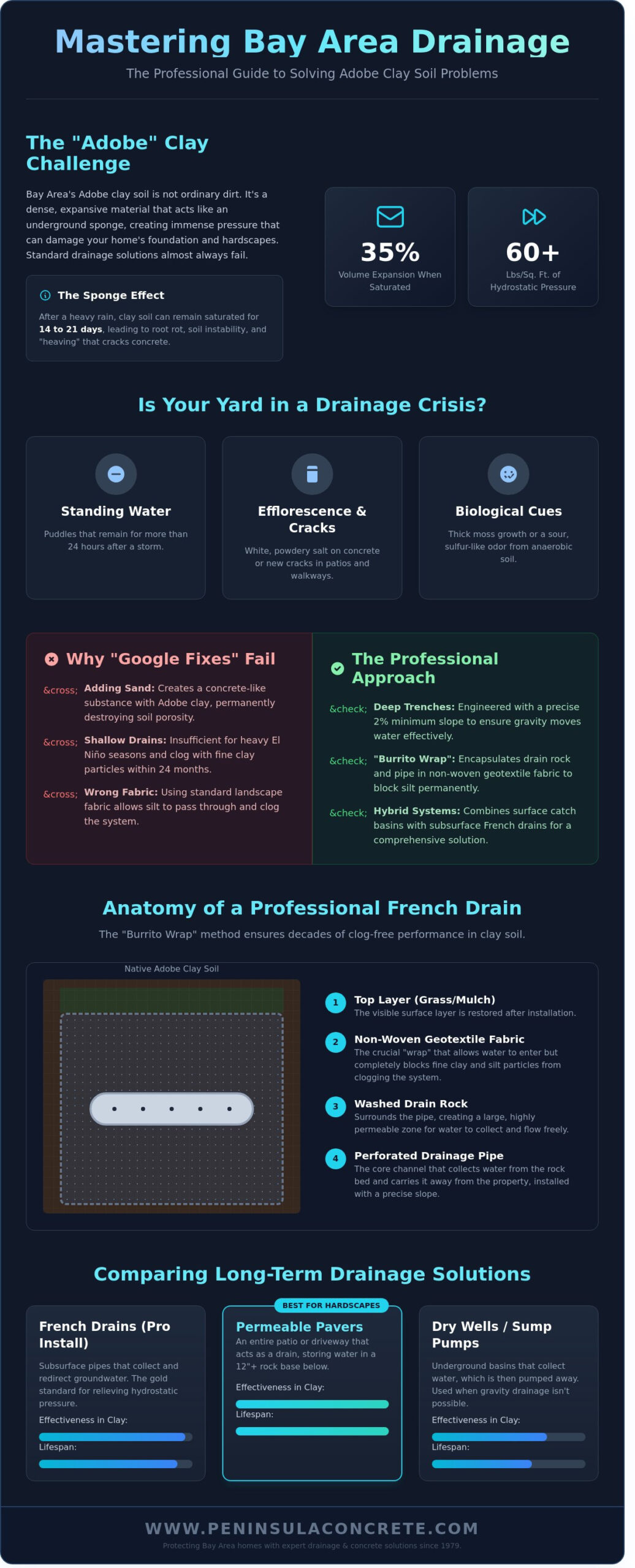
Comparing the Best Clay Soil Drainage Solutions
Choosing the right system depends on how water moves across your unique property. Since 1979, we’ve helped Bay Area homeowners move away from “quick fixes” that fail after one rainy season. Effective backyard drainage for clay soil requires a strategy that accounts for the density of the earth and the specific slope of your lot.
- French Drains: These are the standard for subsurface water. A professional installation typically costs $35 to $65 per linear foot. When installing a French drain in clay soil, we always use a non-woven geotextile filter fabric. This prevents fine clay silts from entering the pipe, extending the system’s lifespan from 5 years to over 30 years.
- Dry Wells: These act as underground storage tanks for runoff. While they cost approximately $2,800 to $4,500, they often struggle in heavy clay because the surrounding soil doesn’t “perk” or absorb water quickly enough.
- Permeable Paver Systems: This is our premium, dual-purpose solution. By using a multi-layered gravel base beneath interlocking pavers, we create a patio that doubles as a massive drainage reservoir. It’s a permanent fix that eliminates standing water while adding 15% to 20% to your home’s curb appeal.
- Sump Pumps: We view these as a last resort. If your backyard has a slope of less than 1%, gravity cannot move the water. In these cases, a heavy-duty basins and pump system is required to lift water and push it to the street discharge point.
French Drains vs. Catch Basins
You don’t always need to dig deep trenches to solve a puddle. French drains are designed to “suck” water out of saturated ground like a sponge. Catch basins are different; they are grate-topped boxes designed to catch high volumes of surface water from downspouts or low spots. In our high-silt environment, catch basins require cleaning every 6 months to remove debris, whereas a properly filtered French drain is nearly maintenance-free for decades.
The Retaining Wall Factor
Bay Area hillsides put immense pressure on landscaping. Wet clay can exert over 1,000 pounds of hydrostatic pressure per square foot against a wall. Without a dedicated drainage “chimney”—a vertical column of drain rock behind the wall—that pressure will cause the structure to lean or collapse. We’ve seen 5-year-old walls fail because they lacked this $500 upgrade. Every wall we build includes integrated weep holes and gravel backfill to ensure the structure stays upright and dry.
How to Install a French Drain in Clay Soil (The Professional Way)
Since 1979, we’ve seen countless DIY drains fail because they weren’t built for the unique demands of Bay Area clay. Installing effective backyard drainage for clay soil requires more than just digging a hole. You need a system that survives the heavy expansion and contraction cycles of our local ground. Professional installation follows a specific five-step protocol to ensure the water actually moves where it’s supposed to go.
- Step 1: Proper Trenching Depth. You must dig at least 18 to 24 inches deep. This depth gets the pipe below the “active zone” where clay shifts most during seasonal changes.
- Step 2: The Burrito Wrap. Line your trench with a high-quality non-woven geotextile fabric. This acts as a filter. It allows water to pass while preventing fine clay silts from migrating into your drainage stone.
- Step 3: Selecting Aggregate. Use 3/4″ clean crushed rock. We never use pea gravel because it lacks the structural stability to support the pipe in shifting soil. Crushed rock provides a 40% void ratio, which is essential for rapid water movement.
- Step 4: Pipe Selection. Professionals choose rigid SDR 35 or Schedule 40 perforated PVC. Flexible corrugated pipe is a mistake; it’s prone to crushing under the weight of wet clay and traps silt in its ridges.
- Step 5: Discharge Points. Verify your local codes. In San Mateo and Santa Clara counties, directing runoff onto a neighbor’s property or into the public right-of-way without a permit can lead to heavy fines.
Avoiding the “Clog” Nightmare
Raw pipe placed directly in clay soil will fail within 24 months as silt fills the perforations. We prevent this by installing 4-inch sweep clean-outs every 50 feet. These access points allow for high-pressure hydro-jetting if sediment ever builds up. It’s the only way to ensure your backyard drainage for clay soil lasts for decades rather than just a few seasons.
Grading and Soil Amendments
Apply “Concrete Thinking” to your yard’s topography. We always aim for a minimum 2% grade, which translates to a 1/4-inch drop for every foot of distance. While some homeowners try using gypsum to “flocculate” or loosen the clay, this process can take 12 months to show results. Physical grading provides an immediate solution that doesn’t rely on chemical changes in the soil. It’s about moving the water, not just managing the mud.
Don’t let standing water ruin your foundation or landscape. Contact our 2nd-generation team to design a professional drainage system that stands the test of time.
Integrating Drainage with Your Bay Area Hardscape Project
Installing a new driveway or patio without a comprehensive drainage audit is a mistake that leads to structural failure. In the Bay Area, our dense clay soil expands when wet and shrinks when dry. This movement exerts thousands of pounds of pressure on hardscape surfaces. It’s why Peninsula Concrete Contractors integrates hidden drainage systems into every paver and concrete project. Skipping this step often leads to standing water that undermines your sub-base within 24 months.
The financial math is clear. Installing backyard drainage for clay soil during a hardscape project typically adds 10% to 15% to the total cost. Conversely, retrofitting a drainage system after the concrete has cured or pavers are set can cost 300% more. This is because it requires demolition and excavation of finished work. Our team identifies these risks before the first shovel hits the ground.
In 2022, we solved a “swamp” issue for a homeowner in Redwood City. The backyard sat at the bottom of a slope, collecting runoff from three neighboring properties. We installed a 60-foot decorative retaining wall combined with a deep-trench French drain system. This transformed a muddy, unusable lot into a 1,200-square-foot functional entertaining space that stayed dry even during the record-breaking storms of early 2023.
Protecting Your Investment
Proper moisture control prevents “heaving,” where expanding clay lifts concrete slabs and causes permanent cracking. By managing backyard drainage for clay soil, we extend the life of interlocking pavers by 10 years or more. Without it, water sits in the joints and washes away the bedding sand. This causes the surface to become uneven and dangerous over time.
To see how a fourth-generation family business approaches these types of projects to protect a homeowner’s investment, you can check out Zahn Paving for examples of their concrete and asphalt work.
Start Your Project with “Concrete Thinking”
Leverage over 45 years of local experience for your next home improvement. As a 2nd-generation family-owned business, we understand the unique composition of Peninsula soil better than anyone else. We’ve provided quality work since 1979, ensuring every project is built to last. Don’t leave your property’s foundation to chance. Contact Peninsula Concrete for a Professional Drainage & Hardscape Consultation today.
SECURE YOUR LANDSCAPE AGAINST BAY AREA ADOBE CLAY
Managing backyard drainage for clay soil requires more than a simple trench. It demands a system designed to handle the unique expansion properties of “Adobe” clay found throughout the Peninsula. Since 1979, our team has installed hundreds of drainage solutions that prevent water from pooling against foundations and ruining expensive hardscapes. You’ve learned that a professional French drain or a strategically placed catch basin can save a homeowner $15,000 or more in future foundation repairs. We specialize in these technical installations to ensure your yard remains functional during the heavy winter rains.
As a 2nd-generation family-owned business, we take pride in our 45 year history of serving local neighbors with honesty and precision. We don’t believe in temporary fixes; we build systems that last. Whether you’re planning a new patio or fixing a swampy lawn, our experience with local soil conditions ensures your project succeeds on the first try. It’s time to stop worrying about the next storm and start enjoying a dry, stable backyard.
When fixing a swampy lawn, many homeowners also explore modern landscaping solutions. High-performance artificial grass from specialists like EverTurf Inc can provide a permanent, mud-free surface that pairs perfectly with an effective drainage system.
Get a Free Estimate for Your Bay Area Drainage Project
We look forward to helping you transform your property into a space you can enjoy year round.
Frequently Asked Questions
Does a French drain actually work in heavy clay soil?
A French drain works in heavy clay soil if you design it with a wider trench and use more drainage rock than usual. We recommend a 12-inch wide trench filled with 3/4-inch clean crushed stone to create a larger surface area for water to enter the pipe. Without this extra space, the dense clay particles will quickly clog the system and render it useless within 2 to 3 years.
How deep should a drainage trench be in clay soil?
Your drainage trench should typically be between 18 and 24 inches deep to effectively manage backyard drainage for clay soil. This depth allows for a 4-inch bedding of gravel, the pipe itself, and at least 6 inches of stone cover. You must maintain a minimum 2% slope, which equals a 1-foot drop for every 50 feet of pipe, to ensure water actually moves toward the discharge point.
Can I use sand to improve drainage in my clay backyard?
You shouldn’t use sand alone because mixing sand into heavy clay often creates a substance similar to low-grade concrete. This “hardpan” layer actually prevents water from soaking into the ground. If you’re looking to improve soil structure, professional landscapers suggest incorporating 3 to 4 inches of organic compost instead of sand to break up the dense soil particles.
What is the best pipe for backyard drainage in the Bay Area?
The best pipe for Bay Area homes is 4-inch rigid PVC, specifically SDR 35 or Schedule 40. We avoid corrugated black plastic because it’s prone to crushing under the weight of our heavy clay and it’s difficult to clean with a high-pressure snake. Rigid PVC handles the shifting ground common in Redwood City and San Mateo much better, often lasting 50 years or more.
How much does it cost to install a professional drainage system in Redwood City?
Professional drainage installation in Redwood City typically ranges from $3,500 to $12,000 depending on the project’s complexity. Most homeowners pay between $60 and $100 per linear foot for a complete system that includes excavation, materials, and debris hauling. Since Peninsula Concrete has been serving the area since 1979, we’ve found that investing in a high-quality system now prevents foundation repairs that can exceed $30,000 later.
Will a retaining wall help with my backyard drainage issues?
A retaining wall helps with backyard drainage for clay soil if it includes a dedicated behind-the-wall drainage system. We install a 12-inch layer of drainage gravel and a perforated pipe at the base of the wall to prevent hydrostatic pressure build-up. Without these 4-inch weep holes and proper backfill, the weight of water-saturated clay will cause a standard wall to lean or collapse within 5 to 10 years.
How do I stop water from pooling on my concrete patio?
You can stop pooling by installing a trench drain along the edge of the patio or by diamond-grinding the surface to correct the slope. A functional patio needs a minimum slope of 1/8-inch per foot to move water away from your home’s foundation. If your concrete has settled over the last 20 years, we often suggest installing a slim-profile channel drain that connects directly to your main yard drainage system.