
Last month, a homeowner in Redwood City received three vastly different quotes for their backyard renovation, leaving them more frustrated than when they started. It’s a common story in the San Francisco Peninsula, where local labor rates and complex terrain often lead to sticker shock regarding the brick patio installation cost. You likely already realize that building here isn’t the same as building anywhere else, especially when you factor in our unique hillside drainage requirements and soil stability concerns.
Understanding what to expect in 2026 requires looking beyond generic online estimators. Since 1979, our 2nd-generation, family-owned team has seen how local factors like site accessibility and material choice, such as traditional clay brick versus modern interlocking pavers, can shift a budget. We’ve written this guide to give you a clear, honest breakdown of what to expect. You’ll learn exactly what drives these prices and how to ensure your investment stands the test of time on Northern California soil.
Key Takeaways
- Understand why the average brick patio installation cost in the San Francisco Peninsula ranges from $25 to $40+ per square foot based on 2026 market trends.
- Identify how unique local factors, such as narrow site accessibility and expansive clay soil, influence your final hardscaping estimate.
- Compare the long-term maintenance and durability of traditional brick versus modern interlocking pavers to choose the best fit for your property.
- Learn why professional drainage solutions are a non-negotiable addition to protect your patio investment from heavy Bay Area rainfall.
- Discover how to vet Peninsula contractors effectively by identifying red flags in low-ball quotes and verifying local references.
Understanding Brick Patio Installation Costs in the Bay Area
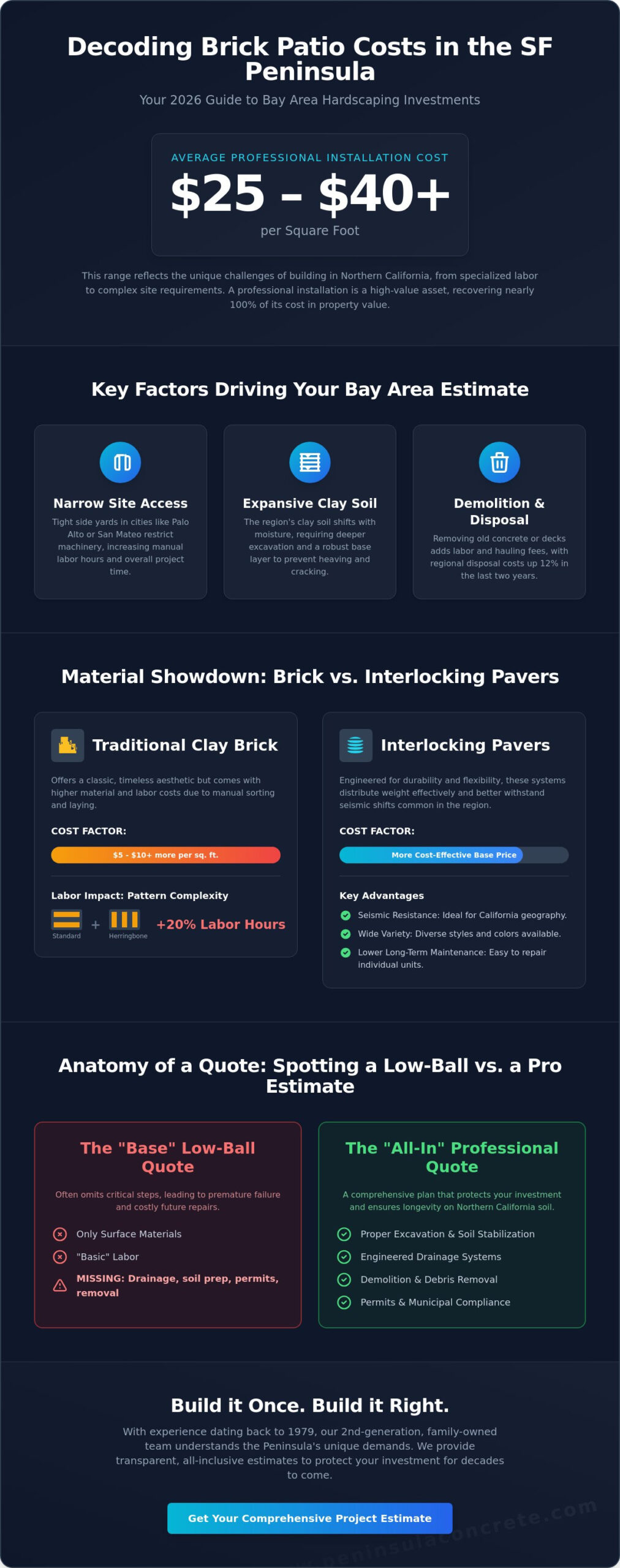
Planning a hardscaping project in 2026 requires a clear look at local economic factors. For homeowners on the San Francisco Peninsula, the average brick patio installation cost currently ranges between $25 and $40 per square foot for professional work. This price point reflects the high standard of living and the specialized craftsmanship required to build structures that last in Northern California. A professional brick patio serves as a high-value asset that recovers nearly 100% of its cost by boosting the resale value and outdoor livability of a Bay Area property.
It’s vital to distinguish between a base estimate and an all-in project total. A base estimate often covers only the surface materials and basic labor. An all-in cost includes essential site preparation such as excavation, soil stabilization, drainage systems, and debris removal. Skipping these steps in our clay-heavy soil often leads to shifting and cracking within just a few seasons. We’ve seen many DIY attempts fail because they didn’t account for the 12% increase in regional disposal fees and permit costs seen over the last two years.
The 2026 Market Reality for Peninsula Homeowners
The Bay Area construction market remains one of the most expensive in the country due to persistent labor shortages. Skilled masons are in high demand, and their expertise ensures your patio doesn’t settle unevenly. At Peninsula Concrete, we provide Quality Work Since 1979, offering a level of reliability that’s hard to find in a volatile market. Our 2nd-generation, family-owned business understands that local inflation and the rising cost of transporting heavy clay materials from Central Valley kilns directly impact your bottom line. We use our long-standing supplier relationships to keep your project on track and within the agreed budget.
Brick vs. Concrete: Why Material Choice Dictates Your Budget
While traditional clay bricks offer a classic aesthetic, they often command a higher price point due to the manual labor involved in sorting and laying them. Many homeowners are now turning to interlocking concrete pavers as a durable alternative. These units are engineered to withstand the seismic shifts common in our region. According to the technical definition of Interlocking Pavers, these systems distribute weight more effectively than a solid slab, making them ideal for the Peninsula’s geography.
- Clay Bricks: Often cost $5 to $10 more per square foot than concrete due to material scarcity.
- Custom Patterns: Complex designs like herringbone or basketweave can increase labor hours by 20% compared to a standard running bond.
- Site Access: Tight side yards in cities like San Mateo or Palo Alto may require smaller equipment, adding to the total brick patio installation cost.
Choosing the right material isn’t just about the initial check you write. It’s about how that surface performs over the next thirty years. We believe in building things once and building them right.
Key Factors That Drive Your Bay Area Hardscaping Estimate
Estimating a brick patio installation cost requires more than just measuring square footage. In the Bay Area, local geography and strict municipal codes play a massive role in the final project total. For example, many homes in Peninsula cities feature narrow side yards that limit access for heavy machinery. When a crew cannot fit a standard skid steer through a 36 inch gate, they must rely on smaller equipment or manual labor. This increases mobilization time and labor hours, which directly impacts your bottom line.
Soil composition is another critical variable. Much of the region sits on expansive California clay, which shifts during seasonal wet and dry cycles. To prevent your bricks from heaving or sinking, contractors must excavate deeper than they would in regions with stable, sandy soil. Additionally, cities like Palo Alto and San Mateo have specific requirements for site drainage and permeable surface ratios. Navigating these building codes ensures your project stays legal, but it requires professional expertise during the planning phase to avoid costly corrections later.
Don’t overlook the cost of clearing the canvas. If your backyard currently has an old, cracked concrete slab or a rotting wooden deck, demolition and removal fees will apply. Hauling away debris to local transfer stations involves disposal fees that are calculated by weight. Removing a heavy, 500 square foot concrete patio is a labor intensive process that adds to the initial project scope.
Excavation and Base Preparation
A brick patio is only as good as what lies beneath it. We believe a 4 to 6 inch compacted sub-base of crushed stone and sand is non-negotiable for longevity. This foundation prevents the shifting that leads to uneven surfaces. If your lot is sloped or features rocky terrain, the excavation process becomes more complex. Sloped yards often require retaining walls or specialized grading to ensure water flows away from your home’s foundation. Using specialized equipment for tight residential lots ensures the job gets done safely without damaging your existing landscaping.
Labor and Craftsmanship Standards
The skill level of your crew directly impacts the durability and beauty of the finished product. Hiring a licensed, bonded, and family owned construction company provides a level of accountability you won’t find with unproven laborers. Professional masons understand the nuance of pattern alignment and structural integrity.
Custom details, like hand cutting bricks for curved edges or intricate herringbone patterns, require more time and precision. A second generation masonry team brings decades of inherited knowledge to the job site. They ensure that every joint is tight and every level is true. If you’re ready to upgrade your outdoor space, you can request a professional site evaluation to get an accurate picture of your project needs.
Brick vs. Interlocking Pavers: A Cost-Benefit Analysis
Deciding between traditional clay brick and interlocking concrete pavers involves more than just the initial brick patio installation cost. While clay brick offers a timeless look, the 20-year total cost of ownership often favors interlocking systems due to their lower repair requirements. Standard clay bricks are fired at temperatures exceeding 2,000 degrees Fahrenheit, making them incredibly dense and heat-resistant. This thermal performance ensures they stay significantly cooler under the California sun than darker concrete alternatives, which is a vital comfort factor for summer afternoons in the South Bay.
The foundation choice determines the long-term success of your project. A rigid bay area concrete foundation provides a solid, non-shifting surface for mortared brick. In contrast, interlocking pavers typically rely on a flexible base of crushed stone and sand. Many homeowners worry that brick is too high-maintenance for the local climate. However, our team has provided quality work since 1979, and we’ve found that maintenance issues like weed growth or shifting are almost always the result of poor sub-grade preparation rather than the material itself.
Durability in the California Climate
Seismic flexibility is a major advantage for interlocking systems. Because these pavers aren’t bound by mortar, they move independently during ground shifts, preventing the unsightly cracks often seen in rigid slabs. Clay bricks offer superior color longevity because the hue is baked into the material, whereas concrete pavers may require UV-resistant sealants every 3 to 5 years to prevent fading. For eco-conscious San Francisco Peninsula residents, permeable interlocking options are excellent for managing heavy winter rains and meeting local drainage codes.
Aesthetic Value and Curb Appeal
High-quality hardscaping is a proven investment, often increasing a home’s resale value by as much as 12% according to recent real estate market data. Clay brick is particularly effective at matching the historic Craftsman and Mediterranean architecture found in Palo Alto and Menlo Park. Over several decades, brick develops a natural patina that adds character and depth. This aging process is a hallmark of quality that concrete rarely replicates, ensuring your patio looks better 30 years from now than it did on day one. When calculating your brick patio installation cost, consider this long-term aesthetic appreciation as part of your home’s equity.
- Clay Brick: Stays cooler, resists fading, matches historic architecture.
- Interlocking Pavers: Flexible during earthquakes, lower upfront labor, permeable options available.
- Foundation: Professional concrete bases prevent the sinking and shifting common in DIY attempts.
Essential Add-ons: Drainage and Retaining Walls
A beautiful brick patio is a significant investment in your home’s value and livability. However, the bricks you see on the surface are only half the story. If you don’t account for water management and structural support, that investment is at risk. During heavy Bay Area winters, a patio without a professional drainage system becomes a major liability. Water that pools against your home’s foundation or underneath the brickwork causes shifting, sinking, and expensive structural damage. We’ve seen these issues firsthand in projects where the initial plan ignored the natural flow of water across the property.
Our team has provided quality work since 1979, and we know that the longevity of your hardscape depends on what lies beneath. Integrating French drains or surface grates into the initial design is the most cost-effective way to handle runoff. While these additions increase the initial brick patio installation cost, they prevent the need for total reconstruction five years down the road. We focus on building patios that last for decades, not just a few seasons.
Protecting Your Investment with Proper Drainage
Common drainage pitfalls in San Mateo and Santa Clara counties often involve clay-heavy soils that don’t absorb water quickly. When we design a layout, we calculate the necessary slope to ensure water moves away from your house. Proactive water management is a fraction of the cost of foundation repair. Peninsula Concrete integrates drainage solutions, such as catch basins and perforated pipes, into every hardscape plan to keep your yard dry and your brickwork level. This 2nd-generation, family-owned approach ensures your home stays protected even during record-breaking rainfall.
Sloped Yards and Multi-Level Patios
The Peninsula’s hilly terrain frequently requires more than a simple, flat surface. If your yard has a grade of more than 10 percent, you will likely need to hire retaining wall contractors to create usable “flat land.” These walls require reinforced footings and specialized backfill to handle the immense pressure of wet soil. Terraced brick patios add a sophisticated, multi-level look to a property, but they do require a higher budget for engineering and labor.
Adding “finishing touches” also impacts the final brick patio installation cost. These include:
- Integrated seating walls for built-in entertaining space.
- Custom brick steps to transition between levels safely.
- Low-voltage LED lighting tucked into the masonry for evening ambiance.
- Permeable joint sand to help with minor water percolation.
These elements turn a basic patio into a functional outdoor room. As a local business with deep roots in the community, we take pride in helping you navigate these technical requirements. We make sure your project is both beautiful and structurally sound from the ground up.
Ready to build a patio that stands the test of time? Contact Peninsula Concrete today for an expert consultation on your drainage and masonry needs.
Hiring the Right Peninsula Contractor for Your Patio
Choosing the right builder is just as vital as the materials you select. While the brick patio installation cost is a primary factor in your decision, the cheapest quote often carries the highest long-term price tag. Low-ball estimates frequently signal red flags, such as a lack of workers’ compensation insurance or the use of sub-standard base materials that lead to sinking and shifting within two years. A reputable contractor provides a clear, itemized breakdown of every expense.
Before you sign any paperwork, ask for specific proof of their credentials and local history. You should verify their California contractor’s license and request a current Certificate of Insurance. Ask for three local references from projects completed within the last 24 months. A trustworthy firm won’t hesitate to share these details. Protect your investment by insisting on a written contract that includes a defined timeline and a milestone payment schedule. Never pay for the entire project upfront. A standard structure involves a 10% deposit, a mid-point payment after excavation and base preparation, and a final payment only when the work meets your satisfaction.
The Value of Local Experience Since 1979
We’ve built a reputation for honesty and high-quality work over the last 45 years. As a 2nd-generation, family-owned business, our roots in the Peninsula run deep. This longevity translates to a superior understanding of the Bay Area’s unique microclimates and soil conditions. Whether you are dealing with the heavy clay of Palo Alto or the sandy soil of the coast, we know how to prep the ground so your patio remains level for decades. Our established presence also means we have priority access to the best material sourcing in Northern California, ensuring your brick patio installation cost reflects the highest quality pavers available. We take pride in being a community-rooted firm that is directly accountable to our neighbors.
Getting Your Free Project Estimate
Preparation is the key to a smooth consultation. Before we visit your home, have a rough idea of your desired square footage and how you plan to use the space. Think about access points for equipment and any drainage issues you’ve noticed during winter rains. We don’t believe in high-pressure sales tactics. Instead, we focus on providing the information you need to make an informed choice. Let us help take your project from planning to success with the craftsmanship your home deserves.
Ready to transform your backyard with a durable, beautiful brick surface? Get a Free Estimate from Peninsula Concrete Contractors Today.
BRING YOUR BAY AREA PATIO VISION TO LIFE
Investing in a high quality outdoor living space requires a clear understanding of the variables involved. Your total brick patio installation cost is shaped by material choices, site accessibility, and critical infrastructure like drainage systems. Since 1979, Peninsula Concrete Contractors has helped local homeowners navigate these complexities with honest advice and superior craftsmanship. We focus on interlocking paver systems that offer the strength and flexibility needed for the Peninsula’s specific terrain.
As a 2nd-generation, family-owned business, we take immense pride in our heritage of reliability. We don’t just lay bricks; we build foundations for family memories. Our team ensures every detail, from soil compaction to final sealing, meets the high standards we’ve maintained for over 45 years. Choosing an experienced contractor means you won’t have to worry about shifting surfaces or water pooling after the first winter storm.
Start your Bay Area patio project today with a free estimate from Peninsula Concrete Contractors
We’re ready to help you transform your backyard into a durable, beautiful retreat that adds lasting value to your home.
Frequently Asked Questions
Is a brick patio more expensive than a stamped concrete patio in the Bay Area?
Brick patios generally cost more than stamped concrete in the Bay Area. While stamped concrete provides a high-end look, brick pavers require more manual labor and specialized base preparation. According to 2024 industry data from HomeAdvisor, the total brick patio installation cost often runs 20% to 30% higher than decorative concrete. We’ve seen this price gap remain consistent since our family-owned business started in 1979.
How long does it take to install a 500-square-foot brick patio?
A 500-square-foot brick patio typically takes 4 to 7 business days to install. This timeline includes site excavation, base compaction, and the precise laying of each brick. Factors like site accessibility or complex herringbone patterns can add 2 days to the schedule. Our experienced crews focus on efficiency and quality to ensure your backyard is ready for use as quickly as possible.
Do I need a permit for a new brick patio in San Mateo or Palo Alto?
You likely need a permit for a new brick patio if it exceeds specific size or drainage thresholds. In San Mateo, the Municipal Code requires a permit for any new hardscape over 400 square feet. Palo Alto has similar regulations regarding lot coverage and permeable surfaces. We recommend checking with your local building department to ensure your brick patio installation cost accounts for these necessary city fees.
Can I install a brick patio over an existing concrete slab to save money?
You can install brick over an existing concrete slab, but the slab must be in excellent condition. If the concrete has cracks wider than 0.25 inches, those issues will eventually cause the bricks to shift. This method saves on excavation costs but requires a thin sand bed or mortar set. It’s a faster way to upgrade your space without a full demolition of your old patio.
What is the most durable type of brick for the California climate?
Severe Weather (SW) grade clay pavers are the most durable choice for the Northern California climate. These bricks are fired at higher temperatures to resist moisture absorption and salt damage. Since 1979, we’ve found that these pavers withstand the Bay Area’s wet winters and dry summers without fading. They maintain their structural integrity for 50 years or more with minimal wear and tear.
How much does maintenance cost for a brick patio annually?
Annual maintenance for a brick patio typically involves cleaning and occasional joint sanding. According to 2024 reports from Angi, professional pressure washing and sealing costs average between $1 and $2 per square foot. If you handle the cleaning yourself, your costs are limited to the price of polymeric sand and a high-quality sealer. Regular upkeep prevents weed growth and keeps the colors vibrant for decades.
Does a brick patio increase my home value in the Bay Area?
A well-designed brick patio increases your home’s appeal and resale value. The 2023 Remodeling Impact Report from the National Association of Realtors shows that outdoor projects like patios can provide a 100% return on investment. In the competitive Bay Area market, high-quality hardscaping is a major selling point. It creates functional living space that buyers find highly desirable, making it a sound financial decision.