
Did you know that a mere quarter-inch of uneven concrete is all it takes to trigger a costly legal battle and an ADA violation? For Bay Area property owners, maintaining safe paths is a legal mandate under the California Streets and Highways Code. You likely worry about the threat of a “trip and fall” lawsuit or the confusion of meeting complex ADA slope requirements. It’s a common concern, especially when you realize that cities like Oakland are facing a backlog of over 5,000 sidewalk service requests as of early 2026. Investing in professional commercial concrete sidewalk repair isn’t just about curb appeal; it’s a vital strategy for proactive liability management.
We understand that you want to keep your property safe without causing a major disruption to your daily business operations. This article will teach you how to identify specific sidewalk hazards and manage repairs to ensure long-term durability and full ADA compliance. We’ll preview the essential standards for vertical displacement and cross slopes while helping you navigate the local permit process. By the end, you’ll have a clear roadmap for securing your property’s legacy and protecting the community you serve.
Key Takeaways
- Identify the critical 1/4-inch threshold for trip hazards and understand the legal implications of ADA non-compliance for California property owners.
- Learn how the Bay Area’s unique environmental factors, such as expansive clay soils and mature tree roots, specifically impact sidewalk stability.
- Determine when to choose cost-effective commercial concrete sidewalk repair methods like precision grinding versus when a full replacement is the safer investment.
- Explore specialized technical solutions, including slabjacking and site hazard mapping, designed to restore compliant slopes and ensure pedestrian safety.
- Understand the long-term benefits of partnering with a local specialist who has navigated Bay Area building codes and climate challenges since 1979.
The Risks of Damaged Commercial Sidewalks: Safety and Liability
A business’s exterior serves as its first handshake with the community. When that handshake is marred by cracked or uneven pavement, it sends a silent message of neglect to every potential customer. Beyond simple visual appeal, the structural integrity of your walkways is a matter of public safety and legal responsibility. Ignoring the need for commercial concrete sidewalk repair can lead to consequences that far outweigh the cost of routine maintenance. Even minor cracks allow water to seep into the subbase. This infiltration erodes the foundation over time, leading to expensive structural failure and deep-seated damage that’s much harder to fix later.
Understanding Trip Hazard Liability
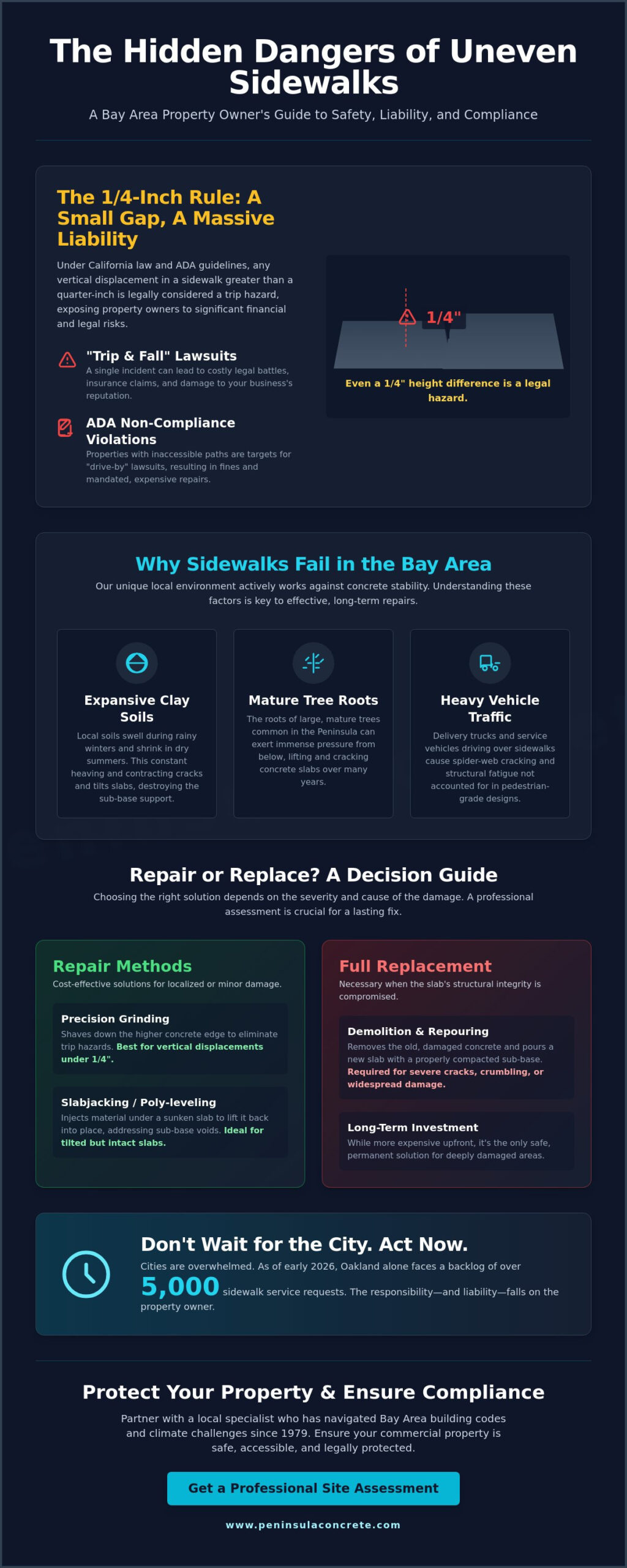
Insurance adjusters and legal professionals follow a strict standard known as the “1/4 inch rule.” Any vertical displacement exceeding one quarter of an inch is officially classified as a trip hazard. This small gap is enough to catch a heel or a walker, leading to serious injury. In the Bay Area, business owners have a “duty of care” to keep their premises safe for all visitors. Documenting regular inspections and repairs creates a paper trail of responsibility. When insurance companies see documented maintenance instead of neglected surfaces, they’re more likely to view the owner as a responsible partner. Without this record, a single trip can lead to a lawsuit that threatens your business’s financial stability.
ADA Compliance for Bay Area Businesses
The Americans with Disabilities Act (ADA) sets rigid standards for slope, width, and surface texture. In 2026, cities like Redwood City have begun tightening local code enforcement to ensure every commercial entrance is accessible to everyone. Failure to comply makes a property an easy target for “drive-by” ADA lawsuits. These legal actions often target businesses with visible gaps or steep slopes before the owner even realizes a problem exists. Understanding the fundamentals of sidewalk construction helps owners recognize when their pavement no longer meets these federal benchmarks.
Professional commercial concrete sidewalk repair addresses these risks before they escalate into litigation. A proactive approach protects your brand’s reputation and ensures that your property remains a welcoming, safe environment for everyone. By addressing minor displacement early, you avoid the heavy financial burden of total demolition and the disruption of a full-scale construction project. Keeping your walkways level is a small investment that pays dividends in peace of mind and professional integrity, much like the confidence provided by the restorative expertise of Padden Dental.
Common Causes of Sidewalk Damage in the San Francisco Peninsula
The San Francisco Peninsula presents a unique set of challenges for any paved surface. Unlike other regions where simple wear and tear are the primary concerns, our local environment actively works against the stability of our infrastructure. Understanding why slabs fail is the first step in planning an effective commercial concrete sidewalk repair. From the ground beneath our feet to the trees overhead, several factors converge to create the cracks and heaves that plague commercial properties.
The Role of Bay Area Soil Conditions
Expansive clay soils are a hallmark of our local geography. These soils act like a sponge; they swell significantly during our rainy winters and shrink during the parched summer months. This constant “wet-dry” cycle creates a rhythmic heaving that can tilt even the thickest concrete slabs. If the initial installation or a previous commercial concrete sidewalk repair didn’t include proper sub-base compaction, these movements are amplified. Over time, the sub-base loses its ability to provide uniform support, leading to the sunken or tilted sections that create dangerous trip hazards. Before committing to a fix, a reliable site assessment can determine if the underlying soil requires stabilization to prevent future movement.
Heavy commercial vehicle traffic also plays a major role in accelerating concrete fatigue. Delivery trucks, garbage collectors, and service vans frequently mount curbs or park on sidewalk sections not designed for such weight. This localized pressure causes “spider-web” cracking and structural failure much faster than pedestrian traffic alone. Meeting the technical requirements of the ADA Standards for Public Rights-of-Way becomes impossible once these environmental and mechanical stresses compromise the surface.
Vegetation and Root Intrusion Management
Our iconic urban canopy, while beautiful, is often at odds with our walkways. Local species like Eucalyptus and various Oaks have aggressive, shallow root systems that seek out moisture under concrete slabs. As these roots thicken, they exert tremendous upward pressure, easily lifting multi-ton sections of pavement. Managing this requires a delicate balance between preserving our trees and ensuring pedestrian safety. Utilizing root barriers during the repair process can direct growth downward, acting as a vital preventative maintenance tool. It’s a necessary step for property owners who want to maintain their greenery without sacrificing the integrity of their sidewalks.
Commercial Sidewalk Repair vs. Full Replacement: A Decision Guide
Choosing between a quick fix and a total overhaul is one of the most significant decisions a facility manager faces. The right choice balances immediate safety needs with long-term financial stewardship. While commercial concrete sidewalk repair often provides a cost-effective solution for localized issues, certain conditions demand a fresh start to ensure structural integrity. We’ve seen many Bay Area properties attempt to patch surfaces that were fundamentally failing, only to face higher costs down the road. Understanding the “Point of No Return” is essential for protecting both your pedestrians and your bottom line.
When to Choose Professional Concrete Repair
Professional repair is the ideal choice for addressing minor trip hazards, surface spalling, or isolated cracks that haven’t yet compromised the entire slab. Techniques like precision concrete grinding or specialized patching can restore a level surface in a fraction of the time required for a full pour. This approach is particularly effective for meeting ADA requirements when the rest of the walkway remains sound. It allows you to stretch your facility budget without compromising the safety of your visitors. For those looking to understand the fundamental steps of this process, our sidewalk repair contractors guide offers a deeper look at restoration concepts.
Signs Your Commercial Sidewalk Needs Full Replacement
Every paved surface eventually reaches a stage where repairs are no longer viable. This occurs when the cost of ongoing maintenance exceeds 50% of the cost of a full replacement. You should consider a complete pour if you observe deep alligator cracking, significant sub-base erosion, or structural failure across multiple sections. While a repair might fix a surface gap, it cannot solve a collapsing foundation caused by the soil issues discussed earlier. A new concrete installation typically offers a 25-year lifespan, providing a “reset button” for your property’s liability profile. You can find more details on structural concrete standards in our guide on Bay Area concrete driveways.
Business Interruption and ROI
Time is a critical factor for any active business. A standard commercial concrete sidewalk repair can often be completed in a single day, allowing foot traffic to resume almost immediately. In contrast, a full replacement involves demolition, sub-base preparation, pouring, and a multi-day curing period. This downtime can disrupt operations and redirect customer traffic. However, if the slab is fundamentally unstable, a repair is merely a temporary bandage. We recommend replacement when the safety risks are systemic. This ensures that your investment provides decades of reliable service rather than a few years of frequent, recurring patchwork.
The Professional Repair Process and ADA Standards
A successful commercial concrete sidewalk repair project starts long before the tools come out. It begins with a meticulous site survey and hazard mapping. We identify every point of non-compliance, marking vertical displacements and measuring slopes to ensure nothing is missed. This diagnostic phase is crucial for businesses. It provides a clear record of the existing conditions and a roadmap for restoration. By pinpointing specific problem areas, we focus our efforts where they matter most, saving you time and preventing unnecessary demolition.
Modern restoration techniques offer surgical precision that traditional methods often lack. Precision concrete grinding is a primary tool for addressing those hazardous lips where slabs have shifted. Using diamond-tipped blades, we shave down the high side of a joint to create a smooth, tapered transition. For sunken slabs, we utilize slabjacking. This process involves injecting specialized high-density foams beneath the concrete to lift it back to its original grade. These methods are efficient and clean, allowing your business to remain accessible while the work is performed.
Step-by-Step Commercial Restoration
Our process begins with deep cleaning and surface preparation. We remove all debris and loose material to ensure a permanent bond for our industrial-grade fillers. We use high-strength patching compounds designed to withstand the heavy traffic of a commercial environment. These materials are chosen for their durability and slip-resistant properties. Once applied, the curing process is remarkably fast. In many cases, your customers can safely walk on the repaired surface within a few hours, minimizing the downtime for your storefront or office complex.
Ensuring Long-Term ADA Compliance
Meeting the strict 2026 standards for accessibility requires more than just a level surface. We carefully measure cross-slopes to ensure they don’t exceed the 2% maximum allowed under federal guidelines. Running slopes are also monitored to stay within the 5% threshold before handrails would be required. Eliminating vertical lips and filling wide gaps ensures that wheelchairs and strollers have a continuous, unobstructed path. We provide detailed documentation of these corrections, which serves as a vital shield for your business’s liability and insurance records. To protect your property and ensure your walkways meet these rigorous benchmarks, schedule a professional site survey with our experienced team today.
Finishing is the final, essential step in the repair cycle. We ensure the texture of the repaired area matches the surrounding concrete as closely as possible. This creates a uniform look that preserves your property’s professional aesthetic. More importantly, we verify that the surface remains slip-resistant even when wet. A well-executed repair is nearly invisible to the untrained eye, but it provides a foundation of safety that lasts for years. Our commitment to quality means we don’t just patch a hole; we restore the integrity of your entire walkway.
Why Peninsula Concrete Contractors is the Bay Area’s Trusted Partner
Since 1979, Peninsula Concrete Contractors has been a cornerstone of the local construction landscape. We aren’t a faceless corporation. We are a multi-generational, family-owned enterprise with a personal stake in the safety and beauty of our neighborhoods. When you choose us for commercial concrete sidewalk repair, you’re partnering with seasoned craftsmen who take immense pride in their work. Our deep understanding of local building codes and the unique Bay Area climate ensures that every project we touch is built to last. We don’t just patch surfaces; we provide solutions that stand the test of time.
Our expertise extends beyond the surface of the concrete. As discussed in earlier sections, water infiltration and sub-base erosion are silent killers of commercial walkways. Because we specialize in drainage system installation alongside our concrete work, we can address the root cause of your sidewalk failure. This holistic approach prevents recurring issues and protects your investment from the ground up. We bring the same level of integrity to a small repair as we do to a massive installation project. Our reputation is built on being dependable, honest, and community-rooted.
A Legacy of Quality in Redwood City and Beyond
Our roots in Redwood City run deep. We’ve spent decades building relationships with property managers and business owners across the Peninsula. This local expertise is vital when hiring landscape contractors and concrete professionals who truly understand regional soil challenges. We invite you to explore our 40-year history of quality to see how our commitment to excellence has shaped the Bay Area. We believe that professional, trustworthy service is the only way to do business. Our legacy is your assurance of a job done right.
Get Your Free Commercial Estimate Today
Don’t wait for a trip hazard to become a legal liability or for the next rainy season to worsen existing cracks. We offer a transparent bidding process designed specifically for the needs of commercial property managers. Our team provides clear, declarative assessments that help you make informed decisions about your property’s maintenance. Take a proactive step toward securing your site today. Contact Peninsula Concrete Contractors for a professional site evaluation and a comprehensive estimate for your commercial concrete sidewalk repair needs. Let us help you maintain a safe, accessible, and professional environment for your customers and employees alike.
Secure Your Property’s Safety and Professional Reputation
Managing a commercial property involves more than just keeping up appearances. It’s about protecting your visitors and your business from the hidden risks of neglected walkways. You now understand how local soil conditions and tree roots actively challenge your infrastructure. By choosing professional commercial concrete sidewalk repair, you address these hazards before they escalate into costly legal issues or structural failures. This proactive approach saves your budget and ensures that your property remains fully accessible to everyone in our community.
Our team has been serving the San Francisco Peninsula since 1979. We bring a specialized understanding of local soil conditions and an A+ reputation for delivering ADA-compliant repairs. We believe in providing honest, durable solutions that reflect our multi-generational commitment to this region. Don’t leave your property’s safety to chance or wait for an inspection notice to arrive. Request a Free Commercial Sidewalk Inspection today to ensure your walkways remain a reliable asset. We look forward to helping you build a safer, more accessible future for your Bay Area business.
Frequently Asked Questions
How much does commercial concrete sidewalk repair cost?
The total investment for restoration depends on the specific method used and the extent of the damage. Factors such as the total square footage, the depth of the cracks, and the complexity of the site access all influence the final bid. We provide transparent, detailed estimates that help property managers plan their maintenance budgets without hidden surprises.
What is the 1/4 inch rule for sidewalk trip hazards?
The 1/4 inch rule is the official standard used to define a trip hazard under ADA guidelines. Any vertical displacement between two adjacent sidewalk sections that exceeds this height must be mitigated. This standard is strictly followed by insurance adjusters and legal professionals to determine property owner liability if a pedestrian is injured on your premises.
Can I repair a sidewalk myself to meet ADA standards?
Attempting a DIY fix to meet ADA standards is not recommended for commercial properties. Federal and local accessibility codes are highly technical and require precise measurements for cross-slopes and running slopes. Hiring a professional ensures that your commercial concrete sidewalk repair meets all legal benchmarks, protecting you from potential lawsuits and code violations.
How long does a commercial sidewalk repair typically take?
Most commercial restoration projects can be completed in a single day. While a full replacement requires several days for demolition and curing, specialized techniques like precision grinding or patching allow for a quick turnaround. This efficiency minimizes business interruption and ensures that your storefront or office entrance is safe for customers by the next business morning.
Will my insurance cover commercial sidewalk repairs?
Coverage for sidewalk work depends entirely on your specific commercial insurance policy. Some policies may cover damage caused by sudden, accidental events, but most view routine maintenance as the property owner’s responsibility. It’s best to consult with your agent to understand how documented repairs can help lower your liability risks and potentially impact your long-term premiums.
What is the difference between concrete grinding and slabjacking?
Concrete grinding involves shaving down the raised edge of a slab to create a level, tapered transition. Slabjacking is a lifting process where specialized material is injected beneath a sunken slab to raise it back to its original grade. Both methods are effective for commercial concrete sidewalk repair, but the choice depends on whether the slab has heaved or settled.
How often should commercial sidewalks be inspected for damage?
Commercial walkways should undergo a thorough safety inspection at least once per year. Properties with heavy delivery truck traffic or mature trees may require more frequent checks, especially after the winter rainy season. Regular monitoring allows you to catch minor displacement before it reaches the hazardous 1/4 inch threshold, saving you from more expensive structural failures later.
Do I need a permit for commercial sidewalk repair in the Bay Area?
Most cities in the Bay Area require a permit for sidewalk work that involves significant removal or replacement of concrete. Minor repairs like precision grinding might not always require a full permit, but it is essential to check local ordinances in cities like San Francisco or San Jose. Working with an established contractor ensures that all necessary paperwork and inspections are handled correctly.