
Imagine waking up after a heavy 3-inch rainstorm to find your tiered backyard has shifted 2 inches closer to your patio. For many homeowners on the San Francisco Peninsula, this isn’t a hypothetical fear but a seasonal reality caused by steep terrain and unstable soil. You likely already know that a standard DIY timber wall won’t cut it when the next seismic event hits. Professional concrete garden wall construction is the only way to transform a precarious slope into a permanent, usable asset that adds genuine value to your home.
At Peninsula Concrete, we’ve provided quality work since 1979, and we understand that a wall must be as resilient as it is beautiful. This guide gives you the exact blueprint to master the technical and aesthetic essentials of building seismic-ready structures tailored for our local landscape. You’ll learn how to navigate the 2026 Redwood City and San Mateo County building codes, select reinforcement that prevents shifting, and finally secure the flat garden space your property deserves. We’ll walk through the permitting process and engineering requirements to ensure your investment stands firm for the next 50 years.
Key Takeaways
- Learn to distinguish between decorative and structural walls to effectively manage erosion on the San Francisco Peninsula’s unique hilly terrain.
- Compare the seismic durability and aesthetic impact of poured concrete versus interlocking blocks for your concrete garden wall construction project.
- Discover how to engineer footings that withstand expansive “Adobe” clay soil and meet strict local seismic safety standards to prevent wall failure.
- Master the essential steps for professional installation and navigate the “4-foot rule” to ensure your project meets San Mateo and Santa Clara county codes.
Understanding Concrete Garden Wall Construction in the Bay Area
In the Bay Area, the land rarely sits flat. From the steep inclines of San Mateo to the rolling hills of Redwood City, homeowners face unique topographical challenges. Professional concrete garden wall construction isn’t just about defining a property line; it’s a vital tool for erosion control. Since 1979, we’ve seen how the Peninsula’s heavy seasonal rains can shift unreinforced soil, leading to costly landscape damage. A well-placed wall stabilizes the earth and creates usable flat space where there was once only a slope.
Modern landscape architecture in Northern California relies on these structures to bridge the gap between form and function. For Redwood City properties, installing high-quality concrete walls increases curb appeal and contributes to long-term equity. Real estate data indicates that professional hardscaping can provide a return on investment of 100% to 150% when it’s time to sell. By choosing a 2nd-generation, family-owned business for your concrete garden wall construction, you ensure your project benefits from decades of local expertise and a commitment to durability.
Garden Walls vs. Retaining Walls: What You Need
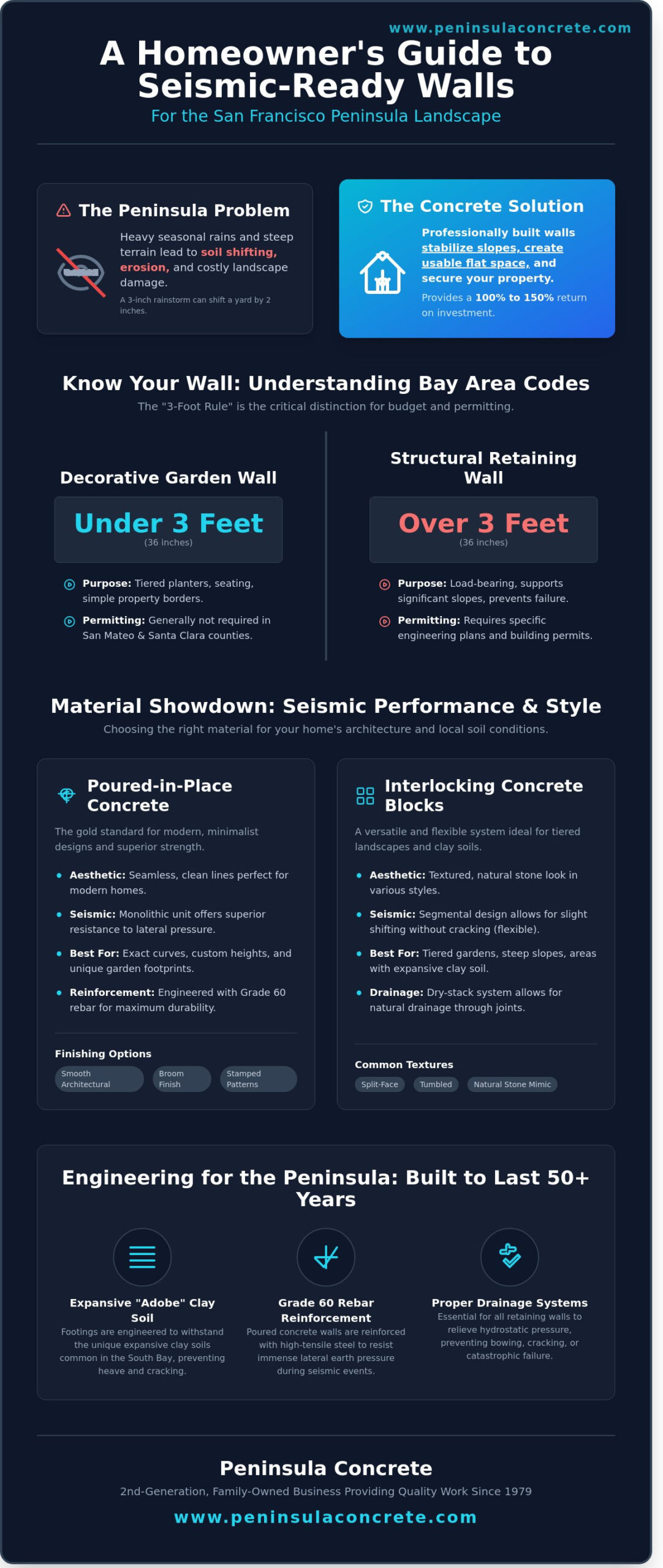
Knowing the difference between a decorative garden wall and a structural retaining wall is essential for your budget and permitting. Most Bay Area building codes use a 3-foot height threshold as the deciding factor. If a wall stays under 36 inches, it’s generally considered a decorative garden wall. These are perfect for tiered planters, seating walls, or simple property borders. Once a wall exceeds 3 feet or supports a significant slope, it becomes a load-bearing retaining wall. These require specific engineering to handle the lateral pressure of the soil. We build both types with the same level of precision to ensure they don’t lean or crack over time.
The Aesthetic Advantage of Concrete
Concrete offers a level of versatility that wood or dry-stack stone can’t match. You can choose sleek, minimalist lines for a modern look or textured finishes that mimic natural stone. For a cohesive design, we often recommend matching your wall’s finish to existing interlocking concrete pavers. This creates a unified aesthetic across your driveway, walkways, and patio. Our color-matching techniques allow us to complement the specific architectural styles found in local neighborhoods, from mid-century modern to traditional California ranch homes. We’ve built a reputation for honesty and high-quality work, ensuring your project looks fantastic for decades.
Material Selection: Poured Concrete vs. Interlocking Blocks
Choosing the right material for your concrete garden wall construction depends on your home’s architectural style and the specific topography of your Peninsula lot. Since 1979, we’ve seen that homeowners prioritize both durability and aesthetic harmony. Poured concrete offers a seamless, high-end look that complements mid-century modern homes in Hillsborough or Palo Alto. Interlocking blocks provide a versatile, textured solution for tiered landscapes in San Mateo or Belmont.
In the Bay Area, seismic performance is non-negotiable. Poured walls act as a single, monolithic unit. When reinforced with Grade 60 rebar, they offer superior resistance to lateral earth pressure. Interlocking systems, known as segmental retaining walls (SRW), are designed to be flexible. They shift slightly during minor tremors without cracking; this makes them a reliable choice for areas with expansive clay soils found in many South Bay neighborhoods.
Poured-in-Place Concrete Walls
This method is the gold standard for modern San Francisco Peninsula designs. It provides a clean, minimalist aesthetic that is impossible to replicate with pre-cast units. We offer various finishing options like smooth architectural surfaces, broom finishes for traction, or custom stamped patterns. Because these walls are cast on-site, they allow for exact curves and custom heights that fit your garden’s unique footprint perfectly. It’s a premium choice that reflects the quality work we’ve provided since 1979.
Interlocking Concrete Block Systems
Segmental retaining walls have gained popularity for tiered gardens due to their efficient installation. These dry-stack systems don’t require mortar, which allows for natural drainage through the joints. They come in various styles, including split-face and tumbled textures that mimic natural stone. For homeowners looking to manage steep slopes or create functional garden beds, these blocks offer a dependable, cost-effective solution that handles soil movement gracefully.
Over a 20-year horizon, poured concrete typically retains a higher cost-to-value ratio. While the initial investment might be 20% to 30% higher than block systems, the custom nature and structural integrity often lead to a 15% higher boost in property appraisal values. Coastal climates require specific care. Our salt-resistant sealants protect finishes from the damp Pacific air, ensuring your investment looks fantastic for decades. When planning your concrete garden wall construction, consider how the finish will age in the salt-rich air of the Peninsula. If you’re ready to evaluate your site’s specific needs, start your project today with a team that understands local conditions.
Engineering for the Peninsula: Soil, Drainage, and Seismic Safety
Building a wall in the Bay Area isn’t just about aesthetics. It’s about outsmarting the unique geological challenges of the Peninsula. From the expansive clays of Palo Alto to the seismic activity near the San Andreas Fault, your concrete garden wall construction requires a foundation built on physics and local experience. We’ve seen how the regional environment treats poorly built structures since 1979, and we know that shortcuts lead to cracks and leaning within just a few seasons.
Managing Bay Area Clay Soil
Much of our region sits on “Adobe” soil, a heavy clay that expands significantly when wet and shrinks during our dry summers. This volume change exerts massive pressure on footings. To bypass this cycle, we dig footers deep into stable subsoil, often reaching depths of 18 to 24 inches. We always install a 6-inch layer of compacted Class 2 aggregate base to provide a level, non-expansive platform. If you’re building on a slope steeper than a 2:1 gradient, it’s a smart move to consult a geotechnical engineer to test soil load-bearing capacity before we pour.
Critical Drainage Systems
Hydrostatic pressure is the primary cause of masonry failure. When rainwater saturates the soil behind a wall, it can weigh over 60 pounds per cubic foot. Without an exit strategy, that water will eventually push your wall over. Our standard builds include a multi-layered approach to moisture management:
- Perforated Drain Pipes: We install 4-inch SDR-35 perforated pipes at the base of the wall to collect subsurface water.
- Crushed Stone Backfill: A 12-inch wide column of 3/4-inch clean crushed stone ensures water flows down to the pipe rather than sitting against the concrete.
- Filter Fabric: This prevents fine clay particles from clogging the drainage stone and maintains long-term flow.
- Weep Holes: We place these every 4 to 6 feet along the base of the wall for immediate pressure relief during heavy winter storms.
Structural safety becomes even more complex as height increases. In California, any wall over 4 feet tall requires a building permit and engineered drawings. The seismic reinforcement needed for these heights involves specific rebar spacing and Grade 60 steel to handle lateral earth movement during a tremor. Because of these legal and safety requirements, hiring retaining wall contractors is vital for any project exceeding the 48-inch threshold. As a 2nd-generation, family-owned business, we ensure every project meets these rigorous local standards to protect your property for decades.
The 5-Step Process for Professional Garden Wall Construction
Success in concrete garden wall construction depends on what stays hidden beneath the surface. At Peninsula Concrete, we’ve refined this five-step process since 1979 to ensure every structure withstands the unique soil shifts of the San Francisco Peninsula. A wall is only as reliable as its foundation, and skipping even a minor detail in the early stages leads to leaning or cracking within 3 to 5 years.
Step 1-2: Foundation and Base Prep
Before the first shovel hits the dirt, we mark all underground utilities by coordinating with 811 services. In areas like Redwood City, frost lines are minimal, but soil stability is a major concern. We excavate trenches 12 inches deep to reach firm, undisturbed subgrade. This depth allows for a robust leveling pad of crushed stone.
- 95% Compaction: We use vibratory plate compactors to reach 95% Standard Proctor density on the base material. This density is the industry standard for preventing the 1-inch or 2-inch shifts that ruin wall alignment.
- The Buried Course: The first layer of concrete block must be partially buried. Setting the first course 3 to 6 inches below the finished grade provides the lateral resistance needed to keep the wall from “kicking out” at the bottom.
- Precision Leveling: We check for level every 4 feet. If the base isn’t perfectly flat, every subsequent row will magnify the error.
Step 3-5: Rising and Reinforcing
Once the base is set, the wall begins to take shape. For any concrete garden wall construction project exceeding 36 inches in height, we integrate geogrid. This high-tenacity mesh extends 3 to 4 feet into the backfill soil, acting as an anchor that prevents the weight of the earth from pushing the wall forward.
We secure the top capstones using high-strength masonry adhesive or vertical rebar reinforcement for poured-in-place designs. This ensures the heavy caps don’t dislodge if someone sits on the wall. The final phase involves backfilling with 3/4-inch clean crushed stone to facilitate drainage. We finish the project by grading the topsoil to a 2% slope. This specific angle directs surface water away from the wall face, which protects the structural integrity for the long haul.
Our family-owned business brings decades of local expertise to every backyard. Contact our 2nd-generation team at Peninsula Concrete to request a professional estimate for your landscape project.
Planning Your Project: Permitting and Hiring in the Bay Area
Successful concrete garden wall construction requires more than just pouring cement; it demands a clear understanding of the regulatory landscape in Northern California. In San Mateo and Santa Clara counties, the 4-foot rule is the standard benchmark. If your wall exceeds 4 feet in height, measured from the bottom of the footing to the top of the wall, you must obtain a building permit. This height limit is strictly enforced to ensure structural safety in our seismically active region. You should also review local zoning ordinances for property line setbacks. In many Peninsula neighborhoods, front yard walls are limited to 3 feet in height to maintain street visibility. Reading these ordinances carefully prevents costly teardowns and legal headaches later.
Local Permit Requirements
You’ll need a structural engineer’s stamp for your garden wall if it exceeds the 4-foot threshold or if it supports a “surcharge,” such as a driveway or a steep slope. In Redwood City, specific building permit triggers apply to hardscaping projects that alter more than 500 square feet of surface area. Beyond city codes, Homeowners Association (HOA) rules often dictate specific materials and colors. Always verify that your chosen concrete finish aligns with your HOA’s architectural guidelines before the first truck arrives. This step is vital for staying compliant with community standards and avoiding fines.
Choosing a Local Specialist
Hiring a contractor with deep roots in the community makes a difference in project longevity. Peninsula Concrete is a 2nd-generation, family-owned business that has delivered quality work since 1979. This 45-year history provides a unique understanding of local soil conditions from Woodside to Palo Alto. Ask potential hires if they handle drainage and grading directly. A reputable team takes these burdens off your shoulders to ensure long-term success. Accountability is always higher when the business owners live in the same community where they work.
Moving from the planning phase to a finished product requires a professional estimate that accounts for every variable. A detailed quote should include site preparation, material costs, and labor for the entire concrete garden wall construction process. We pride ourselves on being a dependable choice for homeowners who value proven expertise over unproven alternatives. Let us help take your project from the planning stage to a successful completion. Our reputation for honesty and high-quality work is built into every yard of concrete we pour.
BUILDING A LASTING LEGACY FOR YOUR BAY AREA LANDSCAPE
Securing your property for 2026 and beyond requires a deep understanding of the San Francisco Peninsula’s unique environment. You’ve learned that successful concrete garden wall construction depends on three critical pillars: precise seismic engineering, strategic drainage systems, and the right material selection for your specific soil type. Whether you opt for the sleek strength of poured concrete or the versatile utility of interlocking blocks, your choice will define your home’s curb appeal for decades. Navigating the local permitting process early ensures your project stays on track and meets every safety code.
Peninsula Concrete has provided quality work since 1979. We’re a 2nd-generation family-owned business with 45 years of local expertise in hardscaping. Our team follows a proven 5-step process to ensure your installation is handled with the professional care it deserves. We’ve built a reputation for honesty and durability that stands the test of time. Don’t leave your property’s structural integrity to chance when you can rely on a team with a local heritage of excellence.
Get Your Free Garden Wall Estimate from Peninsula Concrete Today
We look forward to helping you transform your outdoor space into a safe and beautiful retreat.
Once the dust settles and your new landscape is complete, it’s time to relax and enjoy the fruits of your labor. And if your travels ever take you to the East Coast, you can find that same commitment to quality in other domains. For a taste of authentic Thai cuisine in Queens, NY, you can check out Erawan Thai Bayside.
Frequently Asked Questions
Do I need a permit for a garden wall in Redwood City?
You need a building permit in Redwood City if your wall exceeds 4 feet in height. This measurement includes the portion of the wall buried underground for the footing. If the wall supports a slope or a driveway, the city requires a permit regardless of the height. We recommend checking the Redwood City Building Division’s 2024 guidelines to ensure your project complies with all local safety codes.
How much does concrete garden wall construction cost per linear foot?
Concrete garden wall construction typically costs between $150 and $300 per linear foot in the Bay Area for 2026. For a standard 3 foot high wall, homeowners should budget approximately $225 per foot for materials and labor. These figures fluctuate based on soil conditions and the decorative finish you choose. Our team provides detailed estimates to help you plan your backyard improvements with confidence and precision.
What is the best material for a garden wall on a steep Bay Area slope?
Reinforced poured-in-place concrete is the most reliable material for managing steep Bay Area slopes. This method uses steel rebar and deep footings to resist the lateral pressure of shifting soil. While timber or dry stack stone might look nice, they often fail under the 45 percent inclines found in Peninsula neighborhoods. Since 1979, we’ve found that solid concrete provides the 50 year lifespan homeowners need for hillside stability.
How long does it take to build a typical concrete garden wall?
A standard 50 foot garden wall usually takes 7 to 10 working days to complete from excavation to finishing. This timeline includes 2 days for trenching and steel reinforcement, 1 day for the concrete pour, and several days for the curing process. Weather conditions in San Mateo County can impact this schedule, but our experienced crew maintains a steady pace to keep your project on track and your yard clean.
Can I build a garden wall myself or should I hire a contractor?
You should hire a licensed contractor for any wall over 3 feet tall or any structure retaining soil. Professional builders understand the specific soil expansion rates in the Bay Area, which can reach 10 percent in clay-heavy regions. DIY projects often lack the proper 12 inch deep footings required to prevent sinking or tilting. Hiring a 2nd-generation family business ensures your wall meets engineering standards and lasts for decades.
Why is my existing garden wall leaning or cracking?
Your wall is likely leaning because of hydrostatic pressure caused by poor drainage or inadequate footings. When water builds up in the soil behind the wall, it exerts thousands of pounds of force that pushes the structure forward. Over 60 percent of wall failures we see are due to the lack of crushed rock backfill. If you notice a 1 inch tilt, it’s time to consult a professional for a structural assessment.
How do I ensure my garden wall is earthquake-safe?
You ensure earthquake safety by using Grade 60 steel reinforcement and footings that extend below the frost line. In seismic zones like the San Andreas Fault area, we use 1/2 inch rebar spaced every 12 inches to provide necessary structural integrity. This allows the concrete garden wall construction to flex slightly during a tremor without collapsing. Properly engineered walls are designed to withstand 7.0 magnitude events common in our local history.
What are the best drainage options for a concrete wall?
The most effective drainage system uses a 4 inch perforated pipe wrapped in filter fabric and surrounded by 12 inches of clean gravel. We also install weep holes every 4 to 6 feet along the base of the wall to allow trapped moisture to escape. These components prevent water from weighing down the soil and causing structural damage. Our proven methods have protected Peninsula homes from heavy winter rains for over 45 years.