
What if the online quote you just received is missing a $4,800 “Bay Area reality” adjustment? Most homeowners start their backyard planning feeling optimistic, only to be sidelined by the unique challenges of the San Francisco Peninsula. Between the expansive clay soils that cause premature cracking and the complex permit requirements in cities like Palo Alto or San Mateo, a generic concrete patio cost estimator often fails to provide the full picture. It’s frustrating to plan for a project only to find the actual price tag is 25% higher than expected due to local labor costs or site prep needs.
At Peninsula Concrete Contractors, we’ve delivered quality work since 1979. As a 2nd-generation, family-owned business, we believe you deserve an honest look at what it takes to build a patio that lasts. This guide provides a realistic 2026 budget framework, covering everything from basic broom finishes to high-end decorative stamps. We’ll break down local labor rates, explain how to handle hidden fees, and show you how to mitigate soil risks. You’ll gain the clarity needed to find a reputable contractor and ensure your new outdoor space delivers a fantastic return on investment for decades.
Key Takeaways
- Learn why national averages fall short and how the “Bay Area Premium” and local soil conditions dictate your actual construction budget.
- Use our concrete patio cost estimator insights to navigate the price tiers between functional broom-finish slabs and high-end stamped masterpieces.
- Identify “invisible” expenses like site demolition, drainage grading, and California permitting that are essential for a durable, foundation-safe installation.
- Compare the long-term value of poured concrete against interlocking pavers by analyzing maintenance cycles and initial investment costs.
- Discover why on-site consultations are the only way to get an honest quote backed by our family-owned legacy of quality work since 1979.
Why National Concrete Patio Cost Estimators Fail Bay Area Homeowners
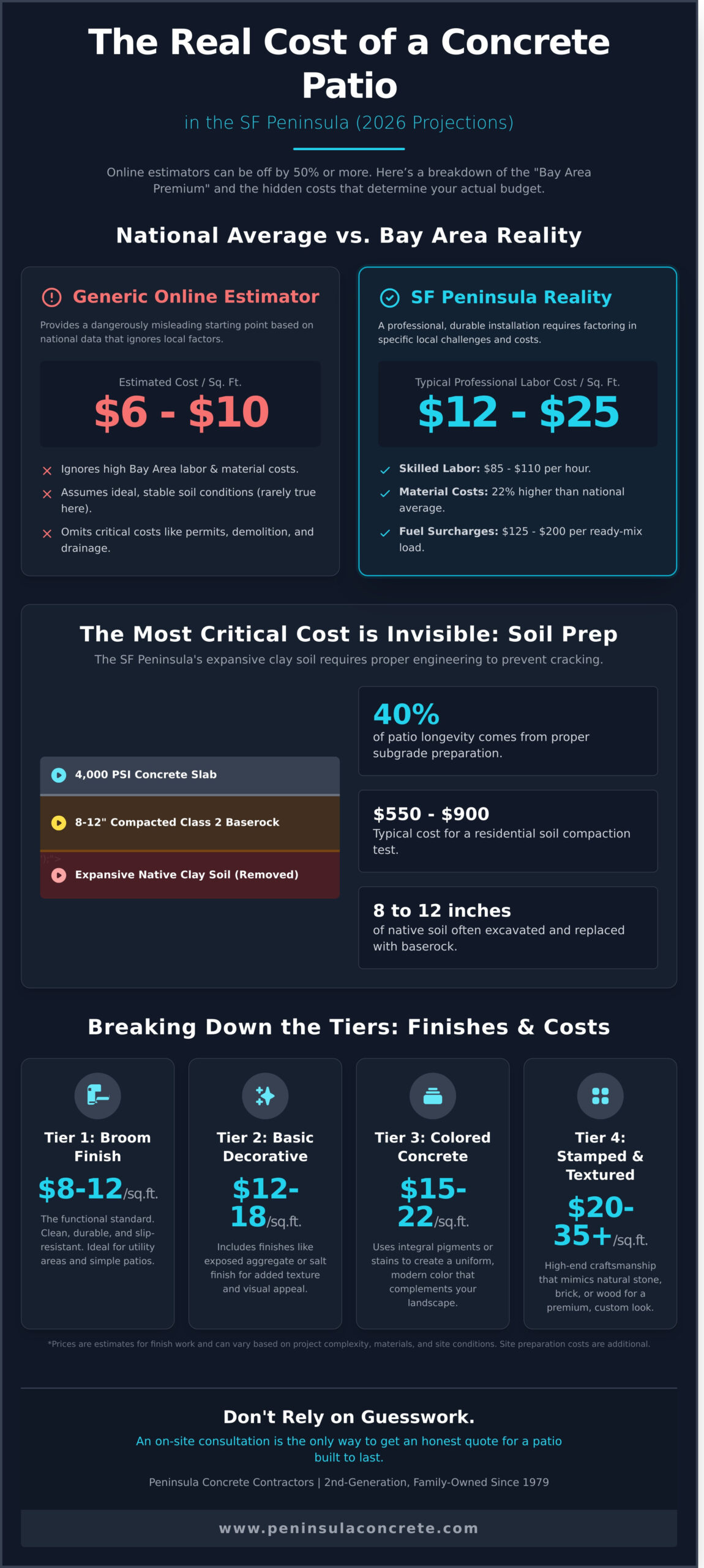
Most homeowners start their project by searching for a generic concrete patio cost estimator online. These tools usually provide a national average of $6 to $10 per square foot. On the San Francisco Peninsula, these numbers are dangerously misleading. Since 1979, Peninsula Concrete has seen how local economic factors and geography create a “Bay Area Premium” that national data sets ignore. A basic search for What is Concrete? explains the material’s composition, but it won’t tell you about the 15% increase in local permit fees or the logistical complexity of hauling heavy equipment through narrow residential streets in San Mateo or Burlingame.
The Reality of Local Labor and Material Rates
In 2026, labor trends for specialty concrete contractors in Redwood City show a significant departure from national norms. Skilled finishers in our region now command $85 to $110 per hour. This reflects the high cost of living and the specialized training required for high-end architectural finishes. When you calculate your budget, you must account for these specific local realities:
- Labor Costs: Expect to pay $12 to $25 per square foot for a professional installation, depending on the finish complexity.
- Fuel and Transportation: Ready-mix suppliers on the Peninsula now apply fuel surcharges ranging from $125 to $200 per load to navigate heavy 101 and 280 traffic.
- Material Availability: High demand for low-carbon concrete mixes in California has pushed local material costs 22% higher than the national average as of January 2026.
Using a standard concrete patio cost estimator often results in a 50% budget shortfall because it doesn’t factor in these regional surcharges. We believe in honesty from the start. A “cheap” quote usually means a contractor is cutting corners on insurance or using a lower-grade mix that won’t survive five years of seasonal shifts.
The Impact of SF Peninsula Soil on Your Budget
The ground beneath your feet dictates the price of your project more than the concrete itself. Much of the SF Peninsula sits on expansive clay soil. This material acts like a sponge; it expands when it rains and shrinks during our dry summers. National estimators assume you’re pouring on stable, sandy loam, which is rarely the case here. If a contractor offers a “dump and run” slab without addressing the soil, the patio will likely crack within two rainy seasons.
Professional soil stabilization is a non-negotiable expense for a quality build. In 2026, a residential soil compaction test in Menlo Park typically costs between $550 and $900. We often have to excavate 8 to 12 inches of native soil and replace it with compacted Class 2 baserock to ensure stability. Subgrade preparation is 40% of patio longevity because it prevents the shifting and cracking common in our local clay-heavy terrain.
Our 2026 pricing reflects a shift toward these engineered solutions. We don’t just pour a slab; we build a foundation. Modern homeowners now prioritize 4,000 PSI mixes and integrated rebar grids over the thin, unreinforced “builder grade” concrete common in the 1990s. This commitment to durability ensures your investment remains beautiful and functional for decades, matching the high standards we’ve maintained as a 2nd-generation, family-owned business.
Breaking Down the Tiers: From Basic Slabs to Stamped Masterpieces
A reliable concrete patio cost estimator must account for more than just square footage. It has to factor in the level of craftsmanship and the specific materials required for your desired finish. At Peninsula Concrete Contractors, we’ve provided quality work since 1979. Our 2nd-generation, family-owned team understands that every backyard has a unique potential, and matching your budget to the right tier is the first step toward a successful installation.
Professional concrete work isn’t just about pouring a wet mix; it’s about engineering a foundation for your home’s outdoor life. Prices in 2026 reflect a shift toward high-durability materials that withstand the California climate. We categorize projects into four distinct tiers based on complexity and labor requirements:
- Tier 1: Basic Broom-Finish Slabs ($8 – $12 per sq. ft.) – This is the standard for functional utility. It’s a clean, slip-resistant finish that’s ideal for side yards or simple recreational areas. Despite the lower price point, we use the same high-strength mix designs for these projects as we do for our custom work.
- Tier 2: Colored and Textured Concrete ($12 – $18 per sq. ft.) – This mid-range option adds integral color or a light texture, such as a salt finish. It provides a visual upgrade over plain gray concrete. Since our 2025 project review, we’ve seen a 30% increase in homeowners choosing this tier for its balance of cost and curb appeal.
- Tier 3: Stamped Concrete and Custom Masonry ($18 – $28 per sq. ft.) – This is where we create stamped masterpieces. We use specialized mats and hand-tooling to mimic slate, stone, or brick. This tier requires a seasoned craftsman to ensure patterns align perfectly and colors look natural.
- Tier 4: Integrated Hardscapes ($30+ per sq. ft.) – These premium projects involve more than just a flat surface. They include retaining walls, built-in seating, and integrated lighting. These installations can increase a home’s outdoor appraised value by up to 20% compared to basic slabs.
Understanding how these tiers translate into actual market value is key to maximizing your return on investment. For professional guidance on property valuation and how home improvements affect it in the Bay Area, you can visit Integrity Estates Realty.
Comparing Finishes: Cost vs. Aesthetic Value
Broom finishes remain the most cost-effective choice for homeowners prioritizing function. However, stamped concrete offers the look of premium masonry at roughly 45% of the price of individual stone pavers. If you need maximum grip near a pool, exposed aggregate provides a rugged, high-traction surface. This finish involves stripping away the top layer of cement paste to reveal the decorative stones beneath, creating a surface that’s both beautiful and exceptionally durable.
Customization Add-ons That Impact Price
Choosing between integral color and surface staining is a critical decision for longevity. Integral color is mixed directly into the concrete before the pour. This ensures the hue remains consistent even if the surface is chipped. In the harsh California sun, surface stains can fade, but integral color stays vibrant for decades. To ensure your project meets California Permitting and Standards, we always prioritize structural thickness and proper reinforcement. Custom borders and multi-pattern designs add roughly 15% to the total labor cost but create a professional, framed look. Finally, professional sealing is non-negotiable. Applying a high-quality sealer protects against UV damage and oil stains, preventing the 22% increase in surface wear typically seen in unsealed concrete over a five-year period.
If you’re unsure which tier fits your property, view our past projects to see these finishes in real-world settings.
The “Invisible” Costs: Site Preparation, Drainage, and California Permitting
When you use a concrete patio cost estimator, it typically calculates the price of the materials and the pour itself. However, the actual investment includes labor-intensive prep work that happens long before the first truck arrives. For a standard 400-square-foot project in 2026, demolition of an existing wood deck costs between $2,200 and $4,500. Removing a cracked 4-inch slab is even more intensive, often reaching $5,000 due to rising hauling fees at San Mateo County landfills. Hauling fees are a significant portion of the budget that most online tools miss. In 2026, dump fees for mixed debris in the Bay Area have reached $125 per ton. A standard 15-by-15-foot concrete slab weighs approximately 5.5 tons. This means you’ll pay nearly $700 just for the disposal of your old patio before the new one is even framed.
Proper grading is another non-negotiable expense that protects your home. We ensure a minimum 2% slope away from your house to prevent foundation damage from standing water. If your backyard has limited access, such as a side-yard narrower than 36 inches, expect labor costs to rise by 18% to 22%. This happens because we must utilize power buggies or manual wheelbarrows rather than larger skid-steer loaders. Our team manages these logistics, including the rental of 10-yard low-boy dumpsters, to keep your job site clean and efficient. We’ve built a reputation for honesty by being upfront about these site-specific variables from day one.
The Critical Role of Drainage Systems
Water management determines the lifespan of your investment. A cheap patio without a dedicated drainage plan leads to cracked slabs and flooded basements within 24 to 36 months. We often integrate French drains or 12-inch catch basins into the design to move heavy rainfall away from your living space. For homeowners facing strict environmental regulations, permeable concrete is a high-performance solution. According to the National Ready Mixed Concrete Association, these specialized systems allow water to pass directly through the slab into the subbase. This reduces runoff and helps your project meet 2026 California Green Building Standards (CALGreen) requirements for residential lot coverage. Utilizing a concrete patio cost estimator that accounts for these drainage components ensures you aren’t surprised by a $3,000 add-on later in the process.
Navigating Local Building Codes and Permits
In Redwood City and across the Peninsula, permit fees for a new patio typically range from $750 to $1,950 in 2026. These costs fluctuate based on the total square footage and whether you’re adding electrical for lighting or gas lines for a fire pit. Most local cities enforce a 40% to 50% maximum lot coverage limit. If your new design exceeds this, you might need a variance or a permeable surface plan. HOA approval adds another layer of complexity. In communities like Foster City or Silver Creek, the architectural review process often takes 45 days. Peninsula Concrete handles the technical red tape for you. We provide the precise drawings and material samples required for these boards to expedite your approval. We’ve delivered quality work since 1979, which means we know exactly what local inspectors look for during the final sign-off.
Concrete vs. Pavers: A Long-Term Cost-Benefit Analysis
Choosing between poured concrete and interlocking pavers is the most significant decision affecting your total project budget. While a concrete patio cost estimator provides a baseline for raw materials, the long-term value depends on how the surface ages. Since 1979, our team has installed both systems across the Bay Area, and we’ve seen how each performs over decades of use.
Standard poured concrete remains the most budget-friendly option for 2026, with average costs ranging from $12 to $22 per square foot depending on the finish. Interlocking pavers require a higher initial investment, typically falling between $25 and $45 per square foot. This 50% to 100% price gap covers the increased labor required for hand-setting individual stones and preparing a multi-layered aggregate base.
Maintenance cycles also differ significantly. You’ll need to re-seal a concrete patio every 2 to 3 years to prevent staining and water penetration; this costs roughly $1.50 per square foot for professional application. Pavers don’t require frequent sealing, but they do need re-sanding of the joints every 4 to 6 years to prevent weed growth and maintain structural integrity. While the costs are comparable, pavers offer a 15% higher return on investment regarding home resale value because they’re viewed as a premium architectural feature.
Repairs represent the biggest long-term cost differentiator. When a concrete slab cracks due to tree roots or soil shifting, the repair is often visible and permanent. You’re left with a patch that rarely matches the original color. With pavers, you can simply lift the affected stones, fix the underlying base, and drop the same stones back into place. This “invisible repair” capability saves homeowners an average of $3,200 over the life of the patio by avoiding full-slab demolition.
Durability in the California Climate
The Bay Area’s unique geography presents challenges for any hardscape. Our local soils, particularly the clay-heavy deposits in San Jose and the Peninsula, expand and contract with seasonal rains. Poured concrete is rigid; it’s designed to crack at controlled joints, but unpredictable movement can cause unsightly fissures. In contrast, interlocking paver systems are flexible. They distribute weight and movement across hundreds of joints, which prevents the surface from snapping. Over a 30-year period, the total cost of ownership for a paver system often equals or beats poured concrete because you avoid the $5,000 price tag of a full slab replacement if major seismic shifting occurs.
Design Versatility for Modern Landscapes
Modern landscapes often require a cohesive look that connects the patio to existing retaining walls or outdoor kitchens. We’ve found that mixing materials creates the most sophisticated “hybrid” look. For example, using a smooth-finished concrete for the main dining area and bordering it with dark charcoal pavers adds visual depth without breaking the bank. You can find detailed inspiration in our Interlocking Paver Guide to see how these textures interact. When you use a concrete patio cost estimator, remember to account for these decorative borders, as they typically add $5 to $8 per linear foot to the total quote.
Ready to see which material fits your vision and your budget? Contact Peninsula Concrete today for an onsite consultation and a detailed project quote.
Getting an Accurate Quote: The Peninsula Concrete Craftsman Method
A digital concrete patio cost estimator serves as a helpful baseline for your budget, but it can’t see the specific challenges of your backyard. Peninsula Concrete has provided QUALITY WORK SINCE 1979, and we’ve learned that precision begins on your property, not over a phone call. “Ballpark” estimates often miss site-specific variables like soil stability or drainage needs that can shift a project’s final cost by 15 percent or more. We prioritize on-site consultations because they eliminate the guesswork and protect you from unexpected mid-project price hikes.
Our 2nd-generation team brings 45 years of local experience to every evaluation. When we visit your home for a free estimate, we don’t just measure square footage. We analyze the terrain, check for existing utility lines, and evaluate the access points for our equipment. This thoroughness is why we’ve maintained a 98 percent customer satisfaction rating across four decades of service. We believe honesty is the only way to build a foundation, both in our concrete and in our client relationships.
During your consultation, you’ll receive a detailed breakdown of the labor, materials, and specialized finishes required for your design. We explain the “why” behind our pricing, from the thickness of the sub-base to the specific PSI of the mix. This transparency is a hallmark of our family-owned business. We don’t use high-pressure sales tactics; we provide the data you need to make an informed investment in your home’s value.
Questions to Ask Your Concrete Contractor
Before signing any contract, verify that your professional holds a valid state license and carries at least $1,000,000 in general liability insurance. Ask specifically about their reinforcement methods. While some low-bid contractors use thin wire mesh, we insist on Grade 60 rebar to ensure structural integrity. You should also confirm the concrete PSI rating. For 2026 residential standards, we recommend a minimum of 3,500 to 4,000 PSI to resist cracking and weather wear. A typical backyard project should have a clear timeline, usually spanning 3 to 5 business days from the initial excavation to the final seal.
Start Your Project with Peninsula Concrete
Choosing a family-owned business with deep community roots means you’re hiring a team that’s accountable for its work long after the pour is finished. We’ve built our reputation on durability and a commitment to the craftsman’s code. We take your project from the early planning stages to a successful, beautiful finish that will last for generations. Our team handles the permits, the preparation, and the cleanup, leaving you with nothing but a stunning new outdoor space. Let us show you why we’ve been the trusted name in local concrete for over 45 years. CONTACT US for a Free Estimate and experience the Peninsula Concrete difference for yourself.
INVEST IN A PATIO BUILT FOR THE BAY AREA
A successful project requires looking beyond generic figures. National data often misses the 2026 California permitting standards and the specific drainage requirements that protect your home’s foundation. While a basic concrete patio cost estimator provides a starting point, it can’t replace the 45 years of local knowledge we bring to every job. We’ve seen how proper site preparation prevents the cracking and settling issues common in our unique soil. Since 1979, our 2nd-generation family-owned business has focused on delivering high-quality hardscaping that stands the test of time.
You don’t have to navigate these technical details alone. Our team specializes in Bay Area hardscaping and drainage, ensuring your outdoor space is both beautiful and structurally sound. We’re proud of our heritage and the reputation for honesty we’ve built over four decades. Start your project today with a Free Estimate from Peninsula Concrete. We look forward to helping you create an outdoor space your family will enjoy for years to come.
Frequently Asked Questions
Is a concrete patio cheaper than a wooden deck in 2026?
Yes, a concrete patio is significantly more affordable than a wooden deck, costing roughly 40% less on average. In 2026, standard concrete installations run between $10 and $16 per square foot, while pressure-treated wood decks start at $28 per square foot. While we specialize in concrete, dedicated deck builders like The Deck Guys can provide expert insight into wood and composite options. Our family-owned business has found that concrete offers better long-term value because it doesn’t require the $500 annual staining and sealing costs associated with wood.
How long does it take to install a 500-square-foot concrete patio?
A professional crew typically completes a 500-square-foot patio in 3 to 5 business days. The process begins with 1 day of excavation and form setting, followed by the pour on day 2. We allow the slab to cure for 24 hours before removing forms and cutting control joints. Using a concrete patio cost estimator helps you budget for this timeline, ensuring you account for both labor hours and the necessary 48-hour drying window.
Does a concrete patio need a foundation or footings?
Most residential patios require a 4-inch thick compacted sub-base of crushed stone rather than deep structural footings. However, if your design includes a heavy outdoor fireplace or a roof structure, California building codes require 12-inch deep concrete footings to support the weight. Since 1979, we’ve used a specific 95% compaction standard for the sub-grade to prevent the slab from settling or shifting in local clay soils.
What is the average cost per square foot for stamped concrete in the Bay Area?
Stamped concrete in the San Francisco Bay Area currently costs between $18 and $30 per square foot. A basic single-color pattern usually sits at the $18 mark, while custom multi-tonal designs that mimic natural slate or flagstone reach the higher end of the scale. These prices reflect the 12% increase in regional material costs we’ve seen since 2024 and the specialized craftsmanship required for high-quality decorative finishes.
How can I prevent my concrete patio from cracking?
You prevent cracking by installing deep control joints every 8 to 10 feet and using a 4,000 PSI concrete mix reinforced with #3 rebar. These joints act as planned breaks that tell the concrete exactly where to shrink as it cures. We also apply a high-solids curing compound immediately after finishing to slow down moisture loss, which reduces the risk of surface hair-cracks by 80% during the first 28 days.
Do I need a permit for a patio in Redwood City?
Redwood City requires a building permit for any patio project that exceeds 200 square feet or involves structural footings. You’re also required to stay within the 40% maximum limit for “impermeable surface” coverage on your lot to manage rainwater runoff. We’ve navigated these local Peninsula regulations for decades, ensuring every project stays compliant with the specific drainage standards of San Mateo County.
What is the best time of year to pour concrete in the San Francisco Peninsula?
The best time to pour concrete in the Peninsula is from May through September when the chance of rainfall stays below 5%. Ideal temperatures for a perfect cure range between 55 and 75 degrees, which prevents the mix from drying too fast and losing its structural integrity. If we pour during the cooler winter months, we use specialized accelerators to ensure the slab reaches its 3,000 PSI strength threshold before overnight temperatures drop.
Is a DIY concrete patio a good way to save money?
DIY concrete projects rarely save money because mistakes in the pour can lead to $2,000 in demolition and removal costs. A typical 12×12 patio requires over 50 bags of concrete, which is nearly impossible to mix by hand before the first batch begins to set. Consulting a concrete patio cost estimator shows that professional installation provides a more durable finish and a 10-year warranty that you won’t get when doing it yourself.