
That hairline crack in your driveway might look like a simple cosmetic fix, but in the Bay Area, what is happening beneath the surface is often the real story. You’ve likely noticed your property value dipping as those unsightly fissures spread across your entryway. It’s frustrating to receive three different quotes from three different contractors, each recommending a different path forward. We understand that confusion. Since 1979, our 2nd-generation, family-owned team has helped Peninsula homeowners navigate the difficult choice of concrete resurfacing vs replacement while accounting for our region’s notorious expansive clay soil.
We agree that your home deserves a driveway that looks new and lasts for 20 years or more. This guide will help you discover whether your concrete needs a simple aesthetic facelift or a total structural overhaul to survive the Peninsula’s unique climate. We’ll provide an honest assessment of structural integrity and explain the real ROI for Bay Area homes in 2026. You will learn exactly how to tell if your foundation is sound or if the shifting earth requires a fresh start.
Key Takeaways
- Learn how to distinguish between a simple cementitious overlay and a full structural demolition to choose the right path for your property.
- Identify the specific signs of “expansive clay” damage that determine if your Bay Area concrete can be saved or if it requires a fresh pour.
- Weigh the financial impact and expected lifespan of concrete resurfacing vs replacement to make a smart investment for your home’s value.
- Explore why interlocking pavers offer a flexible, high-strength alternative that often outlasts traditional poured concrete in our local climate.
- Gain insights from a second-generation, family-owned business that has been delivering quality hardscaping solutions to the Peninsula since 1979.
Understanding the Difference: Concrete Resurfacing vs. Full Replacement
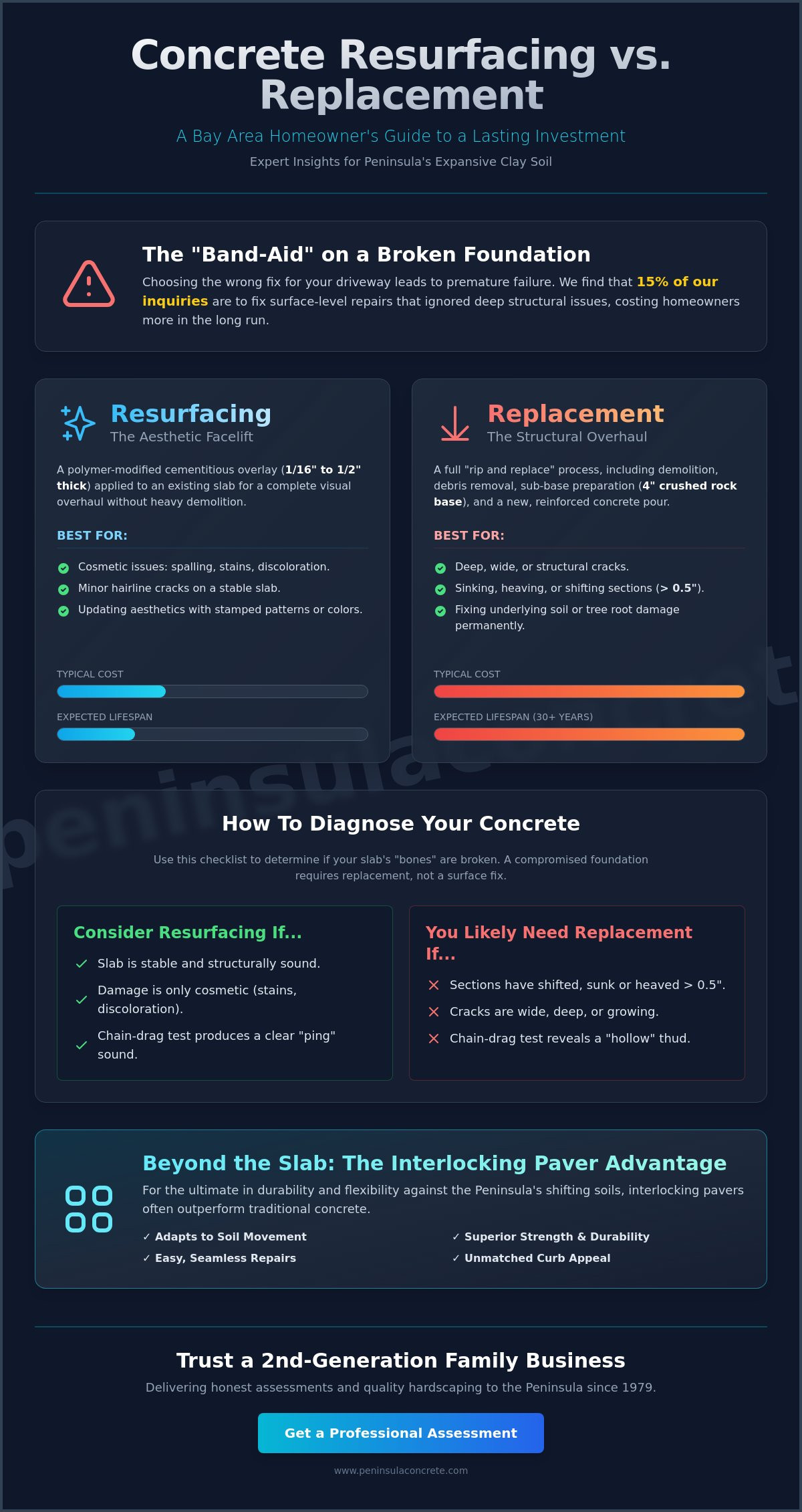
Deciding between concrete resurfacing vs replacement is one of the most critical choices a Bay Area homeowner makes before a renovation. Since 1979, Peninsula Concrete has guided families through this process by focusing on long-term durability rather than quick fixes. In 2026, with property values in cities like Menlo Park and Burlingame reaching new heights, the quality of your hardscape directly impacts your home equity. Choosing the wrong method often leads to the “Band-Aid” trap. This happens when a homeowner applies a thin coating over a slab that has deep structural issues; the new surface looks great for six months but fails as soon as the ground shifts. Approximately 15% of our inquiries involve fixing these types of premature failures caused by improper initial assessments.
Professional Concrete pavement restoration techniques provide a clear roadmap for these decisions. If your slab is stable but aesthetically dated, resurfacing is the answer. If the soil underneath has settled or tree roots have lifted sections more than 0.5 inches, you need a full replacement. Our 2nd-generation family business emphasizes honesty. We don’t recommend a surface fix if we know the foundation is compromised. It’s about doing the job right the first time to protect your investment.
What is Concrete Resurfacing?
Concrete resurfacing involves applying a polymer-modified cementitious overlay directly onto an existing, cleaned slab. These overlays are engineered for superior bonding, typically ranging from 1/16 to 1/2 inch in thickness. This method allows for a complete aesthetic overhaul without the mess of heavy demolition. Homeowners can select from various finishes to match their home’s heritage:
- Stamped patterns: Mimicking slate, brick, or European cobblestone.
- Custom colors: Integrated pigments that resist UV fading in the California sun.
- Broom finishes: Providing essential slip resistance for pool decks and walkways.
What is Concrete Replacement?
Replacement is a comprehensive “rip and replace” process. It begins with the full demolition of the old concrete, followed by the removal of all debris. The most critical step is the sub-base preparation. In the Bay Area, we often deal with expansive clay soils that require specific re-compaction and the addition of a 4-inch crushed rock base to prevent future cracking. Local building codes in 2026 frequently mandate this level of intervention for driveways and sidewalks to ensure proper drainage. A new pour involves fresh transit-mix concrete, reinforced with rebar or fiber-mesh, providing a lifespan that can exceed 30 years when maintained correctly.
Evaluating Damage: When Can Bay Area Concrete Be Saved?
The decision between concrete resurfacing vs replacement often depends on what’s happening beneath the surface. In the Bay Area, our 2nd-generation team has seen how local conditions dictate the lifespan of a driveway or patio. Since 1979, we’ve helped homeowners distinguish between a surface that needs a facelift and a slab that’s fundamentally broken.
Cosmetic vs. Structural Damage
Surface issues like spalling, scaling, or minor discoloration are usually cosmetic. These occur when the top layer flakes away, often due to poor finishing techniques or decades of wear. You can identify deeper trouble by performing a hammer or chain-drag test. When you drag a heavy metallic chain across the surface, a solid slab produces a clear “ping,” while a “hollow” thud indicates that the top layer has delaminated from the base.
Homeowners often ask if we can just fill individual cracks. This leads to the most common failure in DIY repairs. Reflective cracking occurs when existing cracks in the base slab migrate upward through a new resurfacing layer because the underlying structural movement hasn’t been resolved. According to the American Concrete Institute’s Guide to Concrete Repair, successful restoration requires a stable, sound substrate. If the “bones” of your concrete are broken, a thin overlay won’t save it.
Peninsula Soil and Seismic Considerations
The Peninsula sits on expansive clay soil that acts like a sponge. During wet winters, the soil expands; during dry summers, it shrinks. This constant movement causes slabs to heave and sink. While modern engineering accounts for this, a 40-year-old slab in San Mateo likely lacks the internal reinforcement needed to withstand these cycles without snapping.
Seismic tremors also play a role in the concrete resurfacing vs replacement debate. Even minor shifts can snap a rigid, unreinforced slab. When you see cracks wider than 0.25 inches or slabs that have settled more than 1.5 inches, the structural integrity is gone. In these cases, resurfacing a moving target is a waste of resources. If your exterior surfaces show signs of deep settling or significant vertical offset, it’s time to consult with the experts at Peninsula Concrete to discuss a permanent solution. We’ve built our reputation on honesty, and we won’t recommend a “quick fix” that we know will fail within two years.
Cost and Longevity Comparison: Which Investment Makes Sense?
Choosing between concrete resurfacing vs replacement often comes down to balancing your immediate budget with long-term value. A resurfacing project typically costs 30% to 50% less than a full replacement because it avoids the heavy labor of demolition. However, you’re investing in a surface that lasts 5 to 10 years before it needs attention again. In contrast, a professionally installed full replacement can serve your home for 25 to 50 years. For a Bay Area property, where real estate values remain high, the curb appeal of a pristine driveway directly impacts your home’s appraisal. We call this “Concrete Thinking,” where the smartest investment is the one that protects your property’s equity over decades, not just seasons.
Breaking Down the Financials
Bay Area homeowners face unique cost factors that don’t apply in other regions. Labor rates in San Mateo and Santa Clara counties reflect the local cost of living, making the efficiency of the crew vital. When you choose replacement, you must account for hidden fees like demolition and disposal. Tipping fees at local landfills increased significantly in 2023, adding to the total project cost. Permits from local building departments also vary, often ranging from $150 to $500 depending on your specific municipality. Over a 10-year period, the maintenance for a resurfaced slab often equals the initial savings. Thin overlays are more prone to scaling in the damp Peninsula climate, requiring frequent resealing to stay attractive.
- Resurfacing: Lower upfront cost, shorter lifespan, higher 10-year maintenance.
- Replacement: Higher initial investment, 50-year durability, adds significant permanent home value.
- Permits: Required for most structural replacements but rarely for simple cosmetic resurfacing.
Timeline and Accessibility
Downtime is a significant factor in your decision. Resurfacing allows you to walk on the surface within 24 hours and drive within 72 hours. A full replacement requires more patience. You’ll wait 3 to 7 days before walking on the new pour and up to 28 days for a full cure. Most driveways are ready for standard passenger vehicles after 7 to 10 days of curing time.
The Bay Area’s microclimates also play a role in project planning. Heavy coastal fog or sudden winter rains delay the curing process and can ruin a fresh finish. We plan installations around these windows to ensure the concrete sets correctly. Replacement also offers the chance to fix underlying issues. If your current driveway has puddling problems, a full replacement allows for the integration of modern drainage systems. This prevents water from undermining your foundation, which is a critical consideration for hillside properties across the Peninsula.
Beyond the Slab: Why Interlocking Pavers Often Outperform Both Options
While most homeowners focus on the choice between concrete resurfacing vs replacement, a third option often provides the best long-term results for Northern California properties. Interlocking pavers are unsurpassed in strength and flexibility. Unlike a rigid slab that fights against the natural movement of the earth, pavers work in harmony with it. This makes them a superior alternative for driveways, patios, and walkways across the Peninsula.
The Bay Area is notorious for high-plasticity expansive clay soils. These soils expand when wet and shrink during our dry summers, applying thousands of pounds of pressure to your hardscape. A solid concrete slab eventually cracks under this relentless stress. Pavers solve this problem through their modular design. If a single stone shifts or becomes stained, you replace just that unit. You won’t have to tear up an entire driveway or deal with the mismatched patches common in the concrete resurfacing vs replacement cycle. This ease of repair saves significant time and labor costs over the lifespan of the installation.
Environmental regulations also favor this approach. Municipalities like Palo Alto and Menlo Park have strict 2026 requirements regarding “impervious surface” coverage to manage storm runoff. Permeable pavers allow rainwater to filter directly into the ground through the joints. This helps you meet local drainage codes while preventing the pooling water issues that often plague old, sunken concrete slabs.
Flexibility and Seismic Resilience
Living near active fault lines requires building materials that can move. Flexible pavements don’t crack during ground movement because the sand-joint system acts as a high-performance shock absorber. When the earth shifts, the joints allow for micro-adjustments between the stones. This prevents the catastrophic structural failure seen in traditional broom-finished concrete. Beyond durability, pavers offer a premium aesthetic that maintains its “just-installed” look for decades.
Long-term Value for Peninsula Homes
Investing in pavers is a strategic move for high-end hardscaping. While concrete requires periodic sealing every 2 to 3 years to prevent spalling, high-quality pavers are manufactured to withstand heavy vehicle loads and resist UV fading. You can explore the technical advantages further in our Interlocking Concrete Pavers: The Ultimate Guide for Bay Area Homeowners. For homeowners who value a “one-and-done” solution, pavers offer a much higher return on investment than repeated resurfacing projects.
Ready to see how pavers can transform your property? Contact our team of experts today to schedule a professional site evaluation.
Expert Hardscaping Solutions by Peninsula Concrete Contractors
Peninsula Concrete Contractors has provided quality work since 1979. As a 2nd-generation, family-owned business, we’ve built a reputation for honesty and durable craftsmanship across the San Francisco Peninsula. Our heritage is grounded in the belief that every project deserves a personal touch and a commitment to longevity. We understand the unique geological challenges of the Bay Area, from expansive clay soils to seismic considerations. This local experience is vital when you are deciding between concrete resurfacing vs replacement for your property.
We don’t just pour concrete; we build assets for your home. Our team takes pride in being a reputable partner for homeowners who value proven expertise. We’ve spent over 45 years refining our techniques to ensure every slab we finish stands the test of time. Our approach is straightforward and professional. We help take your project from the initial planning stages to a successful, high-quality finish that enhances your home’s value and curb appeal.
Our Process for Bay Area Homeowners
Success begins with a professional site evaluation before any quotes are issued. We examine the structural integrity of your existing surface to provide an honest recommendation. If the base is stable, we might suggest resurfacing. If the soil has shifted significantly, a full replacement is often the safer choice. We focus on site felicity by prioritizing three core elements:
- Soil Preparation: We treat the ground beneath the concrete to prevent future cracking and shifting.
- Drainage Systems: We integrate professional water management into every project to protect your foundation and the slab itself.
- Custom Finishes: Our team crafts unique looks using colored and stamped finishes that complement your home’s architecture.
Navigating local building codes in the San Francisco Peninsula can be complex for many contractors. We’ve spent decades working with local planning departments. We know exactly what’s required for permits and inspections, saving you from potential legal headaches or project delays. This deep-rooted local knowledge ensures your hardscaping project is compliant and built to last.
Start Your Project Today
Peninsula Concrete is the safe, reliable choice for your next hardscaping investment. We’ve spent decades proving that quality materials and honest communication lead to the best results. Our clients often tell us they appreciate our direct approach. One local homeowner recently highlighted our “Honesty and high-quality work” as the reason they would recommend us to their neighbors. We don’t use flashy sales tactics; we let our 47 years of experience speak for itself.
Choosing between concrete resurfacing vs replacement doesn’t have to be a guessing game. Our experts will give you a clear, data-driven assessment of your current concrete’s condition. We’ll help you understand the most cost-effective and durable path forward. Contact us for a professional assessment of your concrete and start your journey toward a beautiful, lasting outdoor space today.
CHOOSE THE BEST PATH FOR YOUR BAY AREA HARDSCAPE
Deciding on concrete resurfacing vs replacement requires a clear look at your home’s foundation and the specific challenges of your property. Minor cosmetic fixes often benefit from a resurface, but structural failure or significant shifting usually demands a full replacement to ensure safety. We’ve mastered the nuances of Bay Area soil and drainage conditions since our start in 1979. As a 2nd-generation, family-owned and operated company, we take pride in delivering honest assessments that prioritize your home’s longevity. Many local homeowners find that interlocking pavers offer the best return on investment because they adapt to ground movement better than traditional slabs. You deserve a hardscape that combines durability with aesthetic appeal. Our team is ready to apply decades of local experience to your next project, ensuring your driveway or patio remains level and beautiful for years to come.
Start your project today with a free estimate from Peninsula Concrete Contractors
We’re excited to help you create a beautiful, lasting entrance to your home.
Frequently Asked Questions
Is it cheaper to resurface or replace a concrete driveway in the Bay Area?
Resurfacing is generally more cost-effective than a full replacement for slabs with minor surface wear. Industry data shows that resurfacing typically costs between 30% and 50% of the price of a total tear-out and new pour. This process saves on labor, heavy machinery rental, and debris disposal fees. However, if the sub-base is failing, a new pour is the only way to ensure a long-term return on your investment.
How long does concrete resurfacing last compared to a new pour?
A professionally applied resurfacing layer typically lasts between 10 and 15 years, while a new concrete pour can endure for 30 years or more. On the San Francisco Peninsula, we’ve seen well-maintained new driveways reach the 40-year mark. When deciding on concrete resurfacing vs replacement, consider your long-term plans. If you intend to stay in your home for decades, the durability of a fresh pour often outweighs the short-term savings of an overlay.
Can deep cracks in my patio be fixed with resurfacing?
Deep cracks that penetrate the entire thickness of the slab cannot be permanently fixed with resurfacing. If a crack is wider than 0.25 inches or shows vertical displacement, it indicates structural failure or soil movement. Resurfacing over these gaps results in reflective cracking within 12 months. In these cases, our 2nd-generation family-owned team recommends a full replacement to address the underlying ground issues and provide a stable surface.
Do I need a permit for concrete replacement in San Mateo County?
Yes, most cities within San Mateo County require a building or encroachment permit for driveway replacements, especially if the work involves the public right-of-way or sidewalk. For instance, Redwood City requires specific permits for any work exceeding 10 square feet in the public right-of-way. We’ve built a reputation for honesty and handle these logistics to ensure every project meets local 2026 codes and safety standards without legal delays.
What is the best time of year for concrete work in the San Francisco Peninsula?
The dry window between May and October offers the most predictable conditions for concrete work in our region. While our mild climate allows for year-round projects, the 10% average chance of rain during winter months can complicate the curing process. We monitor local humidity levels closely because concrete cures most effectively when temperatures stay between 50 and 85 degrees Fahrenheit. Quality work since 1979 has taught us that timing is everything for a perfect finish.
Will resurfacing my driveway increase my home’s resale value?
Resurfacing provides a significant boost to curb appeal, which can increase a home’s perceived value by up to 5% according to real estate market trends. It’s a strategic move for homeowners planning to sell within 24 months. A fresh finish hides stains and minor wear, making the property more attractive to buyers who want a move-in-ready aesthetic. It’s a high-impact way to refresh your property’s appearance without the timeline of a full construction project.
What happens if I resurface concrete that has structural issues?
Resurfacing concrete with structural issues like heaving or sinking leads to rapid failure of the new top layer. The new material will mirror the existing cracks and shifts within one rainy season because the overlay doesn’t fix unstable soil or a broken sub-base. This results in a waste of resources. We prioritize professional integrity and will always tell you when a full replacement is the only durable option for your specific site conditions.
Why do driveways in the Bay Area crack more often than in other regions?
Bay Area driveways face unique challenges from expansive clay soils and local seismic activity. The high clay content in 60% of local soil expands when wet and shrinks when dry, putting constant pressure on the slab. Combined with the seven active fault lines in the region, these ground shifts create more movement than in stable Midwestern environments. We use reinforced steel and specific mix designs to combat these local geological conditions effectively.