
Would you pay $35,000 for a wall that looks great today but leans tomorrow because of the Peninsula’s notorious Bay Mud? In the San Francisco Peninsula, the cost to build a retaining wall 2026 is driven by more than just aesthetics. It’s about engineering a structure that survives our unique soil conditions and strict California building codes. You likely already know that local labor rates are among the highest in the country. It’s frustrating to plan a project when permit fees and engineering requirements feel like a moving target.
We agree that transparency is rare in the construction industry, especially when navigating the complexities of the Bay Area. Since 1979, our family-owned business has focused on providing honest, high-quality work that homeowners can depend on. You’ll discover the real-world costs of construction, including how to budget for the $2,500 permit fees often required for walls exceeding three feet in height. We’ll preview the price differences between interlocking pavers and poured concrete, while explaining exactly which soil conditions trigger a need for professional engineering. This guide gives you the clear roadmap needed to build a durable wall that increases your property value without the typical budget surprises.
Key Takeaways
- Understand the average cost to build a retaining wall 2026 in the Bay Area, where local labor and material trends drive prices between $40 and $350+ per linear foot.
- Compare the durability and cost-effectiveness of poured concrete, interlocking blocks, and natural stone to find the best material for the California climate.
- Learn how the “Bay Area Premium”—including specialized permits and complex soil conditions like Bay Mud—impacts your project’s total investment.
- Discover why proper drainage systems are the most critical factor in preventing wall failure and avoiding expensive long-term repairs.
- See how partnering with a seasoned, family-owned team ensures your project is built to last while securing the best material pricing available.
Understanding Retaining Wall Costs in 2026
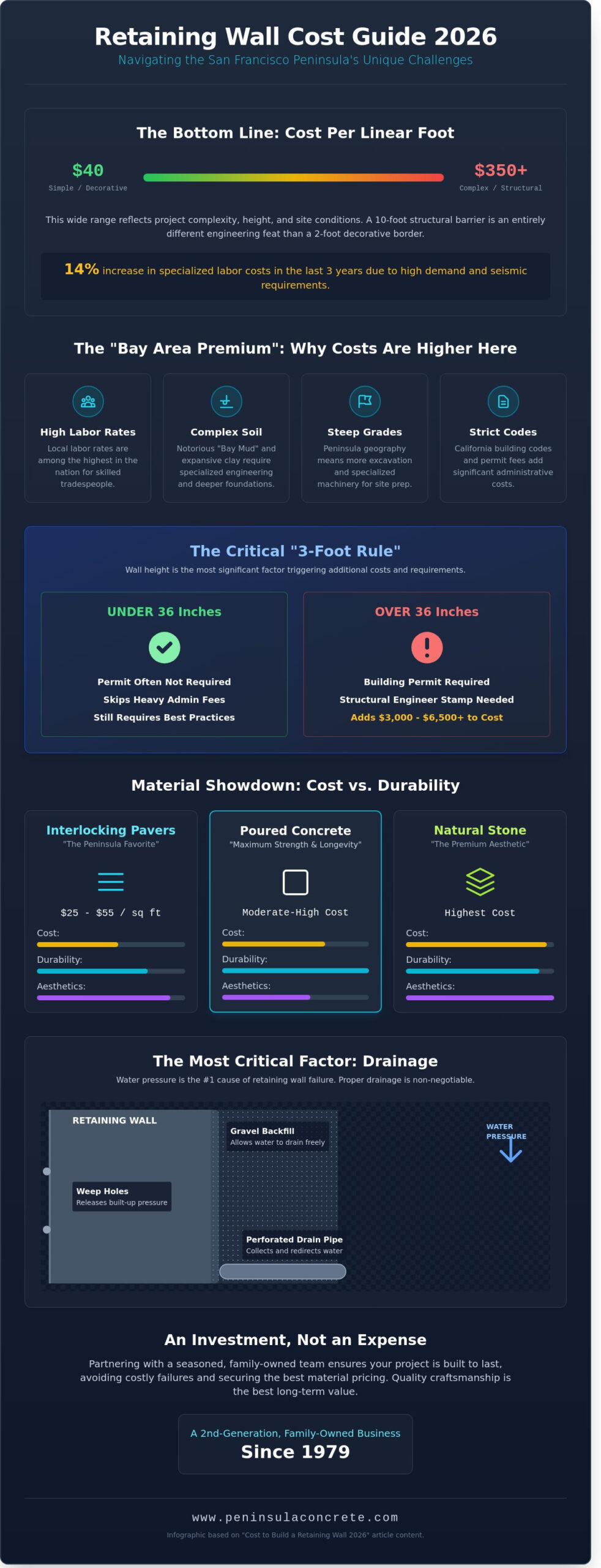
Planning a landscape project in the Bay Area requires a realistic look at current market conditions. For homeowners looking at the cost to build a retaining wall 2026, the price typically ranges from $40 to $350 per linear foot. This wide window exists because a two-foot decorative border and a ten-foot structural barrier are entirely different engineering feats. In 2026, pricing reflects a 14% increase in specialized labor costs compared to three years ago, driven by the high demand for skilled tradespeople who understand California’s unique seismic requirements.
The Bay Area’s geography makes site preparation more expensive than in flatter parts of the country. Retaining walls in cities like Belmont or San Carlos often deal with steep grades and unstable soil. You aren’t just paying for the blocks or the concrete; you’re paying for the specialized machinery and expertise needed to secure a hillside. While it’s tempting to look for the lowest bid, the Peninsula market rewards quality. A wall that fails after five years doesn’t just lose its own value. It threatens the integrity of your entire property and can lead to massive liability issues during a heavy rainy season.
One of the most critical budget factors is the “3-foot rule.” In most local jurisdictions, any wall taller than 36 inches requires a building permit and a structural engineer’s stamp. This threshold can add $3,000 to $6,500 to your total project cost before the first shovel hits the dirt. If your project stays under this height, you skip the heavy administrative fees, but you still need to follow best practices for drainage and footings to ensure the structure lasts for decades.
Linear Foot vs. Square Foot: How Pros Quote
Most contractors provide a quote based on the linear foot, but they calculate their internal costs based on the total square footage of the wall’s face. Height is the primary multiplier here. As a wall gets taller, the depth of the footing must increase exponentially to resist the weight of the earth behind it. You’ll also need to consider the load above the wall. A surcharge is the additional pressure exerted on the wall by objects like parked cars, swimming pools, or steep uphill slopes that necessitates a thicker and more reinforced wall design.
The Baseline: What a Basic Wall Includes
A professional quote should be comprehensive. A standard baseline includes the excavation, the concrete or stone materials, steel reinforcement, and a dedicated drainage system. Many national cost estimators leave out the specific site prep needed for our local clay-heavy soil. Without proper gravel backfill and weep holes, water pressure will eventually crack even the strongest concrete. Since 1979, Peninsula Concrete Contractors has built a reputation for providing transparent, all-in quotes. As a 2nd-generation, family-owned business, we don’t believe in hiding costs. Our estimates reflect the actual cost to build a retaining wall 2026, including the high-quality materials and durable craftsmanship that our heritage is built on. We focus on getting the foundation right the first time so you don’t have to worry about shifting soil or drainage failures ten years down the road.
Material Breakdown: Concrete, Pavers, and Stone Costs
Choosing the right materials for a Bay Area hillside isn’t just about looks. It’s about engineering a structure that survives seismic shifts and heavy seasonal rains. When you estimate the cost to build a retaining wall 2026, you’ll find that labor and material availability in Northern California dictate the final price tag. Since 1979, we’ve seen how different materials hold up against the unique pressures of our local geology. Most homeowners prioritize a high durability-to-cost ratio, especially in areas with expansive clay soil. Selecting a material that matches your home’s architecture while meeting structural requirements is the first step toward a successful project.
Following retaining wall design best practices ensures your investment lasts for decades rather than years. Proper drainage and foundation depth are non-negotiable, regardless of the surface material you choose. If you’re unsure which material fits your slope, you can contact our team for a professional site evaluation.
Interlocking Paver Systems: The Peninsula Favorite
Interlocking pavers currently range from $25 to $55 per square foot installed. These systems are highly popular across the Peninsula because they offer unsurpassed strength and flexibility in shifting soils. Unlike rigid structures, modular blocks can move slightly during seismic events without cracking. This flexibility makes them ideal for the Bay Area’s active fault lines. Because these blocks are manufactured to fit together perfectly, they reduce labor time by approximately 30% compared to traditional masonry. They don’t require mortar, which speeds up the installation process significantly.
Poured Concrete and Stamped Finishes
Poured concrete remains a staple for modern Bay Area designs, costing between $30 and $65 per square foot. It offers a clean, architectural appeal that complements contemporary homes in cities like Palo Alto or San Mateo. For any wall over 36 inches, heavy-duty reinforcement with rebar is a requirement to handle the lateral pressure of the earth. While standard gray concrete is functional, many homeowners opt for decorative finishes. Adding stamped patterns or integrated colors typically adds 15% to 20% to the base cost. This investment transforms a plain structural necessity into a focal point of the landscape.
Natural Stone and Brick Masonry
Natural stone is the high-end option for luxury estates, with prices ranging from $50 to over $150 per square foot. This material creates a timeless legacy look that increases property value. You have two primary choices:
- Dry Stack Stone: This technique relies on gravity and precise stone placement. It’s labor-intensive but offers excellent natural drainage.
- Mortared Stone: This involves bonding stones to a concrete block core. It’s incredibly strong but requires a more complex drainage system to prevent water pressure buildup.
Masonry work is a slow, meticulous process. A skilled craftsman might only complete 15 to 20 square feet of a stone face per day. This high labor demand is why natural stone sits at the top of the price spectrum for the cost to build a retaining wall 2026.
Our family-owned business has built a reputation for honesty and high-quality work over the last 45 years. We understand that every property has unique drainage needs and soil compositions. Whether you choose the modern look of poured concrete or the rugged beauty of interlocking blocks, we ensure the foundation is built to last. Quality work is our signature, and we take pride in helping our neighbors secure their land with structures that stand the test of time.
Bay Area Specific Cost Factors: Permits, Soil, and Slopes
Building in the San Francisco Bay Area involves a unique set of challenges that don’t exist in other parts of the country. Labor rates in our region are consistently 30% higher than national averages. This “Bay Area Premium” reflects the high cost of living and the specialized expertise required to work in a dense, seismically active environment. Peninsula Concrete has navigated these local complexities since 1979, and we know that a generic estimate rarely covers the reality of a Peninsula job site. When you calculate the cost to build a retaining wall 2026, you must factor in these regional variables from the start.
Soil composition is the first major technical hurdle. Many properties in cities like Foster City or Menlo Park sit on “Bay Mud” or expansive clay. These soil types are notorious for shifting. Clay expands significantly when it absorbs winter rains and shrinks during our dry summers. This movement exerts massive lateral pressure on any structure. To prevent a wall from buckling, we often design footings that are deeper and wider than standard specifications. Engineers frequently consult the Caltrans conventional retaining wall guidelines to ensure the structural integrity of the wall matches the specific soil shear strength of the site. Ignoring these geotechnical realities leads to wall failure within five to ten years.
Seismic engineering is another non-negotiable cost. Because we live near the San Andreas and Hayward faults, any wall taller than 3 feet requires robust internal reinforcement. This includes extra rebar and high-strength concrete mixes. These requirements ensure the wall stays standing during a tremor, protecting your home and your neighbors’ property. The engineering alone can add $2,000 to $5,000 to the project total depending on the wall’s height and complexity.
Navigating Local Permits and Engineering Codes
Permit fees in San Mateo and Santa Clara counties are some of the highest in the state. Expect to pay between $500 and $2,500 just for the right to build. Most local jurisdictions require a structural engineer’s stamp for any wall over 3 feet. Additionally, many cities mandate “Special Inspections” during the concrete pour. This means a third-party inspector must be on-site to verify the rebar placement and concrete quality. These inspections usually cost $150 to $250 per hour and are a critical part of the cost to build a retaining wall 2026 in our area.
Terrain and Accessibility Challenges
The geography of the Bay Area hills creates significant logistical costs. A lot with a 20-degree slope can add 25% to your total excavation and hauling budget. Heavy machinery moves slower on inclines, and safety measures must be more rigorous. In tight residential neighborhoods like those in the San Carlos hills or San Francisco, we often face restricted site access. If a standard excavator cannot reach your backyard, we have to use smaller “mini” equipment or implement a “Hand-Carry” surcharge. This covers the manual labor of moving tons of material by hand or wheelbarrow. Finally, we must manage drainage according to local Low Impact Development (LID) standards. These rules ensure that your new wall doesn’t cause runoff issues for the properties below you, requiring sophisticated gravel backfill and perforated pipe systems.
Budgeting for Longevity: Drainage and Hidden Costs
A retaining wall that looks beautiful on the day of completion is only a success if it stays standing for decades. Since 1979, our family-owned business has seen countless walls fail prematurely because of a single overlooked factor: water. When you calculate the cost to build a retaining wall 2026, you aren’t just paying for the visible stone or concrete. You’re investing in a complex engineering system designed to fight gravity and moisture. Cutting corners on what happens behind the wall is the fastest way to double your long-term expenses through repairs and total replacements.
Hydrostatic pressure is the primary enemy of any hillside structure. When soil becomes saturated after a typical Bay Area winter storm, it gains immense weight. Water weighs approximately 62.4 pounds per cubic foot. Without a clear exit path, this moisture builds up behind your wall, exerting thousands of pounds of lateral pressure that can easily buckle reinforced concrete or shift heavy interlocking blocks. This hidden force is why drainage isn’t an optional add-on; it’s the most critical component of your project’s structural integrity.
The Critical Role of Drainage Systems
Experienced homeowners should budget 20% to 25% of their total project cost for water management alone. This includes high-quality perforated pipes, 3/4-inch clean crushed stone for backfill, and heavy-duty non-woven filter fabric to prevent silt from clogging your system. It’s essential to understand Does My Retaining Wall Need a Drainage System? before finalizing your 2026 budget. To ensure stability, we always incorporate weep holes, which are small, strategically placed openings at the base of the wall that allow trapped water to escape safely to the front of the structure.
Excavation and Site Preparation
The groundwork determines whether your wall stays level or begins to lean within three seasons. In San Mateo and Santa Clara counties, the cost of hauling away heavy clay soil often reaches $55 to $90 per ton in 2026. Beyond simple digging, we focus on reaching a 95% Proctor density compaction rate for the soil beneath the wall. For interlocking paver systems, we install a 6-inch thick leveling pad of compacted gravel to create a stable foundation. This precision prevents the settling and shifting that plagues “budget” installations done by less experienced crews.
Hidden costs can also impact your final invoice if they aren’t identified during the initial site walk. If your project requires the demolition of an existing concrete wall, expect to pay between $20 and $40 per linear foot for removal and disposal. Utility lines are another common variable. Rerouting a main irrigation line or a gas pipe that sits in the excavation zone can add $1,800 to $3,500 to your total cost to build a retaining wall 2026. We pride ourselves on our reputation for honesty, which is why we identify these potential hurdles before we ever break ground.
With total costs often running into the tens of thousands, many homeowners explore ways to fund their project. Financial service providers like Icon Capital LLC specialize in real estate loan programs that can make such essential home improvements more manageable.
At Peninsula Concrete, we’ve built a legacy of dependable craftsmanship over the last 45 years. We don’t just build walls; we build peace of mind for Bay Area families. Let us help you plan a project that stands the test of time and weather.
Start your project today by requesting a comprehensive retaining wall consultation from our local experts.
Why Professional Installation Saves Money Long-Term
Hiring a professional isn’t just about convenience; it’s about protecting a major financial investment. At Peninsula Concrete, we’ve provided quality work since 1979. This 45-year legacy means we understand the unique soil conditions and seismic requirements of the Bay Area better than anyone else. When you calculate the cost to build a retaining wall 2026, you’ve got to consider the price of a redo. A wall that fails after 36 months costs twice as much as one built correctly the first day.
Our long-standing history in the region allows us to secure better material pricing than a standard retail customer. We maintain established relationships with local quarries and suppliers, ensuring we get premium rebar and high-strength concrete at rates that keep your project competitive. We don’t use temporary labor. Our crews are reliable, experienced, and have worked together for years. This efficiency reduces labor hours and keeps the cost to build a retaining wall 2026 within your specific budget.
These principles of hiring experienced, reputable teams hold true across the state. In Southern California, for instance, homeowners often turn to established specialists like Delta C9 for their remodeling and construction needs, underscoring the universal value of proven expertise.
Professional contractors bring the added value of insurance and warranties. As a 2nd-generation, family-owned business, we stand behind every yard of concrete we pour. If a drainage issue arises or a settlement crack appears, a licensed firm is there to fix it. Without those protections, a homeowner is left footing the bill for expensive repairs. We take pride in our reputation for honesty, ensuring you don’t face hidden fees or surprise change orders mid-project.
Property valuation in the Peninsula remains some of the highest in the country. A well-constructed retaining wall adds between 10% and 15% to a home’s total curb appeal and structural integrity. In cities like Redwood City and Palo Alto, usable flat land is a premium. By professionally terracing a sloped lot, you’re effectively increasing the square footage of your outdoor living space. This functional upgrade provides a return on investment that far outweighs the initial construction costs.
The True Cost of DIY Failures
DIY sounds cheaper until the first heavy rain of the season. We frequently see common mistakes like footings that are only 8 inches deep when the soil requires 18 inches for stability. Lack of proper drainage stone and filter fabric is another 75% of why walls fail prematurely. When water builds up behind a wall without a clear exit, the hydrostatic pressure can reach thousands of pounds, causing the structure to buckle.
Fixing a leaning or collapsed wall typically costs 1.5x more than the original build. This is because a professional team must first perform demolition and haul away tons of debris before they can even begin the new construction. Furthermore, unpermitted walls are a massive liability during a home resale. In the current Bay Area market, an unpermitted structure can stall a 2.5 million dollar transaction or force a 30,000 dollar price reduction during the closing process.
Start Your Project with Peninsula Concrete
Our “Concrete Thinking” approach manages every detail from the first site visit to the final cleanup. This methodology ensures that we identify potential drainage issues or soil instability before the first shovel hits the ground. We’ve spent over 40 years serving Redwood City and the surrounding Peninsula, building a reputation for durable, high-quality craftsmanship that lasts for decades. We treat every yard as if it were our own family’s property.
We invite you to experience the peace of mind that comes with hiring a reputable, local expert. Let our team help take your project from the planning stages to a successful, lasting finish. Don’t risk your property’s safety with unproven alternatives or risky DIY attempts. Contact us today to discuss your vision and get a clear, honest breakdown of your project requirements.
SECURE YOUR BAY AREA PROPERTY WITH EXPERT CRAFTSMANSHIP
Building a wall that lasts requires more than just stacking stones. You must account for the unique Redwood City soil and specific 2026 permit requirements that influence your total investment. While material choices like interlocking pavers or structural concrete dictate your initial budget, the real value lies in professional engineering and proper drainage systems. These elements prevent the structural failures that often plague DIY projects. Understanding the cost to build a retaining wall 2026 is the first step toward a stable, beautiful property. Since 1979, our 2nd-generation family team has focused on delivering honest, high-quality work that stands the test of time. We are specialists in structural concrete and interlocking pavers designed specifically for the Bay Area’s challenging slopes. Don’t leave your home’s safety to chance. Let us help you navigate the planning process with the expertise of a local team that’s served this community for over 45 years. Request a Free Quote from our 2nd-Generation Family Team today. We’re ready to help you build a legacy of quality on your own land.
Frequently Asked Questions
How much does a 50-foot retaining wall cost in the Bay Area?
A 50-foot retaining wall typically costs between $15,000 and $37,500 in the Bay Area. This calculates to roughly $100 to $250 per linear foot for a standard 3-foot height. The total cost to build a retaining wall 2026 depends heavily on the chosen material and site access. For instance, a poured concrete wall requires more labor than interlocking blocks, which can increase the final price by 30%.
Do I need a permit for a 3-foot retaining wall in San Mateo County?
You don’t need a building permit for a 3-foot wall in San Mateo County as long as it isn’t supporting a surcharge like a driveway. The California Building Code allows walls under 4 feet, measured from the bottom of the footing to the top, to proceed without a permit. Always verify with the local planning department, as 15% of Peninsula municipalities have stricter zoning rules. This ensures your project stays legal.
What is the cheapest material for a durable retaining wall in 2026?
Interlocking concrete blocks are the most cost-effective choice for a durable structure. While pressure-treated wood costs 20% less initially, it often rots within 15 years in our damp coastal climate. Concrete blocks provide a 50-year lifespan and lower the long-term cost to build a retaining wall 2026. We’ve used these materials since 1979 because they offer the best balance of price and performance for local homeowners.
How long does it take to build a typical residential retaining wall?
A typical 50-foot residential retaining wall takes 5 to 10 business days to complete. The first 3 days focus on site preparation, excavation, and trenching for the footing. Weather conditions can shift this timeline, especially during the rainy season. Our 2nd-generation family-owned team prioritizes efficiency to ensure your backyard remains usable. We’ve refined this process over 45 years to keep your project on schedule and on budget.
Will a new retaining wall increase my Bay Area home value?
A professionally installed retaining wall increases Bay Area property values by an average of 10% to 12%. It creates usable flat land on sloped lots, which is a premium feature in hillside cities like San Carlos. Beyond aesthetics, it protects your home’s foundation from erosion and soil creep. Appraisers view a structural wall as a critical investment that prevents land loss and protects the primary residence’s long-term integrity.
Does homeowners insurance cover retaining wall collapse?
Standard homeowners insurance policies don’t cover retaining wall collapse caused by earth movement, wear and tear, or poor maintenance. Coverage usually only applies if a specific event like fire or a vehicle impact causes the damage. Data shows that 85% of wall failures stem from improper drainage or hydrostatic pressure. Investing in high-quality engineering now prevents a total loss that your insurance provider won’t reimburse in the future.
What is the best time of year to build a retaining wall in Northern California?
The best time to build is between May and October when the soil is dry and stable. Construction during the winter months often faces delays due to the 20 inches of rain we receive annually in Northern California. Dry conditions allow for proper soil compaction and ensure the concrete or mortar cures correctly. Planning your project for the summer months helps avoid the logistical headaches of mud and site runoff.