
In the San Francisco Peninsula, yard drainage isn’t just a landscaping upgrade; it’s foundation insurance for a multi-million dollar asset. When you research the cost to install drainage system in yard projects, the figures often reflect the high stakes of protecting your home from the Bay Area’s expansive clay soils and seasonal deluges. It’s stressful to watch water pool near your foundation, and it’s equally frustrating to receive a contractor quote that feels like a mystery. You deserve a dry, usable yard without the technical jargon or sticker shock.
At Peninsula Concrete Contractors, we’ve built a reputation for honesty and high-quality work since 1979. We believe you should have a transparent cost breakdown you can actually trust. This guide provides the hard data you need for 2026, analyzing local labor rates and specific regulatory factors across the Peninsula. We’ll explore why a professional French drain remains a vital investment and how integrated hardscape solutions protect your property for the long haul.
Key Takeaways
- Understand why professional drainage acts as essential insurance against expensive Bay Area foundation repairs and soil erosion.
- Get a transparent breakdown of the cost to install drainage system in yard projects, which typically range from $1,500 to $8,000 for Peninsula homeowners.
- Identify how local “Adobe” clay soil and property elevation changes directly impact excavation labor and your final contractor quote.
- Learn to avoid the common “slope mistake” that causes most DIY drainage systems to fail during the first heavy rain.
- Discover the Peninsula Concrete “Concrete Thinking” method for solving drainage issues at the root cause with quality work since 1979.
Understanding the Cost of Yard Drainage in the Bay Area
Yard drainage is far more than just digging a trench and laying pipe. It’s a precisely engineered system designed to capture, manage, and divert water away from your home’s foundation. At Peninsula Concrete Contractors, we’ve provided quality work since 1979, and we know that a well-designed system is the first line of defense for your property. In 2026, the cost to install drainage system in yard projects reflects a combination of rising material prices and localized regulatory requirements that ensure environmental safety. While the initial investment might seem significant, it’s a fraction of the price compared to the astronomical costs of structural foundation repair in California.
The Cost of Inaction: Why Drainage Matters
National Averages vs. Peninsula Realities
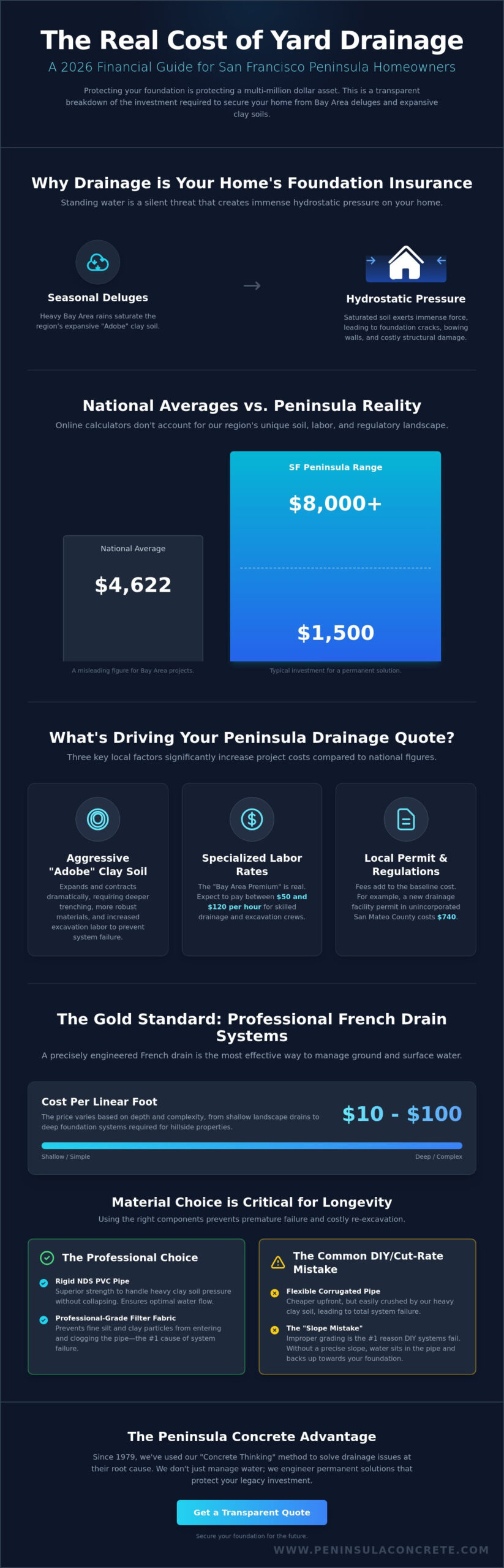
Many online calculators suggest a national average for yard drainage around $4,622, but these figures often fall short for local homeowners. Our region’s unique topography and clay-heavy soils require a level of engineering that national statistics simply don’t capture. A common solution is the French drain, which uses a gravel-filled trench to redirect surface water away from vulnerable areas. However, Bay Area projects typically start higher due to several factors:
- Local Permit Fees: In unincorporated San Mateo County, a permit for a new drainage facility costs $740, while Santa Clara County requires permits for any project creating over 2,000 square feet of new impervious surface.
- Specialized Labor: The “Bay Area Premium” is a reality, with local landscape and drainage crews charging between $50 and $120 per hour depending on the complexity of the excavation.
- Soil Composition: Our “Adobe” clay expands and contracts aggressively, requiring more robust materials and deeper trenching than what’s needed in sandy or loamy regions.
We use our “Concrete Thinking” approach to ensure every dollar spent on the cost to install drainage system in yard goes toward a permanent solution. We don’t just treat the symptoms of standing water; we solve the root cause to protect your legacy and your home investment.
Cost Breakdown by Drainage System Type
Most Bay Area contractors utilize a linear foot pricing model for drainage projects. This model is straightforward because it bundles excavation, piping, backfill materials, and soil disposal into a single predictable metric. When you calculate the cost to install drainage system in yard, you’ll find that the complexity of the installation often dictates the final price more than the hardware itself. We focus on integrating these systems seamlessly with your existing landscape. For example, installing interlocking concrete pavers provides a perfect opportunity to hide sub-surface pipes while creating a durable, permeable surface that assists with water management.
The materials we select are chosen for longevity. We prefer rigid NDS PVC pipes over flexible corrugated options. PVC handles the pressure of our heavy clay soil without collapsing. A high-quality installation also requires specific drain rock and professional-grade filter fabrics. These fabrics prevent fine silt from entering the pipe, which is the primary cause of system failure over time. Investing in these materials now prevents expensive excavation and replacement costs in the future.
French Drains: The Gold Standard
French drains remain the most effective way to manage groundwater. In 2026, professional installation typically costs between $10 and $100 per linear foot. This wide range reflects the difference between a shallow landscape drain and a deep foundation drain. Peninsula hillside properties often require deeper trenches to intercept water moving through the soil before it reaches the home. While corrugated pipe is cheaper, we recommend rigid PVC for its superior flow rates and ease of maintenance. A properly installed French drain acts as a hidden gutter for your yard, keeping the ground stable and your foundation dry.
Surface Drainage: Catch Basins and Channel Drains
Surface drainage focuses on capturing water before it can soak into the ground. Trench or channel drains are essential for Bay Area concrete driveways where large flat surfaces create significant runoff. These systems generally cost between $30 and $150 per linear foot. Catch basins are point-source collectors that work well in low spots on patios or near downspouts. Installation complexity increases when we must cut into existing concrete to lay the new lines. This requires precision and specialized equipment to ensure the new drain integrates perfectly with the slope of your hardscape. Let our team help take your project from planning to success by scheduling a drainage consultation today.
Local Factors That Affect Your Drainage Quote
Every lot on the Peninsula presents a unique set of engineering challenges that go beyond simple pipe selection. While we’ve discussed material averages, the specific geography of your property often dictates the final project total. The cost to install drainage system in yard is highly sensitive to the physical effort required to move earth in our unique environment. We use our “Concrete Thinking” approach to analyze these variables during our site walk, ensuring your quote reflects the technical reality of your landscape rather than a generic estimate.
Soil Composition: The Clay Factor
Our region is defined by “Adobe” clay soil, which is notoriously difficult to manage. This material is dense, heavy, and expansive. When it’s dry, it becomes hard as stone, slowing excavation to a crawl. When it’s wet, it turns into a sticky mass that is difficult to trench. This density requires us to use significantly more drain rock to ensure water can actually reach the system. Since clay is much heavier than sandy soil, disposal fees at local Peninsula transfer stations are often higher. This is also why precision is vital for retaining wall contractors who must account for the massive weight of saturated clay pushing against their structures.
Access and Property Density
The high density of neighborhoods in cities like Palo Alto, Burlingame, and San Mateo creates significant logistical hurdles. If our mini-excavators can’t fit through a narrow side gate, we must switch to manual labor. Hand-digging a deep French drain through Adobe clay is a slow process that increases the labor hours required for a project. As a local, 2nd-generation, family-owned business, Peninsula Concrete Contractors has spent decades navigating these tight urban spaces. We coordinate closely with 811 utility markers to protect your existing gas and water lines. Our experience allows us to work efficiently in confined areas without damaging your landscape or compromising the integrity of neighboring properties.
DIY vs. Professional Installation: Is it Worth It?
At first glance, the cost to install drainage system in yard projects might tempt you to reach for a shovel and a rental truck. Saving on labor, which typically accounts for 80% to 85% of a professional quote, is a powerful motivator. However, the true cost of a DIY project includes more than just pipes and gravel. You must factor in the rental of heavy-duty trenchers, the high price of professional-grade PVC, and the significant expense of soil disposal at local Bay Area facilities. Without the specialized equipment and experience of a seasoned crew, a project that should take two days can easily stretch into three weekends of back-breaking labor.
The most significant risk of DIY work isn’t the physical effort; it’s the lack of protection. Professional contractors provide a 10-year warranty on their workmanship, giving you recourse if a system fails. A DIY installation offers zero protection. If your system clogs or collapses, you’re responsible for the cost of ripping it out and starting over from scratch. We’ve built a reputation for honesty and quality since 1979 by fixing systems that were installed incorrectly the first time.
The Risks of Improper Slope and Discharge
Gravity-fed systems rely on precise physics. The “slope mistake” is the most common reason DIY drainage fails. If a trench doesn’t maintain a consistent drop of at least 1/8 to 1/4 inch per foot, water will sit stagnant in the pipe. This creates a breeding ground for roots and silt that eventually block the system entirely. Stagnant water also increases hydrostatic pressure, which is the force exerted by moisture against your foundation or retaining walls. This pressure can cause concrete to crack or bow, leading to structural failures that cost tens of thousands of dollars to remediate.
Permitting and Local Code Compliance
Navigating San Francisco Peninsula building codes is a complex task for any homeowner. Many Bay Area cities have strict regulations regarding where you can discharge captured water. For instance, some municipalities forbid directing runoff toward the street curb or public storm drains without a specific permit. In California, you can also be held legally liable if your drainage system diverts water onto a neighbor’s property, causing damage to their landscape or foundation. Hiring licensed landscape contractors ensures your project meets all local environmental and building codes. Protect your home investment by choosing a team that understands local regulations. Contact us for a professional assessment of your yard’s drainage needs today.
The Peninsula Concrete Advantage: Quality Since 1979
At Peninsula Concrete, we don’t view drainage as a side project. It’s the essential core of every high-quality hardscape we build. Since 1979, we’ve provided quality work that stands up to the unique weather patterns of the San Francisco Peninsula. Our “Concrete Thinking” approach means we look beyond the surface level. Instead of just treating a soggy patch of grass, we analyze the soil composition and property slope to solve the root cause of your water issues. When you evaluate the cost to install drainage system in yard, remember that you’re investing in a solution that protects your entire property for decades.
We take immense pride in being a local, 2nd-generation, family-owned business. This heritage isn’t just a tagline; it’s a promise of accountability. We aren’t a faceless corporation. We’re a team with a personal stake in our community’s reputation. Our clients trust us because we’re honest about what’s needed and what isn’t. We’ve built a reputation for high-quality work by treating every home as if it were our own. We invite you to view our project gallery to see how we’ve helped your neighbors achieve dry, beautiful yards through proven engineering and seasoned craftsmanship.
Integrated Drainage and Hardscaping
One of the most common mistakes in construction is treating drainage as an afterthought. We always recommend installing subsurface systems before pouring new patios or driveways. This “one-and-done” construction approach prevents you from having to tear up expensive new work later. By integrating these systems early, we ensure the cost to install drainage system in yard is optimized within your broader project budget. This proactive method is how we protect your walkways and sidewalks from the lifting and cracking caused by saturated clay soils. It’s a safer, more reliable choice for homeowners who value long-term durability.
Start Your Project Today
Getting started is straightforward. Our process begins with a comprehensive site assessment where we evaluate your property’s specific challenges. We don’t believe in generic quotes. We provide an honest, professional estimate based on the actual labor and materials required for your unique lot. Whether you’re dealing with standing water or planning a major hardscape renovation, we have the experience to guide you. Let us help take your project from planning to success with the same dedication we’ve shown since 1979. Contact Peninsula Concrete Contractors for a free drainage estimate and secure your home’s foundation today.
SECURE YOUR HOME INVESTMENT FOR THE LONG HAUL
Investing in a professional drainage system is the most effective way to protect your San Francisco Peninsula property from the long-term damage caused by standing water and expansive clay. We’ve seen first-hand how improper water management leads to cracked foundations and failing hardscapes. By understanding the real-world cost to install drainage system in yard, you can make an informed decision that secures your home’s structural integrity. Quality work since 1979 has taught us that a “one-and-done” approach, where drainage is integrated with your hardscaping, provides the best return on investment.
Our team specializes in the unique challenges of Bay Area Adobe clay and complex hillside topography. As a local, 2nd-generation, family-owned business, we provide the honest guidance and seasoned craftsmanship your investment deserves. We use our “Concrete Thinking” method to ensure every pipe and basin is positioned for maximum efficiency. Don’t wait for the next heavy rain to discover a problem that could’ve been prevented. We’re ready to help you achieve a dry, beautiful, and safe landscape that lasts for decades.
Get Your Free Drainage Estimate from Peninsula Concrete today and start your project with confidence.
Frequently Asked Questions
How much does a French drain cost per foot in the Bay Area?
In the Bay Area, professional French drain installation typically ranges from $10 to $100 per linear foot. This wide pricing gap depends on trench depth, soil density, and the choice between flexible corrugated pipe or rigid PVC. High-end projects on sloped Peninsula lots often require deeper excavation and more gravel backfill, which pushes the cost to install drainage system in yard toward the higher end of that range.
Will my homeowners insurance cover the cost of a new drainage system?
Standard homeowners insurance policies rarely cover the cost of a new drainage system. Insurers generally view these installations as preventative maintenance or property improvements rather than repairs for a covered loss. However, investing in a professional system now can prevent foundation damage that insurers might exclude from coverage if they deem the cause to be long-term seepage or poor maintenance.
Do I need a permit to install a yard drainage system in San Mateo County?
Yes, San Mateo County requires specific permits for most drainage work. As of May 2026, a permit for a new drainage facility in unincorporated areas costs $740. If you are removing and replacing an existing old system, the permit fee is $142. We coordinate these permits for our clients to ensure every project stays compliant with local building codes and environmental regulations.
Can I discharge my yard water directly into the street or storm drain?
You cannot always discharge water directly into the public storm drain without proper authorization. Many Bay Area municipalities have strict regulations to protect the San Francisco Bay from unfiltered runoff. You may be required to install a dry well or a rain garden to filter the water first. In some cases, a specific curb discharge permit is needed to connect your system to the street gutter.
How long does a professional yard drainage installation take?
Most residential drainage projects are completed within 2 to 5 business days. A simple catch basin installation might take a single afternoon, while a comprehensive French drain system for a large perimeter can take a full week. Factors like “Adobe” clay soil and limited equipment access in narrow side yards can extend the timeline. We provide a specific schedule during our initial site assessment.
What is the most effective type of drainage for heavy clay soil?
French drains using rigid PVC pipe and professional-grade filter fabric are the most effective for heavy clay. Because our local clay is so dense, it doesn’t allow water to pass through easily. A deep gravel trench creates a path of least resistance, allowing water to reach the perforated pipe. We use rigid pipe instead of corrugated because it’s easier to clear of the silt that clay soil often produces.
How often should a professional drainage system be maintained?
Does a new drainage system increase my home’s property value?
A professionally installed drainage system significantly increases your home’s marketability and protected value. In the high-stakes San Francisco Peninsula real estate market, a dry basement and stable foundation are major selling points. Buyers in 2026 prioritize climate-resilient homes. Protecting your property from hydrostatic pressure and soil erosion ensures you maintain your property investment while adding usable square footage to your outdoor living spaces.