
Could a weekend of hard labor actually decrease your home value? You want a beautiful outdoor space for hosting without the $35 per square foot price tag of a professional crew. It’s natural to look at the 60% savings offered by a DIY project and think it’s a manageable task for a motivated homeowner. However, in the Bay Area’s volatile clay soil, a paver system is only as good as the invisible layers beneath it. The debate between DIY pavers vs professional installation often comes down to whether you’re prepared to haul four tons of gravel or risk the dreaded “paver sink” within two years.
We’ve seen projects fail because a homeowner underestimated the physical toll or the complexity of drainage. This guide helps you decide if your project is a weekend job or requires the 40-year expertise of a 2nd-generation, family-owned business. You’ll learn about the latest May 2026 permitting requirements for the San Francisco Peninsula, the true cost of materials versus labor, and how to ensure your patio remains level for decades. We’ll show you how to achieve a high-quality result that increases your property value while avoiding the common pitfalls of improper base preparation.
Key Takeaways
- Learn how to achieve 95% Proctor density compaction to prevent your pavers from shifting in the Bay Area’s notorious “Adobe” clay soil.
- Evaluate the true financial impact of DIY pavers vs professional installation by comparing retail material costs against the long-term value of a structural guarantee.
- Navigate the specific “Impervious Surface” regulations and permitting requirements unique to San Mateo and Santa Clara counties.
- Identify the exact project scale that requires a structural engineer and the 40-year expertise of a local, 2nd-generation contractor.
DIY Pavers vs. Professional Installation: The Bay Area Reality
Deciding between DIY pavers vs professional installation isn’t just a financial choice. It’s a logistical challenge. The San Francisco Peninsula presents unique obstacles that don’t exist in flatter, less congested regions. If you’re planning a project in San Mateo or Palo Alto, you have to account for “Adobe” clay soil and the nightmare of hauling heavy materials through 101 or 280 traffic. What looks like a simple weekend job on a YouTube video often turns into a grueling month-long marathon for the average homeowner.
The labor is intense. For a typical 500-square-foot patio, you’ll need to excavate and move roughly 10 tons of soil. Then, you’ll bring in 10 tons of base rock. Doing this manually is a recipe for physical injury. Professional crews use specialized machinery to handle this volume in hours, whereas a DIYer might spend four weekends just on the dirt work. The “hidden labor” of driving to stone yards and managing multiple deliveries in Bay Area traffic can quickly drain your enthusiasm.
What Does ‘DIY’ Really Mean for a Paver Project?
Sourcing is your first hurdle. Big-box stores rarely carry the high-performance aggregates needed for a lasting base. You’ll need to coordinate with local quarries and handle the logistics of heavy truck access on narrow Peninsula streets. Beyond a shovel, you must master professional tools. A plate compactor is non-negotiable for stability. You’ll also need a masonry saw with a diamond blade to fit pavers around edges. If you don’t use these correctly, you’ll end up with uneven gaps and a “wavy” surface that collects water. Rental fees for this equipment can add $200 to $500 to your budget very quickly.
The Professional Standard in Hardscaping
We view every project as an engineered system. Professional installation is a multi-layered system designed for 30+ years of use. This begins with site engineering and laser-leveling to ensure a perfect pitch away from your home. We use commercial-grade interlocking concrete paver units that offer superior durability compared to basic bricks. Our 2nd-generation, family-owned team brings a level of craftsmanship that only comes from decades of experience. Peninsula Concrete has provided quality work since 1979, and we understand how to build for the long term. We handle everything from San Francisco Peninsula permitting to the final sweep of polymeric sand. This turnkey approach provides a structural guarantee that a DIY project simply cannot offer. You get peace of mind and a beautiful, level patio that actually increases your home’s value.
Why Base Preparation is the #1 Cause of DIY Failure
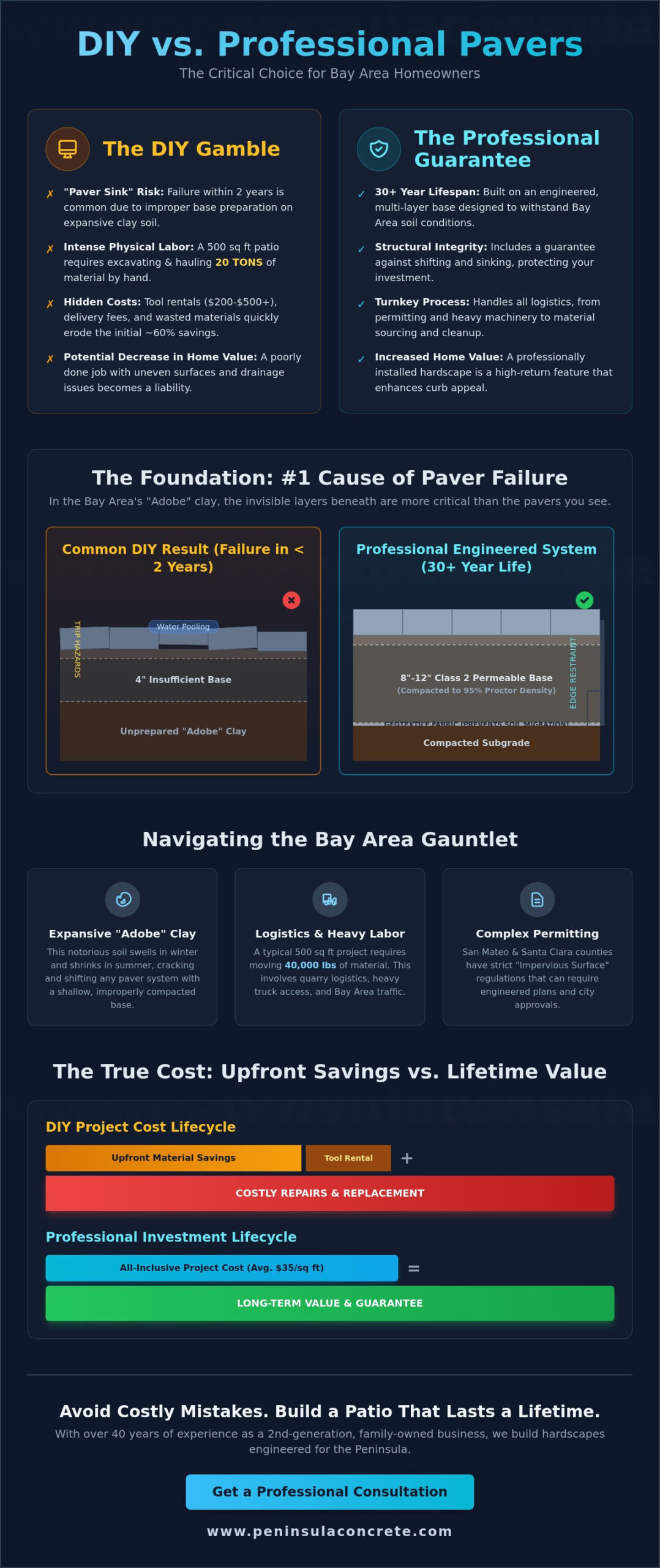
Most hardscape failures in the Bay Area happen before the first stone is even touched. When comparing DIY pavers vs professional installation, the biggest differentiator is the invisible foundation. Our region is famous for “Adobe” clay, a heavy, expansive soil that acts like a sponge. It swells during our rainy winters and shrinks during our dry summers. Without a properly engineered base, your beautiful patio will shift, crack, or sink within two seasons. A professional knows that simple digging isn’t enough to counteract these natural forces.
A professional installation requires reaching 95% Proctor density. This level of compaction isn’t achieved by just running a rental compactor over the dirt once. It involves “lifts,” which means compacting thin layers of rock sequentially to ensure a rock-solid foundation. We also use heavy-duty geotextile fabrics. This fabric acts as a permanent barrier between the clay and your base rock. It prevents the soil from migrating upward and “swallowing” your foundation over time. Without this invisible barrier, your pavers will eventually lose their level surface and create trip hazards.
To keep your project from “creeping” or spreading outward, we install industrial-grade edge restraints. These are spiked deep into the ground to lock the entire system in place. It’s this level of detail that has defined our reputation for quality work since 1979. We don’t just lay stones; we build a structural system that stands the test of time.
Managing the Bay Area’s Expansive Soils
California’s extreme wet and dry cycles are brutal on shallow foundations. Most DIY guides suggest a four-inch base, but the Bay Area reality often requires 8 to 12 inches of Class 2 permeable base rock. This deeper excavation allows for better load distribution and handles the vertical movement of the clay. As a 2nd-generation, family-owned business, we’ve seen how “cutting corners” on excavation leads to expensive repairs later. Deep base preparation is the only way to ensure long-term durability.
Drainage Systems: More Than Just a Slope
Water management is the most overlooked part of hardscaping. A simple slope isn’t always enough to protect your home’s foundation from pooling water. We integrate French drains and catch basins directly into the hardscape to whisk water away from critical areas. You can see how interlocking concrete pavers facilitate superior drainage by allowing water to permeate through the joints rather than pooling on the surface. If you want a patio that stays dry and stable, start your project today with a team that understands local drainage needs.
Real Cost Comparison: Upfront Savings vs. Lifetime Value
The financial gap between DIY pavers vs professional installation looks significant on paper. As of May 2026, material-only costs for concrete pavers in the Bay Area range from $3 to $7 per square foot. When you add gravel, sand, and edging, your total material investment might be $5 to $12 per square foot. In contrast, professional installation typically ranges from $20 to $35 per square foot. For a standard 200-square-foot patio, a DIY approach costs between $1,400 and $2,200, while a professional job ranges from $3,200 to $5,600. It’s easy to see why homeowners are tempted to pick up a shovel.
However, these numbers don’t tell the full story of the San Francisco Peninsula market. Professional contractors access wholesale pricing and commercial-grade materials that aren’t available at retail home improvement stores. You also have to account for equipment. Renting a plate compactor and a masonry saw can cost $200 to $500 for a single weekend. If the project stretches into a second or third week, those rental fees quickly erode your savings. There’s also the “Opportunity Cost” to consider. In a high-income market like ours, spending 60 to 80 hours of your personal time on manual labor has a high price tag. Most homeowners find that their time is better spent elsewhere while experts handle the heavy lifting.
The True DIY Budget (Including the ‘Oops’ Factor)
A realistic DIY budget must include waste and disposal. You should plan for 10% more material than your square footage suggests to account for cuts and broken stones. More importantly, getting rid of excavated Bay Area “Adobe” clay is expensive. Disposal fees and truck rentals for several tons of dirt can add hundreds to your bottom line. If the base isn’t perfect, the cost to fix a sinking patio is often 1.5 times the cost of the original installation. You have to pay for the removal of the old pavers, the disposal of the failed base, and a completely new start.
The ROI of Professional Hardscaping
Professional work is an investment in your home’s equity. Appraisers in the Peninsula recognize the difference between a weekend project and a structurally sound installation. While a DIY patio might have a 5-year lifespan before it needs major repairs, our professional systems are designed for 40 years of durability. A level, well-drained driveway or patio significantly boosts curb appeal and resale value. Read our Bay Area concrete driveways guide to see how durability impacts long-term property value. Since 1979, we’ve focused on providing quality work that stands the test of time. Our 2nd-generation, family-owned business ensures your hardscape remains a permanent asset rather than a temporary fix.
Permitting and Regulations: Navigating the Peninsula
Navigating the legal side of hardscaping is where the DIY pavers vs professional installation debate gets complicated. Many homeowners assume that if they own the land, they can build whatever they want. In the Bay Area, this is rarely the case. San Mateo and Santa Clara counties enforce strict “Impervious Surface” limits. These regulations restrict how much of your property can be covered by materials that don’t absorb water. If you exceed these limits with a DIY project, you could face heavy fines or be forced to remove the installation entirely. A professional contractor understands these calculations and ensures your design stays within legal boundaries.
The rules change depending on your specific city. In San Francisco, as of May 2026, you generally don’t need a building permit for at-grade walkways or driveways less than 30 inches above grade. However, if your project involves a retaining wall over 4 feet tall, measured from the bottom of the footing, the city requires a permit and often a structural engineer’s stamp. San Jose has moved to a digital-first system called SJePlans. Since January 1, 2026, all new applications must comply with the 2025 California Building Standards Code (Title 24). This code mandates stricter energy efficiency and sustainable material choices that many DIYers aren’t aware of until it’s too late.
Bay Area Permeability Requirements
Because of our region’s focus on water conservation and runoff management, many Peninsula cities now mandate permeable paver systems for larger projects. These systems allow rainwater to filter back into the ground rather than flooding city storm drains. Sourcing the correct aggregates and meeting the specific infiltration rates required by local law is a technical challenge. We handle all the municipal paperwork and ensure your project meets these environmental standards. Consult our retaining wall contractors guide for more information on permit-heavy structural projects.
Working Within HOA Guidelines
If you live in a managed community, the DIY pavers vs professional installation choice often comes down to your Homeowners Association (HOA). Most HOAs require detailed site plans, material samples, and technical specifications before they grant approval. They want to see that the color and material choice match neighborhood standards. As a 2nd-generation, family-owned business, we provide the professional drawings and specs that boards demand. Our reputation for “Quality Work Since 1979” carries weight with local review boards, often leading to faster approvals. We take the stress out of the application process by providing a turnkey solution that respects your neighborhood’s aesthetic. To ensure your project meets all local and HOA standards, schedule a site evaluation with our experienced team today.
The Peninsula Concrete Difference: 40+ Years of Hardscape Mastery
The choice between DIY pavers vs professional installation is ultimately a choice between a temporary backyard fix and a permanent structural asset. Peninsula Concrete Contractors has provided quality work since 1979, building a legacy on the foundation of honesty and technical precision. As a local, 2nd-generation, family-owned business, we don’t just see a project as another job site. We see it as our reputation on the line with every stone we set. We’ve spent over four decades mastering the specific soil conditions and diverse topography of the San Francisco Peninsula. We know how the local clay behaves in every season, and we know exactly what it takes to build a hardscape that won’t shift when the ground moves.
Hiring a reputable contractor gives you a level of peace of mind that a weekend project simply cannot provide. We manage the entire lifecycle of your project, from complex drainage engineering to the final application of joint sand. Instead of spending your valuable weekends hauling thousands of pounds of gravel and wrestling with industrial rental equipment, you can trust our seasoned craftsmen to deliver a turnkey solution. Our deep roots in the community mean we’re accountable to our neighbors. We’ve built a reputation for high-quality work that a faceless corporation or a temporary DIY fix can’t match. This heritage of excellence is why Peninsula Concrete Contractors remains the safe, reliable choice for homeowners who value proven expertise.
Our Process: From Planning to Success
Every successful hardscape begins with a deep understanding of the land’s unique challenges. We start by evaluating your site’s specific drainage patterns and soil composition to identify risks that an untrained eye might overlook. This isn’t a generic approach; it’s a site-specific engineering plan designed for long-term stability. Once the foundation is solid, we move to a precision installation using industry-leading interlocking systems. These pavers are unsurpassed in strength and flexibility, making them the ideal choice for our seismic region. Discover why choose Peninsula Concrete Contractors for your next upgrade and see how our professional standards transform your outdoor living space into a lasting investment.
Get Your Custom Hardscape Estimate
Taking the first step toward a durable, beautiful outdoor space is straightforward. We help you craft a project that fits your home’s unique architecture and your personal lifestyle goals. Whether you need a permeable driveway to meet local runoff ordinances or a modern entertainment patio, we ensure the final result is as functional as it is aesthetic. Contact a 2nd-generation expert at Peninsula Concrete Contractors today for a site-specific evaluation to see how we can take your project from planning to success. Let our experience work for your home. Quality work since 1979 isn’t just a tagline; it’s our promise to every homeowner on the Peninsula who expects the best.
INVEST IN A LASTING OUTDOOR LEGACY
Deciding between DIY pavers vs professional installation is a choice between a temporary fix and a permanent structural asset. As we’ve explored, the San Francisco Peninsula’s notorious “Adobe” clay demands precise engineering, and navigating the digital-first 2025 California Building Standards Code is a significant undertaking for any homeowner. A professional installation provides the 40-year durability and structural guarantee that a weekend project simply cannot match. You deserve an outdoor living space that increases your home equity without the risk of shifting surfaces or drainage failure.
Peninsula Concrete Contractors has delivered quality work since 1979. As a 2nd-generation, family-owned and operated business, we’ve spent over 40 years serving the San Francisco Peninsula with honesty and craftsmanship. We understand the local soil conditions, weather patterns, and complex municipal requirements of our region. Our team is ready to help you take your hardscape from the planning phase to a successful, lasting reality. Start your professional paver project with Peninsula Concrete Contractors today to ensure your investment stands the test of time. We look forward to building a high-quality outdoor space you’ll be proud to share for decades to come.
Frequently Asked Questions
Is it actually cheaper to lay pavers yourself in the Bay Area?
Upfront savings are significant, but long term costs often tell a different story. When considering DIY pavers vs professional installation, you save roughly $15 to $25 per square foot on labor, but you pay retail prices for materials and roughly $500 for equipment rentals. If the base fails due to poor compaction, the cost to excavate, dispose of the old material, and start over makes the original “savings” disappear instantly.
Do I need a permit for a paver patio in the San Francisco Peninsula?
Permit requirements depend on your city’s specific grade and “impervious surface” rules. In San Francisco, as of May 2026, you typically don’t need a permit for at-grade patios or walkways less than 30 inches above the ground. However, cities like San Jose require all new projects to comply with the 2025 California Building Standards Code (Title 24), which mandates specific drainage and sustainable material choices that a professional can help you navigate.
How long does a professional paver installation take compared to DIY?
A professional crew can finish a standard 500-square-foot project in three to five days. Because we use specialized machinery and follow a streamlined process, we minimize the time your yard is a construction zone. A DIY project of the same size typically stretches across four to six weekends, which doesn’t include the time spent coordinating material deliveries or hauling away tons of excavated soil in Peninsula traffic.
What is the best type of paver for the Bay Area’s clay soil?
Interlocking concrete pavers are the most reliable option for our region’s expansive “Adobe” clay. These systems are unsurpassed in strength and flexibility, allowing the surface to shift slightly during California’s wet and dry cycles without cracking. Unlike a solid concrete slab, the sand joints between the pavers act as a flexible network that distributes weight and prevents structural failure when the soil expands or contracts.
Can I lay pavers over my existing concrete driveway?
You can install pavers over concrete using an “overlay” method if the slab is structurally sound and free of major cracks. However, this raises the height of your driveway by roughly three inches, which can create dangerous trip hazards or prevent your garage door from closing properly. We generally recommend a full excavation to build a deeper, 12-inch foundation that ensures your new pavers remain level and properly drained for decades.
How do I know if my DIY paver base is compacted enough?
Your base rock must reach 95% Proctor density to support the weight of vehicles or heavy patio furniture. You can perform a simple “screwdriver test” by trying to push a standard screwdriver into the compacted rock; if it penetrates more than a quarter inch, you need more passes with a heavy plate compactor. Professionals use specialized equipment to compact thin layers, or “lifts,” to ensure the foundation is as solid as a roadbed.
What happens if my DIY pavers start sinking after one winter?
Sinking is usually caused by water saturating the base or the clay soil “swallowing” the gravel foundation. Rebuilding a failed system is often the most expensive part of the DIY pavers vs professional installation debate. You’ll have to remove every stone, add a heavy duty geotextile fabric to separate the soil from the rock, and re-engineer the base. It’s almost always more cost-effective to build it correctly the first time with a structural guarantee.
Why is drainage so important for hardscaping in Northern California?
Northern California’s intense winter rain can quickly turn clay soil into a moving foundation. Without integrated French drains or catch basins to whisk water away, moisture pools against your home and causes pavers to shift. Peninsula Concrete Contractors has prioritized engineered drainage for over 40 years. Our 2nd-generation, family-owned team builds systems that manage runoff effectively, ensuring your investment stays stable and dry regardless of the weather.