
Why does a standard driveway replacement on the San Francisco Peninsula cost 30% more than the national average? It isn’t just about the premium materials. Between the expansive clay soil that shifts under your feet and the strict permit requirements in cities like Palo Alto or San Mateo, the driveway replacement cost Bay Area homeowners face is driven by technical necessity. You likely already know that cutting corners during the pour leads to spiderweb cracks by next winter. It’s a frustrating reality for local property owners who want a surface that lasts longer than a single season.
At Peninsula Concrete Contractors, we’ve provided quality work since 1979, and we believe transparency is the foundation of every successful project. This guide provides a clear breakdown of 2026 pricing, covering everything from the $1,500 demolition fee to the specialized drainage systems required for Northern California weather. You’ll learn how to navigate local labor rates and select finishes that won’t buckle under soil pressure. We’ll walk through the exact logistics of securing permits and choosing a finish that adds lasting value to your home.
Key Takeaways
- Understand why the driveway replacement cost Bay Area homeowners face is 30-50% higher than national averages and see the projected 2026 price ranges.
- Discover the “Four Pillars” of a professional budget, including the most overlooked costs like California demolition fees and essential soil stabilization.
- Compare the long-term investment value and maintenance requirements of standard concrete versus premium interlocking pavers to find your best fit.
- Learn how to navigate complex Peninsula permit requirements and drainage regulations to keep your project compliant with local city codes.
- Benefit from 47 years of local, family-owned expertise in managing the unique soil conditions and logistical challenges specific to the San Francisco Peninsula.
Average Driveway Replacement Cost in the Bay Area for 2026
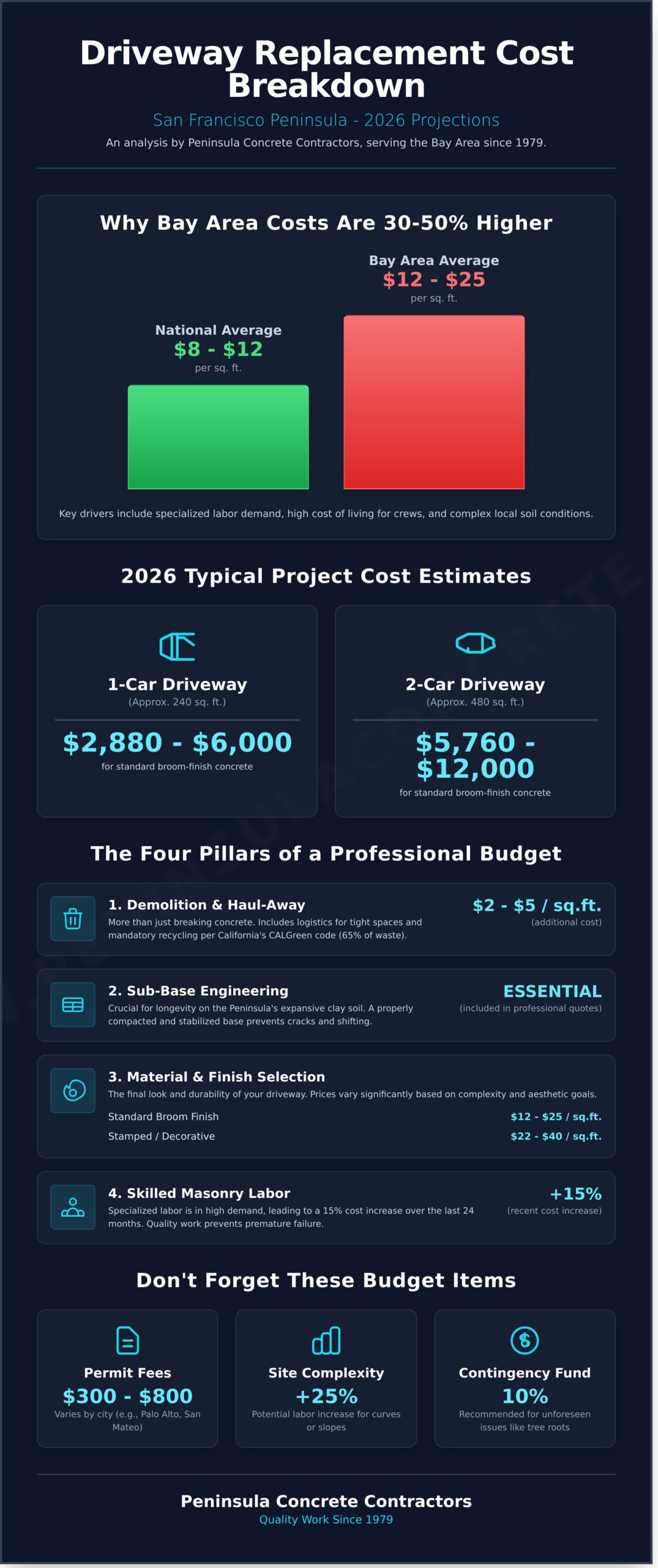
Estimating your driveway replacement cost Bay Area requires looking at local economic factors that don’t exist in other parts of the country. Since 1979, our family-owned business has watched these cycles shift; however, 2026 presents a unique landscape for homeowners. Current pricing for a standard concrete driveway ranges from $12 to $25 per square foot. This puts the Bay Area roughly 40% higher than the national average, which typically sits between $8 and $12. High demand for skilled masonry labor and the extreme cost of living for crews on the Peninsula drive these premiums.
For a standard one-car driveway measuring approximately 240 square feet, homeowners should budget between $2,880 and $6,000. A typical two-car driveway of 480 square feet often ranges from $5,760 to $12,000. These figures represent the “all-in” price for standard broom-finish concrete. If you’re planning a project in 2026, you must account for the 15% increase in labor costs seen over the last twenty four months. Labor shortages in the specialized masonry trade continue to push project lead times and pricing higher across San Mateo and Santa Clara counties.
Square Foot Pricing vs. Total Project Cost
A professional quote is more than just a single number. At Peninsula Concrete, our per-square-foot rate includes the essential structural elements: setting the forms, installing grade-60 rebar, and the actual pour. We’ve built a reputation for honesty, so we’re clear about what adds to that base price. Driveway geometry plays a massive role; curved edges or steep slopes on Peninsula hillsides increase labor intensity by 25%. In tight residential areas like Redwood City, we often see minimum project fees of $3,500 to cover the logistics of moving heavy equipment onto smaller lots.
2026 Material Price Trends: Concrete vs. Alternatives
While ready-mix concrete prices stabilized in late 2025, they remain at a premium compared to pre-2020 levels. Fuel surcharges for delivery trucks have risen 12% since 2024, directly impacting every estimate. You’ll also see a significant cost gap between finishes. A standard broom finish is your most cost-effective path, while decorative stamped concrete can add $10 to $15 per square foot to your total.
Many homeowners are also looking at long-term durability and environmental impact. While standard concrete is our hallmark, some projects now incorporate permeable paving systems to manage stormwater runoff, which is a growing concern for local building departments. Budgeting for your driveway replacement cost Bay Area project means weighing these material choices against your long-term goals for the property. We recommend a 10% contingency fund to cover unforeseen soil stabilization needs or tree root removals, which are common issues in our established local neighborhoods.
- Standard Concrete: $12-$25 per sq. ft.
- Stamped/Decorative: $22-$40 per sq. ft.
- Demolition/Removal: $2-$5 per sq. ft. (additional)
- Permit Fees: Varies by city (typically $300-$800)
Quality work since 1979 means we don’t cut corners on the base or the reinforcement. Our 2nd-generation team ensures your investment stands up to the specific soil conditions found in the Bay Area. Start your project today by getting a clear, professional assessment of your site’s specific needs.
The Four Pillars of a Driveway Replacement Budget
Since 1979, our family-owned business has seen how homeowners underestimate the complexity of a total tear-out. Calculating the driveway replacement cost Bay Area residents face requires looking far beyond the price of a concrete truck. A professional estimate is built on four critical pillars: demolition logistics, sub-base engineering, material specifications, and skilled craftsmanship. Skipping any of these steps leads to a driveway that fails long before its 30-year potential life expectancy.
Demolition is the most overlooked expense in Northern California. It’s not just about breaking up the old slab; it’s about the logistics of moving 20 to 45 tons of debris through narrow Peninsula side-yards. California’s CALGreen mandates require that 65 percent of non-hazardous construction waste be recycled. This adds specialized labor and transportation costs that “trunk-and-trailer” contractors often ignore. When you get a quote, ensure it includes the full scope of these environmental compliance fees.
Demolition and Haul-Away Fees in the Peninsula
Tight neighborhoods in San Carlos, San Mateo, or Burlingame often require smaller, more expensive equipment like mini-skid steers to avoid damaging neighboring property or blocking narrow streets. Dump fees are a variable cost based on concrete thickness; a 6-inch thick slab costs 50 percent more to haul away than a standard 4-inch sidewalk-grade slab. You must also account for Bay Area permits and regulations which ensure that the disposal and site work follow local environmental codes.
Site preparation is where the real longevity of your driveway is decided. In our region, we deal with expansive clay soil that moves with every seasonal rain cycle. We install a minimum 6-inch layer of Class II basalt crushed rock to create a stable platform. Without this engineered layer, the soil will expand and contract, causing the concrete to buckle and snap under the weight of your vehicles.
Sub-Base Engineering for Expansive Clay Soil
Bay Area clay is notorious for the “Bay Area heave,” a phenomenon where soil swells in winter and shrinks in the dry summer. We mitigate this by using geo-textile fabric, a professional-grade barrier that costs roughly $0.65 to $1.10 per square foot but prevents the expensive rock base from sinking into the mud. Proper compaction using a 1,000-pound vibratory roller is the only way to ensure your driveway replacement cost Bay Area investment doesn’t result in a sinking slab by 2028.
Material quality isn’t just about “wet rocks.” We specify a 4,000 PSI mix with integrated fiber mesh and #3 rebar spaced 12 inches on center. Cheap labor often cuts corners here, using 2,500 PSI “sidewalk” mixes that can’t handle the weight of a modern SUV or electric vehicle. This leads to the “2-year crack,” where hairline fractures become structural failures because the contractor didn’t use enough reinforcement. Our 2nd-generation team focuses on craftsmanship because we’ve built our reputation on honesty since 1979. If you want to see how these standards apply to your home, you can view our past projects to understand the value of professional installation.
Finally, labor and craftsmanship represent the difference between a 10-year and a 40-year driveway. A skilled crew understands the timing of the “cream” on the concrete and knows exactly when to cut control joints to prevent random cracking. While “cheap” labor might save you $2,000 today, the cost of replacing a failed driveway in five years is double the original price. We believe in doing it right the first time.
Concrete vs. Interlocking Pavers: Which Investment Wins?
Choosing the right material is the most significant decision you’ll make when planning your project. In the local market, your choice directly dictates the total driveway replacement cost Bay Area homeowners should expect to pay. Since 1979, we’ve seen trends shift, but the core debate remains focused on the balance between upfront price and long-term durability. Concrete currently ranges from $12 to $25 per square foot, while high-end interlocking pavers typically fall between $25 and $50 per square foot installed.
The price gap reflects more than just material costs. Pavers require a more intensive labor process, including a multi-layered sub-base and hand-setting each unit. However, the investment often pays for itself through reduced repair needs. While a solid concrete slab is rigid, pavers are flexible. This flexibility is vital in our region, where soil expansion and minor seismic activity are daily realities. A single crack in a concrete driveway can require a full slab replacement. In contrast, if a paver shifts, you can simply lift it, level the base, and reset the stone.
The Case for Traditional Concrete
Concrete remains a top choice for homeowners who prioritize a clean, modern aesthetic and a faster project timeline. Most concrete pours are completed in just a few days, allowing you to regain access to your garage quickly. Modern techniques like salt finishes or integral color allow us to create sophisticated looks that complement mid-century modern homes in Palo Alto or Los Altos. For more details on maintaining these surfaces, see our Bay Area Concrete Driveways: A Durability Guide. It’s a reliable, cost-effective solution that has served our clients well for over four decades.
Why Interlocking Pavers are Surging in 2026
We’ve noticed a 35% increase in paver installations over the last two years. This surge is driven by homeowners seeking “seismic-proof” hardscaping. According to the Interlocking Concrete Pavement Institute, these systems are designed to distribute heavy loads across the entire surface, which prevents the structural failure often seen in rigid materials. Furthermore, 2026 drainage regulations in many Bay Area municipalities now favor permeable paver options. These systems allow rainwater to filter back into the soil, reducing runoff and helping you meet strict local environmental codes. You can learn more about these options in our Interlocking Pavers: The Ultimate Hardscape Guide.
Maintenance requirements differ significantly between the two. Concrete needs a fresh coat of high-quality sealer every three to five years to prevent staining and water penetration. Pavers require a different approach. You’ll need to refresh the polymeric sand in the joints approximately every five to seven years to keep the units locked tight and prevent weed growth. While both require some upkeep, pavers offer a “forever” look because they don’t show the same age-related wear as a weathered slab.
Property value is the final piece of the puzzle. In high-stakes markets like the Peninsula, curb appeal accounts for up to 7% of a home’s total appraisal value. A custom paver driveway often serves as a “signature” feature that distinguishes a property during a sale. When you calculate your driveway replacement cost Bay Area, consider that pavers often return 80% to 100% of their cost in immediate home equity. We’ve built our reputation on helping families choose the path that makes the most sense for their specific budget and long-term goals.
Navigating Bay Area Permits and Drainage Regulations
Replacing a driveway on the Peninsula involves more than just pouring concrete. Most cities from Burlingame down to Sunnyvale require a building or site development permit for what homeowners often assume is a simple swap. This oversight can lead to stop work orders and hefty fines that inflate your total driveway replacement cost Bay Area. Cities require these permits to ensure the new slab doesn’t negatively impact local utility lines or neighbor property lines.
If your project touches the sidewalk, curb, or gutter, you’ll likely need an encroachment permit. This is a separate authorization allowing your contractor to work within the public right-of-way. In 2026, local municipalities have intensified inspections on these transition zones to prevent trip hazards and ensure ADA compliance. Since 1979, we’ve seen how these small details can derail a project if not handled correctly from day one. Our team manages the entire submittal process; we take the paperwork headache off your plate so you don’t have to spend your mornings at the city planning desk.
New 2026 storm water runoff requirements have changed the landscape for residential hardscapes. Regulations now mandate that any new impermeable surface over 500 square feet must include a plan for onsite water retention or filtration. This aims to reduce the strain on the Bay Area’s aging sewer systems during heavy atmospheric river events. Failing to account for these rules during the design phase can lead to permit denials or expensive mid-project retrofits.
City-Specific Permit Costs (Redwood City, Palo Alto, San Mateo)
Redwood City permits cost $400 to $850; they enforce a 40% maximum coverage limit for front yard impermeable surfaces. Palo Alto fees range from $900 to $1,800, often requiring reviews for protected trees. San Mateo typically charges $500 to $1,200, focusing on street approach compliance. Towns like Woodside or Menlo Park add strict aesthetic rules to maintain neighborhood character.
Integrating Drainage Systems to Protect Your Investment
Proper grading ensures a 2% slope away from your foundation. Adding channel drains or catch basins adds $2,000 to $4,500 to the driveway replacement cost Bay Area but prevents foundation damage. These systems capture runoff before soil erosion occurs. If your property has slopes, consider if your retaining wall needs a drainage system to handle the extra volume. Integrating these early prevents future demolition.
Don’t let red tape and runoff rules stall your home improvement plans. Contact Peninsula Concrete today to schedule a site walk and get an accurate, all-inclusive estimate for your project.
Quality Since 1979: The Peninsula Concrete Advantage
Experience isn’t just a number on a business card; it’s the difference between a driveway that lasts fifteen years and one that lasts fifty. Since 1979, Peninsula Concrete has worked with the specific geological challenges of Northern California. Bay Area soil is notorious for its high clay content, which expands and contracts with our seasonal rain cycles. We’ve spent 47 years perfecting sub-base preparation techniques that counteract this movement. We don’t just pour concrete; we engineer a foundation designed to survive the shifting terrain of cities like San Mateo and Palo Alto.
Our 2nd-generation status brings a level of family-owned accountability you won’t find with national franchises. When you call us, you’re speaking with owners who have a personal stake in the company’s reputation. We treat every project as a reflection of our family name. This heritage means we prioritize long-term durability over quick, cheap fixes that often inflate the long-term driveway replacement cost Bay Area homeowners face when they have to repair shoddy work just a few years later.
Transparency is the bedrock of our bidding process. Many contractors provide a “low-ball” estimate only to add “unforeseen” disposal fees later. We include the full cost of hauling away your old asphalt or concrete, which currently averages $45 to $65 per ton in local recycling fees, right in the initial quote. You won’t find hidden surcharges for equipment mobilization or site cleanup on your final invoice. We believe honesty is the only way to maintain a business for nearly five decades.
We respect your neighborhood as much as we respect your property. Construction is inherently disruptive, but we’ve refined our logistics to minimize the impact on your neighbors. We coordinate deliveries to avoid blocking narrow residential streets during peak commute hours. Our crews maintain a tidy job site, ensuring that dust and debris don’t migrate to the house next door. We aim to be the contractor your neighbors ask for by name once they see the finished result.
The Peninsula Concrete Guarantee
Our commitment to quality starts with a 4,000 PSI concrete mix and grade 60 rebar reinforcement. We never use flimsy wire mesh that settles to the bottom of the slab. Because our roots are firmly planted in Redwood City, you can trust that we’ll be here to honor our warranty. We’ve been a local fixture since 1979, and we plan to be here for the next generation of homeowners. Contact us today to schedule a local site evaluation and see the Peninsula difference for yourself.
Starting Your Project Today
Your free estimate walk-through is a comprehensive 30-minute assessment where we check for drainage issues and root intrusions from nearby trees. For the 2026 season, our typical lead times for residential driveway projects range from 3 to 5 weeks from the date of the signed contract. We handle all the necessary city permits and inspections so you don’t have to manage the bureaucracy. Get a Free Estimate for Your Driveway Replacement and ensure your investment is protected by 47 years of local expertise. We’ll help you understand every factor affecting your driveway replacement cost Bay Area project from start to finish.
PLAN YOUR 2026 PROJECT WITH CONFIDENCE
Navigating the driveway replacement cost Bay Area homeowners face in 2026 doesn’t have to be a guessing game. You’ve seen how material durability and proper drainage planning are the keys to a successful installation. Since 1979, our team has specialized in the unique soil profiles of the Peninsula, ensuring every pour or paver we set stands up to local conditions. We’re a 2nd-generation, family-owned business that’s spent over 45 years building a reputation for honesty and technical excellence.
Choosing an experienced partner means your project will meet all local drainage regulations and permit standards without unnecessary delays. We take pride in our heritage of craftsmanship and treat every home like it’s our own. Don’t settle for unproven contractors when you can rely on decades of local expertise and a personal touch. We’re ready to help you transform your property with a driveway that combines strength, beauty, and long-term value.
Start your driveway project today with a free estimate from Peninsula Concrete
We’re excited to help you get your project started right.
Frequently Asked Questions
How much does a 2-car concrete driveway cost in the Bay Area?
A standard 400-square-foot 2-car driveway typically costs between $6,400 and $10,800 in 2026. This equates to a driveway replacement cost Bay Area homeowners can expect to range from $16 to $27 per square foot for a basic installation. Prices vary based on the thickness of the slab and the complexity of the site. At Peninsula Concrete, we’ve provided honest estimates since 1979 to ensure our neighbors get the best value for their investment.
Is it cheaper to resurface or replace my driveway?
Resurfacing is cheaper upfront, costing about $3 to $7 per square foot compared to $15 to $25 for a full replacement. However, resurfacing only lasts 8 to 12 years and won’t fix deep structural cracks. If your driveway has cracks wider than 0.25 inches, a full replacement is the more durable choice. It’s better to invest in a long-term solution that protects your property’s heritage rather than applying a temporary fix.
Do I need a permit to replace my driveway in Redwood City?
Yes, you must obtain a concrete permit from the Redwood City Building Department for any driveway replacement. As of 2024, the city requires a licensed C-8 contractor to pull this permit to ensure the work meets local drainage and sidewalk standards. We handle the paperwork for our clients to make the process simple. This ensures your project stays compliant with municipal codes and avoids 10 percent late filing penalties.
How long does a new concrete driveway take to cure before I can drive on it?
You should wait at least 7 days before driving a standard passenger vehicle on your new driveway. While the concrete feels hard within 24 hours, it takes 28 days to reach its full structural strength of 4,000 PSI. Avoid parking heavy delivery trucks or RVs on the slab for the first 30 days. This patience ensures your high-quality installation remains pristine and crack-free for decades to come.
Why is concrete cracking so common in Northern California?
Concrete cracks often in Northern California due to expansive clay soils that shift during the wet winter months. These soils can expand by up to 10 percent when saturated, putting immense pressure on the slab. We use reinforced rebar and strategic control joints to manage this movement. Our 2nd-generation experience has taught us exactly how to prep the sub-base to withstand these local geological challenges effectively.
Will a new driveway increase my Bay Area home’s value?
A new driveway can increase your home’s value by 5 percent to 10 percent through improved curb appeal. Real estate data shows that the driveway replacement cost Bay Area residents pay often yields an ROI of 60 percent to 75 percent upon resale. It’s the first thing buyers see when they pull up to your property. Our reputable team ensures the finish is flawless, making your home stand out in the competitive Peninsula market.
What is the best month to pour concrete in the San Francisco Peninsula?
The best months to pour concrete on the San Francisco Peninsula are May through September. During this window, the risk of rain is less than 5 percent, which is crucial for the surface finish. Ideal temperatures for curing are between 50 and 80 degrees Fahrenheit. We’ve been monitoring local weather patterns since 1979 to schedule our pours during these optimal windows. This precision results in a stronger, more durable finished product.
Can I replace my concrete driveway with permeable pavers?
Yes, you can replace your concrete with permeable pavers to improve drainage and aesthetics. These systems reduce stormwater runoff by 80 percent and are unsurpassed in strength and flexibility. They’re a fantastic choice for homeowners in areas with strict 2024 impervious surface limits. Our family-owned business specializes in these interlocking systems, providing a modern look that respects the environment. This upgrade often qualifies for local green infrastructure credits.