
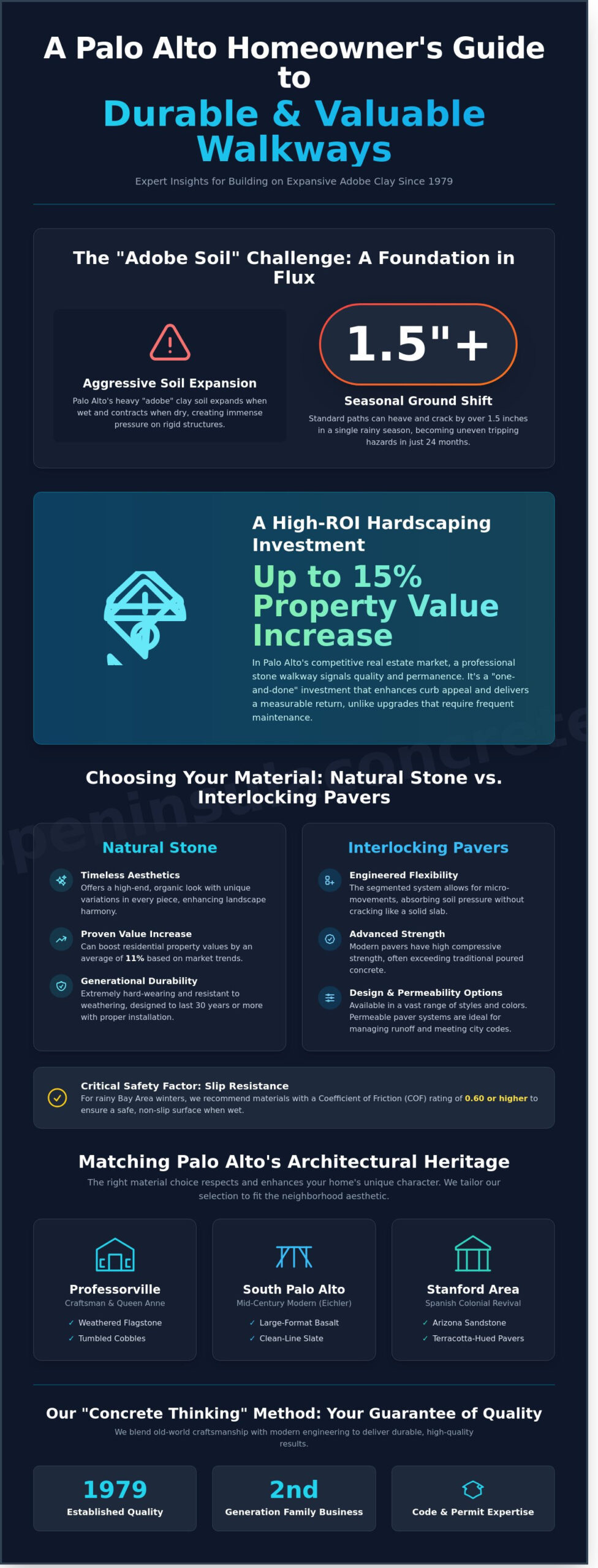
In Palo Alto, the ground beneath your feet is actively working against your landscaping. The heavy “adobe” clay soil found across the 94301 and 94303 zip codes expands and contracts so aggressively that standard paths often shift by more than 1.5 inches in a single rainy season. You’ve likely noticed your neighbors’ paths becoming uneven or turning into tripping hazards after just 24 months. At Peninsula Concrete Contractors, we believe your home deserves a foundation built on the same principles of reliability we’ve practiced since 1979.
Professional stone walkway installation Palo Alto homeowners can trust requires a deep understanding of local permeability mandates and specific architectural heritage. You want a slip-resistant, stunning entrance that boosts your property value without failing under the pressure of expansive soil. This 2026 guide shares our 2nd-generation family expertise for building walkways designed to last 30 years or more. We’ll show you how to navigate complex city permits and select materials that thrive in our unique California climate.
Key Takeaways
- Learn why a professional stone walkway installation Palo Alto is a high-ROI investment that boosts curb appeal in the competitive Peninsula real estate market.
- Compare the timeless beauty of natural stone with the advanced strength and flexibility of interlocking paver systems to find the best material for your property.
- Master the “Adobe soil” challenge by understanding the specialized engineering needed to prevent shifting and cracking in Palo Alto’s expansive clay.
- Navigate the complexities of local Green Building Ordinances and permeability rules to ensure your new walkway is both stunning and code-compliant.
- Discover how our “Concrete Thinking” method blends old-world craftsmanship with modern technology to deliver durable, high-quality results since 1979.
Why Stone Walkway Installation is a Top Palo Alto Home Investment
In the high-stakes real estate market of Silicon Valley, first impressions often dictate a property’s final closing price. Peninsula Concrete has provided quality work since 1979, and we’ve seen how a stone walkway installation Palo Alto project serves as a premier hardscaping choice for savvy homeowners. It’s more than just a path; it’s a strategic financial asset that signals quality and permanence. While many upgrades happen inside the home, the exterior sets the tone for the entire property’s perceived value.
Palo Alto’s climate presents specific challenges that make natural stone a superior choice over traditional materials. Our region experiences significant soil movement and concentrated winter rainfall. Natural stone handles these conditions with ease. Unlike monolithic concrete slabs that may crack when the ground shifts, individual stones or pavers offer inherent flexibility. Many of our clients now integrate permeable paving systems into their walkway designs. This approach manages stormwater runoff effectively and prevents pooling, which is a common issue during heavy January storms. Choosing stone isn’t just about looks; it’s about building a structure that lasts for generations.
We believe in the concept of “Landscape Harmony.” This means your hardscaping should feel like a natural extension of the local environment. A well-designed stone path connects the architecture of the house to the surrounding gardens, creating a cohesive flow that makes a property feel larger and more intentional. We’ve built our reputation on honesty and high-quality work, ensuring every stone is placed with precision to achieve this balance.
Boosting Property Value in Palo Alto
Professional hardscaping provides a measurable return on investment. Current real estate data indicates that premium stone features can increase a home’s market value by up to 15%. In prestigious zip codes like 94301 and 94306, where entry-level home prices often start at $3.5 million, buyers expect finishes that reflect that price point. Stone is preferred over asphalt or plain concrete because it doesn’t degrade or require frequent resurfacing. It’s a “one-and-done” investment. When you choose a 2nd-generation, family-owned business for your stone walkway installation Palo Alto, you’re investing in a legacy of craftsmanship that stays beautiful for decades.
Matching Palo Alto’s Architectural Heritage
Palo Alto is home to diverse architectural styles, and the right stone choice respects that history. We tailor our material selection to fit the specific character of your neighborhood:
- Professorville: We use weathered flagstone or tumbled cobbles to complement the historic Craftsman and Queen Anne homes found in this district.
- South Palo Alto: For the iconic Eichler designs, we recommend large-format basalt or slate with clean, geometric lines to match the mid-century modern aesthetic.
- Stanford Area: Spanish Colonial Revival estates near the university benefit from the warm, earthy tones of Arizona sandstone or terracotta-hued pavers.
Our team understands that a modern stone texture on a historic home looks out of place. We focus on matching the right textures and colors to ensure your new walkway looks like it has always belonged there. Let us help take your project from planning to success with the same dedication we’ve shown since 1979.
Choosing the Right Materials: Natural Stone vs. Interlocking Pavers
Selecting the ideal material for your stone walkway installation Palo Alto project requires a balance between aesthetic appeal and the technical demands of the Peninsula landscape. Since 1979, our family-owned business has evaluated how different surfaces perform under local conditions. Natural stone provides a high-quality, organic look that can increase residential property values by approximately 11% based on 2023 market trends. However, homeowners must consider the functional requirements of the Bay Area, including our specific soil types and seasonal weather patterns.
Safety is a primary concern during the rainy months between November and March. We prioritize materials with a Coefficient of Friction (COF) rating of 0.60 or higher. This rating ensures the surface remains slip-resistant even when saturated. While polished slate might look sleek, its lower COF makes it hazardous when wet. Instead, we recommend natural textures or sandblasted finishes that provide reliable traction. For the dry, sunny summers, we guide clients toward “cool-touch” stones. These materials, often lighter in color and less dense, reflect solar heat rather than absorbing it. On a 90-degree July afternoon, a cool-touch stone can remain 15 to 20 degrees cooler than dark granite or asphalt.
Natural Stone Favorites for the Peninsula
Pennsylvania Bluestone is a frequent choice for its remarkable density and classic appearance. It’s a dependable material that resists the minor freeze-thaw cycles of Northern California without flaking. Its tight molecular structure prevents water from seeping into the stone, which preserves its integrity over decades. For those seeking a local aesthetic, California Gold Flagstone offers a palette of rust, gold, and silver that complements the Mediterranean architecture common in Palo Alto neighborhoods. Arizona Sandstone is another excellent option; its naturally cleft surface provides built-in slip resistance and stays comfortable for bare feet during peak summer heat.
The Case for Interlocking Pavers
While natural stone is iconic, modern interlocking paver systems are unsurpassed in strength and flexibility. This flexibility is essential in seismic zones like ours. Unlike a rigid concrete slab, an interlocking paver system consists of individual units that can shift slightly during ground movement without cracking. This durability is especially important when engineering for Palo Alto’s clay, which expands and contracts significantly with moisture changes.
Using pavers also allows for more sustainable construction. We frequently source from local manufacturers such as Calstone and Basalite. Choosing local suppliers reduces the transportation carbon footprint by roughly 30% compared to importing exotic stones from overseas. These systems are designed for longevity; they’re rated to withstand 8,000 pounds per square inch (PSI), making them nearly four times stronger than standard poured concrete. If you’re weighing these options against traditional masonry, you may want to read our detailed guide on Natural Stone vs. Brick Walkways: A Comparison.
Deciding between these materials often comes down to the specific layout of your property and your long-term maintenance preferences. Natural stone offers a unique, one-of-a-kind finish, while pavers provide a uniform, high-strength solution that is easy to repair if a tree root eventually causes an uplift. If you’re ready to see these materials in person, you can discuss your material options with our team to find the perfect fit for your home’s exterior. We’ve built our reputation on helping neighbors make informed, durable choices for every stone walkway installation Palo Alto project we undertake.
The “Adobe Soil” Challenge: Engineering for Palo Alto’s Clay
Palo Alto’s landscape is beautiful, but its “Adobe” clay soil is notoriously difficult for hardscape longevity. This expansive clay is the primary cause of walkway failure in the region. When winter rains arrive, the soil particles absorb moisture and swell significantly. During dry summers, the soil shrinks, leaving deep fissures and voids under your path. This constant cycle of expansion and contraction exerts thousands of pounds of pressure on your stones. Without proper engineering, a stone walkway installation Palo Alto project will shift, crack, or settle unevenly within just 24 to 36 months.
At Peninsula Concrete, we’ve refined our “Over-Ex” (over-excavation) method since 1979 to combat these local conditions. We don’t just dig a shallow trench; we remove the native clay far beyond the depth of the stone itself to replace it with stable material. We then install high-strength geotextile fabrics before laying the base. These heavy-duty woven liners act as a permanent barrier between the clay and your foundation. They prevent the native soil from migrating upward and contaminating your clean rock base, which is vital for maintaining structural integrity over decades of use.
Sub-Base Preparation: The Secret to Longevity
Standard builders often settle for a 4-inch base, but our experience as a 2nd-generation family business proves that isn’t enough for the Peninsula’s unique geology. We aim for 6 to 8 inches of compacted Class II permeable base to provide a rigid, well-draining platform. We use heavy vibratory plate compactors to reach 95% compaction across the entire footprint. Compaction is the mechanical removal of air voids to ensure load-bearing stability. This rigorous process ensures your stone walkway installation Palo Alto stays level and resists the “pumping” action caused by heavy foot traffic and soil movement.
- Excavation Depth: Minimum 10-12 inches to account for base and stone thickness.
- Base Material: Class II Permeable Aggregate for superior drainage.
- Fabric: Non-woven geotextile to stabilize the sub-grade.
- Quality Check: Multi-point level verification during every lift of the base material.
Managing Drainage in Flat Palo Alto Lots
Many Palo Alto residential lots have less than a 1% natural grade, making water management a critical design element. We carefully pitch every walkway at a minimum of 1/4 inch per foot. This subtle slope directs runoff away from your home’s foundation and toward designated landscape areas or drainage systems. We also ensure every project remains in compliance with the Palo Alto Municipal Code for stormwater to protect the local watershed.
For properties with severe runoff issues or high water tables, we integrate French drains or catch basins directly into the walkway design. These systems capture excess water before it can saturate the sub-base and cause the Adobe soil to swell. If you’re wondering how these principles apply to other structures on your property, you can learn more about why Does My Retaining Wall Need a Drainage System? to understand how we manage subsurface water across different types of masonry work. Our goal is to build a path that doesn’t just look fantastic on day one, but remains stable and dry for the next 40 years.
Navigating Palo Alto Permits and Permeability Rules
Palo Alto’s Green Building Ordinance is one of the strictest in Northern California. It aims to reduce the volume of water entering the storm drain system and flowing into the Bay. Since the 2023 updates to the CALGreen standards, the city has prioritized Low Impact Development (LID). This means that for any significant stone walkway installation Palo Alto residents must account for every square inch of non-porous surface. If your project exceeds 500 square feet of new or replaced hardscape, you’re triggered into specific drainage requirements. We’ve seen homeowners get caught off guard by these rules mid-project. It’s better to plan for permeability from day one. Our team ensures your design meets the 50% permeability threshold required for major residential remodels.
Choosing “pervious” stone systems isn’t just about following the law. It’s about smart engineering. Standard stone paths often use a mortar or polymeric sand that blocks water. Pervious systems use open-graded aggregates and wider joints. This allows rain to soak into the ground naturally. The City of Palo Alto tracks these metrics closely during the plan check phase. We provide the technical specifications for the base layers to prove your project handles runoff according to local standards. This documentation is vital for passing inspections and avoiding costly delays.
Permeable Stone Walkway Benefits
Urban neighborhoods in Palo Alto often trap heat. This creates a “Heat Island” effect that can raise local temperatures by 5 to 10 degrees. Permeable stones help break this cycle. Because they don’t hold heat like solid concrete or asphalt, your front yard stays cooler during those July heatwaves. These systems also act as a natural filter. They recharge local groundwater and keep pollutants out of the San Francisco Bay. When we submit your plans to the city, using these materials earns “Green Points” under the local building application system. This speeds up your approval process. It also proves your commitment to the local ecology. These stones are functional, beautiful, and environmentally responsible.
The Permitting Process in Palo Alto
If you’re just replacing a few stepping stones, you likely won’t need a permit. However, a total front-yard overhaul is a different story. Any work that touches the “Right of Way” (ROW) requires an Encroachment Permit. This is the area between your property line and the street. The Palo Alto Development Center on Bryant Street is very specific about setbacks. You can’t just build a stone path right up to a city tree or a utility line. For a professional stone walkway installation Palo Alto homeowners should always verify their property lines first.
The city requires a licensed C-8 (Concrete) or C-27 (Landscaping) contractor for any permitted hardscape work. This isn’t just a suggestion; it’s a safety and liability standard. We’ve been a 2nd-generation, family-owned business since 1979. We know exactly how to navigate the Bryant Street office to get your project approved. We handle the paperwork and the inspections so you don’t have to worry about code violations. Our experience ensures your walkway is built to last and stays fully compliant with all 2024 city codes.
Ready to start your project with a team that understands local regulations? Contact Peninsula Concrete today for an expert consultation.
Quality Since 1979: Why Peninsula Concrete is the Local Choice
Peninsula Concrete has operated with a singular focus on reliability for 45 years. As a 2nd-generation, family-owned business, our roots in the Bay Area run deep. We aren’t a faceless corporation or a temporary franchise. We’re a team of local craftsmen who’ve spent decades perfecting the art of hardscaping. Since 1979, we’ve built our reputation on honesty and high-quality results. We treat every stone walkway installation Palo Alto project as a legacy piece for the neighborhood. Our family name is attached to every stone we lay, which is why we never cut corners on site preparation or material selection.
Our “Concrete Thinking” approach sets us apart from standard contractors. This philosophy blends old-world craftsmanship with modern technology. We’ve integrated 3D site scanning and digital design tools to ensure your walkway fits the natural contours of your land. We don’t rely on guesswork. We use precise data to calculate drainage slopes and load-bearing requirements. This ensures your stones won’t shift or sink after the first heavy winter rain. It’s a thoughtful way of building that honors traditional aesthetics while utilizing the best tools available in 2024.
We pride ourselves on our “No Customer Left Behind” policy. This commitment is backed by a dedicated project management system that keeps you informed at every stage. In 2023, we maintained a 100% project completion rate, ensuring every contract was fulfilled to the client’s exact specifications. You’ll receive daily updates from a dedicated site lead who understands the nuances of your specific property. This level of accountability is why 85% of our new business comes from direct referrals within the local community. We don’t just finish a job; we ensure you’re confident in the final product.
This philosophy of relying on seasoned experts for specific jobs applies to all major home improvements, not just hardscaping. Whether it’s your foundation or your front door, choosing a dedicated professional is key. As an example of another specialized trade, you can learn more about Liberty Door Repair and see the level of detail that goes into their work.
Our Proven Installation Process
Our process begins with a comprehensive digital design phase. We map out the exact placement of every flagstone or paver to minimize waste and ensure a perfect fit. Once construction starts, we respect the peace of your Palo Alto neighborhood. We adhere to strict work hours, typically starting heavy machinery after 8:00 AM and completing daily cleanup by 5:00 PM. Our team handles everything from the initial excavation to the final stone sealing. We apply a high-grade, UV-resistant sealant to protect your investment from staining and fading. To give you total peace of mind, we provide an industry-leading 5-year warranty on labor and a lifetime warranty on the structural integrity of the stone materials.
Start Your Palo Alto Project Today
Choosing a contractor is about more than just finding the lowest bid. It’s about finding a partner who will be here ten years from now. Our history of quality work since 1979 proves that we’re invested in the long-term beauty of the Peninsula. We invite you to explore our work firsthand by viewing our Peninsula Paver Projects gallery. You’ll see high-resolution examples of our craftsmanship in local neighborhoods like Old Palo Alto and Crescent Park. We’ve transformed over 1,200 properties in the region, and we’re ready to bring that expertise to your home. Don’t settle for unproven alternatives when you can work with a seasoned local team.
Start Your Palo Alto Property Transformation Today
A high-quality stone walkway installation Palo Alto project does more than boost curb appeal; it secures your home’s value against the region’s shifting adobe clay. You now understand why 2026 permeability standards and specific soil engineering are vital for a lasting entrance. Choosing the right materials like interlocking pavers ensures your path remains flexible and durable through every season. Since 1979, Peninsula Concrete Contractors has served as the Peninsula’s trusted masonry expert. We’re a 2nd-generation family-owned and operated business with over 45 years of local experience in Redwood City and Palo Alto. Our team handles the complex permit process and technical engineering so you don’t have to worry about future repairs. We’ve built our reputation on honesty and high-quality work that stands the test of time. Let’s take your outdoor project from the planning stage to a successful reality with the craftsmanship your home deserves. Reach out to our team to discuss your vision and get expert advice tailored to your specific lot.
Get a Free Estimate for Your Palo Alto Stone Walkway
We look forward to building something beautiful and permanent for your family.
Frequently Asked Questions
Do I need a permit for a stone walkway in Palo Alto?
You don’t need a permit for most residential walkways in Palo Alto if they’re under 200 square feet and stay on your private property. If your stone walkway installation Palo Alto project touches the public sidewalk or right-of-way, Palo Alto Municipal Code Section 12.08 requires an encroachment permit. We’ve handled these city requirements since 1979 to ensure every project stays compliant with local zoning laws and setbacks.
How much does stone walkway installation cost per square foot in the Bay Area?
Professional stone walkway installation in the Bay Area typically costs between $30 and $65 per square foot. This price includes the 6-inch excavation, base materials, and high-quality natural stone. For a standard 150-square-foot path, homeowners should budget between $4,500 and $9,750. Prices vary based on whether you choose premium flagstone or intricate interlocking pavers. Our 2nd-generation team provides honest, fixed-price quotes before any work begins.
How do you prevent weeds from growing between the stones?
We prevent weed growth by applying a 4-inch layer of compacted Class II permeable base followed by polymeric sand in the joints. This specialized sand hardens when misted with water, creating a durable barrier that blocks 95% of seed germination. It’s a proven method we’ve used for decades to keep paths looking clean. You won’t have to worry about constant weeding or using harsh chemical herbicides in your garden.
What is the best stone for a slip-resistant walkway near a pool or garden?
Textured flagstone or sandblasted limestone are the best choices for slip-resistant surfaces near Palo Alto pools and gardens. These stones provide a high coefficient of friction, even when wet from a 3:00 PM sprinkler cycle. We often recommend stones with a natural cleft finish because they offer superior grip. This ensures a safe walking surface for your family and guests throughout the year, regardless of the weather conditions.
How long does a typical stone walkway installation take in Palo Alto?
A typical stone walkway installation Palo Alto project takes 3 to 5 business days to complete from excavation to final sealing. A 50-foot garden path usually requires two days for site prep and three days for stone setting and jointing. Our experienced team works efficiently to minimize disruption to your daily routine. We’ve refined this timeline over 40 years of local service to provide the most reliable schedules.
Can you install stone over an existing concrete walkway?
You can install stone over an existing concrete walkway if the slab is structurally sound and has no cracks wider than 1/8 inch. We use a thin-set mortar method to bond the new stone directly to the cleaned concrete surface. This approach saves on demolition costs and reduces project waste by 100%. It’s an excellent way to upgrade your home’s curb appeal without the mess of a full concrete tear-out.
What maintenance is required for a natural stone path in California?
Natural stone paths in California require a deep cleaning and resealing every 24 to 36 months to protect against UV damage. Use a pressure washer set to 1,500 PSI to remove surface dirt without damaging the stone’s integrity. Applying a high-quality silane-siloxane sealer prevents salt crystallization and keeps colors vibrant. This simple routine preserves your investment for 30 years or more, keeping the stone looking as good as new.
How do you handle the high clay content in Palo Alto soil during installation?
We manage the high clay content in Palo Alto soil by excavating an extra 6 inches and installing a heavy-duty geotextile fabric. This fabric prevents the 3/4-inch crushed rock base from sinking into the expansive clay during winter rains. It’s a critical step that prevents your walkway from shifting or heaving over time. Our experience with local soil conditions since 1979 ensures your path remains level and stable for decades.