
A standard concrete driveway often begins to show its age after just 15 years, but a professional-grade paver system is designed to outlive the mortgage. At Peninsula Concrete, we’ve provided quality work since 1979, and we’ve seen firsthand how the right materials withstand the unique challenges of the San Francisco Peninsula. You probably worry about how the heavy clay soil in our region might cause your hardscape to sink or shift over time. It’s a valid concern, especially when you consider our local seismic activity and the high standards for property value in 2026.
In this guide, we’ll answer the critical question of how long do interlocking pavers last by showing you why a 50 year lifespan is the benchmark for a well-installed project. You’ll discover how these flexible systems provide superior earthquake resilience compared to rigid slabs. We’ll also walk through the specific engineering requirements for Bay Area soil and the simple maintenance habits that ensure your curb appeal remains flawless for decades. Our 2nd-generation, family-owned team is here to help you build a legacy that increases your home’s value for the long haul.
Key Takeaways
- Discover why professional-grade pavers can endure for over 50 years in the Bay Area, significantly outperforming traditional asphalt and concrete.
- Learn the “90/10 Rule” of installation and why your project’s lifespan depends almost entirely on the quality of the sub-base compaction.
- Find out exactly how long do interlocking pavers last when you implement simple maintenance strategies and professional sealing to protect your investment.
- Compare the long-term lifecycle costs of pavers versus poured concrete to see how the “Repairability Factor” saves you money over several decades.
- See how our 2nd-generation, family-owned expertise and “Quality Work Since 1979” philosophy ensures a durable, high-quality result for your home.
The Lifespan of Interlocking Pavers: What to Expect in the Bay Area
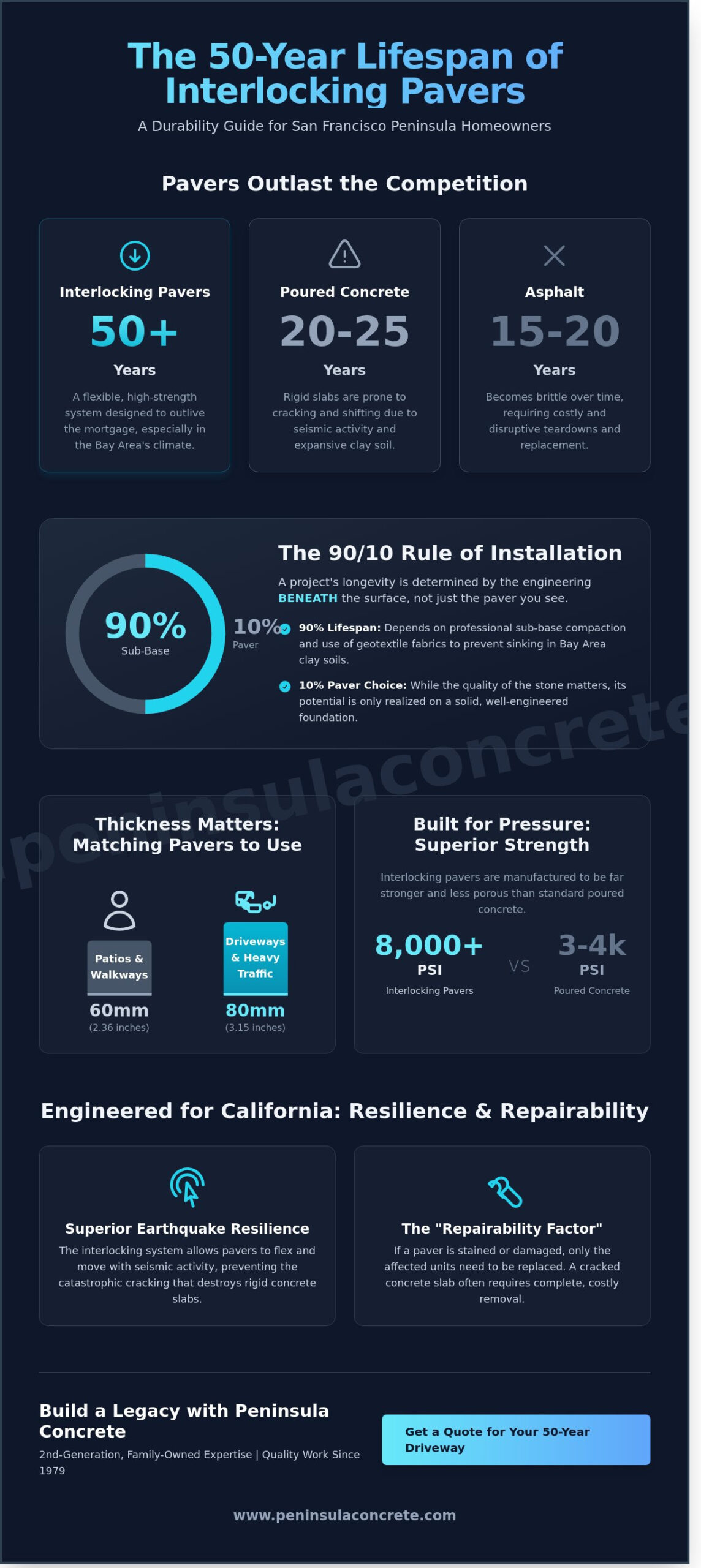
If you are investing in a home exterior renovation, you need to know how long do interlocking pavers last in our specific local environment. For a professional installation on the SF Peninsula, high-quality interlocking pavers typically last 40 to 50 years, often outliving the homeowners themselves. This durability is a primary reason why Peninsula Concrete has focused on this material since 1979. We have seen these systems maintain their integrity while other surfaces fail.
Comparing this longevity to other materials reveals a stark difference in long-term value. Traditional asphalt usually lasts 15 to 20 years before it becomes brittle and requires a complete teardown. Poured concrete often shows significant cracking within 20 to 25 years because it cannot flex with California’s seismic activity. The Bay Area climate is actually more paver-friendly than most of the country. We don’t deal with the extreme freeze-thaw cycles of the East Coast, and we don’t use corrosive road salts that eat away at stone surfaces over time.
The 50-Year Surface: Material vs. System
There is a common myth that a lifetime guarantee refers only to the stone itself. While the stones are incredibly durable, the true longevity comes from the entire structural system. Each interlocking concrete paver is manufactured under intense pressure exceeding 8,000 psi. This makes them significantly stronger and less porous than the 3,000 to 4,000 psi concrete used for standard poured driveways.
Thickness Matters: 60mm vs. 80mm Pavers
The depth of the stone is a technical detail that determines how long do interlocking pavers last when subjected to daily stress. Choosing the wrong thickness for the job is the most frequent cause of premature failure in residential projects.
- 60mm Pavers: These are 2.36 inches thick and are designed for pedestrian areas like patios, garden paths, and pool surrounds.
- 80mm Pavers: These are 3.15 inches thick and are the industry standard for Bay Area driveways or any area supporting vehicle weight.
Using the wrong thickness is a recipe for a short-lived project. An 80mm stone provides the necessary mass to resist the twisting forces of car tires and heavy SUVs. If a contractor uses thin 60mm stones for a driveway to save on material costs, the surface will likely shift or rut within 10 years. Matching the stone thickness to the intended load ensures your project reaches its full 50-year potential without structural compromise.
Why Installation Quality Dictates Your Paver Lifespan
When homeowners ask how long do interlocking pavers last, they often focus on the color or style of the stone. However, our team at Peninsula Concrete follows the 90/10 Rule. This means 90% of a project’s longevity is determined by the engineering beneath the surface, while only 10% is the actual paver you see. A beautiful stone installed on a weak foundation will fail within 3 to 5 years, whereas a properly prepared base allows the same stone to last for 40 years or more. Quality work since 1979 has taught us that there are no shortcuts to a permanent driveway or patio.
The foundation starts with rigorous sub-base compaction. We use heavy machinery to ensure the ground is dense enough to support vehicle and foot traffic without “sinking” over time. To ensure maximum stability, we integrate geotextile fabrics between the native soil and the gravel base. This fabric prevents the two layers from mixing. Without it, the gravel base eventually disappears into the soft California dirt, leading to ruts and uneven stones. The Federal Highway Administration notes the Durability of Interlocking Pavement depends heavily on these structural layers to distribute weight and prevent localized failures.
Engineering for Bay Area Clay
San Mateo and Santa Clara counties are known for expansive clay soils. This soil type expands significantly when wet and contracts during our dry summers. To combat this, we utilize specialized excavation depths tailored to your specific property. For example, a driveway often requires 8 to 12 inches of excavation to replace unstable dirt with a thick road-base layer. This provides the necessary mass to resist soil movement during heavy January rains. Relying on professional interlocking concrete pavers expertise ensures your investment doesn’t shift or buckle when the seasons change.
Seismic Flexibility: Why Pavers Survive Shifting
Living near major fault lines requires building materials that can move. Unlike rigid concrete slabs that inevitably crack during tremors, interlocking pavers are designed with “sand joints.” This system allows for micro-movements during seismic activity. Because the units are independent, they pivot and settle without structural damage. This flexibility is a primary reason why homeowners choose this system for long-term durability. When you consider how long do interlocking pavers last in a seismic zone, they consistently outperform traditional materials. If you want a surface built to last, let us help take your project from planning to success with a foundation that honors our heritage of quality work since 1979.
Maintenance Strategies to Reach the 50-Year Mark
Interlocking pavers are designed for extreme durability, but reaching the 50-year milestone requires a proactive approach. At Peninsula Concrete, we have seen installations from the early 1980s that still look pristine because the homeowners followed a consistent care routine. Regular maintenance prevents surface degradation caused by organic debris and environmental pollutants. While the pavers themselves are incredibly strong, the system relies on the integrity of the joints and the surface finish to withstand the test of time.
Understanding how long do interlocking pavers last often comes down to how well you manage these three factors:
- Debris Removal: Sweeping away leaves and dirt prevents tannins from staining the surface and keeps organic matter from settling in the joints.
- Drainage Checks: Ensuring your driveway or patio maintains its 2 percent slope prevents water from pooling, which can eventually soften the subbase.
- Spot Repairs: One of the biggest advantages of this system is the ability to fix “settling” without replacing the entire surface. If a small area dips due to a localized soil issue, you can simply lift the affected pavers, add bedding sand, re-compact the area, and reset the original stones.
Sealing for Protection and Aesthetics
Sealing is not just a luxury for Peninsula homes; it is a vital layer of defense. The Bay Area’s high UV index can fade the pigments in concrete over several decades. High-quality sealants act like a sunscreen for your hardscape. They also create a non-porous barrier that prevents motor oil, grease, and berry stains from penetrating the surface. We recommend resealing your pavers every 3 to 5 years to maintain their structural integrity and vibrant color. You can choose between a “wet look” sealant, which deepens the color and adds a slight sheen, or a “natural” sealant that provides protection without changing the appearance of the stone.
Weed Prevention and Joint Integrity
Pavers vs. Poured Concrete: A Durability Showdown
When evaluating how long do interlocking pavers last compared to traditional poured concrete, the difference becomes clear around the 15-year mark. While a new concrete slab looks clean on day one, it’s a rigid structure. In the Bay Area, where seismic shifts and expansive clay soils are common, rigidity is a liability. Industry data suggests that interlocking pavers can maintain their structural integrity for 30 to 50 years, whereas traditional concrete driveways often require significant repairs or replacement within 20 years due to surface scaling and deep fractures.
The 30-year lifecycle cost of pavers is lower because you avoid the total failure scenario. By year 20, a paver driveway still looks intentional and high-end. In contrast, a two-decade-old concrete slab usually shows its age through spiderweb cracks and discoloration. Pavers are unsurpassed in strength because they distribute weight across individual units. This prevents the massive tension build-up that snaps solid slabs during ground movement.
The Cost of Cracks
Standard Bay Area concrete driveways eventually face pressure from the region’s aggressive tree roots and shifting soil. When a root grows under a slab, the concrete has no choice but to crack. Fixing this requires a jackhammer, a messy patch, and a permanent scar on your property. With interlocking pavers, you can lift the specific stones, prune the root, and relay the same pavers. There’s no patch mark. This easy maintenance preserves Peninsula real estate values, as curb appeal remains flawless for decades.
Permeable Options and Municipal Codes
Modern Bay Area landscaping must often comply with “C.3” stormwater requirements. These regulations mandate that large hardscape projects manage runoff on-site to protect local watersheds. Permeable paver systems are designed with wider joints and specialized aggregates that allow water to filter directly into the ground. This prevents standing water and reduces pressure on your home’s foundation. By eliminating runoff, you preserve the sub-base material, which is a major factor in determining how long do interlocking pavers last in high-moisture environments. Proper drainage ensures the soil underneath remains stable, preventing the sinking or tilting often seen in poorly drained concrete installations.
Ready to upgrade your home with a surface built to endure the Peninsula’s unique conditions? Contact our 2nd-generation, family-owned team to start your project.
Maximizing ROI with Peninsula Concrete Contractors
When you invest in a new driveway or patio, you aren’t just looking for a surface that looks good for a few years. You want a 50-year result. Since 1979, we’ve focused on providing high-quality work that stands up to the unique environmental pressures of the San Francisco Peninsula. Understanding how long do interlocking pavers last depends heavily on the contractor’s ability to prepare the sub-base and manage the specific clay-heavy soils found in our region. We don’t cut corners because we know that the foundation is what determines the longevity of your investment.
The Peninsula Concrete Difference
We’re a 2nd-generation, family-owned business. This heritage means we don’t just finish a job and disappear; we’ve built a 45-year reputation for honesty and craftsmanship in the Bay Area. Our clients choose us because of our quality concrete work and our deep understanding of local conditions. We provide local references from neighbors who have had our pavers for decades. These references matter because they prove our installations remain level and beautiful long after others have shifted or cracked.
Bay Area soil, particularly the expansive clay found in cities like San Mateo and Palo Alto, requires a specific approach. We don’t use a one-size-fits-all method. We analyze the soil density and slope of your property to ensure the base layer is thick enough to prevent the settling that often ruins cheaper installations. Our “Quality Work Since 1979” philosophy is built into every square foot we lay.
Ready to Build a Lifetime Surface?
A successful project starts with a clear plan. We help you take your vision from the initial design phase to a completed, long-term success. Every paver installation we perform includes a custom-engineered drainage system. This is critical. Water trapped beneath the surface is the primary reason why pavers fail prematurely. By integrating proper runoff solutions, we ensure the answer to how long do interlocking pavers last on your property is “a lifetime.”
We invite you to schedule a free consultation and project estimate. Our team will walk your site, evaluate your drainage needs, and explain how we can maximize your property’s value. We’ve spent over four decades perfecting our process to ensure your home looks its best. Contact Peninsula Concrete Contractors today to start your project with a team that values quality work since 1979.
INVEST IN A LIFETIME OF CURB APPEAL
Investing in your home’s exterior requires a long-term perspective. You now know that how long do interlocking pavers last depends heavily on two critical factors: precision installation and proactive maintenance. While standard poured concrete often develops structural cracks within 10 to 15 years, a professionally installed paver system can easily reach the 50-year mark. This longevity is especially vital in the Bay Area, where our unique soil conditions and seasonal rains demand expert drainage integration to prevent settling or shifting.
Peninsula Concrete Contractors has delivered quality work since 1979. As a 2nd-generation, family-owned business, we don’t just lay stones; we build durable foundations that stand the test of time. We focus on technical excellence, ensuring every joint and base layer prevents the common failures that shorten a driveway’s life. You deserve a landscape that remains as beautiful in two decades as it looks on day one. Our team is ready to help you navigate the planning process with honesty and proven expertise. Let’s build something that lasts for generations.
Get Your Free Paver Installation Estimate
Frequently Asked Questions
Do interlocking pavers increase home value in the Bay Area?
Yes, they provide a significant return on investment for local homeowners. According to the 2023 Remodeling Impact Report from the National Association of Realtors, homeowners can recover 100% of the cost for outdoor projects like new paver walkways or patios. In the competitive Bay Area real estate market, high quality hardscaping creates the curb appeal necessary to attract premium offers during the first 14 days on market.
What happens if one paver cracks or gets stained?
You can replace individual stones without disturbing the rest of your driveway or patio. If a single 4×8 brick gets an oil stain or a rare crack, we simply pop it out and slide a new one into the sand bed. It’s a 15 minute job that maintains the uniform look of your property. This modular design is a primary reason why Peninsula Concrete has recommended this system for quality work since 1979.
Are pavers more durable than stamped concrete for driveways?
Yes, interlocking pavers offer 8,000 psi compressive strength which is double the standard 4,000 psi found in poured concrete. Stamped concrete often develops hairline fractures within 3 to 5 years because it can’t expand and contract easily. Pavers avoid this issue entirely because the sand joints act as built-in expansion gaps. They’re unsurpassed in strength and flexibility for long term residential use.
How much maintenance do interlocking pavers actually require?
When homeowners ask how long do interlocking pavers last, the answer usually depends on simple maintenance like sand top-offs every 3 years. You’ll only need to perform a deep clean and professional seal coat every 36 months to protect the color from UV rays. Most clients spend less than 5 hours a year on basic sweeping. This minimal effort keeps the installation looking like it was finished yesterday.
Can interlocking pavers withstand heavy SUV and truck traffic?
Yes, these systems are engineered to support 8,000 pounds per square inch. They easily handle heavy vehicles like the 6,000 pound Tesla Model X or a Ford F-150 without shifting. The sand-filled joints distribute the weight across the entire surface rather than concentrating it on one spot. Our 2nd-generation family-owned business has installed these driveways for decades, and they consistently handle the heaviest residential loads without structural failure.
Will pavers shift during a minor earthquake or soil movement?
Pavers are designed to move with the earth rather than fighting against it. In the Bay Area, where seismic activity is a reality, this flexibility is a major technical advantage. While a solid concrete slab might snap during a 3.0 magnitude tremor, a paver system adjusts its position and settles back into place. This prevents the costly structural cracks that often ruin traditional poured driveways after minor soil shifts.
Is it cheaper to repair pavers or poured concrete over 20 years?
Repairing pavers is nearly 50% more cost-effective because you only fix the specific area of damage. If you’re wondering how long do interlocking pavers last versus concrete, the 20 year outlook favors the modular system. Poured concrete repairs usually require jackhammering a large section and pouring new material that rarely matches the original color. Pavers allow for invisible, localized repairs that save you thousands in labor costs over the decades.