
Your driveway’s biggest enemy isn’t the weight of your SUV; it’s the 40 percent expansion rate of the clay soil beneath your feet. Since 1979, we’ve seen how the Bay Area’s unique ground conditions can turn a beautiful patio into a tripping hazard if the wrong interlocking paver patterns are chosen. You want a high-value hardscape that boosts your curb appeal without shifting or collecting puddles during a wet January. As a 2nd-generation, family-owned business, we understand the frustration of homeowners who feel overwhelmed by design choices while worrying about long-term durability.
We’ve spent over 45 years perfecting the balance between aesthetic style and structural engineering. In this guide, you’ll learn which layouts provide the best lateral resistance for heavy vehicle traffic and how to ensure proper drainage on your property. We will break down the three most reliable patterns for California homes and show you how to choose a look that stays level and beautiful for a lifetime.
Key Takeaways
- Learn why selecting the right layout is the most critical design phase for increasing property value in competitive Bay Area markets.
- Compare the top five 2026 interlocking paver patterns, including the ultra-durable Herringbone and the contemporary Running Bond.
- Identify which specific layouts provide the best structural integrity against San Mateo County’s expansive clay soil and local seismic activity.
- Discover how to optimize your hardscape for function by integrating professional drainage systems and traffic-flow planning into your design.
- Understand the advantage of working with a local, second-generation family business that has provided quality work since 1979.
The Role of Interlocking Paver Patterns in Bay Area Hardscaping
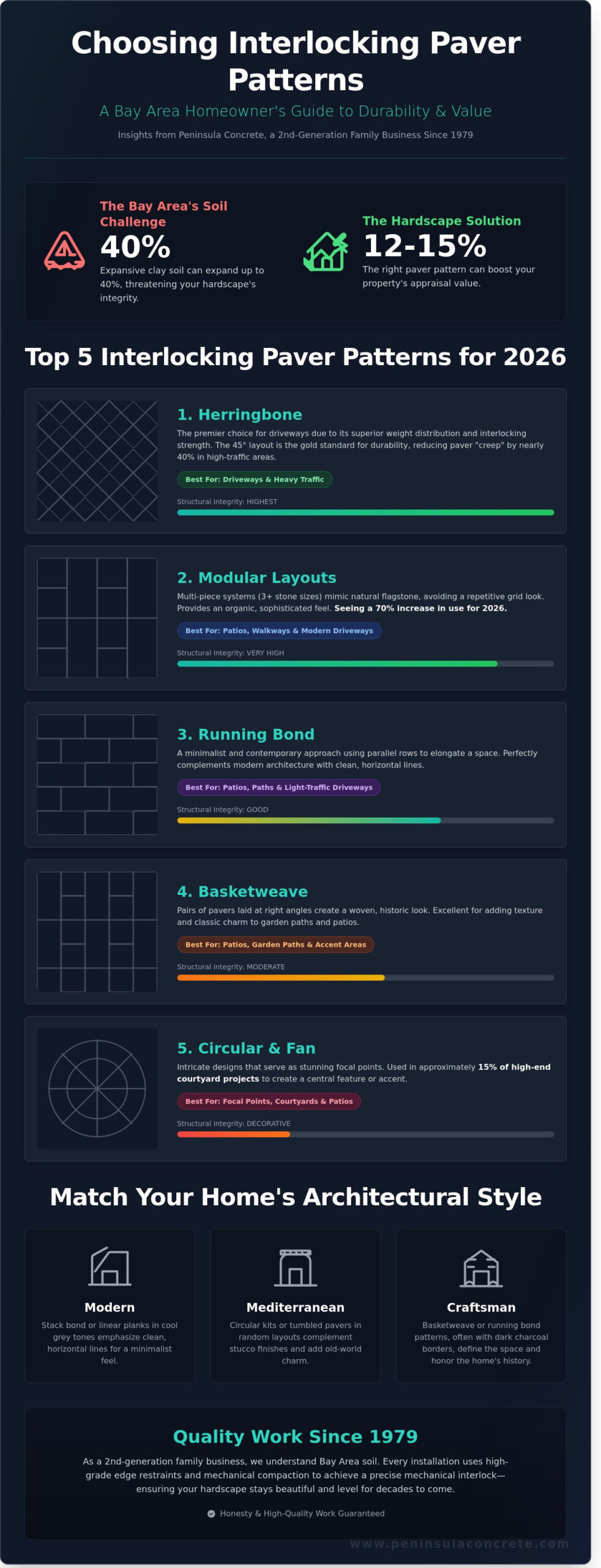
Selecting a layout is the most influential decision for Peninsula homeowners during the design phase. It determines how your driveway handles a 5,000-pound vehicle and how it flows with your home’s exterior. In the competitive San Francisco Peninsula real estate market, professional hardscaping can increase a property’s appraisal value by 12% to 15%. Choosing the right interlocking paver patterns is about more than just picking colors; it’s a strategic move for both curb appeal and structural longevity.
Aesthetics vs. Structural Integrity
True interlocking paver patterns function through a precise mechanical relationship. The system relies on vertical, horizontal, and rotational interlock achieved through specialized joint sand and mechanical compaction. A 45-degree herringbone pattern offers the highest level of structural integrity for driveways because it prevents pavers from shifting under the stress of tires braking or accelerating. Without proper edge restraints, even the most beautiful layout will lose its crisp lines within 24 months. Our team ensures every installation uses high-grade restraints to maintain that day-one look.
Matching Your Home Style
Your pattern needs to respect the architectural history of your specific neighborhood. Palo Alto’s Mid-century Modern homes thrive with large-format planks or linear running bond layouts that emphasize clean, horizontal lines. Historic Redwood City residences often look best with traditional “I” patterns or random modified ashlar designs that mimic old-world stone. Use these guidelines to narrow your search:
- Modern: Stack bond or linear planks in cool grey tones for a minimalist feel.
- Mediterranean: Circular kits or tumbled pavers in random layouts to complement stucco finishes.
- Craftsman: Basketweave patterns or running bonds with dark charcoal borders to define the space.
Peninsula Concrete has been refining these techniques since 1979. We understand that a driveway in Menlo Park needs a different structural approach than a garden path in Woodside. Our 2nd-generation expertise ensures your chosen layout stays level and beautiful for decades. We’ve built a reputation for honesty and high-quality work that stands up to the unique soil conditions of the Bay Area.
Top 5 Interlocking Paver Layout Ideas for 2026
Choosing the right interlocking paver patterns is a decision that balances engineering with aesthetics. Since 1979, our family-owned team has installed thousands of square feet across the Peninsula, and we’ve found that five specific layouts dominate the 2026 design landscape. These patterns don’t just look good; they provide the structural “lock” necessary to prevent shifting in California’s expansive soils.
- Herringbone: The premier choice for driveways due to its superior weight distribution and interlocking strength.
- Running Bond: A minimalist approach that uses parallel rows to elongate a space and complement modern architecture.
- Basketweave: Pairs of pavers laid at right angles to create a woven, historic look that’s popular for garden paths.
- Circular and Fan: Intricate designs that serve as focal points for approximately 15% of high-end courtyard projects in the Bay Area.
- Modular Layouts: Multi-piece systems that use three or more stone sizes to mimic the natural variation of real flagstone.
The Versatile Herringbone Pattern
Herringbone remains the gold standard for durability. You’ll typically choose between a 45-degree or a 90-degree orientation. The 45-degree layout is the most difficult to install, but it offers the highest degree of interlock, reducing paver “creep” by nearly 40% in high-traffic driveways. If you have a narrow driveway, laying a 45-degree herringbone pattern creates a visual trick that makes the path appear wider. It draws the eye to the outer edges rather than straight down the line of travel. This is a reliable choice for homeowners who prioritize a “set it and forget it” installation that stays level for decades.
Linear and Modular Modernity
Modern Bay Area homes often feature clean, horizontal lines that pair perfectly with a running bond pattern. This layout mimics the look of traditional brickwork but uses larger, contemporary stones. In 2026, we’re seeing a 70% increase in the use of large-format modular pavers. These systems use 3-piece or 5-piece stone sets to create a “random” appearance. This prevents the repetitive “grid” look and provides a more organic, natural stone feel. It’s a sophisticated way to achieve a custom look without the high cost of hand-cut natural stone. If you’re ready to upgrade your outdoor space, you can start your project today with a team that has built a reputation for honesty and quality since 1979.
The beauty of interlocking paver patterns lies in their flexibility. Unlike solid concrete slabs, these patterns allow for slight movements in the ground without cracking. This is vital for maintaining a reputable, high-quality finish in our local climate. Whether you prefer the nostalgic feel of a basketweave or the sleekness of modular stones, the pattern you choose dictates the long-term performance of your investment.
Structural Integrity: Which Patterns Handle Bay Area Soil Best?
San Mateo County is famous for its expansive clay soil, often called “Bay Mud.” This soil expands by up to 10% when wet and shrinks significantly during our dry summers. This constant cycle puts immense pressure on any hardscape. While poured concrete often snaps under this tension, interlocking paver patterns offer a flexible surface that breathes with the earth. We’ve seen thousands of driveways across the Peninsula since 1979; the ones that last use the soil’s movement to their advantage rather than fighting it.
Homeowners often worry their pavers will look wavy in five years. Waves aren’t a paver problem; they’re a drainage and compaction problem. In 90% of cases, surface shifting happens because the installer didn’t account for the clay beneath. By using geo-textile fabrics to separate the clay from the base rock, we ensure your pattern stays as flat as the day we finished it. It’s a proven method that has kept our projects stable for over four decades.
Seismic Flexibility and Pavers
Living near the San Andreas Fault means your ground will eventually move. Interlocking systems work because the sand-filled joints act as tiny shock absorbers. During a tremor, the pavers shift slightly and settle back into place. Rigid patterns like a stack bond create long, straight failure lines that are prone to buckling. We recommend offset patterns to break up these stress points. A properly engineered sub-base, typically 6 to 8 inches of compacted Class 2 aggregate, provides the essential foundation that keeps your investment level during seismic shifts.
Load Distribution and Traffic
Not all interlocking paver patterns handle weight the same way. For driveways, the 45-degree herringbone pattern is the industry gold standard. It distributes vehicle weight across the entire grid, preventing the “creeping” or shifting often seen in simple running bonds. While a running bond looks great on a pool deck, it lacks the lateral strength required for a 4,000-pound vehicle.
- Herringbone: Best for driveways due to 45-degree locking action.
- Running Bond: Ideal for pedestrian paths and pool decks.
- Circular Patterns: Great for focal points but requires expert cutting to maintain strength.
Our team has installed over 2 million square feet of pavers since we opened our doors. We know that driveway longevity depends on maximizing interlock friction. When the pattern is tight and the base is solid, your pavers won’t budge, even under heavy daily traffic. It’s the difference between a project that looks good for a season and one that lasts for generations.
Designing for Function: Patterns for Driveways vs. Patios
At Peninsula Concrete, we’ve spent over 45 years refining how interlocking paver patterns perform under real-world Bay Area conditions. A pattern isn’t just about aesthetics; it dictates how water moves and how your surface handles weight. Proper layouts guide the eye toward your home’s entrance while hiding necessary drainage slopes. We integrate professional borders like Soldier Courses, where pavers are laid side-by-side vertically, or Sailor Courses, where they’re laid end-to-end. These borders act as a structural frame to lock the field in place. This prevents lateral shifting over decades of use. For local homeowners, we prioritize permeable patterns that meet California’s strict water runoff regulations, ensuring your property manages heavy winter rains without flooding or pooling.
High-Traffic Driveway Solutions
Driveways face intense horizontal forces from vehicle braking and turning. We recommend a 45-degree Herringbone pattern for these high-stress areas. This specific layout is unsurpassed in strength because it interlocks on four sides, preventing the “creeping” often seen with simple running bonds. For modern heavy SUVs, such as a 6,000-pound Tesla Model X, we always install 80mm thick pavers rather than the standard 60mm variety used for walkways. We also utilize three-color blends. These variegated tones effectively hide tire marks and occasional oil drips that are common in busy households.
Entertainment-Ready Patio Designs
Patios allow for more creative freedom than driveways. We often design “outdoor rugs” by using a contrasting color or a different interlocking paver patterns style to define a dining area or lounge space. If your yard has multiple levels, we use consistent border patterns to create safe, visual transitions between steps and landings. When planning for 1,200-degree fire pits or heavy outdoor kitchen islands, we reinforce the base layer and select patterns that allow for clean, circular cuts. This precision ensures your focal points look integrated into the masonry rather than just sitting on top of it. Our goal is to create a space that feels like a natural extension of your indoor living area.
This principle of creating a cohesive look extends inside the home as well. Just as pavers define an outdoor room, modern flooring can unify your interior spaces. For homeowners exploring durable and stylish options, seeing examples of professional vinyl flooring installation Singapore can provide inspiration for achieving a seamless transition from the patio to the living room.
Of course, the perfect patio is often framed by a beautiful lawn. For homeowners looking for inspiration on the softscape side of their project, family-owned companies like Ray Lawns demonstrate how professional lawn care completes the vision of a total outdoor oasis.
Quality Work Since 1979: Bringing Your Paver Vision to Life
Since 1979, Peninsula Concrete has transformed outdoor spaces across the Bay Area with a focus on structural integrity and aesthetic precision. We don’t believe in “eyeballing” a layout. A single degree of error at the start of a driveway can lead to a 4-inch gap by the time the installation reaches the garage. Our 2nd-generation team uses laser-levels and string lines to ensure your chosen interlocking paver patterns remain perfectly aligned from the first stone to the last.
Our process is built on 45 years of local experience. Every project follows a strict protocol to ensure longevity:
- Drainage Planning: We conduct a 100% site-specific evaluation to manage water runoff, preventing pooling near your foundation.
- Base Compaction: We use industry-grade vibratory plate compactors to create a rock-solid sub-base that resists settling.
- Precision Edging: We install reinforced concrete or heavy-duty snap-edge restraints to keep your pavers from shifting over time.
- The Final Sweep: We finish with high-quality polymeric sand, swept into every joint to lock the system together and deter weed growth.
As a family-owned business, we’ve built our reputation on honesty. We provide clear timelines and transparent pricing for every Redwood City home we service. You aren’t just hiring a crew; you’re partnering with craftsmen who have a personal stake in the community’s beauty.
The Value of Experienced Installation
Complex interlocking paver patterns like the 90-degree herringbone or intricate Versailles layouts require specialized diamond-blade saws and a steady hand. If the cuts aren’t precise, the structural interlock fails. A professionally installed system offers a significant return on investment because it eliminates the need for repairs five years down the road. Our crews maintain consistent 1/8-inch joint lines across projects exceeding 2,000 square feet, ensuring the surface is as durable as it is beautiful.
Start Your Project Today
Reviewing our gallery of successful Bay Area projects helps you visualize how different textures and colors work in real-world lighting. During your free site evaluation, we analyze your property’s grade and discuss which materials best suit your daily use. We take the guesswork out of hardscaping so you can enjoy a stress-free transformation. Contact Peninsula Concrete for your free paver estimate and let our decades of expertise work for you.
UPGRADE YOUR OUTDOOR LIVING SPACE WITH CONFIDENCE
Choosing the right interlocking paver patterns is a critical decision that impacts both the beauty and the longevity of your property. In the Bay Area, your hardscape must withstand unique soil conditions and specific drainage requirements to prevent shifting over time. Since 1979, our team has specialized in selecting layouts that offer maximum structural integrity for driveways and patios alike. We focus on high-quality materials and precise installation techniques that have defined our reputation for over 45 years.
As a 2nd-generation family-owned and operated company, we bring a personal level of care to every project we touch. We’ve spent decades mastering the nuances of local terrain, ensuring your investment remains durable and attractive for the long haul. You deserve a contractor who values honesty and proven results. Let’s help you navigate the technical details of soil stability and design to create a space your family will enjoy for decades. It’s time to turn your vision into a reality with a team you can trust.
Start your Bay Area hardscape transformation today with a free estimate!
We’re ready to get to work on your next project.
Frequently Asked Questions
What is the strongest interlocking paver pattern for a driveway?
The herringbone pattern is the strongest choice for any driveway because it distributes weight evenly across all four sides of each stone. This 45 or 90 degree layout prevents shifting even when 8,000 pound SUVs or delivery trucks frequent the surface. Our team has used this specific configuration since 1979 to ensure driveways remain level and stable through decades of heavy use in the Bay Area.
Do certain paver patterns require more maintenance than others?
Intricate interlocking paver patterns with smaller stones require more frequent joint maintenance because they have a higher linear footage of seams. You’ll likely need to sweep in new polymeric sand every 3 to 5 years to prevent weed growth and keep the system rigid. Simpler, large-format patterns reduce the total joint area by 25 percent, which slightly lowers your long term upkeep requirements for the patio.
How do I choose a pattern that matches my Redwood City home style?
To match a Redwood City home, look at your roofline and siding; a classic Ashlar pattern complements the 60 percent of local homes built in the mid-century Ranch or Craftsman styles. We recommend choosing a three-piece modular layout in earth tones to bridge the gap between your garden and the structure. Our 2nd-generation experts help you select textures that respect the heritage of the Peninsula while providing modern durability.
Can I mix different paver colors within the same pattern?
You can definitely mix colors to create visual depth or define specific zones like outdoor kitchens and fire pits. Most high-quality installations use a primary color for 90 percent of the field and a contrasting charcoal or mocha shade for the soldier course border. This technique highlights the interlocking paver patterns and gives the project a custom, professional finish that boosts curb appeal and property value.
Are complex paver patterns significantly more expensive to install?
Complex patterns like a circular fan or a multi-size modified Herringbone typically increase labor costs by 15 to 20 percent. These designs require significantly more precision cuts along the edges, which adds hours to the installation timeline. While the material cost stays the same, the extra craftsmanship ensures a unique look that sets your property apart from standard neighborhood driveways or basic walkways.
How does the pattern affect drainage on my patio?
The pattern itself doesn’t change the slope, but choosing a permeable pattern significantly improves how your patio handles Bay Area rain. A specialized herringbone or grid layout with wider joints can manage 10 inches of water per hour, directing runoff into the sub-base instead of toward your foundation. This prevents puddling and keeps your outdoor living space dry within minutes after a typical winter storm.
What happens if a single paver in a complex pattern breaks?
Replacing a single broken paver is a straightforward process that doesn’t require tearing up the entire patio. A technician can extract the damaged unit and seat a new one in under 45 minutes, maintaining the structural integrity of the rest of the surface. We always recommend keeping 10 to 15 extra pavers from your original 2026 installation to ensure a perfect color match for any future repairs.
How long does a professionally installed interlocking paver system last in the Bay Area?
A professionally installed paver system in the Bay Area will last between 30 and 50 years with minimal intervention. Since 1979, we’ve seen our installations withstand seismic shifts and soil expansion that would typically crack standard poured concrete. The flexibility of the interlocking system allows it to move with the earth, ensuring your investment remains beautiful and functional for at least half a century.