
Your Bay Area home sits on some of the most active clay soil in California, and that rigid slab of concrete you’re considering is already under immense pressure. Since we started Peninsula Concrete Contractors in 1979, we’ve seen thousands of homeowners struggle with the same dilemma: interlocking pavers vs stamped concrete. You want a stunning entryway that boosts your property value by the 15% average seen in high-end neighborhoods, but you’re likely worried about seeing hairline fractures turn into jagged, expensive cracks after just one season of soil expansion. It’s a common concern for families across the San Francisco Peninsula who value long-term reliability over a quick fix.
It’s frustrating to invest in your home only to watch the shifting ground undermine your hardscape. You deserve a surface that stays level and vibrant for 30 years or more without constant repairs. This 2026 guide will show you exactly which material offers the best durability and ROI for our local climate. We’ll compare maintenance requirements, color retention, and structural flexibility to help you make a choice that stands the test of time. From identifying the most crack-resistant patterns to calculating 10-year upkeep costs, you’ll gain the clarity needed to start your project with total confidence.
Key Takeaways
- Understand how the San Francisco Peninsula’s expansive clay soil and seismic activity dictate whether a rigid or flexible hardscape is the right long-term choice for your property.
- Compare the visual impact of seamless finishes against pattern-rich designs to determine which style best enhances your home’s curb appeal using modern UV-resistant pigments.
- Evaluate the critical differences between interlocking pavers vs stamped concrete regarding upfront installation costs and long-term maintenance requirements.
- Learn why the initial “sticker shock” of certain materials is often offset by the hidden costs of crack repairs and frequent resealing over a 20-year period.
- Discover how a 2nd-generation, family-owned approach to installation ensures your foundation is built to the highest standards for lasting durability in the Bay Area.
Interlocking Pavers vs. Stamped Concrete: Defining the Two Giants of Hardscaping
Choosing the right material for your driveway or patio is a decision that stays with your home for a generation. At Peninsula Concrete, we’ve helped Redwood City homeowners make this choice since 1979. We’ve seen trends come and go, but the debate between interlocking pavers vs stamped concrete remains the central question for any serious hardscaping project. This choice defines the next 30 years of your property’s curb appeal and functional value. It isn’t just about color or pattern; it’s about how the surface interacts with the California soil and our unique climate.
Our 47-year history as a 2nd-generation, family-owned business has given us a front-row seat to the evolution of these materials. By 2026, technology has pushed both options to new heights of durability. Modern pavers now feature face-mix technology that keeps colors vibrant for decades. Meanwhile, stamped concrete has benefited from advanced polymer additives and UV-resistant sealants that were unavailable even five years ago. We approach every project with a craftsman’s perspective, knowing that the foundation we lay today represents our reputation for years to come.
The fundamental difference lies in the structure. Pavers are a modular system of individual units. Stamped concrete is a monolithic, continuous slab. One moves with the earth; the other resists it. Both have their place in high-end landscape design, but understanding their technical DNA is the first step toward a successful installation. We’ve built a reputation for honesty, and that starts with explaining exactly what you’re buying before the first shovel hits the dirt.
What Exactly Are Interlocking Pavers?
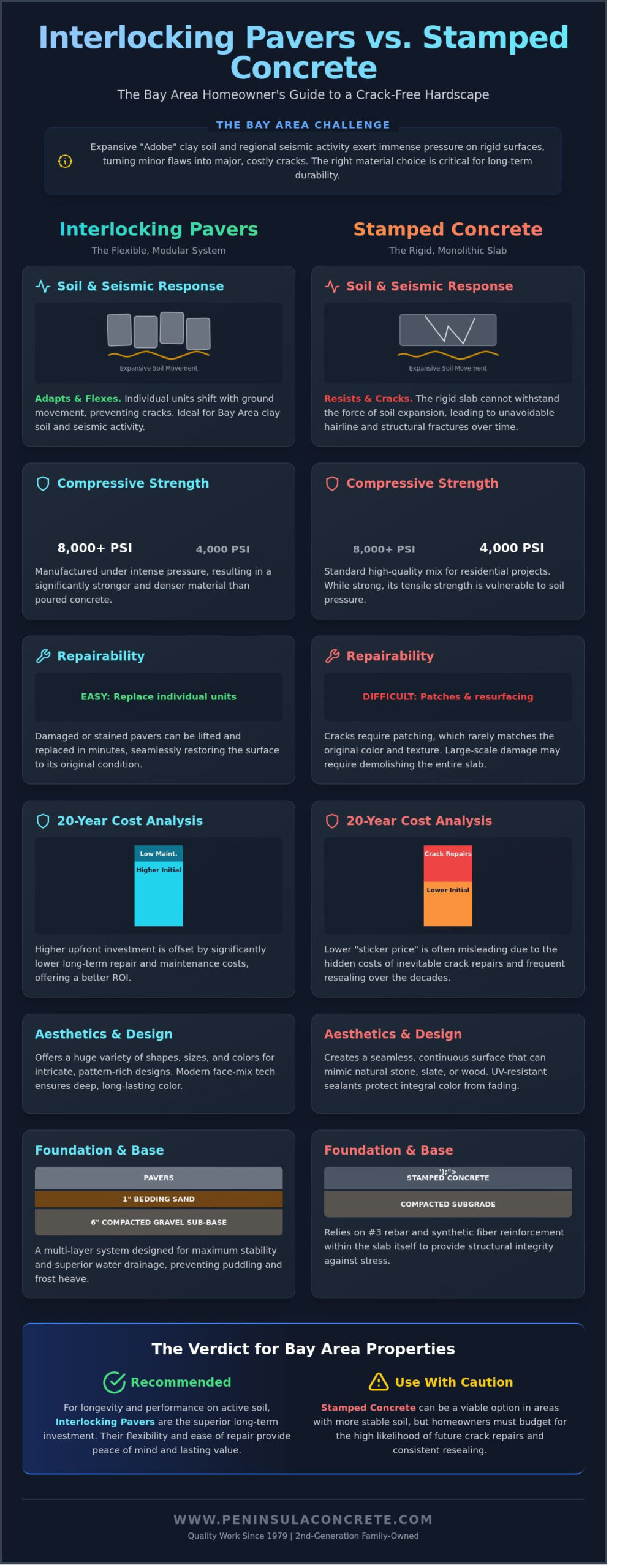
Interlocking pavers are high-strength concrete units manufactured under intense pressure, often exceeding 8,000 PSI. This makes them significantly stronger than standard poured concrete. These units “interlock” through a combination of their geometric shapes and the specialized sand joints between them. This creates a “living” pavement system. Because the units are individual, they can shift slightly without cracking. This flexibility is a major advantage in areas with expansive clay soils or seismic activity. A professional pavement construction using pavers requires a multi-layer base: a 6-inch compacted stone sub-base, followed by a 1-inch layer of bedding sand. This system ensures superior drainage and prevents the “puddling” issues common with flat surfaces.
The Anatomy of Stamped Concrete
Stamped concrete begins as a traditional pour of high-quality, 4,000 PSI concrete. While the mix is still wet, we apply color hardeners and release agents before pressing heavy rubber mats into the surface. These mats create deep textures that mimic natural slate, cobblestone, or wood planks. To ensure the longevity of this rigid slab, we use a combination of #3 rebar and synthetic fiber reinforcement. This creates a durable, monolithic structure that’s easy to maintain. Modern 2026 sealants provide a non-slip finish while protecting the integral color from the harsh sun. It’s a fantastic choice for homeowners who want a seamless look without the maintenance of individual joints. We take pride in our “Quality Work Since 1979,” ensuring every slab is pitched correctly for water runoff.
The Bay Area Factor: Why Soil and Seismic Activity Matter for Your Choice
The San Francisco Peninsula presents a unique set of geological challenges that dictate the lifespan of any outdoor installation. Our team has been navigating these conditions since 1979. We understand that a driveway in San Mateo faces different pressures than one in a more stable climate. The primary conflict involves the local “Adobe” clay soil. This material is highly expansive. It swells significantly during our winter rains and contracts during the dry summer months. When you evaluate interlocking pavers vs stamped concrete, you’re really choosing between a rigid system and a flexible one. A solid slab of concrete is a single, unyielding unit. Even with professional-grade steel reinforcement, the sheer force of expanding soil can exceed the 3,000 PSI tensile strength of the material, leading to unsightly fractures.
Soil Movement: The Silent Concrete Killer
Bay Area clay can exert thousands of pounds of pressure per square foot against the bottom of your hardscape. In neighborhoods throughout Palo Alto and Menlo Park, seasonal moisture cycles cause the ground to heave and subside by as much as 2 inches. Stamped concrete utilizes “control joints” to encourage the concrete to crack in straight, hidden lines. However, these joints don’t always account for the lateral pressure of shifting clay. Random “spider” cracks often migrate across the decorative stamps, ruining the aesthetic. Interlocking pavers offer a self-healing alternative. Because the system consists of individual units bound by polymeric sand, the joints act as tiny expansion gaps. If the soil moves, the pavers shift slightly and settle back into place without a single structural break. This inherent flexibility is why many homeowners find long-term savings through easier repairs when choosing pavers over solid slabs.
Seismic Resilience on the Peninsula
Proximity to the San Andreas Fault makes seismic resilience a mandatory consideration for Peninsula homeowners. A monolithic concrete slab is brittle. During a tremor, seismic waves travel through the rigid material. Since the concrete cannot bend, it snaps. This can result in catastrophic displacement where one side of a crack sits 1 inch higher than the other, creating a permanent trip hazard. Modular pavers function differently. They act like a jointed armor that absorbs and dissipates ground vibration. At Peninsula Concrete, we recommend a specific sub-base preparation for local conditions:
- A minimum of 6 inches of compacted Class II permeable aggregate for driveways.
- Geotextile fabric layers to prevent soil contamination of the base.
- One inch of bedding sand to allow for micro-adjustments during tremors.
This engineering approach ensures that your investment remains level even after minor geological events.
Redwood City driveways provide a perfect case study for these issues. Many properties in the Edgewood Park area struggle with a high water table and “Bay Mud” characteristics. Traditional concrete driveways here often show “stair-step” cracking within 5 to 7 years of installation. This happens because solid slabs trap moisture underneath, which softens the subgrade and leads to “pumping” when cars drive over it. When comparing interlocking pavers vs stamped concrete in these zones, pavers are the clear winner for drainage. They allow for better integration with French drains and modern catch basins. If you’re concerned about how your specific lot will handle the next rainy season, we can help you choose a durable drainage solution that protects your home’s foundation and your new hardscape.
Aesthetic Flexibility: Comparing Design Patterns and Texture Options
Choosing between a seamless look and a modular pattern defines your home’s curb appeal for decades. Stamped concrete provides a continuous, fluid surface that mimics expensive stone without the gaps found in traditional masonry. Interlocking pavers offer a rich, textured appearance that highlights individual craftsmanship and geometric precision. Since we started Peninsula Concrete in 1979, we’ve helped over 5,000 Bay Area homeowners navigate these visual choices. Our 45 years of experience shows that while trends shift, the demand for durability remains constant.
Color management has evolved significantly. For projects scheduled in 2026, we utilize high-performance UV-resistant pigments that bond at a molecular level within the mix. This prevents the “chalking” effect common in older installations. While older methods relied solely on topical sealers that peeled after 24 months, modern integral colors stay vibrant for 10 to 15 years. We often integrate natural stone or brick masonry into our designs to ground the project. A brick soldier course around a concrete patio adds a touch of traditional elegance that purely modern materials can’t replicate on their own.
Customizing Stamped Concrete
Popular 2026 patterns like Ashlar slate and Italian slate provide deep textures that catch the light beautifully. We recommend integral color for the base because it ensures the hue stays consistent even if the surface suffers a heavy impact. Broadcast color hardeners are used on top to add 3,000 PSI of additional surface strength and varied tonal highlights. Adding a 12 inch smooth troweled border or a cobblestone apron can elevate a standard driveway, making it look like a custom estate entrance rather than a simple utility slab.
The Versatility of Paver Patterns
When comparing interlocking pavers vs stamped concrete, the structural strength of the layout is a major factor. A herringbone pattern provides the best interlock for heavy SUVs and delivery trucks; it prevents shifting by distributing weight across 45 degree angles. Mixing textures is where our “Concrete Thinking” blog really shines. We often combine smooth, large-format pavers with rugged natural stone accents to create a unique contemporary look. In many Bay Area municipalities, using permeable pavers is now a requirement to meet C.3 stormwater regulations. These systems allow 100 percent of rainfall to filter through the joints, reducing runoff and protecting our local watersheds.
Our status as a 2nd-generation, family-owned business means we don’t just follow the latest fad. We’ve seen the “California Gold” trends of the 1990s give way to the “Cool Gray” palettes of the 2020s. We’ve built a reputation for honesty by telling you which patterns will look dated in five years and which will remain timeless. Whether you want the sleek look of seamless Italian slate or the rugged charm of tumbled pavers, we have the technical skill to execute it perfectly. Quality Work Since 1979 is our promise to every client who trusts us with their home’s exterior.
- Pattern Strength: Herringbone is 25 percent more resistant to tire scuffing than running bond.
- Color Longevity: Modern UV-stable pigments retain 90 percent of their saturation after a decade of California sun.
- Local Compliance: Permeable options can reduce your city “impervious surface” fees by up to 100 percent in specific zones.
The right choice depends on your home’s architecture and your personal style. Stamped concrete offers a wide, sweeping canvas that makes small backyards feel more expansive. Pavers offer a tactile, high-end feel that increases property value through visible complexity. We’re here to help you weigh these options based on your specific site conditions and long-term goals. Don’t settle for a cookie-cutter driveway when you can have a custom-designed hardscape that lasts for generations.
Maintenance and Longevity: The 20-Year Cost Analysis
Homeowners often experience sticker shock when comparing initial quotes for interlocking pavers vs stamped concrete. High-quality pavers typically range from $15 to $25 per square foot, while stamped concrete often lands between $12 and $18. This 25% to 40% price gap leads many to choose the poured slab. However, a 20-year financial analysis reveals a different story. Over two decades, the hidden costs of maintaining stamped concrete often exceed the initial savings. We’ve seen this play out since 1979; the cheapest option upfront rarely stays the cheapest for long.
Stamped concrete relies on a topical sealer to protect its color and texture. Without this chemical barrier, the California sun bleaches the pigments and water penetrates the surface. This leads to hairline fractures or surface scaling. Pavers avoid this trap. Because they are individual units, they flex with the soil. They don’t trap tension. You aren’t just paying for a surface; you’re paying for a system that lasts 30 to 50 years without structural failure.
Maintenance Realities for Homeowners
Stamped concrete requires a professional resealing every 2 to 3 years to keep its luster. In Redwood City, professional sealing costs approximately $2.50 per square foot. For a 1,000-square-foot driveway, that’s a $2,500 bill every few years. Interlocking systems require far less. You’ll need to sweep in new polymeric sand every 5 to 7 years to prevent weed growth and stabilize the joints. This is a simple DIY task or a low-cost service call. For oil stains, concrete is unforgiving. Once a stain penetrates the sealer, it’s often permanent. With pavers, you simply pull up the two or three stained stones and drop in fresh ones.
The Repairability Factor
Concrete will crack; it’s a mathematical certainty. When a stamped slab cracks, the repair is never invisible. Patching compounds don’t take stain the same way as the original pour, leaving a permanent “scar” across your patio. Our 2nd-generation team utilizes the “unzip” method for paver repairs. If a tree root lifts a section or a utility pipe bursts underground, we lift the specific pavers, fix the issue, and relay the same stones. The repair is 100% invisible. We’ve built our reputation on this level of reliability. While we guarantee the surface looks fantastic, we prioritize the base. Peninsula Concrete Contractors focuses on a 6-inch to 8-inch compacted sub-base because a surface is only as good as the ground beneath it.
Projected ROI also favors the interlocking system. Local real estate data indicates that premium paver installations in the Peninsula area retain 80% of their value during a home appraisal. Stamped concrete typically recovers 50% to 60% due to the visible wear and tear that accumulates over time. If you plan to stay in your home for more than seven years, the math heavily favors the durability of a modular system. It’s an investment in your property’s future equity.
Ready to invest in a surface that stands the test of time? Contact our 2nd-generation family team today for a detailed 20-year cost estimate for your project.
The Peninsula Concrete Standard: Choosing the Right Foundation for Your Home
Choosing the right surface for your property is a major financial and aesthetic investment. At Peninsula Concrete, we’ve spent over 45 years refining our approach to San Francisco Bay Area landscapes. Our 2nd-generation, family-owned business treats every installation as a legacy project. We understand that your driveway or patio isn’t just a utility; it’s an extension of your home’s character. Whether you are weighing interlocking pavers vs stamped concrete, the success of the project depends entirely on the preparation beneath the surface.
The Bay Area presents unique challenges, specifically with expansive clay soils and frequent seismic shifts. We evaluate every square foot of your property before a single shovel hits the dirt. This includes analyzing soil density and the specific slope of your lot. We don’t use a one-size-fits-all template. Instead, we customize the sub-base thickness to ensure your hardscape won’t sink or shift after the first rainy season.
Effective drainage is the backbone of every project we undertake. In our region, we see an average of 20 inches of rain annually, often concentrated in heavy winter bursts. Without a professional drainage plan, even the most beautiful hardscape will fail within 5 years. We integrate custom drainage systems, including perforated pipes and catch basins, that handle 100% of surface runoff. This protects your investment and prevents water from pooling near your home’s foundation.
The final verdict on interlocking pavers vs stamped concrete often comes down to your property’s specific environment. If you live in an area with high seismic activity or heavy tree roots, interlocking pavers are the superior choice because they are flexible. They move with the earth rather than cracking. If you want a specific architectural texture for a backyard pool deck or a seamless patio, stamped concrete provides a continuous, high-end finish that resists weed growth and offers a lower initial price point.
While these two options are the most common in the Bay Area, it’s interesting to see how different climates lead to other solutions. In regions with heavy rainfall like Ireland, for example, many homeowners turn to specialist firms like ResinBound Dublin that provide permeable, seamless surfaces designed for superior drainage.
Our Proven Process Since 1979
We manage the mess so you don’t have to. Our 5-step installation process includes daily site cleanups and strict adherence to a 10-day timeline for most residential driveways. We’ve completed over 4,000 projects in the community since 1979. We treat every job as a legacy project, ensuring the durability and honesty our family name stands for. You’ll receive a clear schedule of milestones so you’re never left wondering about the status of your home.
Start Your Project Today
Ready to transform your outdoor space? Your initial on-site consultation takes about 45 minutes. During this time, we measure your space, check soil conditions, and discuss the best material for your specific goals. We provide a transparent, detailed quote with no hidden fees. Take the first step toward a more beautiful, durable property by reaching out to our team. Contact Peninsula Concrete for a Free Hardscape Estimate and let us help you build a foundation that lasts for generations.
SECURE YOUR BAY AREA HARDSCAPE INVESTMENT
Deciding on interlocking pavers vs stamped concrete requires a clear understanding of your property’s soil and drainage profile. Our 20-year cost analysis shows that while stamped concrete provides a beautiful, cost-effective surface, interlocking pavers offer the necessary flexibility for the Bay Area’s seismic shifts. Since 1979, we’ve helped homeowners navigate these choices with honesty and technical precision. As a 2nd-generation family-owned business, we don’t just install surfaces; we build lasting foundations. We’ve spent 45 years specializing in local drainage solutions to ensure your patio or driveway stands the test of time. Your home deserves a contractor who understands the specific geological demands of the Peninsula. We’re proud of our heritage and the high-quality work we’ve delivered to thousands of neighbors over the decades. Let’s transform your outdoor space into a durable masterpiece that adds real value to your property.
Start your project today with a free estimate from Peninsula Concrete. You’ll appreciate the difference that four decades of experience makes.
Frequently Asked Questions
Is stamped concrete cheaper than interlocking pavers in the Bay Area?
Stamped concrete is generally more affordable, typically costing $15 to $22 per square foot in the Bay Area. Interlocking pavers usually range from $25 to $45 per square foot because of the intensive labor required for individual placement. Since 1979, we’ve found that concrete remains the budget friendly choice for large patios. It provides a high end look without the premium price tag of stone.
Do interlocking pavers increase home value more than concrete?
Interlocking pavers typically offer a higher return on investment, often recovering 70% to 80% of their installation cost at resale. While stamped concrete adds beauty, savvy buyers value the 30 year durability and easy repair of individual stones. This makes the choice of interlocking pavers vs stamped concrete a key decision for long term equity. Our family owned business has seen paver driveways maintain their value for decades.
How long does stamped concrete last before it starts cracking?
You can expect hairline cracks in stamped concrete within 2 to 5 years due to natural ground movement or thermal expansion. We use rebar and strategic control joints to manage these shifts, but concrete is ultimately a rigid slab. In contrast, pavers are flexible and won’t crack under the same conditions. This is why we’ve built a reputation for honesty; we always tell clients that concrete eventually cracks.
Can you put pavers over an existing concrete driveway?
You can install thin pavers over existing concrete if the slab is stable and has less than 1/4 inch of vertical displacement. This process, known as an overlay, requires a thin sand bedding layer and proper drainage considerations. It’s a faster way to upgrade your curb appeal without the cost of a full demolition. Our 2nd generation team has perfected this technique to give old driveways a fresh, high quality look.
Which is better for a pool deck: pavers or stamped concrete?
Pavers are the superior choice for pool decks because they remain 15% cooler than stamped concrete and provide better grip for wet feet. If you need to access a broken pipe under the deck, you can lift individual units and replace them perfectly. Stamped concrete requires jackhammering and leaves a visible patch. For a safe and functional pool area, pavers are unsurpassed in strength and flexibility, and for the pool itself, many homeowners partner with specialists like Marlin Exteriors, Inc. to ensure a high-quality build.
How often do I need to reseal my stamped concrete patio?
You should reseal your stamped concrete every 2 to 3 years to maintain its color and moisture protection. High traffic areas or spots with direct sun might require attention after 18 months. Neglecting this maintenance leads to 40% faster color fading from California’s intense UV exposure. Regular sealing keeps your patio looking as good as it gets and protects your initial investment from the elements.
Are pavers more slip-resistant than stamped concrete?
Pavers offer significantly better slip resistance because of their textured surface and the sand joints between each stone. Stamped concrete can become slippery when wet unless we add a non slip additive like SharkGrip to the final sealer. Most pavers meet or exceed the ADA requirement of a 0.6 static coefficient of friction. This makes them the safer choice for families concerned about falls on rainy days.
What is the best way to prevent weeds from growing between pavers?
Using polymeric sand in the joints is the most effective way to block weed growth between your pavers. This specialized sand hardens like mortar after it’s swept in and misted with water. It creates a durable barrier that stops 95% of weed seeds from germinating in the gaps. We’ve used this method since it became industry standard to ensure our clients enjoy a low maintenance, fantastic looking outdoor space.