
What if your home’s first impression could command attention while actually standing up to the Peninsula’s shifting soil? You likely agree that a standard, uninspired slab of grey concrete often looks dated against a high-end Bay Area property. It’s a common frustration for homeowners who want modern concrete driveway designs but worry about the region’s soil movement causing cracks or failing to meet the strict drainage requirements of the 2025 California Building Standards Code, which became effective January 1, 2026.
At Peninsula Concrete, we’ve built a reputation for honesty and quality work since 1979. We’re here to show you how the latest trends are the perfect intersection of minimalist aesthetics and high-performance engineering. We’ll explore 2026 trends like geometric slabs and polished finishes; we also break down the essentials for Peninsula properties, from handling San Mateo County’s $740 new driveway permit fees to selecting reinforced concrete options that range from $9 to $15 per square foot for lasting durability. Let us help you take your project from planning to a successful, high-end finish that stands the test of time.
Key Takeaways
- Modern design in the Bay Area has shifted from traditional curves to sharp, linear layouts that prioritize clean lines and geometric shapes.
- Learn how to achieve a high-end look using saw-cut joints and sand-matrix finishes to create sophisticated, slip-resistant modern concrete driveway designs.
- Compare the monolithic aesthetic of concrete with the modular flexibility of interlocking pavers to find the right balance of style and maintenance for your home.
- Discover why sub-grade preparation and integrated drainage systems are critical for preventing cracks caused by the Peninsula’s unique soil movement.
- Understand how working with an established, local contractor ensures your project meets the latest 2026 California building codes and local permit requirements.
Defining the Modern Concrete Aesthetic in the Bay Area
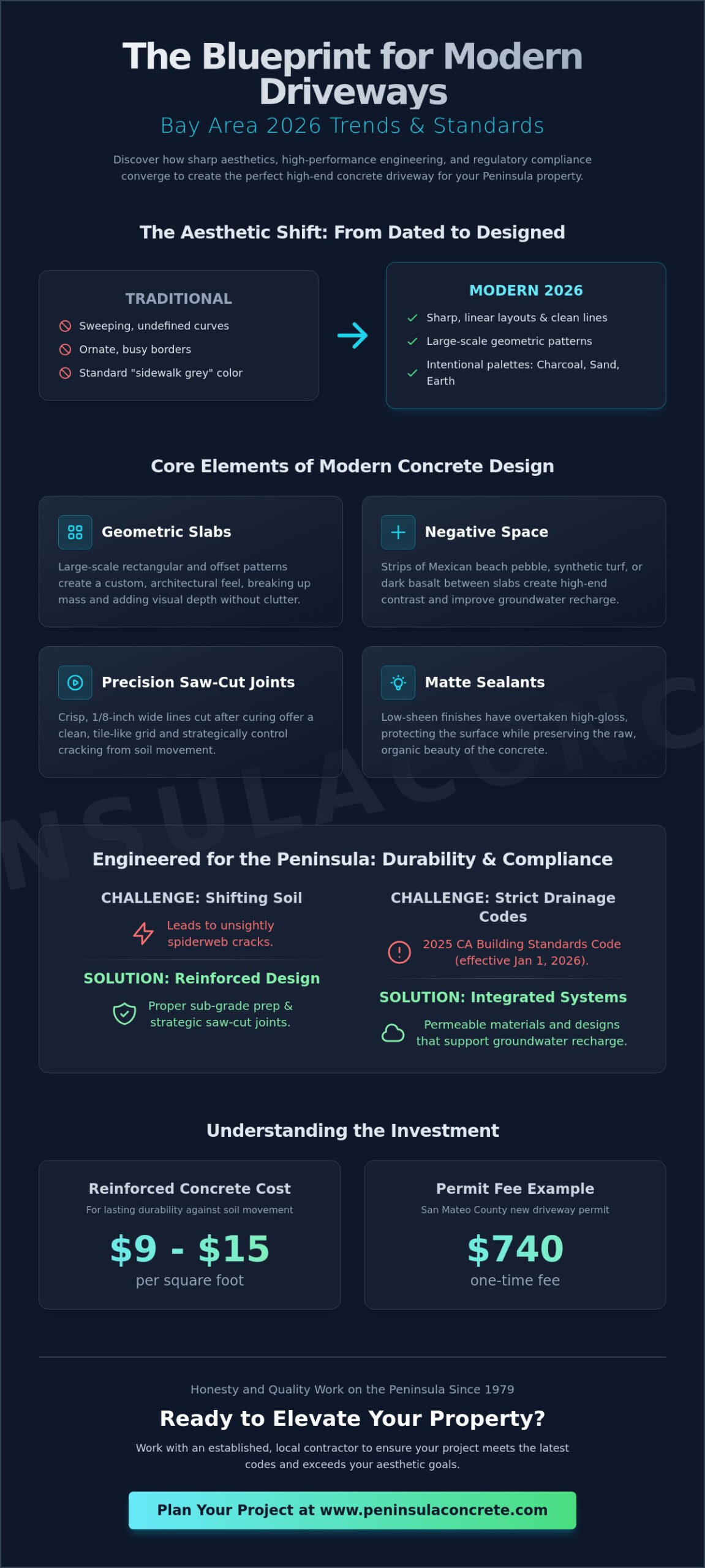
Modern concrete is the natural partner for the region’s iconic architectural styles. Whether you own a mid-century Eichler in San Mateo or a contemporary modernist build in Los Altos, the driveway should feel like an extension of the home’s floor plan. We often see homeowners move away from the “poured sea of grey” toward large-scale geometric slabs. By incorporating negative space, such as strips of Mexican beach pebble or synthetic turf between concrete sections, you create a high-end look that also addresses environmental needs. Integrating Pervious Concrete into these designs allows for better groundwater recharge. This is vital for meeting the strict drainage requirements established in the 2025 California Building Standards Code.
Linear Layouts and Geometric Patterns
Large-scale rectangular slabs are the hallmark of contemporary design this year. We often recommend using “offset” patterns, similar to a running bond in brickwork, to provide visual depth without making the area feel cluttered. This technique breaks up the mass of the concrete and adds a custom, architectural feel to the property. Linear joints are strategically placed to absorb the stress of soil movement; they ensure that any inevitable settling follows a clean, pre-determined line instead of creating an unsightly spiderweb crack.
Color Palettes for the Peninsula
The standard “sidewalk grey” has been replaced by more intentional palettes that complement the local landscape. Charcoal, warm sand, and cool earth tones are the primary choices for 2026. To achieve a cohesive look, we suggest matching the driveway’s base tone to your home’s exterior trim or secondary siding color. For a truly sophisticated finish, matte sealants have overtaken high-gloss options. These low-sheen finishes protect the surface while maintaining the raw, organic beauty of the material, ensuring your modern concrete driveway designs look established and professional from the day they are poured.
Trending Concrete Finishes and Patterns for 2026
Choosing the right finish is what transforms a simple slab into a centerpiece of your home’s exterior. In 2026, modern concrete driveway designs have moved away from the heavy, artificial look of stamped patterns that mimic wood or stone. Instead, the focus has shifted toward architectural textures that celebrate the raw, industrial beauty of the material itself. These finishes aren’t just about style. They are engineered to provide superior traction and longevity on the unique terrain of the San Francisco Peninsula.
One of the most popular high-end looks this year is the “Floating Slab.” This design uses recessed borders or deep channels between large concrete sections to create the illusion that the driveway is composed of massive, hovering blocks. By filling these recesses with dark basalt or uniform river stones, you achieve a sharp, high-contrast aesthetic that complements contemporary Bay Area homes. When planning these intricate layouts, it is helpful to reference the technical standards for Permeable Pavement Systems to ensure your design supports proper water infiltration and structural integrity.
The Precision of Saw-Cut Joints
Precision is the defining characteristic of modern installations. Traditionally, joints were created using hand-held groovers while the concrete was wet, resulting in rounded, often messy edges. Today, we use diamond-tipped saws to cut joints after the concrete has initialy cured. This produces a 1/8-inch wide, crisp line that mimics the look of large-format tile. These saw-cut joints are more than a visual choice. They provide a critical technical advantage by creating a deep, clean plane of weakness. This ensures that as the concrete expands and contracts, any cracking occurs at the bottom of the cut where it remains invisible, preserving the seamless “grid” look popular in San Francisco contemporary homes.
Textured Finishes: Sand-Wash vs. Broom
Texture is vital for safety, especially on the sloped properties found in San Carlos or Belmont. While a standard broom finished concrete surface remains a durable, slip-resistant staple for many Bay Area homes, many homeowners are upgrading to a sand-matrix or sand-wash finish. This process involves removing the very top layer of cement paste to reveal the fine sand underneath. The result is a premium, architectural feel that looks like fine-grit sandpaper. It offers excellent traction without the “industrial” look of deep broom marks. If you’re ready to elevate your home’s entrance, contact us today to discuss which architectural finish best suits your property’s grade and style.
For those seeking a bolder statement, exposed aggregate is making a comeback with a modern twist. Instead of the varied, multi-colored river rocks of the 1980s, the 2026 trend uses uniform, dark stones like black granite or charcoal basalt. This creates a sophisticated, monolithic appearance that hides tire marks and requires very little maintenance over its long lifespan.
Modern Concrete vs. Interlocking Pavers: Choosing Your Look
Deciding between a monolithic slab and a modular paver system often comes down to the specific architectural goals of your Peninsula home. While both materials offer incredible durability, they provide very different visual textures. Concrete offers a continuous, unbroken surface that feels industrial and expansive. Pavers, by contrast, introduce a rhythmic, modular pattern that can soften the look of a large front yard. Because we’ve been providing quality work since 1979, we’ve seen how both choices perform against the Bay Area’s unique soil conditions. It’s not just about the surface; it’s about how the system handles the earth beneath it.
Maintenance is a key differentiator that many homeowners overlook during the design phase. Concrete requires a high-quality sealant every three to five years to prevent staining and preserve its color. However, it completely eliminates the issue of weeds growing through joints. Pavers offer a different trade-off. They are easier to repair if a utility pipe bursts underground, but they require occasional joint sand replenishment to stay stable. For those who want the best of both worlds, hybrid designs are a major trend for 2026. Using large concrete slabs framed by a border of dark, linear pavers creates a custom, high-end look that defines the space without the “sea of grey” effect.
The Case for Monolithic Concrete
If your goal is a seamless, ultra-modern aesthetic, monolithic concrete is the gold standard. It provides the flat, clean planes required for minimalist architecture. This style is particularly effective for properties with heavy tree roots or significant soil movement. A properly reinforced slab, designed according to American Concrete Institute (ACI) standards, distributes weight more evenly than individual units. This prevents “tripping hazards” that can occur when individual pavers shift over time. For a deeper look at how the alternative stacks up, read our interlocking concrete pavers guide to see which fits your lifestyle.
When to Choose Large-Format Pavers
In 2026, “plank” style pavers have become a favorite for modern concrete driveway designs. These long, narrow units mimic the look of hardwood flooring and provide a sleek, directional flow to your entrance. They are also an excellent choice for meeting local environmental codes. Many cities on the Peninsula now require a certain percentage of “permeable” surface area to manage rainwater runoff. Pavers naturally allow water to drain through the joints, reducing the need for complex, expensive drainage systems. Their inherent flexibility also makes them a safe choice for homes near fault lines, as the joints allow the surface to flex during seismic shifts without cracking.
Engineering Modern Driveways for Bay Area Terrain and Drainage
A beautiful surface is only as good as the engineering beneath it. In the Bay Area, where expansive clay soils and steep hillsides are the norm, modern concrete driveway designs must prioritize structural integrity just as much as aesthetics. We’ve seen many “cheap” installations fail within five years because the contractor ignored the local geology. Since 1979, our team has focused on building driveways that don’t just look high-end on day one but remain level and crack-free for decades. Engineering for 2026 requires a deep understanding of the updated California Building Standards Code, ensuring every project meets modern safety and environmental mandates.
Managing water is the biggest challenge for Peninsula properties. Heavy winter rains can quickly undermine a driveway if the drainage isn’t handled correctly. Modern aesthetics favor “hidden” drainage solutions that move water away from your home’s foundation without the need for unsightly plastic grates. By integrating slot drains or permeable gravel strips into the layout, we maintain the clean, minimalist lines that define contemporary style. This approach ensures your property remains compliant with local pervious surface requirements, which have become increasingly strict in cities like Palo Alto and Menlo Park over the last two years.
Integrated Drainage Systems
Slot drains are the gold standard for 2026 modern designs. These narrow, stainless steel channels are almost invisible, yet they can move massive amounts of runoff during a storm. For homes situated on the steep grades of San Carlos or Belmont, managing the flow of water is even more critical. In many cases, professional retaining wall contractors are needed to terrace the land around the driveway. This prevents soil erosion and ensures that the driveway remains a stable, level platform for your vehicles. If you’re dealing with a complex slope, start your project today by consulting with our experienced engineering team.
Soil Stabilization and Reinforcement
Sub-grade preparation is 90% of a successful job. We begin by over-excavating the site and replacing unstable clay with a heavily compacted rock base. To combat the Peninsula’s natural soil movement, we utilize a grid of heavy-duty rebar and secondary fiber reinforcement throughout the slab. This creates a flexible yet incredibly strong internal skeleton. Peninsula Concrete utilizes a higher-than-standard 4,000 PSI concrete mix with integrated fiber reinforcement to ensure maximum structural integrity against the Peninsula’s expansive clay soils. This extra investment in material quality is why our family-owned business has maintained a reputation for durability for over 45 years.
Elevating Your Peninsula Property with Peninsula Concrete Contractors
Choosing a partner for your home improvement project is a decision based on trust and proven results. At Peninsula Concrete, we’ve built a reputation for honesty and high-quality work that spans over 45 years. While modern concrete driveway designs require a forward-thinking aesthetic, they also rely on the foundational knowledge that only decades of local experience can provide. We aren’t just contractors; we’re a 2nd-generation, family-owned business with a personal stake in every neighborhood we serve, from the hills of Woodside to the coastal streets of Pacifica.
Our unique “Concrete Thinking” approach ensures that every detail is considered long before the first pour. We take your project from the initial planning stages to a successful, durable finish by combining your vision with our technical expertise. This collaborative process allows us to address the specific challenges of your property, whether it’s managing a complex slope or ensuring compliance with the latest 2026 building codes. We take immense pride in our heritage and the fantastic results we’ve delivered to thousands of satisfied clients since 1979.
Our Local Heritage and Expertise
The San Francisco Peninsula is home to a wide variety of micro-climates and soil types. Understanding how these factors affect concrete is what sets us apart from large, faceless corporate entities. A family-owned team offers a level of care and accountability that a national franchise simply cannot match. We’ve spent decades studying how local soil shifts and how different finishes react to the Peninsula’s salt air and fog. You can see why we are the top choice for Bay Area concrete projects by exploring our history of successful installations across the region.
Start Your Modern Driveway Project Today
If you’re ready to transform your property with modern concrete driveway designs, the first step is a professional consultation. We offer free estimates that provide a clear, honest breakdown of the work required for your custom project. During our site walk-through, we’ll discuss your aesthetic goals, evaluate your property’s drainage needs, and explain how we’ll ensure a lasting result. Our team guides you through every step of the process, from navigating local permit requirements to the final sealant application. The Peninsula Concrete guarantee is simple: we provide quality work, transparent communication, and results that increase your home’s value for years to come. Start your project today by contacting our team for a personal consultation.
Start Your Peninsula Driveway Transformation
Investing in modern concrete driveway designs is about more than just following current trends; it’s about securing your property’s value and structural health. You’ve seen how geometric layouts and architectural finishes like sand-matrix can elevate a home’s exterior. You also understand that sub-grade preparation and integrated drainage are the only ways to combat the Peninsula’s shifting soils and meet the 2026 California Building Standards Code. These technical details are where our heritage makes the difference.
Peninsula Concrete has been a 2nd-generation, family-owned business providing quality work since 1979. We are specialists in Bay Area hardscaping who understand the local neighborhoods and micro-climates. Our team takes pride in honesty and high-quality craftsmanship, ensuring your project moves from the planning stage to a successful finish. Request Your Free Estimate for a Modern Concrete Driveway today. We look forward to helping you build a beautiful, durable entrance that stands the test of time.
Frequently Asked Questions
What is the best concrete finish for a modern look in 2026?
The sand-matrix finish is the top choice for 2026 because it offers a refined, architectural texture that is also slip-resistant. This finish provides a sophisticated alternative to traditional broom finishes by exposing the fine sand within the mix. You should pair this with precision saw-cut joints to achieve the clean, tile-like grid pattern that defines high-end contemporary properties on the Peninsula.
How do I prevent my modern concrete driveway from cracking in the Bay Area?
Proper sub-grade preparation and reinforcement are the keys to preventing cracks in the Bay Area’s expansive clay soil. We excavate the site and install a heavily compacted rock base before adding a grid of rebar and fiber reinforcement. These structural steps allow the slab to withstand soil movement without fracturing, especially when using a 4,000 PSI concrete mix designed for durability.
Can I use modern concrete designs on a steep driveway?
You can absolutely use modern concrete designs on steep driveways by prioritizing high-traction finishes. Sand-wash or broom textures are essential for safety on the hillsides of San Carlos or Belmont. Our team also integrates slot drains to ensure water runoff doesn’t compromise the driveway’s stability during heavy winter rains, which is a common concern for sloped Peninsula properties.
How much more does a decorative modern concrete driveway cost than standard concrete?
Decorative finishes such as stamping or specialized patterns typically increase the cost of a concrete driveway by $3 to $8 or more per square foot. According to 2026 industry reports, while plain concrete ranges from $7 to $14 per square foot, a custom modern design with saw-cut joints and architectural coloring often falls in the $12 to $20+ range. This investment significantly boosts curb appeal and long-term property value.
Do modern concrete driveways require a lot of maintenance?
Modern concrete driveways require very little maintenance compared to modular systems like pavers. You only need to apply a high-quality sealant every three to five years to protect against tire marks and oil stains. Because there are no open joints where weeds can grow, you won’t spend your weekends pulling grass from the surface. This makes it a perfect choice for busy Bay Area homeowners.
How long does it take to install a modern concrete driveway in the Bay Area?
A typical installation takes between one and two weeks from the demolition of your old driveway to the final pour. This timeline includes the necessary days for site preparation, form setting, and reinforcement installation. Once the pour is complete, you can usually walk on the surface within 24 hours, though we recommend waiting seven days before driving a vehicle on the new slab.
Are modern concrete driveways permeable?
Standard concrete isn’t naturally permeable, but modern designs can be engineered to manage water runoff. We achieve this by using pervious concrete mixes or by leaving intentional gaps between slabs for gravel or grass strips. These “floating slab” designs allow rainwater to infiltrate the ground, helping homeowners meet the strict pervious surface requirements set by local Peninsula building departments in 2026.
What colors are trending for driveways in the San Francisco Peninsula?
Charcoal, sand, and cool earth tones are the primary colors trending for Peninsula homes this year. Homeowners are moving away from standard grey toward deeper shades that match dark window trims or modern siding. We use integral pigments that are mixed directly into the concrete, ensuring the hue remains consistent and vibrant even if the surface experiences minor wear over time.