
Your driveway is an engineering project first and an aesthetic upgrade second. In our region, the notorious expansive clay soil acts like a slow-moving tide, shifting and buckling standard surfaces until they are unrecognizable. You likely want a front entrance that reflects the architectural heritage of the Peninsula without the constant worry of structural failure. This guide to professional paver driveway installation Palo Alto provides the technical roadmap you need to ensure your investment survives the local environment.
We understand that homeowners here face unique challenges, from meeting the updated 2025 California Building Standards Code to managing the $5,000 city permit deposit. You’ll learn exactly how interlocking systems provide the flexibility that solid slabs lack, how to navigate current municipal codes, and why a “set it and forget it” durability profile is possible even in 2026. Since 1979, we’ve seen how the right foundation makes the difference between a temporary fix and a lifetime asset that increases your home equity.
Key Takeaways
- Learn how custom paver entrances boost property valuation in neighborhoods like Crescent Park while meeting Palo Alto’s strict drainage requirements.
- Understand the engineering behind interlocking systems that resist shifting and buckling in the Peninsula’s notorious expansive clay soil.
- Discover why professional paver driveway installation Palo Alto offers superior flexibility and easier repairability compared to traditional poured concrete slabs.
- Follow the step-by-step installation process used by experts to ensure a heavy-duty, high-performance base for your new driveway.
- Identify the specific criteria for selecting a local, 2nd-generation hardscape contractor who respects the architectural heritage of your home.
The Value of Paver Driveway Installation in Palo Alto’s Real Estate Market
In neighborhoods like Crescent Park and Old Palo Alto, a home’s exterior serves as a high-stakes first impression. Professional paver driveway installation Palo Alto does more than replace cracked concrete; it signals to potential buyers that the property is engineered for the long term. High-end Peninsula real estate demands materials that age gracefully. While asphalt often softens and ruts under the intense California sun, a well-designed interlocking concrete paver system maintains its structural integrity for decades. This durability is why savvy homeowners view hardscaping as a strategic investment in their property’s valuation.
The shift toward these systems is driven by more than just aesthetics. Local property owners are increasingly opting for permeable solutions to manage the unique environmental demands of the Bay Area. By integrating your new driveway with existing interlocking concrete pavers on your walkways or patios, you create a cohesive, high-value hardscape. This unified look eliminates the disjointed appearance of mixed materials, which can often detract from a home’s market appeal.
Palo Alto Drainage and Permeability Standards
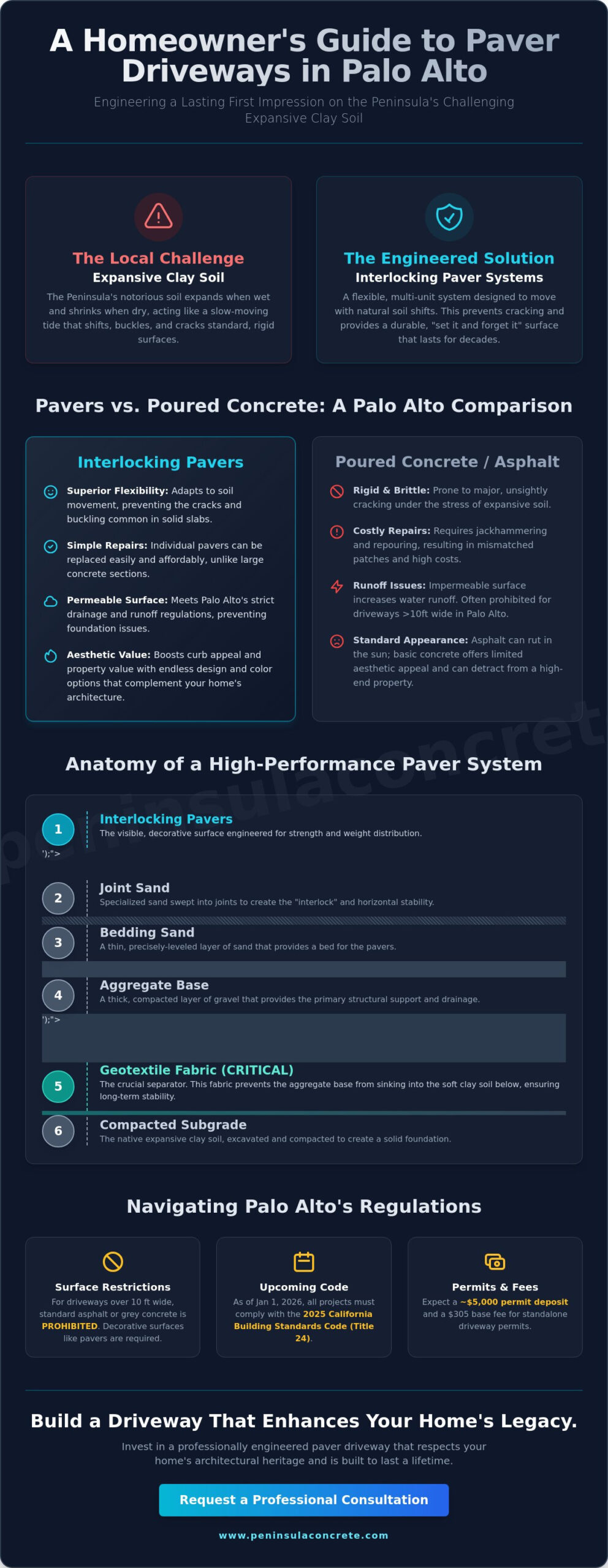
The city has some of the strictest runoff regulations in the region. As of January 1, 2026, all projects must comply with the 2025 California Code of Regulations, Title 24. For surfaces exceeding 10 feet in width, the Palo Alto Municipal Code actually prohibits the use of standard asphalt or grey concrete. Instead, decorative surfaces like stone pavers or bricks are required. These pervious surfaces are essential for managing stormwater on-site and preventing water damage to your foundation. Navigating these rules requires a specialized landscape construction company that understands the $5,000 permit deposit and the $305 base fee required for standalone permits.
Architectural Synergy with Peninsula Homes
Your driveway should feel like a natural extension of your home’s architectural heritage. Whether you own a Mid-Century Modern gem or a classic Spanish Colonial, the right paver choice bridges the gap between the street and your entryway. We recommend color palettes that complement the natural Bay Area landscape, moving away from cool grays toward the warmer, earthy tones that are trending in 2026. This attention to detail ensures your paver driveway installation Palo Alto respects the character of the neighborhood while providing a modern, low-maintenance surface that lasts for generations.
The Anatomy of a High-Performance Interlocking Paver System
An interlocking paver system isn’t just a decorative surface; it’s a structural machine designed to distribute weight across a flexible, multi-layered platform. When executing a paver driveway installation Palo Alto, we focus on the layers you can’t see. This flexibility allows for natural soil movement, which is vital in our local climate. Unlike a rigid concrete slab that snaps under pressure, these systems move as individual units. This prevents the unsightly cracking that plagues so many Peninsula driveways.
In Palo Alto, the primary engineering hurdle is expansive clay. This soil type changes volume significantly based on moisture levels, expanding when wet and shrinking during our dry summers. Without proper preparation, your driveway will eventually ripple or sink. We combat this by excavating deep enough to remove the most reactive layers. Then, we install a heavy-duty geotextile fabric. This fabric acts as a structural separator, preventing the expensive aggregate base from migrating into the soft clay below over time.
The “interlock” isn’t just a marketing term. It describes the frictional resistance between stones. When we perform Professional Paver Installation, we use specific stone geometries and specialized joint sand to lock everything in place. This creates a surface that is actually stronger than the sum of its parts. If you want to understand how these layers fit into your broader project, you can read our guide on hiring landscape contractors in the Bay Area to ensure your team has the right expertise.
A high-performance system consists of four primary components:
- The excavated sub-grade: The native soil prepared to handle the load.
- Geotextile separation fabric: The invisible barrier that prevents stone migration.
- Compacted aggregate base: The structural foundation of the driveway.
- Interlocking pavers and joint sand: The visible, wear-resistant surface.
The Base Layer: Engineering for Stability
For a standard paver driveway installation Palo Alto, we typically require a base depth of 6 to 8 inches of compacted Class II aggregate. Commercial entries or driveways handling heavy SUVs might require 10 to 12 inches to handle the increased traffic loads. The sub-base is the foundation that prevents future rutting and “dipping.” We use a specific aggregate mix that allows for optimal compaction while still permitting water to drain through the system effectively.
Edge Restraints and Jointing Sand
Longevity depends on containment. Without concrete or heavy-duty plastic edge restraints, the perimeter stones will eventually shift outward, causing the entire system to unravel. In 2026, we utilize advanced polymeric jointing sand. This isn’t just sand; it’s a high-tech binder that hardens when misted with water. It prevents weed growth and ant infestations while still allowing the joints to flex. This sand facilitates the “interlocking” mechanism during the final vibration phase of the installation, ensuring the stones stay exactly where they were placed.
Pavers vs. Poured Concrete: Which is Better for Silicon Valley Homes?
Choosing the right material for a paver driveway installation Palo Alto often comes down to a battle between upfront cost and long-term performance. While we have provided high-quality poured concrete solutions for decades, interlocking systems offer a unique structural advantage in the Peninsula’s specific environment. Concrete is a rigid material. When the earth moves beneath it, the slab must resist that force until it eventually snaps. Pavers, however, are flexible. They act as a “living” surface that distributes weight and absorbs soil shifts without structural failure. This flexibility is essential for maintaining a pristine look over a 25-year lifecycle.
Repairability is another major factor for local homeowners. If a utility line leaks or a heavy truck causes a localized dip, a concrete driveway requires a jackhammer and a full-section pour. These patches rarely match the original color or texture. With pavers, you simply lift the affected stones, repair the base, and zip them back into place. The repair is invisible and keeps the driveway looking new. For more details on how concrete holds up in our region, see our Bay Area Concrete Driveways guide.
Initial Investment vs. Long-Term ROI
Homeowners often experience “sticker shock” when comparing initial quotes. A professional paver driveway installation Palo Alto costs more than a standard pour because of the intensive labor and material layers required. However, you must consider the long-term return on investment. Pavers don’t require the costly resurfacing or crack-filling that concrete needs every 10 years. Local appraisers also recognize high-end hardscaping as a premium feature in neighborhoods like Old Palo Alto. This “instant equity” often offsets the initial price gap by significantly increasing the property’s market appeal.
Performance in Palo Alto’s Expansive Clay
Our “Concrete Thinking” philosophy suggests that in areas with significant soil heave, flexibility is your best friend. Interlocking systems self-adjust to seasonal moisture changes without the catastrophic cracking seen in rigid slabs. There’s also a comfort factor to consider. During a typical Peninsula summer, dark asphalt can reach temperatures 40 to 60 degrees higher than the surrounding air. Lighter-toned pavers reflect more sunlight. This keeps your driveway significantly cooler for pets and family members, making the space more usable during the peak of the day.
The Step-by-Step Process of Professional Paver Installation
A successful paver driveway installation Palo Alto begins long before the first stone is laid. Every Peninsula project starts with a rigorous site assessment and utility locating. We identify underground lines to prevent service interruptions and ensure the new grading plan works with your property’s existing topography. This phase is critical because it identifies potential drainage hurdles that could impact your home’s foundation. We don’t guess; we measure. Our 2nd-generation experience has taught us that a driveway is only as good as the earth beneath it.
Grading is the next vital step. We ensure every drop of rain moves efficiently away from your structure, meeting Palo Alto’s strict runoff requirements. By removing the “bad” expansive clay and replacing it with engineered aggregate, we create a stable environment for your new hardscape. This “Peninsula Way” of preparation is what separates a reputable contractor from a general landscaper. If you’re ready to upgrade your home’s entrance, contact us today to schedule your professional site assessment.
Step 1-3: Preparation and Base Work
We begin by excavating the site to a depth of 10 to 12 inches. This depth is necessary to accommodate the structural base required for heavy vehicle traffic. Once the area is cleared, we use mechanical plate compactors to stabilize the sub-grade. We insist on compacting the aggregate in 2-inch “lifts.” This technique ensures maximum density throughout the entire base, preventing the “dipping” or rutting common in poorly installed driveways. Finally, we install a one-inch layer of bedding sand, which is screeded to a perfectly level surface to support the pavers.
Step 4-6: Laying, Cutting, and Finishing
Our craftsmen use the “Click-Drop” method to place each stone. This technique ensures tight joints and maintains the geometric integrity of the pattern. For curves and borders, we perform precision cuts that give the project a “Distinguished” and custom-tailored look. Once the stones are set, we sweep specialized joint sand into the gaps and use a vibratory compactor over the entire surface. This final vibration is the magic moment. It forces the sand into the joints and pushes the pavers into the bedding sand, locking the entire driveway into a single, monolithic unit that is ready for immediate use.
Why Heritage Matters: Selecting Your Palo Alto Hardscape Contractor
Choosing the right team is just as vital as the engineering we’ve discussed in previous sections. A general landscaper often lacks the heavy equipment and structural expertise needed for high-performance hardscaping. You need a specialized landscape construction company that understands load-bearing requirements and sub-grade stabilization. At Peninsula Concrete Contractors, we’ve built our reputation on honesty and high-quality work since 1979. This 47-year history in the Bay Area gives us a unique advantage over newer firms that haven’t seen how their work holds up over four decades of California weather.
Our status as a 2nd-generation, family-owned business isn’t just a label; it’s a commitment to accountability. We aren’t a faceless corporation. We’re a team with a personal stake in the community. This heritage translates to peace of mind for you. Every paver driveway installation Palo Alto we perform is overseen by experts who value proven craftsmanship over flashy sales tactics. We also insist on ICPI (Interlocking Concrete Pavement Institute) certification for our installers. This certification proves our team has mastered the technical standards required to build driveways that last a lifetime.
Questions to Ask Before Signing a Contract
Before you sign any contract, ensure you’re protected. Ask if the contractor handles the complex Palo Alto permitting process and the mandatory city deposits. You should also confirm they manage underground utility marking to avoid costly accidents. A reputable pro will provide a specific warranty on both materials and labor. Don’t hesitate to ask for local references in neighborhoods like Crescent Park or Old Palo Alto. Seeing a 20-year-old driveway that still looks perfect is the best proof of quality you can find.
The Peninsula Concrete Contractors Guarantee
Our commitment to “Concrete Thinking” means we prioritize smart designs and durable builds. We understand your time is valuable. We manage every job site to minimize disruption to your Silicon Valley schedule; we keep the workspace clean and efficient from start to finish. We’ve built a legacy of trust by delivering on our promises for nearly half a century. If you’re ready to start your project with a team that values quality as much as you do, Get a Free Estimate from Peninsula Concrete Contractors today.
Build a Peninsula Entrance That Lasts for Generations
Your home deserves an entrance that balances architectural beauty with the technical rigor required by local conditions. We’ve explored how professional paver driveway installation Palo Alto increases property value in elite neighborhoods while solving the engineering puzzles of expansive clay. By choosing a system that flexes with the earth rather than fighting it, you secure a surface that remains pristine for decades. Since 1979, we’ve navigated the specific permit requirements and drainage codes that define Palo Alto hardscaping.
Our 2nd-generation, family-owned team brings nearly 50 years of “Concrete Thinking” to every project. We don’t just lay stones; we build foundations that respect the heritage of your property. Let our experience guide you through the 2026 requirements to ensure a seamless, high-quality result. Request Your Free Palo Alto Driveway Consultation Today. We look forward to helping you take your project from planning to success.
Frequently Asked Questions
How long does a paver driveway installation take in Palo Alto?
A standard 600-square-foot paver driveway installation Palo Alto typically takes 7 to 10 working days to complete. This timeline includes the demolition of existing surfaces, sub-grade excavation, and the mandatory city inspections. Larger projects or those requiring complex drainage systems can extend the schedule to 14 days. We manage every phase to ensure the work stays on track and minimizes disruption to your daily routine.
Do I need a permit for a new driveway in Palo Alto?
Yes, you must obtain a permit from the City Engineer before performing any driveway work within the public right-of-way. As of May 2026, the City of Palo Alto requires a $5,000 deposit for driveway permits and a base fee of $305 per permit. Failure to secure these approvals before starting work results in a penalty of two times the original fee. We handle these regulatory requirements as part of our professional service.
How do I clean and maintain my interlocking pavers?
Maintaining your interlocking pavers involves simple routine care like sweeping and occasional rinsing with a garden hose. We recommend a professional cleaning and resealing every 3 to 5 years to preserve the color and protect the joint sand. Because we use high-quality polymeric sand, you won’t need to worry about frequent sand replacement or structural shifting. This profile is a hallmark of our 2nd-generation craftsmanship.
Can pavers handle the weight of heavy SUVs or delivery trucks?
Interlocking pavers easily support the weight of heavy SUVs and delivery trucks when installed over a properly compacted base. Most pavers are rated at 8,000 PSI; this is significantly stronger than the 3,000 to 4,000 PSI found in standard residential concrete pours. This high compressive strength ensures your driveway remains flat and stable even under the repeated load of heavy Peninsula vehicles.
Will weeds grow between my driveway pavers?
Weeds won’t grow through the pavers if the jointing sand is properly installed and maintained. We use advanced polymeric sand that hardens into a semi-solid barrier, effectively blocking seeds from taking root. While some surface organic matter might accumulate over time, a quick sweep or rinse prevents any significant growth. This modern material is a vast improvement over the plain sand used in older installations.
What happens if a single paver gets stained or cracked?
You can replace individual stones without disturbing the rest of the driveway if a stain or crack occurs. This is the primary advantage of the modular design used in a paver driveway installation Palo Alto. We simply lift the damaged unit, adjust the bedding sand, and drop in a new paver. This process is invisible and takes less than an hour, saving you the cost of a full driveway replacement.
Are paver driveways slippery when wet?
No, pavers aren’t slippery when wet because they feature a naturally textured surface that provides excellent slip resistance. Unlike stamped concrete or smooth troweled finishes, pavers offer consistent traction for both vehicles and pedestrians during rainy Bay Area winters. This safety feature makes them an ideal choice for sloped driveways or homes with young children and elderly family members who need secure footing.
How does Palo Alto’s clay soil affect my driveway warranty?
Our warranty specifically addresses the challenges of Palo Alto’s expansive clay soil by requiring a deep, engineered sub-base. We use geotextile fabric and compacted aggregate to prevent soil movement from affecting the surface integrity. Because we’ve provided quality work since 1979, we know how to build a foundation that qualifies for our long-term structural guarantee. This ensures your investment is protected even as the Peninsula soil shifts seasonally.