
The most weathered patio on your street might actually be in better structural shape than a brand-new driveway with a failing foundation. When you’re staring at a dull, moss-covered walkway, it’s easy to assume the entire system is a loss. However, the choice between paver restoration vs replacement rarely depends on how the surface looks today. It depends on what’s happening underneath your feet. You likely want to end the constant battle with weeds and eliminate those dangerous tripping hazards once and for all, but you don’t want to overspend on a full replacement if a professional refresh will suffice.
This guide provides the expert perspective you need to evaluate your hardscape’s integrity with confidence. We’ll show you how to identify deep structural issues versus simple surface wear. You’ll also learn how the 2026 updates to California’s Title 24 and water ordinance standards might influence your decision. By the end, you’ll know exactly how to restore that “like-new” finish and ensure your outdoor space remains safe and beautiful for another decade.
Key Takeaways
- Learn to distinguish between surface-level weathering and structural foundation shifts to avoid unnecessary project costs.
- Understand the primary factors in paver restoration vs replacement, focusing on sub-base integrity and drainage efficiency.
- Discover how a professional revitalization can add a decade of life to your hardscape when issues are limited to minor settling or fading.
- Identify the specific warning signs, such as widespread undulating surfaces, that indicate a complete structural replacement is the only safe path forward.
- Leverage 40 years of local expertise to evaluate whether your current edge restraints are robust enough to support a successful restoration.
Assessing Your Hardscape: Signs of Paver Wear and Tear
Determining the health of your driveway or patio requires more than a passing glance. To the untrained eye, a layer of moss or a faded color might suggest the entire system is failing. However, a seasoned hardscape professional looks deeper. The choice between paver restoration vs replacement often comes down to distinguishing between a tired surface and a compromised foundation. In the Bay Area, our unique climate of heavy seasonal rains and persistent coastal fog plays a significant role in how these materials age over decades of use.
Cosmetic vs. Structural Red Flags
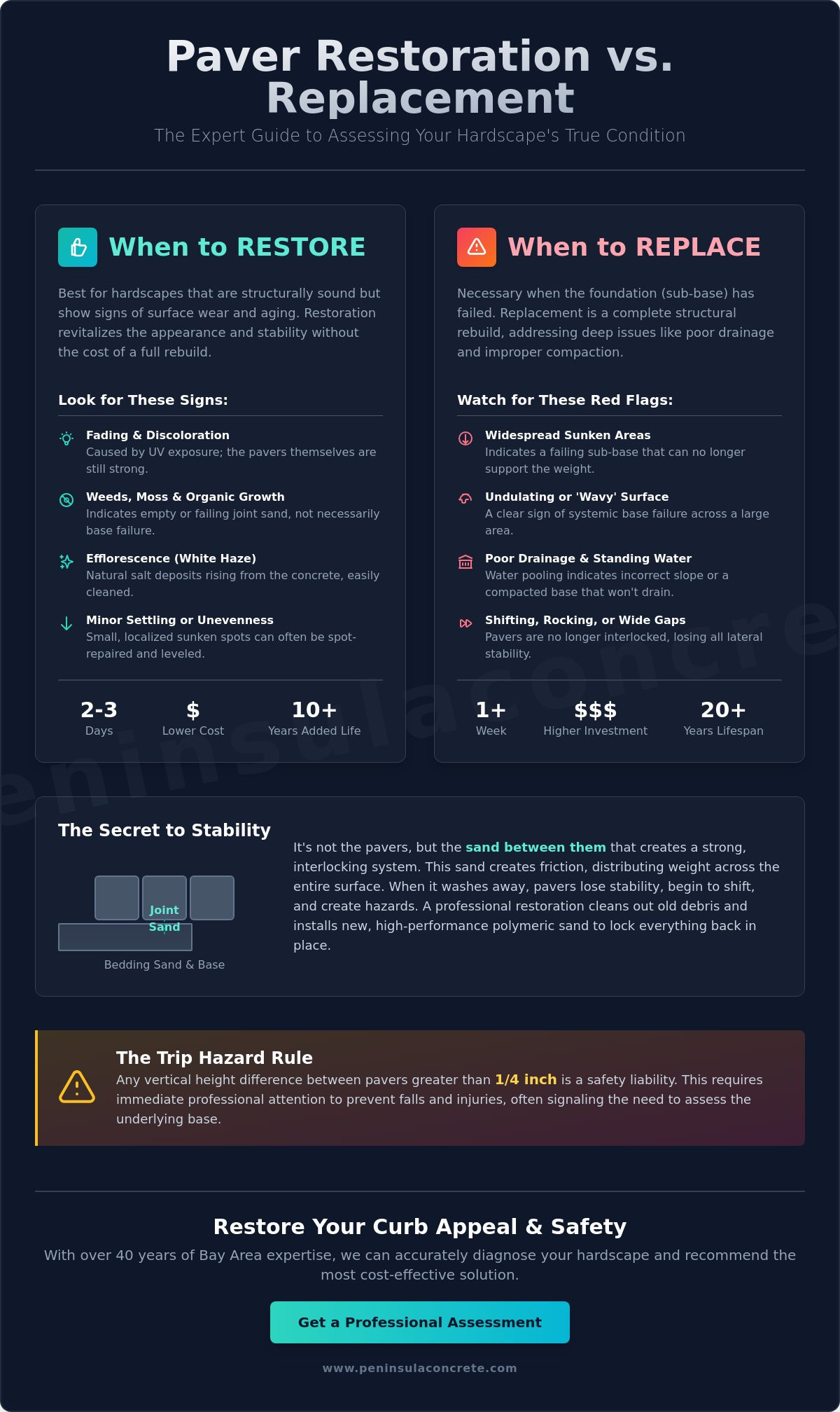
Surface weathering is frequently mistaken for structural failure. Over time, intense California UV rays naturally break down the pigments in an interlocking concrete paver, leading to a muted or “dusty” appearance. This is purely aesthetic and doesn’t impact the stone’s compressive strength. You might also notice efflorescence, which is a white, powdery salt deposit that rises to the surface. While homeowners often worry this indicates a defect, it’s a natural occurrence in concrete products that can be cleaned without needing a full replacement.
Structural red flags are different. If you see wide gaps between stones, significant undulating “waves” across the surface, or individual units that rock when stepped on, you’re likely looking at sub-base failure. Minor stains from leaves or dirt are easily handled during restoration, but deep, neglected oil saturations or chemical burns may require replacing individual units even if the rest of the patio stays intact.
The Role of Joint Sand in Stability
The secret to a durable hardscape isn’t the pavers themselves; it’s the sand between them. Interlocking systems rely on a specific friction mechanism where sand creates a “bridge” between units, distributing weight evenly across the entire surface. When Bay Area moisture consistently saturates these joints, it can lead to sand depletion. Once the joints are empty, the pavers lose their lateral stability and begin to shift under the weight of vehicles or foot traffic.
Weed growth is often the first sign of this breakdown. While many homeowners try to solve the problem by hosing out the weeds, this often accelerates the damage by removing the remaining structural sand. This creates a cycle of instability that eventually leads to dangerous trip hazards. If your pavers are still level but the joints are empty or filled with organic debris, a professional restoration can usually save the system. If the shifting has already caused significant height differences between stones, it’s time to evaluate if the underlying base can still support the load.
- Surface Wear: Fading, moss, and efflorescence usually point toward restoration.
- Structural Failure: Sunken areas, standing water, and shifting stones often require replacement.
- Safety Hazards: Any vertical displacement greater than a quarter inch is a trip hazard that needs immediate professional attention.
Restoration vs. Replacement: Understanding the Core Differences
Choosing between paver restoration vs replacement is a decision that impacts both your project budget and your property’s daily usability. Restoration is an intensive revitalization process. It’s designed to extend the life of a system that remains structurally sound. In contrast, replacement is a complete engineering reset. This path involves removing every existing stone to address deep-seated issues that a surface refresh simply cannot touch. Understanding these differences helps you avoid paying for a new installation when a professional deep-clean and repair would suffice.
Restoration projects move quickly. Most Bay Area patios can be fully restored in two to three days with minimal disruption to your daily routine. Replacement is a major construction event. It requires heavy machinery for demolition and significant excavation. This process can take a week or more depending on the square footage and the complexity of the site. While restoration maintains your existing footprint, replacement allows you to completely re-imagine the layout and flow of your outdoor space.
The Scope of Paver Restoration
Professional restoration begins with industrial-grade pressure washing. This step removes decades of organic buildup, moss, and failed old sealers. We don’t just spray the surface; we clear the joints entirely to prepare for new materials. Next, we perform precision leveling. This involves lifting specific sunken pavers that have settled due to surface-level sand washout and adjusting the bedding layer beneath them. The process concludes with the application of high-grade polymeric sand and professional-grade sealants. This stabilizes the joints and protects the stones from the Peninsula’s unique climate. If you’re looking for a way to protect your investment, you can view our hardscape services to see the quality we maintain.
The Scope of Paver Replacement
If your sub-base has failed, replacement is the only responsible choice. This path starts with the demolition and hauling away of all old materials. We then re-grade and compact the sub-base to ensure proper water runoff and long-term stability. This is the ideal time to upgrade to modern interlocking concrete pavers. Modern manufacturing standards offer significantly better density and color retention than the materials available just a decade ago. Replacement addresses the “Base Failure” issues, such as widespread undulating waves or chronic drainage problems, that restoration cannot fix. When evaluating paver restoration vs replacement, remember that a new installation provides a brand-new foundation built to last for another thirty years.
When to Restore: Revitalizing Your Peninsula Patio or Driveway
Restoration is the craftsman’s choice for hardscapes that have “good bones” but a tired, weathered appearance. If your patio or driveway is mostly level but looks dull, restoration offers the highest return on investment. Choosing paver restoration vs replacement in these scenarios can save you significant capital. A professional restoration typically costs around $4,000, while a full replacement for the same area might reach $20,000. This makes restoration an attractive option for homeowners who want to reclaim their curb appeal without the expense of a total engineering reset.
Before committing to a refresh, we always evaluate your edge restraints. These are the hidden anchors that hold your entire paver system in place. If the plastic or concrete edges are cracked or moving, the stones will eventually spread. If your edges are secure and the primary issues are just fading or moss, restoration is the right path. Many homeowners attempt a weekend DIY project with a rented pressure washer, but this often backfires. Consumer-grade machines often lack precision flow control. Too much pressure can etch the face of the stone, while too little fails to remove deep-seated moss. Our industrial equipment removes debris without compromising the integrity of the pavers.
Correcting Minor Settling and “Ruts”
Minor settling doesn’t always signal a failed foundation. Driveways often develop small ruts where heavy SUVs park daily. We address these by carefully lifting the affected pavers and adding fresh bedding sand to the specific low spots. Once we re-level and compact these areas, the surface becomes safe and flat again. This surgical approach is highly effective for localized repairs. We take great pride in matching the original paver shapes and colors so the repaired area blends seamlessly with the rest of your hardscape. If you aren’t sure if your settling is minor or structural, you can ask our team for an expert evaluation.
The Power of Professional Sealing
The final stage of restoration is the application of a high-performance sealant. This isn’t just about looks; it’s about protection. In our coastal Bay Area environment, salt air and persistent moisture can accelerate the breakdown of concrete materials. Sealants lock in the new joint sand, which prevents ant hills from forming and stops weed seeds from taking root. You can choose a “wet look” finish to deepen the color and add a slight sheen, or a “natural” finish that protects the stone without changing its appearance. This protective layer ensures your pavers stay vibrant and stable for years to come.
When Replacement is the Smarter Long-Term Investment
Restoration is a powerful tool, but it cannot fix a foundation that has fundamentally surrendered to the elements. Deciding on paver restoration vs replacement requires an honest assessment of the sub-base. If your driveway looks like a series of rolling hills or water pools against your home’s foundation after a light rain, you’ve moved past the point where a simple refresh is effective. A full replacement is an engineering reset. It’s the only way to address chronic structural failures that would otherwise cause a restored surface to fail again within a single season.
Material lifespan also dictates this choice. While concrete pavers are incredibly durable, they aren’t immortal. If you notice widespread cracking, “pitting” on the stone faces, or spalling where the top layer of the paver is flaking off, the concrete has lost its structural integrity. At this stage, the stones can no longer hold the friction required for a stable interlocking system. Replacing the system doesn’t just fix the aesthetics; it restores the safety and load-bearing capacity of your property.
Base Failure and Bay Area Soil Challenges
Bay Area geography presents unique hurdles for older hardscapes. In cities like Redwood City, expansive clay soils are a constant factor. These soils swell significantly when wet and shrink during our dry summers, putting immense pressure on any sub-base that wasn’t engineered for high-movement environments. If your base has failed, the pavers will shift again within months of a restoration because the underlying ground is unstable. This is often a sign that you need a more robust solution, perhaps even hiring retaining wall contractors to stabilize sloping ground or address soil erosion that is undermining your patio’s foundation.
Upgrading for Modern Durability
Many local hardscapes installed thirty or forty years ago used thinner base layers and less sophisticated compaction methods than what we use today. Modern standards for bay area concrete and paver systems are significantly higher. A full replacement allows us to excavate deeper, use geo-textile fabrics to separate soil from the base rock, and integrate a professional drainage system installation. These modern techniques ensure that water is moved away from your property rather than sitting beneath your pavers and softening the soil. A new installation also provides the perfect opportunity to update your home’s layout, allowing for larger entertaining areas or a more functional driveway footprint that meets your current needs. If you suspect your hardscape has reached its limit, contact our team for a site assessment to see if a full replacement is your safest path forward.
Professional Hardscaping with Peninsula Concrete Contractors
The choice between paver restoration vs replacement eventually requires a pair of expert eyes on the ground. At Peninsula Concrete Contractors, we’ve spent over four decades mastering the nuances of Bay Area hardscaping. Our craftsman-led approach ensures you receive a recommendation based on structural reality, not a sales quota. We specialize in high-performance Interlocking Paver Systems and robust Drainage System Installation to protect your property’s value. We’ve built our reputation on the belief that a hardscape should be as durable as it is beautiful.
Every project begins with a thorough evaluation of your existing site. We don’t just look at the surface of your driveway or patio; we analyze the pitch, the edge stability, and the signs of sub-base movement. This honest assessment is what separates a long-term solution from a temporary fix. Whether your project requires a multi-step restoration or a complete engineering reset, we use only premium materials designed to withstand the Peninsula’s unique environmental pressures.
A Legacy of Quality Since 1979
Founded in 1979, our family-owned enterprise remains headquartered in Redwood City. We’re deeply rooted in the communities we serve, from San Mateo to Palo Alto. This local history means we understand the specific challenges of expansive clay soils and coastal salt air better than anyone else. Our team provides honest advice based on what will serve your property best over the next ten to twenty years. We invite you to view our gallery of local Bay Area transformations to see the level of precision we bring to every Interlocking Paver System we touch.
Ready to Transform Your Outdoor Space?
We’ve refined a “No-Surprises” estimate process that gives you a clear, detailed breakdown of the work required. We know that any construction project can be an inconvenience. That’s why our crews focus on maintaining a clean job site and minimizing disruption to your daily life. We treat your property with the same respect we’d give our own homes. If you’re ready to resolve those tripping hazards and restore your home’s curb appeal, we’re here to help you choose the right path. Request a free estimate from our expert team today.
Protecting Your Property Value with the Right Hardscape Strategy
Deciding between paver restoration vs replacement isn’t just about the immediate cost. It’s about protecting the long-term integrity of your home. You’ve learned that surface fading and minor ruts are often fixable through professional cleaning and re-sanding. However, widespread undulating surfaces and chronic drainage issues require a full structural reset to prevent future damage. Making the right call now ensures your investment remains safe and functional for years to come.
As a family-owned and operated business since 1979, we bring deep Redwood City local expertise to every site visit. We are specialists in both concrete and interlocking paver systems. This allows us to provide an honest evaluation based on decades of hands-on craftsmanship. Don’t let a weathered driveway or uneven patio lower your home’s curb appeal. Get a Professional Assessment from Peninsula Concrete today to see which path is right for your property. We look forward to helping you create a beautiful outdoor space that serves your family for decades to come.
Frequently Asked Questions
Is paver restoration worth the money?
Yes, it is an excellent investment for hardscapes with intact foundations. It prevents minor issues from escalating into structural failures. Professional restoration protects your home’s curb appeal and can save you from the significantly higher costs of a full excavation. It’s especially valuable in the Bay Area, where salt air and fog accelerate surface wear on concrete materials. Protecting your existing stones now avoids a much larger bill later.
How long does a professional paver restoration last?
A high-quality restoration typically lasts between three to five years before a maintenance refresh is needed. The longevity depends on the quality of the sealant used and the amount of traffic the area receives. Regular cleaning helps maintain the finish. We focus on using industrial-grade polymeric sand and sealants to ensure your patio stays stable and vibrant for as long as possible under the California sun.
Can I replace just a few broken pavers instead of the whole patio?
You can certainly replace individual stones if the rest of the system is structurally sound. Interlocking paver systems are designed to be “zippered” open, allowing for surgical repairs. We carefully remove the damaged units and replace them with matching stones. This is a common part of the restoration process, though color matching older pavers requires a craftsman’s eye to ensure a seamless blend with the existing installation.
Does sealing pavers make them slippery?
Most professional sealants include anti-slip additives to maintain a safe walking surface. While high-gloss “wet look” sealants can be smoother than natural finishes, we use specific grit materials that provide traction even when the surface is wet from coastal mist. It’s a common concern for local homeowners, but choosing the right product ensures your driveway or walkway remains safe for all family members and guests.
How much cheaper is restoration compared to full replacement?
Restoration is significantly more budget-friendly because it eliminates the costs of demolition, hauling, and new material sets. While we don’t provide flat rates without a site visit, restoration generally costs a fraction of a full replacement. When evaluating paver restoration vs replacement, homeowners often find that restoration allows them to revitalize their entire outdoor space while keeping their original project budget focused on other home improvements.
What happens if I don’t replace the joint sand in my pavers?
Empty joints lead to the total breakdown of your hardscape’s interlocking mechanism. Without sand, pavers begin to shift, tilt, and rock under pressure. This creates dangerous tripping hazards and allows weeds to take root deep within the bedding layer. Neglecting the joint sand eventually causes the sub-base to wash away during heavy rains, which turns a simple restoration project into an expensive, mandatory replacement.
Can restoration fix drainage issues on my driveway?
Restoration cannot fix deep-seated drainage problems or improper grading. A restoration refresh focuses on the surface and joint stability. If water pools against your foundation or flows toward your garage, you likely need a full replacement with a new Drainage System Installation. We assess the pitch of your driveway during our evaluation to ensure we don’t recommend a surface fix for a problem that requires an engineering solution.
How do I know if my paver base has failed?
Widespread “waves” or deep depressions across the surface are the most common signs of base failure. If the entire area looks undulating rather than just having a few sunken stones, the foundation has likely shifted or washed out. This often happens when evaluating paver restoration vs replacement in areas with expansive clay soil. If the base is no longer level, any new sand or sealant applied during restoration will fail within months.