
Last Tuesday, a homeowner in San Jose watched a city inspector post a red “Stop Work” notice on their half-finished backyard project. It’s a stressful, expensive mistake that happens to roughly 20% of DIY builders who overlook the specific retaining wall permit requirements California mandates for residential properties. You want to improve your landscape, not end up in a legal battle with the building department or facing heavy fines for non-compliance.
We know that the mixture of engineering jargon and local soil stability concerns feels overwhelming. As a 2nd-generation, family-owned business, we’ve provided quality work since 1979 and understand the frustration of bureaucratic red tape. This guide simplifies the process so you can move forward with your project. We’ll explain the 4-foot rule, identify when you need a structural engineer, and show you how to find a reputable local contractor who gets the job done right the first time.
Key Takeaways
- Learn how to accurately measure your wall height from the bottom of the footing to ensure compliance with the California Building Code.
- Use “Concrete Thinking” to identify external surcharge loads, such as nearby pools or driveways, that may require advanced structural engineering.
- Navigate the specific retaining wall permit requirements California jurisdictions like San Mateo and Santa Clara enforce to avoid costly project delays.
- Prepare a professional submittal package by distinguishing between basic site plans and the technical engineering drawings required by local building departments.
- Partner with an established, family-owned team that has been delivering quality work since 1979 to manage the complex permitting process for you.
Do I Need a Permit for a Retaining Wall in the Bay Area?
Peninsula Concrete has built a reputation for honesty and high-quality work since 1979. We know that homeowners on the SF Peninsula often feel overwhelmed by local building codes. Before you dig, you must understand the retaining wall permit requirements California mandates for safety and structural integrity. What is a Retaining Wall? At its core, it’s a structure designed to resist the lateral pressure of soil. In the Bay Area, that pressure is often compounded by seismic activity and steep grades. Building without a permit isn’t just a minor oversight. It’s a legal risk that can lead to heavy fines, mandatory tear-downs, or significant title issues when you try to sell your home. Our team has seen unpermitted walls fail during heavy rains, leading to costly emergency repairs that far exceed the original cost of a permit.
The California 4-Foot Rule Explained
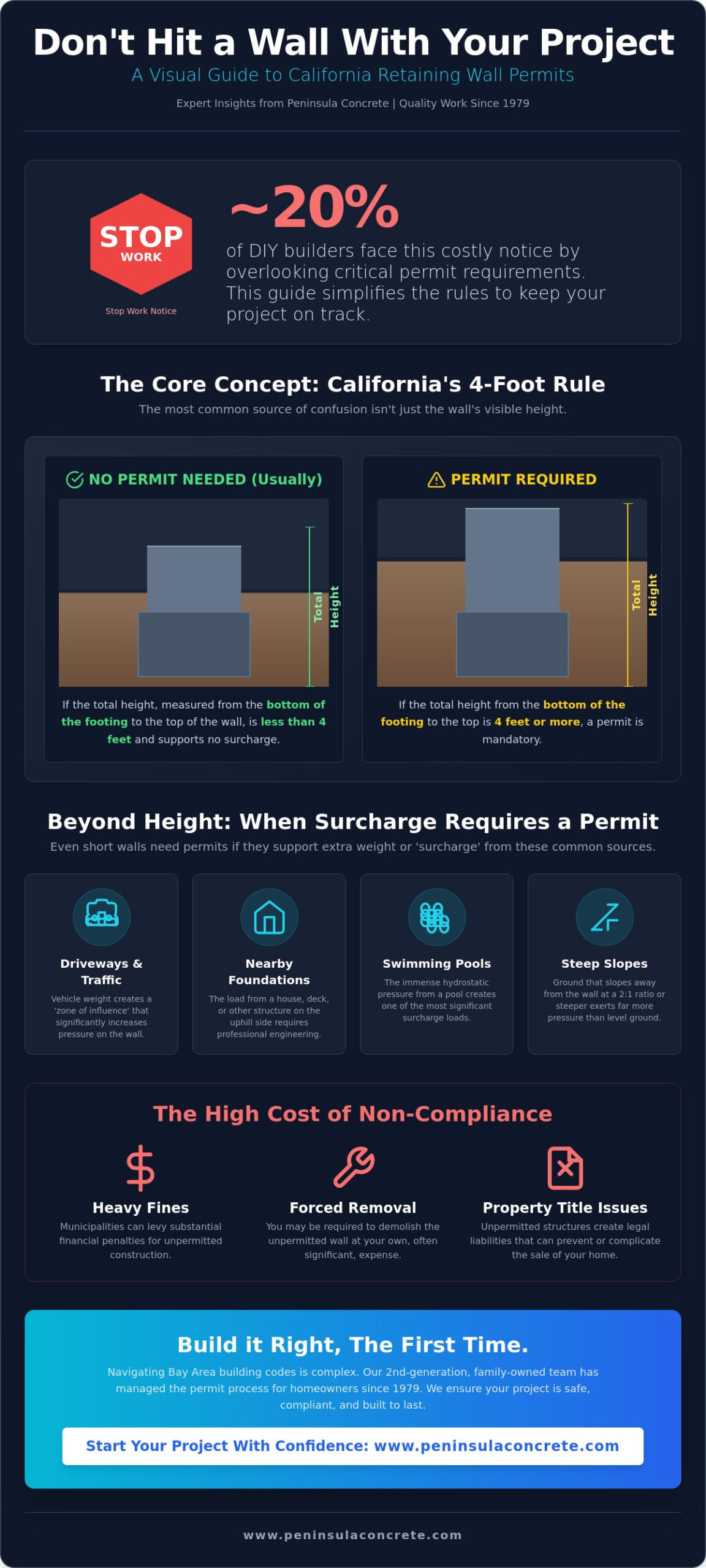
The 2026 California Building Code states that a building permit is not required for retaining walls that are not over 4 feet in height measured from the bottom of the footing to the top of the wall, provided the wall does not support a surcharge. This specific measurement is the most common source of confusion for local homeowners. If your wall stands 3 feet above the soil but has an 18-inch deep concrete footing, the city considers that a 4.5-foot wall. You’ll need a permit. Even “repair and replacement” projects often require a fresh permit if the original wall was never documented or if you’re changing the structural footprint of the barrier. We’ve been a 2nd-generation, family-owned business long enough to know that cutting corners on these measurements always causes headaches later.
Exceptions: When Even Short Walls Need Permits
Height isn’t the only factor that triggers a visit to the building department. A 2-foot wall might still require a permit if it’s under “surcharge loading.” This occurs when there’s extra weight pressing down on the soil behind the wall. Common examples include:
- A driveway or parking area located within a distance equal to the wall height.
- A swimming pool or house foundation located on the uphill side.
- Sloped backfill where the ground rises at a 2:1 ratio or steeper away from the top of the wall.
- Walls built near property lines or public right-of-ways.
Municipalities in San Mateo and Santa Clara counties often add their own layers of retaining wall permit requirements California residents must follow. We’ve built a legacy of quality work since 1979 by ensuring every project meets these rigorous standards from day one. Don’t guess on your measurements or soil pressure. Let us help take your project from planning to success by verifying these critical details before the first shovel hits the ground.
Understanding Surcharge Loading and Soil Pressure
At Peninsula Concrete, we apply what we call “Concrete Thinking” to every project. This means looking beyond the surface of a wall to the invisible forces acting against it. Lateral earth pressure is the constant push of soil against your structure. When you add external weight, known as surcharge loading, that pressure increases exponentially. Standard retaining wall permit requirements California jurisdictions enforce typically trigger at a height of 4 feet. However, if a surcharge is present, you’ll likely need a permit and professional engineering regardless of the wall’s height.
External loads come in many forms. A swimming pool filled with water, which weighs 62.4 pounds per cubic foot, creates massive hydrostatic and structural pressure. Neighboring buildings or heavy machinery also add to this load. In the Bay Area, we must also account for seismic activity. Our proximity to the San Andreas and Hayward faults means walls must withstand lateral forces during an earthquake. This is why a Geotechnical (Soils) report is often a mandatory part of the permit process. This report, prepared by a licensed engineer, identifies the soil’s shear strength and bearing capacity to ensure the wall doesn’t slide or topple.
Vehicle and Traffic Surcharge
Walls built to support or border a parking area face unique challenges. When a heavy SUV or delivery truck sits near the edge of a wall, it creates a “zone of influence.” This is generally defined as a 45-degree angle extending downward from the load point. If your wall falls within this zone, it’s supporting the vehicle’s weight, not just the dirt. Engineering for these sites requires thicker footings and increased rebar reinforcement. If you’re coordinating a larger renovation, our guide on Bay Area concrete driveways explains how we integrate these structural elements for long-term durability.
Sloped Sites and Terraced Designs
Terraced walls are a popular way to manage the steep hillsides of the Peninsula, but they require careful spacing. If walls are placed too close together, the upper wall’s weight pushes down on the lower one, a phenomenon called “double loading.” To avoid this, the horizontal distance between walls should typically be at least twice the height of the lower wall. Local clay soils, common in cities like San Mateo and Palo Alto, make this even more critical. These expansive clays swell when wet, significantly increasing the pressure on your drainage systems and wall face.
We’ve been a 2nd-generation, family-owned business since 1979, and we’ve seen how improper planning leads to wall failure. It’s always safer to verify your specific site conditions with a professional before breaking ground. If you’re ready to ensure your project meets all local safety codes, contact our team for an expert consultation on your structural needs.
Regional Nuances: San Mateo vs. Santa Clara vs. SF Requirements
In affluent communities like Atherton, Hillsborough, or Los Altos Hills, the Design Review Board (DRB) often gets involved if your wall is visible from the street. These boards prioritize neighborhood aesthetics. You can’t just install a plain cinder block wall; you’ll likely be required to use high-quality finishes that match the local architectural style. Environmental factors also play a huge role. Many Peninsula cities have strict tree preservation ordinances. In Palo Alto, for example, if a wall’s footing encroaches on the “dripline” of a protected oak tree, you’ll need an arborist’s oversight and a specialized permit to ensure the root system stays intact.
Local drainage mandates are another critical hurdle. Bay Area municipalities are aggressive about managing runoff to protect the local watershed. Most jurisdictions require a professional drainage plan showing how water will be diverted. You’re legally prohibited from directing new runoff onto a neighbor’s property, so integrated French drains and weep holes are mandatory components of any reputable design.
City-Specific Height Restrictions
Height triggers vary wildly across the East Bay and South Bay. Oakland generally allows walls up to 6 feet in height without a complex permit, provided they don’t support a surcharge like a driveway or a neighbor’s fence. In contrast, Danville is much more conservative, often triggering a permit requirement once the soil height exceeds 3 feet. San Jose has specific rules regarding materials; masonry walls often face more scrutiny than timber walls because of their weight and seismic risk. You should always check your specific parcel’s zoning map, as setback requirements might limit a wall’s height to just 2 or 3 feet if it’s built close to a property line.
Aesthetic and Material Mandates
In many Bay Area neighborhoods, a raw concrete wall won’t pass inspection. You might be required to apply stucco, stone veneer, or decorative finishes to ensure the structure blends into the landscape. There’s also a legal distinction between a “fence” and a “structure.” A fence simply provides privacy, while a structure holds back thousands of pounds of earth. If your project crosses that line, the engineering requirements become much more rigorous. For professional design-build advice that navigates these local hurdles, it’s best to work with experienced landscape contractors who understand the specific retaining wall permit requirements California residents must follow in 2026.
The Retaining Wall Permit Checklist: Documentation & Engineering
Submitting a permit application in the Bay Area requires more than just a sketch on a napkin. You need a technical package that proves your wall will stand for decades without endangering your home or your neighbors. To meet the retaining wall permit requirements California building departments enforce, your submittal package must include a site plan, structural calculations, and a clear drainage strategy. Gathering these documents correctly the first time prevents the city from bouncing your application back for revisions.
Engineering and Site Plans
A common mistake homeowners make is confusing a site plan with a structural drawing. A site plan shows the wall’s location in relation to property lines, existing structures, and natural slopes. Most Bay Area planning departments require these drawings to be at a scale of 1 inch equals 10 feet or 1/8 inch equals 1 foot. This level of detail helps officials ensure the wall doesn’t encroach on utility easements or setback lines.
Structural engineering drawings focus on the wall’s internal strength. These documents must be “wet-stamped” by a licensed Professional Engineer (PE). This stamp is a legal guarantee that the design accounts for soil pressure, seismic activity, and the specific weight of the concrete. Without a PE’s signature, your application won’t make it past the first review desk. The drawings must detail the rebar schedule, concrete PSI, and the exact depth of the footings based on your local soil conditions.
Drainage and Hydrostatic Pressure
Water is the primary cause of wall failure in Northern California. When soil gets saturated, it exerts immense hydrostatic pressure. To prevent a collapse, your plans must show a robust drainage system. This typically includes a layer of clean gravel backfill, perforated pipes to carry water away, and weep holes spaced along the wall’s face. You must prove to the city that your wall won’t redirect runoff onto a neighbor’s yard. California civil code holds property owners liable for damages caused by altered drainage patterns, so cities are strict about hydraulic requirements.
Working with experienced retaining wall contractors ensures these technical details are integrated from the start. Our team at Peninsula Concrete has managed these retaining wall permit requirements California homeowners face since 1979. We know how to design systems that satisfy both city engineers and the unique topography of the Peninsula.
Be prepared for special inspections during construction. For walls over a certain height or those supporting a heavy surcharge, the city often requires a third-party inspector to be present during the concrete pouring phase. They verify the rebar placement and concrete mix match the approved engineering plans exactly. We’ve built a reputation for honesty and high-quality work, so we welcome these inspections as a final check on our craftsmanship.
Ready to secure your permits and start your build? Contact our expert team at Peninsula Concrete today to ensure your project is built to last.
Navigating the Process with Peninsula Concrete
Peninsula Concrete has delivered QUALITY WORK SINCE 1979. For over 45 years, our team has helped Bay Area homeowners navigate the complex retaining wall permit requirements California enforces for structural safety. As a 2nd-generation, family-owned business, we don’t just pour concrete; we manage the bureaucratic “red tape” that often stalls residential projects. We take pride in our reputation for honesty and our ability to take a project from the initial planning stages to a successful, permitted completion.
Permitting is a legal necessity for any wall supporting a surcharge or exceeding specific height limits. Our deep roots in the local community mean we have established relationships with building departments across the Peninsula. We ensure your project adheres to the 2026 California Building Code standards. This professional oversight prevents costly mid-project delays and ensures your investment is fully protected by law.
The Value of a Licensed Contractor
California law is clear regarding structural work. Under the California Business and Professions Code, any home improvement project exceeding $500 must be performed by a licensed contractor. Hiring unlicensed labor for a structural retaining wall is a dangerous gamble. It often results in immediate “Stop Work” orders, heavy fines, and a lack of insurance coverage if the wall fails. Our 2nd-generation firm provides the liability protection and bonding you need for total peace of mind.
We ensure “Quality Work” that passes city inspections the first time. Our crews understand the specific engineering demands of local soil, from the expansive clays in the hills to the sandy loams near the coast. By following strict permit requirements, we guarantee that your wall features the correct reinforcement and drainage systems required for long-term stability.
Next Steps for Your Peninsula Project
Every durable structure begins with a professional site evaluation. We start by assessing your property’s topography and unique drainage needs. This survey is a critical step before the soil testing phase, as it provides the data necessary for a successful permit application. Our team guides you through these technical requirements so you never feel overwhelmed by the process.
Ready to secure your landscape with a structure built to last? We offer honest assessments and professional expertise for all your wall and drainage needs. Contact us today to plan your permitted retaining wall and experience the reliability of a local leader in concrete craftsmanship.
SECURE YOUR PROPERTY WITH PROVEN BAY AREA EXPERTISE
Navigating the retaining wall permit requirements California enforces doesn’t have to be a roadblock for your home improvement plans. Whether you’re managing specific surcharge loading regulations in San Mateo or the updated 2026 seismic safety standards in Santa Clara, success depends on precise engineering. Peninsula Concrete has delivered Quality Work Since 1979, helping homeowners bridge the gap between complex building codes and functional landscapes. We’re a 2nd-generation, family-owned business with a deep understanding of the unique soil pressures that define Northern California construction.
Don’t risk the structural integrity of your property or face potential fines by cutting corners on documentation. Our team brings decades of specialized experience in Bay Area seismic codes to every project. We’ve built our reputation on honesty and reliable results, ensuring your new wall stands the test of time. We’re ready to help you move from the planning phase to a finished product you can be proud of. Reach out to us today to discuss your vision and get your project moving forward.
Get a Professional Quote for Your Bay Area Retaining Wall
Frequently Asked Questions
How high can a retaining wall be without a permit in California?
In California, you can typically build a retaining wall up to 4 feet high without a permit, measured from the bottom of the footing to the top of the wall. However, many Bay Area jurisdictions like San Mateo County reduce this limit to 3 feet if the wall supports a slope or a surcharge. Meeting retaining wall permit requirements California standards means checking local municipal codes before you dig to avoid costly project delays.
Do I need a permit to repair an existing retaining wall in the Bay Area?
You don’t need a permit for minor cosmetic repairs, but structural work requires official approval in the Bay Area. If you’re replacing more than 50 percent of the wall or altering its height, local building departments classify this as new construction. We’ve built a reputation for honesty since 1979, and we’ve seen homeowners face heavy fines for “repairing” a failing 5-foot wall without first obtaining the necessary structural permits.
What is surcharge loading and why does it affect my permit?
Surcharge loading refers to any additional weight placed on the soil behind the wall, such as a driveway, a swimming pool, or a 2nd-generation home foundation. This extra pressure increases the lateral force against the structure, which triggers stricter retaining wall permit requirements California mandates regardless of the wall’s height. Engineering becomes mandatory when a surcharge is present within a distance equal to the wall’s height.
How much does a retaining wall permit cost in San Francisco?
Retaining wall permit fees in San Francisco are based on the total valuation of the project as outlined in the 2024 San Francisco Building Code Fee Schedule. For a project valued at 10,000 dollars, the basic permit fee starts around 250 dollars; this excludes plan review and state taxes. Total costs often fluctuate based on whether your project requires an additional Soils Report or structural engineering reviews by the Department of Building Inspection.
Can I build a retaining wall on my property line in California?
You can build a retaining wall on your property line in California, but you must ensure no part of the footing or drainage system encroaches on your neighbor’s land. California Civil Code Section 841 requires neighbors to share responsibility for boundaries, but retaining walls are often the sole responsibility of the owner who altered the natural grade. We recommend a professional survey to confirm 100 percent of the structure stays within your legal boundaries.
Does a 3-foot wall require engineering if it is on a slope?
A 3-foot wall requires professional engineering if the ground slopes upward at a ratio steeper than 2 to 1. Even though the wall is under the standard 4-foot height limit, the weight of the sloping earth creates pressure that standard gravity walls can’t always handle. Most Peninsula cities require a licensed engineer to sign off on any wall built on a slope exceeding 15 degrees to prevent future soil failure.
What happens if I build a retaining wall without a permit?
Building without a permit often results in a “Stop Work” order and a fine that can be 10 times the original permit fee. If the wall doesn’t meet safety codes, the city can force you to demolish the entire structure at your own expense. This also creates a title cloud that prevents 100 percent of potential buyers from securing a mortgage when you eventually try to sell your home.
How long does it take to get a retaining wall permit in the Peninsula?
Obtaining a retaining wall permit in Peninsula cities like Redwood City or Palo Alto typically takes between 4 and 8 weeks. This timeline includes the initial plan submission, a 14-day period for the first round of comments, and any necessary revisions. Our family-owned team has navigated these local departments since 1979. We find that complete engineering sets significantly speed up the approval process for our clients.