
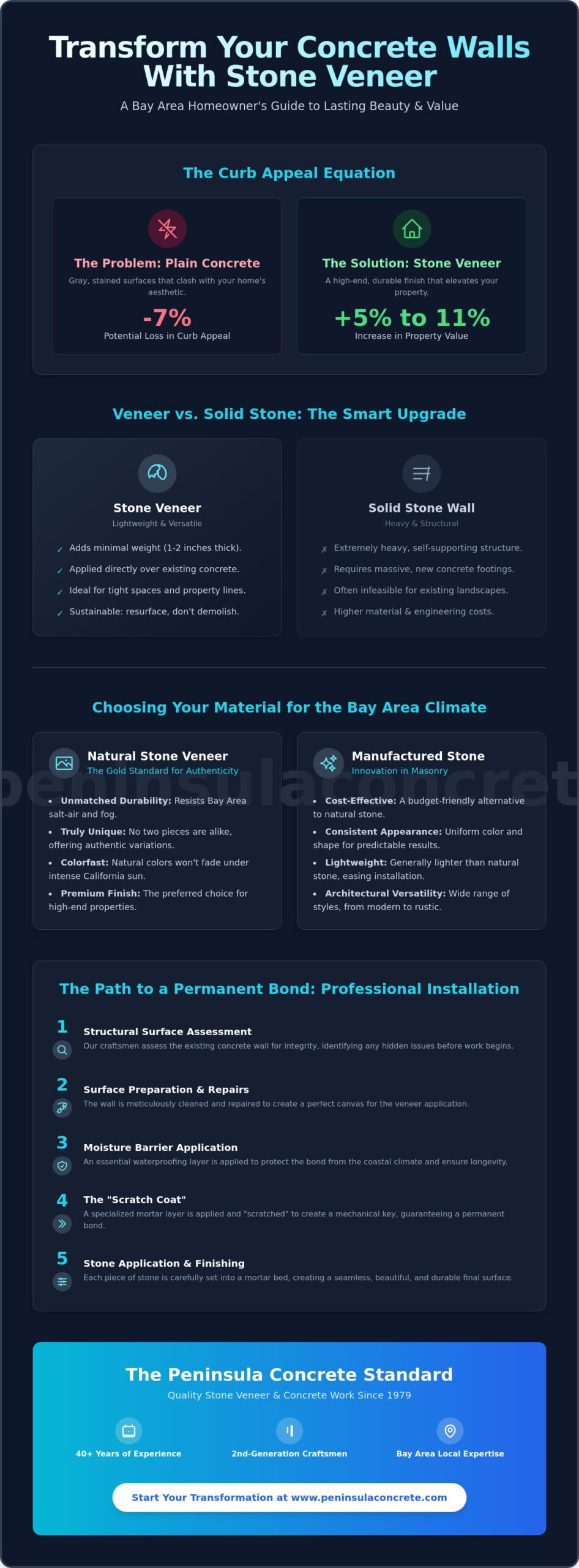
A plain concrete retaining wall can drag down your home’s curb appeal by as much as 7% according to landscape value studies. For many homeowners in the San Francisco Peninsula, these gray, stained surfaces feel like an eyesore that clashes with the natural beauty of the local landscape. You likely want a solution that looks authentic and high-end but worry about the technical details. It’s common to feel overwhelmed by the choice between natural stone and manufactured options, especially when you fear the material might peel or crack after a few seasons of Bay Area weather.
At Peninsula Concrete, we’ve provided quality work since 1979, and we know that the right application of stone veneer for concrete walls can completely redefine your property’s aesthetic. This guide will teach you how to select the best materials for our coastal climate and explain the professional installation process used by 2nd-generation craftsmen. You’ll learn how to transform your existing structures into durable features that increase your home’s value and match the sophisticated style of our community. We’ll walk you through material selection, moisture barriers, and the secrets to a long-lasting finish.
Key Takeaways
- Discover how to elevate plain retaining walls and sloped yards into high-value landscape features using professional-grade masonry techniques.
- Compare the authenticity of natural stone with the cost-effectiveness of manufactured veneer to select the best material for your property’s aesthetic.
- Learn the true ROI of stone veneer for concrete walls by identifying hidden costs in surface preparation, repairs, and waterproofing.
- Understand the essential installation steps, from structural surface assessments to the “scratch coat” process, that guarantee a permanent bond.
- Find out how “Concrete Thinking” and over 40 years of local expertise help you integrate stone features seamlessly into your existing Bay Area hardscaping.
Transforming Your Property: Why Stone Veneer for Concrete Walls is the Ultimate Bay Area Upgrade
Many homeowners across the San Francisco Peninsula face a common design challenge: functional but unattractive structural concrete. Whether it is a foundation wall or a massive retaining structure holding back a sloped yard, raw concrete rarely matches the high-end aesthetic of a luxury home. Since 1979, Peninsula Concrete has helped residents solve this by using Stone veneer to bridge the gap between industrial strength and natural beauty. Adhered masonry veneer is a lightweight, thin layer of natural or manufactured stone that is applied directly over a structural concrete base using specialized mortars.
The Aesthetic Advantage in the San Francisco Peninsula
The Bay Area is home to a diverse range of architectural styles, from 1950s Mid-Century Modern Eichlers to classic Coastal Craftsman builds. Stone veneer allows you to customize your exterior to match these distinct looks. For a modern feel, many clients choose tight-stacked slate or linear limestone. These textures perfectly complement interlocking concrete pavers in luxury driveways and patios. By wrapping a concrete foundation in stone that matches your garden walls, you create a seamless transition that makes the entire landscape feel intentional and cohesive.
Veneer vs. Solid Stone: Understanding the Difference
Weight is the most critical factor when upgrading existing structures. A solid stone wall requires massive footings to support its own weight, which often isn’t feasible for property line walls or narrow side yards. Stone veneer is typically only 1 to 2 inches thick, meaning it adds minimal bulk and weight to your existing concrete footings. This makes it the ideal choice for tight spaces where every inch of clearance matters. Adhered masonry relies on the structural integrity of the underlying wall for support, while load-bearing masonry is self-supporting and carries its own weight plus additional structural loads. Using stone veneer for concrete walls ensures you get the timeless look of solid masonry without the need for heavy-duty structural engineering.
Types of Stone Veneer: Choosing the Right Material for Your Walls
Selecting the right material is the most critical decision you’ll make when planning a renovation. The Bay Area’s varied microclimates, from the breezy hills of San Carlos to the foggy flats of Daly City, require materials that can withstand moisture and salt. When you choose stone veneer for concrete walls, you’re balancing aesthetic appeal with long-term structural performance. You can consult a Stone Veneer Buying Guide to understand basic material differences, but local experience often dictates the best fit for our specific California soils and weather patterns.
Natural Stone Veneer: The Premium Choice
Natural stone is the gold standard for authenticity. Since these are real slices of granite, limestone, or quartz, the colors won’t fade under the intense California sun. It’s the preferred material for high-end landscape contractors because it offers unmatched durability in the Peninsula’s salt-air and fog-heavy environments. Every piece is unique. You’ll find color variations that manufactured products simply can’t replicate, providing a luxury finish that lasts for decades.
Manufactured Stone: Innovation in Masonry
Modern manufactured stone uses high-strength cement and iron oxide pigments to mimic natural textures with high precision. It’s significantly lighter than natural stone; this makes it an excellent choice for older bay area concrete walls that might not support the weight of full-bed masonry. This material is cost-effective and comes in consistent color palettes, making it easier to match modern exterior paint trends or existing patio designs.
Beyond the material itself, you must evaluate the stone profile to ensure it fits the scale of your project. Different shapes change how light hits the wall and how the structure feels in your yard:
- Ledge Stone: Features narrow, rectangular strips. It’s ideal for adding texture to low retaining walls or modern accent strips.
- Stack Stone: Offers a tight, mortarless look. It provides a clean, contemporary aesthetic for tall vertical surfaces and fireplace surrounds.
- Field Stone: Uses larger, more irregular shapes. This profile creates a rustic, “old-world” appearance that suits traditional California ranch homes.
Panelized systems are another option if you’re looking for speed. These systems use pre-arranged sections of stone to cover large areas quickly. While they save time during installation, they lack the custom, hand-laid look of individual stones. If you’re unsure which profile suits your property, our team can help you evaluate your site to find the perfect match for your home’s architecture.
The Economics of Stone Veneer: Cost, Value, and Long-Term ROI
Homeowners should account for specific site conditions that influence the final quote. You’ll need to consider hidden costs like surface preparation. A concrete wall must be free of paint, oil, and debris to ensure a permanent bond. If the existing wall has drainage issues or structural cracks, these must be repaired before the first stone is set. Professional-grade sealant is a non-negotiable for Bay Area masonry to prevent salt air from eroding the mortar bond and protecting the stone from the region’s unique climate cycles.
The San Francisco real estate market consistently rewards high-quality curb appeal. According to the 2023 Cost vs. Value report, manufactured stone veneer projects are among the few home improvements that frequently recoup over 100% of their cost at the time of resale. This high ROI makes it a strategic choice for those looking to build equity while enjoying a beautiful landscape.
Analyzing the Installation Investment
Labor costs vary based on the complexity of your chosen design. A simple dry-stack look installs faster than an intricate mosaic pattern that requires custom stone cutting. Wall height and accessibility also play a major role in pricing; a street-facing retaining wall is much simpler to stage than a tiered garden wall in a restricted backyard. While DIY kits exist, hiring experienced retaining wall contractors is a safer investment. Professionals understand the local soil expansion and drainage requirements that prevent the veneer from de-laminating over time.
Durability and Lifespan in the Bay Area
The Bay Area’s seismic activity makes flexibility a key concern for any permanent structure. Because stone veneer for concrete walls is lighter than solid stone, it often handles minor shifts better without compromising the underlying structure. We also have to manage efflorescence, which is that white, powdery salt residue common in coastal environments. Our team follows the Professional Installation Guidelines for Stone Veneer to ensure proper moisture barriers are in place. This level of care, which we’ve refined since 1979, prevents water from getting trapped behind the stone and causing damage during our wet winters.
Professional Installation: How to Apply Stone Veneer to Concrete Walls
Installing stone veneer for concrete walls requires more than just applying mortar to a surface. It’s a technical process that Peninsula Concrete has perfected over decades of local service. A successful project ensures the stone stays bonded for 30 years or more, even with the Bay Area’s unique soil shifts and seismic activity. Quality work since 1979 has taught us that shortcuts in the installation phase always lead to delamination or water damage later.
The Critical Importance of Surface Prep
You can’t bond new stone to a dirty foundation. We start by assessing the concrete for sealants or paint. If the wall is smooth or coated, mortar won’t stick. We use a pressure washer at a minimum of 3,000 PSI to strip away debris. For stubborn paint, sandblasting is the only reliable method to reach the raw aggregate. We also check for spalling, which is when the concrete surface flakes off. If more than 15% of the surface is spalling, we must repair the substrate before proceeding. On smooth surfaces, we mechanically fasten a 2.5 lb metal lath to give the scratch coat a “key” to grab onto.
Mastering the Masonry Bond
The choice of mortar depends on the weight of your stone. We typically use Type S mortar for stone veneer for concrete walls because it offers a high compressive strength of 1,800 PSI. This is necessary for heavier natural stones. We use the “back-buttering” technique, where we apply a 1/2 inch layer of mortar directly to the back of each stone. This ensures 100% coverage and eliminates air pockets where water could freeze and expand.
- Hydration Control: In the California sun, concrete can suck moisture out of the mortar too fast. We lightly mist the wall with water to keep the bond from becoming brittle.
- Drainage: We integrate weep holes or drainage mats if the wall is retaining earth. This prevents hydrostatic pressure from pushing the veneer off the wall.
- Temperature: We avoid installation if the ambient temperature exceeds 90 degrees, as this ruins the curing process.
The final aesthetic depends on the joint style. A “dry stack” look hides the mortar for a modern feel, while an “over-grout” style creates a rustic, Old World appearance. Once the stones are set, we allow a 48-hour curing period before applying a breathable silane-based sealer. This protects the finish from salt air and moisture penetration without trapping vapor inside the wall. Our 2nd-generation, family-owned team treats every wall as a legacy project.
Ready to upgrade your property with a professional finish? Contact Peninsula Concrete today to schedule an expert consultation for your stone veneer project.
The Peninsula Concrete Standard: Quality Stone Veneer Since 1979
Choosing a masonry partner involves more than just comparing quotes. Since 1979, Peninsula Concrete has served the Bay Area as a 2nd-generation, family-owned business. We’ve built our reputation on a foundation of honesty and high-quality work. Our unique “Concrete Thinking” approach means we don’t view your project in isolation. We look at how your stone veneer for concrete walls integrates with your existing hardscaping, drainage, and soil conditions. This holistic perspective ensures your investment remains durable and beautiful for decades.
The Peninsula Concrete guarantee is simple: we provide local accountability. We aren’t a faceless corporation. We are a team with a personal stake in the community. Our craftsmen bring decades of experience to every site, ensuring that the structural integrity of your wall is never compromised by the aesthetic finish. We treat every home with the respect it deserves, maintaining professional standards from the first consultation to the final cleanup.
Local Expertise for Your Bay Area Home
We’ve spent over 45 years perfecting our craft across the San Francisco Peninsula. Our team understands that the secret to a long-lasting facade is starting with quality concrete work. If the base wall isn’t sound, the stone won’t stay. We focus on proper surface preparation and moisture barriers tailored to the Bay Area’s specific climate needs. Our extensive portfolio features a wide range of local stone veneer for concrete walls, showcasing everything from contemporary stacked stone in Palo Alto to traditional fieldstone in Menlo Park.
- Proven Longevity: Over four decades of successful projects in your neighborhood.
- Structural Integrity: Expert knowledge of local seismic and soil requirements.
- Design Variety: A deep portfolio of natural and manufactured stone styles.
Start Your Transformation Today
Taking your project from a plan to a success begins with a clear, professional process. When you contact us for a free project estimate, we don’t just send a generic bid. We perform a detailed site walk to identify the specific needs of your property. We’ll discuss stone types, mortar colors, and how the new installation will flow with your current landscape. Our team is committed to professional project management, which includes maintaining clean job sites and adhering to strict timelines.
Don’t settle for unproven contractors when it comes to your home’s exterior. Let us help you navigate the design and installation process with confidence. Contact Peninsula Concrete today to schedule your consultation and experience the standard of quality we’ve maintained since 1979.
ELEVATE YOUR BAY AREA PROPERTY VALUE
Choosing stone veneer for concrete walls is a smart way to upgrade your home’s exterior while ensuring lasting durability. This material doesn’t just hide unsightly surfaces; it adds a layer of protection and significant market value to your property. Since 1979, our team has specialized in these masonry transformations across the Peninsula. We’ve seen how the right texture and material choice can completely change a landscape’s feel. As a 2nd-generation, family-owned business, we understand the importance of getting every detail right from the start. We’re local specialists who treat every project with the same care we’d give our own homes. You don’t have to settle for cracked or boring concrete any longer. It’s time to give your outdoor space the professional finish it deserves. Our experts are ready to guide you through the selection and installation process with the honesty and skill we’ve been known for over the last 45 years. We look forward to helping you build something beautiful.
Start your stone veneer project today with a free estimate from Peninsula Concrete Contractors!
Frequently Asked Questions
Can stone veneer be applied directly to a concrete retaining wall?
Yes, you can apply stone veneer for concrete walls directly to a masonry surface if it’s clean and unpainted. The concrete must be free of form release agents or sealers that prevent mortar from bonding. If the wall is smooth, we recommend using a wire lath and a scratch coat to ensure a permanent bond that lasts for decades.
How long does stone veneer last on a concrete wall in the Bay Area?
Stone veneer typically lasts 30 to 50 years when installed correctly by professionals. In the Bay Area’s Mediterranean climate, these materials withstand our wet winters and dry summers without significant degradation. We’ve seen installations from our early years in 1979 that still look excellent today because the concrete substrate provides a stable, rigid foundation for the stone.
Is natural stone veneer better than manufactured stone for coastal homes?
Natural stone veneer is generally superior for homes in coastal cities like Pacifica or Half Moon Bay. It resists salt spray and fading from intense UV exposure better than manufactured alternatives. While manufactured stone looks great, the ASTM C1364 standards for cast stone show that natural materials often have lower water absorption rates, which prevents salt crystallization damage over time.
Does stone veneer require a special drainage system?
Yes, a proper drainage system is vital to prevent hydrostatic pressure and efflorescence. We install a drainage plane or weep screed at the base of the wall to allow moisture to escape safely. According to the Masonry Veneer Manufacturers Association (MVMA) guidelines, failing to provide a path for water can lead to bond failure or unsightly white salt deposits.
Can I install stone veneer over a painted concrete wall?
No, you can’t install stone veneer directly over paint because the mortar won’t bond to the painted surface. You must either sandblast the paint away or install a metal lath over the wall using masonry fasteners. This creates a mechanical bond that supports the weight of the stone veneer for concrete walls without relying on the paint’s limited adhesion.
How much does it cost to add stone veneer to an existing wall?
Costs vary based on the stone type and wall condition. According to the 2023 Remodeling Cost vs. Value Report, a manufactured stone veneer project has a high return on investment, often recouping over 100 percent of its cost at resale. Prices depend on whether you choose natural fieldstone or cast products, but the investment significantly increases your property’s curb appeal and market value.
Will stone veneer crack during an earthquake?
Properly installed veneer moves with the structure, but severe seismic activity can cause cracking. We follow California Building Code Chapter 14 requirements for adhered veneers to ensure maximum safety for your family. Using high quality polymer modified mortars provides the flexibility needed to withstand the 3.0 to 5.0 magnitude tremors common in the San Francisco Bay region without losing adhesion.
How do you clean and maintain stone veneer walls?
Maintenance is simple and requires only a soft bristle brush and a bucket of mild detergent mixed with water. You should avoid pressure washers and harsh acid based cleaners, as these can damage the stone’s face or the mortar joints. We recommend a quick inspection every 12 months to check for any loose stones or blocked weep holes to keep your wall looking fantastic.