
In early 2024, a homeowner on a 15 percent grade in San Mateo watched as a sudden rainstorm turned their smooth driveway into a dangerous slide. It’s a common story in our region, where steep hills and shifting clay soil put constant stress on your property. You likely agree that a driveway should be a permanent asset, not a source of recurring repair bills. Finding the best material for driveway in Bay Area homes requires more than just picking a style; it requires engineering for our specific seismic and weather patterns.
As a 2nd-generation, family-owned business, we’ve delivered quality work since 1979. We know you want a surface that resists cracking during a 4.0 magnitude tremor and manages heavy runoff to protect your foundation. This guide shows you how to achieve a 20 year lifespan and high ROI using materials specifically suited for Northern California. We’ll compare high performance concrete, interlocking pavers, and permeable solutions to ensure your 2026 project is a total success.
Key Takeaways
- Learn how to combat San Francisco fog and seismic shifts by selecting moisture-resistant materials designed for the Bay Area’s unique Mediterranean climate.
- Compare the durability and visual appeal of interlocking pavers versus stamped concrete to determine the best material for driveway in Bay Area luxury properties.
- Discover specialized paving solutions for the Peninsula’s steep terrain that ensure maximum traction and proper drainage during rainy winters.
- Analyze the 30-year total cost of ownership and see how a high-quality driveway installation significantly boosts home resale value in the competitive Silicon Valley market.
- Understand how 45+ years of local, family-owned expertise ensures your project is built with the honesty and craftsmanship that Peninsula Concrete has provided since 1979.
The Bay Area Driveway Challenge: Climate, Terrain, and Seismic Shifts
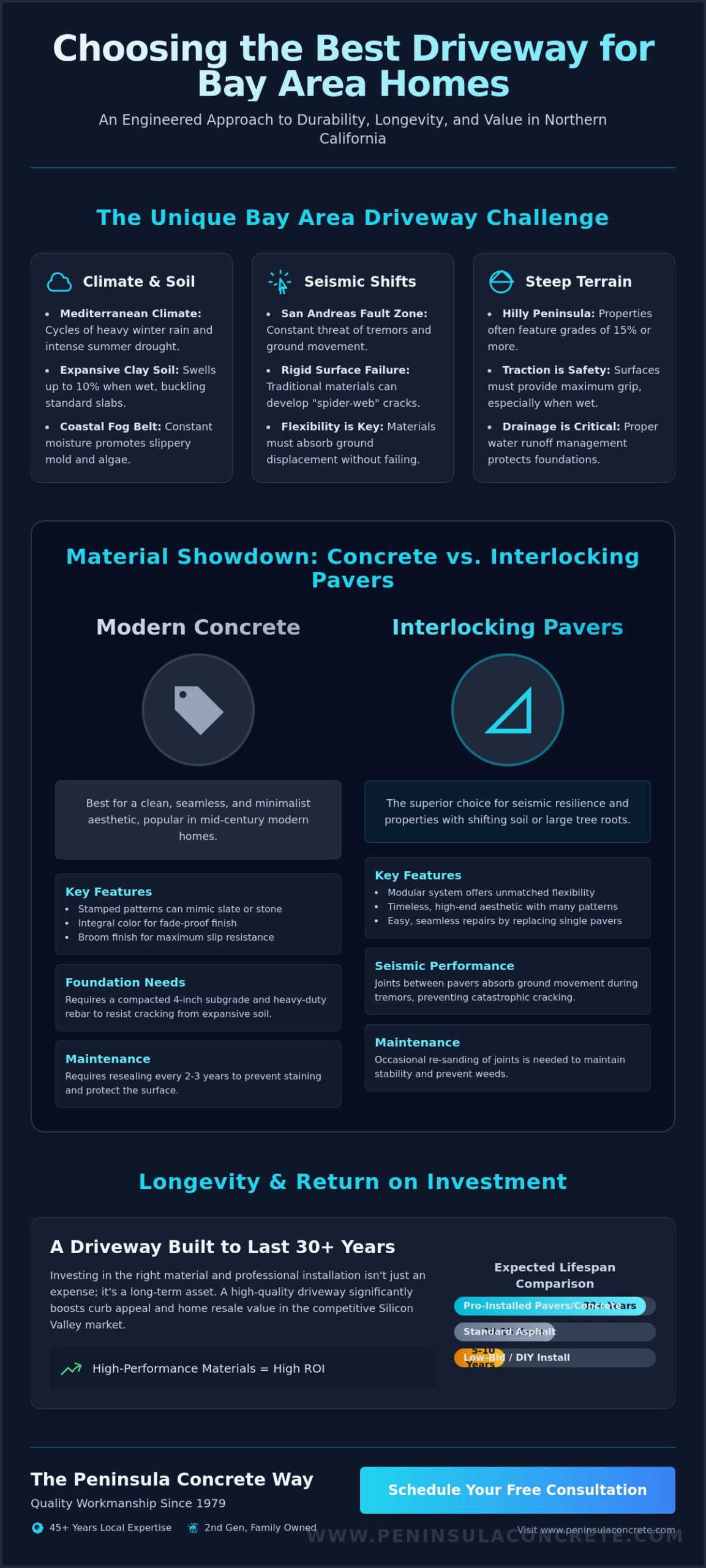
Choosing the best material for driveway in Bay Area projects involves more than picking a color or texture. Our local environment presents a specific set of engineering hurdles that standard construction often ignores. Since 1979, our family-owned business has seen how the Mediterranean climate, with its cycles of heavy winter rain and intense summer droughts, affects residential surfaces. In Silicon Valley, expansive clay soils are a major factor. These soils can swell by up to 10% in volume when wet, exerting enough upward pressure to buckle poorly reinforced slabs. A driveway must be built to withstand these subterranean shifts without failing.
While homeowners often research common driveway materials, many standard options don’t account for the unique Bay Area topography. We focus on durability and long-term reliability to ensure your investment lasts for decades. Our 2nd-generation team understands that the foundation is just as important as the surface finish.
Moisture Management in the Fog Belt
Persistent dampness is a daily reality in neighborhoods like Daly City and the San Francisco fog belt. This constant moisture promotes the growth of slippery mold and algae on porous surfaces. We prioritize materials that offer high slip-resistance to keep your family safe during misty mornings. Pervious concrete is an excellent 2026 solution for these areas. It allows heavy rainfall to drain through the surface into the ground, which reduces runoff and prevents the standing water that leads to surface degradation.
Designing for the San Andreas Fault Line
Seismic activity is a constant factor on the Peninsula. Rigid, thin surfaces like traditional asphalt often develop spider-web cracks after even minor tremors. We’ve found that interlocking paver systems are unsurpassed in strength and flexibility for this reason. Because they are modular, the joints allow for slight movement during a tremor. This prevents the catastrophic cracking seen in monolithic slabs. Seismic resilience in 2026 residential hardscaping is defined as a surface’s capacity to absorb ground displacement through modular flexibility without structural failure. Selecting the best material for driveway in Bay Area homes means preparing for the earth to move. We’ve built a reputation for honesty and high-quality work by ensuring every project is ready for the unique challenges of our region.
Concrete vs. Interlocking Pavers: The Best Materials for Bay Area Homes
When you’re deciding on the best material for driveway in Bay Area projects, the choice usually comes down to two heavyweights: concrete and interlocking pavers. Both offer the durability needed for our local climate, but they serve different architectural goals. Since 1979, we’ve seen homeowners shift between the sleek, monolithic look of concrete and the intricate, timeless patterns of stone. Stamped concrete provides a seamless surface that mimics slate or flagstone, while pavers offer a modular aesthetic that feels high-end and traditional. Maintenance differs too. Concrete typically requires a fresh coat of sealer every 2 to 3 years to prevent staining. Pavers need occasional re-sanding of the joints, especially in damp microclimates like the Peninsula, to keep the structure stable and weed-free.
The Versatility of Modern Concrete
Concrete isn’t just a gray slab anymore. For mid-century modern homes in Palo Alto or Menlo Park, colored concrete is a major trend for 2026. We use integral pigments to ensure the color goes all the way through the pour, preventing surface fading. You can choose a standard broom finish for maximum slip resistance on steep inclines or go with custom stamped patterns for a premium look. Success depends on what’s underneath. We emphasize heavy-duty rebar reinforcement and a compacted 4-inch subgrade to handle the Bay Area’s expansive clay soils. This foundation prevents the unsightly cracking that often plagues DIY or low-bid installs. It’s a reliable, permanent solution for homeowners who want a clean, minimalist aesthetic.
Why Interlocking Pavers Win on Flexibility
If your property has large oak trees or shifting soil, pavers are often the best material for driveway in Bay Area neighborhoods like Atherton. They use a sand-set installation method. This creates a flexible pavement system that moves with the earth instead of fighting it. If a tree root lifts a section, you don’t have to jackhammer the whole driveway. You just lift the affected stones, fix the root, and relay them. Permeable pavements are also becoming a requirement in many local municipalities to manage storm water runoff. These systems allow water to filter back into the ground, meeting strict environmental codes while looking beautiful. They offer a level of strength and flexibility that is unsurpassed in residential construction.
If you’re ready to upgrade your curb appeal and want a surface built to last, contact our team to discuss which material fits your home’s unique footprint and local soil conditions.
Solving the Steep Slope and Drainage Dilemma
Hilly terrain across the Peninsula requires more than just curb appeal. When your property sits on a 15% grade or higher, selecting the best material for driveway in Bay Area projects becomes a matter of safety and structural integrity. We’ve seen many driveways fail because the installer didn’t account for the unique physics of a sloped lot. Since 1979, our team has focused on building surfaces that handle the specific demands of Northern California’s topography.
Traction and Safety on 15%+ Grades
Standard smooth concrete is a liability on a hill. We recommend a heavy broom finish or textured interlocking pavers to create necessary friction. These surfaces allow tires to maintain a grip during our intense winter storms. Asphalt poses a different risk. During the first rains of the season, which often arrive in late October, oils rise to the surface of newer asphalt and create a slick film. This “oil slick” effect can cause vehicles to lose control on even moderate inclines.
Transition zones where your driveway meets the public sidewalk also require precision. Most local building departments mandate a 2% maximum cross-slope to ensure pedestrian safety. If your sloped property requires structural stabilization, it’s vital to review our Hiring Retaining Wall Contractors Guide to protect your investment. Proper grading at the street entrance prevents “bottoming out” and ensures a smooth transition for low-clearance vehicles.
Advanced Drainage for Heavy Bay Area Rains
Water is the primary threat to any driveway foundation. Without proper management, heavy runoff can erode the subbase or flood your garage. Modern driveway design relies on French drains and catch basins to intercept water before it reaches the home. We’ve installed these systems for decades to manage the high-volume runoff seen during the 2023 and 2024 atmospheric river events.
Many municipalities, including Palo Alto and Menlo Park, now require pervious surfaces for new construction to reduce the burden on city storm drains. Permeable pavers allow water to filter through the joints into a specialized stone reservoir. This prevents the “sheet flow” effect that occurs on solid surfaces during heavy downpours. The relationship between driveway pitch and water management is critical because even a 1% error in slope can direct thousands of gallons of water toward your home’s foundation.
Choosing the best material for driveway in Bay Area homes means looking beneath the surface. A well-engineered drainage plan protects your concrete from cracking and prevents soil saturation around your property. We prioritize these technical details to ensure your driveway remains a durable, safe asset for your family.
Longevity and ROI: What Driveway Material Lasts 30+ Years?
The “Asphalt vs. Concrete” debate often ignores the total cost of ownership. Asphalt demands regular sealcoating every few years to prevent oxidation from the intense California sun. Without this, the binder becomes brittle and fails. High-quality concrete installations avoid these recurring expenses. For a deeper dive into how different materials hold up against our local climate, consult the Bay Area Concrete Driveways Durability Guide. Our family-owned business has provided quality work since 1979, seeing firsthand which materials survive the decades and which crumble under the pressure of Bay Area soil movement.
Maintenance Schedules that Prevent Failure
Preventative care is the secret to a 30-year lifespan. Annual inspections are vital to catch minor issues before they become structural disasters. In the South Bay, sun exposure is the primary enemy, causing materials to expand and contract. In the North Bay, moisture from persistent fog can settle into untreated cracks, weakening the base. When determining the best material for driveway in Bay Area climates, we look at how the subgrade handles our unique clay-heavy soil. If you notice “alligator cracking”—small, interconnected cracks that look like reptile skin—it’s a sign of subgrade failure. Catching drainage clogs early prevents water from pooling under the slab, which is the leading cause of premature replacement.
Curb Appeal and Property Value
A driveway is the “grand entrance” that sets the tone for a home’s entire valuation. Real estate data suggests that high-end driveway materials like interlocking pavers often provide a 70% to 80% ROI upon home sale. This is because the driveway is the first thing a potential buyer sees. It’s essential to match your material to the local architecture:
- Eichler Homes: Clean, minimalist concrete lines complement the mid-century modern aesthetic found in Palo Alto and Sunnyvale.
- Victorian Estates: Intricate paver patterns or stamped concrete can mimic the historical charm of San Francisco or Alameda properties.
- Mediterranean Villas: Earth-toned pavers or exposed aggregate finishes pair perfectly with the stucco and tile roofs common in Los Gatos.
Investing in a premium surface tells buyers the home has been meticulously maintained. It removes the “deferred maintenance” worry from their minds. If you’re ready to upgrade your home’s value with a surface built to last, contact Peninsula Concrete to start your project today.
The Peninsula Concrete Way: Quality Work Since 1979
We’ve spent more than 45 years refining our craft across the region. Our deep local experience informs every material recommendation we make for our clients. We don’t just pour surfaces; we apply “Concrete Thinking” to ensure your investment stands the test of time. This philosophy involves smart, forward-looking designs that outlast the competition by accounting for long-term wear and environmental shifts. As a 2nd-generation, family-owned business, we provide a level of accountability that larger corporations simply can’t match. Our name is attached to every project, and we take that responsibility seriously. You can learn more about why choose Peninsula Concrete for your next home improvement by exploring our history of success.
Our Heritage of Honesty and High-Quality Work
Since 1979, we’ve remained a local staple in the Peninsula community. We’ve built a reputation for honesty and high-quality work that spans generations of homeowners. Our team understands the specific permitting requirements and environmental regulations that vary between cities like Palo Alto, San Mateo, and Mountain View. This local knowledge prevents costly delays and ensures your project meets all current 2026 standards. We often meet neighbors who still use driveways we poured in the 1990s. These surfaces remain functional and attractive decades later because we never cut corners on preparation. Choosing the best material for driveway in Bay Area homes requires a contractor who understands how local soil expansion and salt air exposure affect different surfaces over time.
Start Your Project with a Professional Estimate
Selecting a material is only one part of a successful project. A professional site walkthrough is vital to identify hidden challenges before any ground is broken. Our process involves a detailed assessment of your property to address specific technical needs. We focus on the details that matter for long-term durability:
- Soil Composition: We identify expansive clay or unstable soil that could lead to shifting and cracking if not handled correctly.
- Slope and Drainage: Our team analyzes the grade of your land to ensure water runoff doesn’t damage your foundation or violate local drainage codes.
- Regulatory Compliance: We handle the nuances of Bay Area building codes so you don’t have to worry about red tape.
Our team provides a clear, honest path from the initial planning stages to the final pour. We take pride in being an experienced, dependable choice for homeowners who value a personal touch and proven expertise. Contact us today to plan your dream driveway!
BUILD A DRIVEWAY THAT DEFIES THE BAY AREA ELEMENTS
Selecting the best material for driveway in Bay Area properties involves balancing aesthetics with the region’s specific geological demands. Your choice must account for the seismic shifts and steep slopes common throughout the Peninsula. Interlocking pavers provide the necessary flexibility to shift with the earth, while reinforced concrete offers the structural integrity required for a 30 year lifespan. Proper drainage systems are equally vital to manage the heavy runoff during our winter months and prevent soil erosion around your foundation. You need a surface that performs as well as it looks.
Peninsula Concrete has provided QUALITY WORK SINCE 1979. We’re a 2nd-generation, family-owned and operated team that understands local soil conditions and seismic hardscaping requirements. We’ve built our reputation on honesty and durable craftsmanship. Don’t leave your home’s curb appeal or safety to chance. We’re ready to help you navigate the planning process and ensure your new driveway is a lasting success for decades to come.
Get Your Free Bay Area Driveway Estimate Today
We look forward to building a foundation you can trust for your family home.
Frequently Asked Questions
What is the most earthquake-resistant driveway material for the Bay Area?
Interlocking pavers are the most earthquake-resistant choice because they function as a flexible pavement system. Unlike solid concrete slabs that crack when the ground shifts, individual pavers move independently during seismic activity. This flexibility allows the driveway to settle back into place without structural failure, which is vital for homes near the San Andreas or Hayward faults.
How much does a new concrete driveway cost per square foot in San Francisco?
A new concrete driveway in San Francisco typically costs between $12 and $22 per square foot based on 2024 industry reports from Angi. These rates reflect the specific labor costs and strict debris disposal fees required by San Francisco County. Selecting the best material for driveway in Bay Area installations involves weighing these initial costs against the 30 year lifespan of professional concrete work.
Do I need a permit to replace my driveway in the Peninsula?
You generally need an encroachment permit or a building permit to replace a driveway in Peninsula cities like Palo Alto or San Mateo. For example, the City of Palo Alto requires a permit for any work that modifies the curb cut or touches the public right-of-way. Our team has managed these local municipal requirements since 1979 to ensure every project stays fully compliant with current city codes.
Which driveway material is best for very steep hills?
Broom-finished concrete is the best material for driveway in Bay Area properties located on steep inclines. This specific finish creates a high-traction surface that prevents tires from slipping during rainy winter months. For hills with a grade steeper than 15 percent, we often recommend specialized grooving patterns to provide maximum grip and safety for your vehicles.
How long does a paver driveway last compared to concrete in our climate?
Interlocking pavers typically last 50 years or more, while a standard concrete driveway lasts approximately 25 to 30 years in the Bay Area climate. Pavers are remarkably durable because they’re manufactured in a controlled environment to reach a compressive strength of 8,000 psi. This is nearly double the strength of standard poured concrete, making them a fantastic long-term investment for your home.
Can I install a permeable driveway to help with local drainage issues?
You can install pervious concrete or permeable pavers to manage runoff and comply with local C.3 Stormwater requirements. These systems allow water to drain through the surface at a rate of approximately 5 gallons per minute per square foot. This technology prevents puddling on your property and reduces the amount of pollutants entering the San Francisco Bay.
How does the Bay Area fog affect driveway maintenance?
The consistent moisture from the Bay Area marine layer encourages the growth of moss, mold, and mildew on porous driveway surfaces. This damp environment requires homeowners to apply a high-quality sealer every 3 to 5 years to prevent moisture penetration. Regular sealing protects the integrity of the material and keeps the surface looking reputable and clean despite the daily fog cycles.
Why should I avoid asphalt for my residential Bay Area property?
You should avoid asphalt because it has a short lifespan of only 10 to 15 years and requires frequent resealing to prevent cracks. Asphalt also absorbs significant heat during the summer, which can increase the ambient temperature around your home by several degrees. It’s a petroleum-based product that can soften in high heat and track oily residue into your house, making it less practical than durable concrete.