
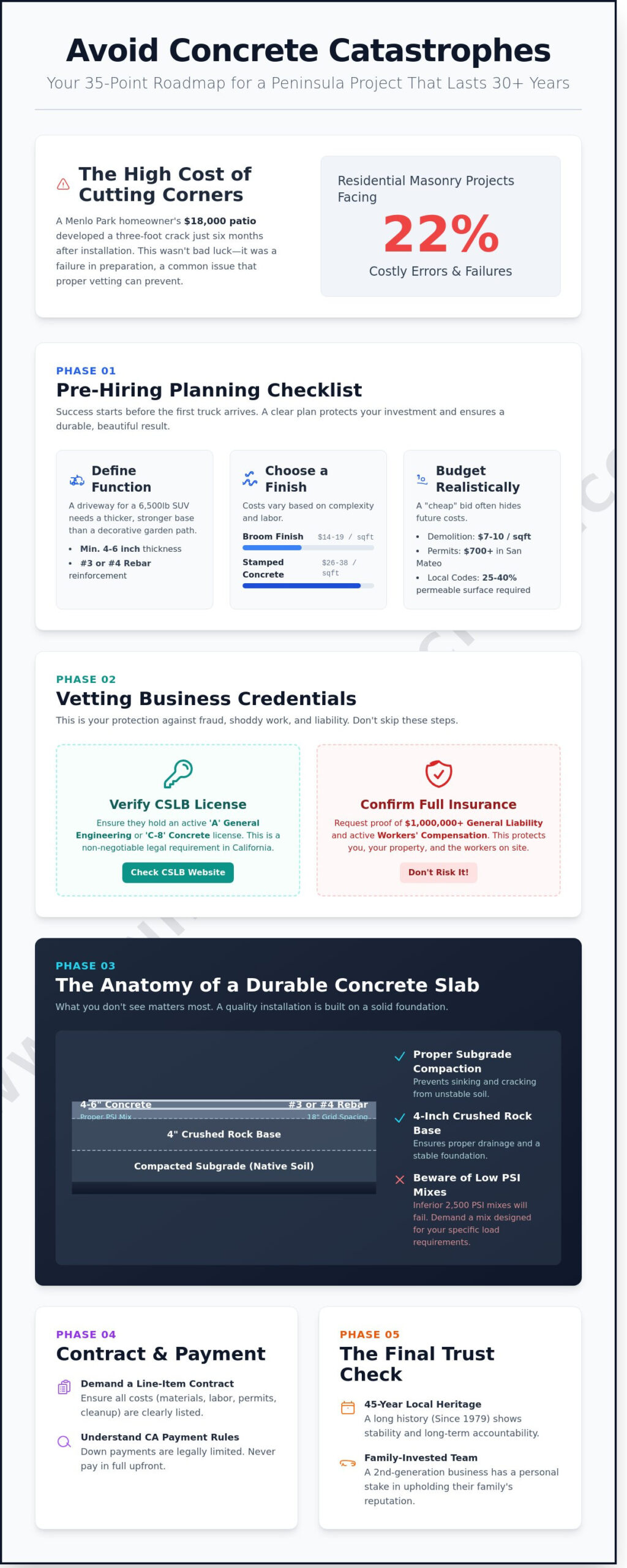
Last winter, a homeowner in Menlo Park discovered a three foot crack snaking through their new $18,000 patio just six months after the pour. This wasn’t bad luck; it was the direct result of a contractor skipping critical subgrade preparation that local Peninsula soil demands. You deserve to feel confident that your investment won’t crumble under the first sign of Bay Area weather. We understand that technical terms like PSI ratings or rebar spacing can feel like a second language, and the anxiety of local permitting is enough to stall any project before it begins.
Our goal is to give you total peace of mind. This comprehensive hiring a concrete contractor checklist provides a 35-point roadmap to help you vet professionals and avoid the costly errors that plague 22% of residential masonry projects. We’ve built our reputation on quality work since 1979, and now we’re sharing our internal standards with you. This guide covers everything from verifying insurance to mastering Peninsula-specific codes. It ensures your new driveway or walkway lasts for at least 30 years without hidden costs or structural failures.
Key Takeaways
- Learn how to define your project’s primary function and preferred finish early to ensure the final result meets both aesthetic and structural requirements.
- Protect your property by verifying active CSLB status and ensuring your contractor holds the specific license classifications required for professional Bay Area work.
- Use our comprehensive hiring a concrete contractor checklist to vet critical technical details, from specific PSI mix designs to proper rebar reinforcement.
- Navigate California’s strict payment regulations and learn how to demand a line-item contract that keeps your project on budget and legally protected.
- Understand why a 45-year local heritage and a family-invested team offer a superior level of trust and accountability for your Peninsula home investment.
Phase 1: The Pre-Hiring Planning Checklist
Success in any San Francisco Peninsula masonry project begins long before the first truck arrives. You need a clear roadmap to ensure your investment lasts for decades. Using a hiring a concrete contractor checklist helps you avoid the common pitfalls that plague DIY attempts or cut-rate installations. Since 1979, our 2nd-generation, family-owned business has seen how proper planning protects your property value.
First, identify the primary function of your surface. A driveway meant to support a 6,500-pound electric SUV requires different structural integrity than a decorative walkway for a garden. Load-bearing surfaces need a minimum 4-inch to 6-inch thickness, often reinforced with #3 or #4 rebar spaced at 18-inch intervals. For those interested in understanding concrete and its compressive strength, the water-to-cement ratio is vital for ensuring the slab doesn’t flake or scale during the first winter.
Choose your preferred finish early in the process. A standard broom finish provides excellent slip resistance and remains the most cost-effective choice at $14 to $19 per square foot in 2026. Stamped concrete, which mimics high-end materials like slate, brick, or European cobblestone, typically ranges from $26 to $38 per square foot depending on the complexity of the patterns. Exposed aggregate is a durable, mid-range favorite that highlights natural river stones within the mix, offering a textured look that hides dirt and wear effectively.
Check your local Redwood City or Peninsula zoning laws before signing any contracts. Many cities now mandate that 25% to 40% of your front yard remains a permeable surface to manage groundwater levels. This might require you to install pervious concrete or specific drainage systems to meet 2026 environmental standards. Ignoring these codes can result in heavy fines or the forced removal of your new driveway.
Defining Your Project Scope
Your scope must address the unique geography of the Bay Area. Are you building on a San Francisco Peninsula slope? You likely need retaining walls to prevent soil creep and ensure a level pour. Integrated drainage systems are non-negotiable for properties with elevation changes. Without a 2% minimum slope or professional French drains, pooling water will undermine your sub-base and cause early failure. Consider interlocking pavers if you want a flexible system that handles minor ground movement better than a solid slab while providing unsurpassed style.
The ‘Concrete Thinking’ Budget Framework
Realistic budgeting saves you from mid-project stalls and financial stress. In 2026, material costs remain a significant factor in every quote. Factor in $7 to $10 per square foot just for the demolition and haul-away of your existing cracked slab. Don’t forget hidden costs that many homeowners overlook. Permit fees in San Mateo County can exceed $700 for certain residential projects; utility marking via 811 is a mandatory safety step that must be scheduled. A “cheap” bid often omits proper sub-grade compaction or uses inferior 2,500 PSI mixes. If a contractor skips the 4-inch crushed rock base, you’ll spend 3x more on repairs when the surface cracks within 24 months. Our “Concrete Thinking” approach prioritizes doing it right the first time. Using this hiring a concrete contractor checklist ensures you account for every dollar before the work starts.
Phase 2: Vetting Business Credentials and Heritage
Phase two of your hiring a concrete contractor checklist moves from the aesthetic to the administrative. You must verify that any candidate holds an active license with the California State License Board (CSLB). Specifically, look for an ‘A’ General Engineering license or a ‘C-8’ Concrete classification. These aren’t just suggestions; they’re legal requirements that prove the contractor has passed rigorous testing and possesses the necessary trade knowledge for structural work. Using California contractor requirements as your guide ensures you aren’t putting your property at risk with an unlicensed operator.
The CSLB keeps a public record of any legal actions or bond claims against a business. It’s a goldmine of information for homeowners. If a contractor doesn’t have a ‘C-8’ license, they shouldn’t be doing structural concrete work on your home. Hiring an unlicensed worker might save you $500 today, but it can cost you $5,000 in fines or structural repairs tomorrow. This verification step is the foundation of a safe project and a durable finished product.
Financial protection is the next non-negotiable item. Request a certificate of insurance that shows at least $1,000,000 in General Liability coverage and active Workers’ Compensation. This protects you if a crew member gets injured on your driveway or if your home’s foundation is accidentally damaged. Don’t accept a simple verbal “yes” or a blurry photocopy. The document should come directly from their insurance agent to confirm it’s current. You also need to verify they have a local, physical office on the Peninsula. A business that only operates out of a P.O. Box lacks the community accountability you want for a major investment.
Workers’ Compensation is particularly critical in California. If a contractor is a solo operator and claims they don’t need it, be careful. The moment they bring a helper onto your property, they’re legally required to have coverage. Without it, you become the employer in the eyes of the law if an accident occurs. A $1,000,000 liability policy ensures that if a concrete truck cracks a neighbor’s curb or hits a water line, the insurance company pays the bill, not your personal savings account.
Longevity and Community Roots
Look for a business with a deep legacy. Our team has provided quality work since 1979, surviving multiple economic cycles. A 2nd-generation, family-owned firm offers a level of personal accountability that large corporations can’t match. Ask for references from projects completed over 10 years ago. Seeing how a 2014 driveway looks today tells you more about their skill than a photo of a project poured last week.
Local Bay Area Specialization
The Peninsula presents unique challenges like the expansive clay soils found in Redwood City and Menlo Park. This soil shifts with the seasons, requiring specific sub-base compaction to prevent cracking. Experienced local contractors also understand San Mateo County permit workflows and California’s Title 24 drainage requirements. This specific expertise is a vital part of your hiring a concrete contractor checklist. When you’re ready to work with local experts, contact us for a consultation.
Phase 3: The Technical Craftsmanship Checklist
Quality isn’t accidental; it’s engineered. Since 1979, our team has seen how small technical shortcuts lead to significant structural failures within just five years. Your hiring a concrete contractor checklist must move beyond aesthetics to address the engineering of the slab. Before you commit to a proposal, verify that your professional follows the standards outlined in the CSLB’s guide to hiring a contractor. This ensures they operate with the transparency required for high-stakes residential projects.
Start by demanding a specific concrete mix design. For a standard 4-inch thick driveway, you need a minimum of 3,500 to 4,000 PSI (pounds per square inch) strength. Footings for retaining walls might only require 2,500 PSI, but high-traffic surfaces need that extra density to resist scaling and abrasion. If a contractor cannot tell you the specific PSI rating they’ve ordered from the ready-mix plant, they aren’t prioritizing the lifespan of your investment.
Reinforcement is another non-negotiable area. For driveways and heavy-use patios, verify the use of rebar reinforcement over thin wire mesh. We recommend #3 rebar placed on 12-inch or 18-inch centers. Wire mesh often ends up pressed into the dirt during the pour, rendering it useless. Rebar, when properly chaired up into the center of the slab, provides the tensile strength necessary to hold the concrete together when the ground shifts.
Finally, ensure the proposal includes a detailed plan for expansion joints. Concrete naturally expands and contracts with temperature changes. A professional plan places control joints at intervals no more than 24 to 30 times the thickness of the slab. For a 4-inch slab, this means a joint every 8 to 10 feet. Without these intentional “weak spots” for the concrete to crack, the slab will eventually spiderweb in unpredictable, unsightly patterns.
Subgrade and Drainage: The Invisible Foundation
The soil beneath your concrete dictates its future. A reputable contractor will excavate enough space to install a minimum 4-inch crushed rock base, typically using Class 2 aggregate. This base provides a stable platform and allows for minor soil movement without stressing the slab. Subgrade compaction is the #1 factor in preventing cracks. If the contractor doesn’t use a power plate compactor on the soil and the rock, the concrete will settle and fail. To prevent puddling, the team must also guarantee a 1-2% slope, which equates to a 1/8-inch to 1/4-inch drop per linear foot, directing water away from your home’s foundation.
Finishing and Curing Standards
The work doesn’t end when the concrete is level. To protect against the unique Bay Area moisture and salt air, the contractor should use high-quality silane or siloxane-based sealants. These penetrate the surface to create a hydrophobic barrier. Ask about their curing method; applying a curing compound that meets ASTM C309 standards is essential for retaining moisture during the first seven days. This process ensures the surface reaches maximum hardness. When temperatures exceed 80 degrees, the crew must have a “hot weather” plan. This includes using sunshades or misting the subgrade to prevent the concrete from drying prematurely, which causes “map cracking” on the surface.
Using this hiring a concrete contractor checklist allows you to filter out providers who prioritize speed over substance. We’ve built our reputation on these technical details for over four decades, and we believe every homeowner deserves that same level of transparency.
Phase 4: Evaluating the Proposal and Contract
You’ve narrowed down your list of candidates to the top contenders. Now it’s time to look at the fine print. A professional proposal reflects the contractor’s attention to detail and their respect for your budget. If a bid arrives on a single sheet of paper with one total price, ask for more. You need a line-item breakdown. This should specify the cost for 4,000 PSI concrete, the amount of rebar or wire mesh included, and the estimated labor hours. Disposal fees for old concrete can often run between $500 and $1,500 depending on the project size; ensure this is a separate line item so you aren’t surprised by a final invoice.
California law is strict about down payments to protect homeowners. You should never pay more than 10% of the total project price or $1,000, whichever is less. This protects you from contractors who take large sums and disappear. At Peninsula Concrete Contractors, we’ve followed these standards as a 2nd-generation, family-owned business for decades. Establish a schedule where payments are tied to specific milestones, such as 30% after the site is graded and forms are set, and the final 10% only after the site is fully cleared. Using a comprehensive hiring a concrete contractor checklist helps you compare these line items side-by-side to ensure you’re getting a fair market rate.
Every agreement needs a firm Start Date and an Estimated Completion Date. While concrete is weather-dependent, a reputable pro will commit to a specific window. Clarify who handles the final cleanup before the first shovel hits the dirt. Removing heavy wooden forms and excess slurry requires specific equipment and labor. If the contractor leaves these behind, you’ll be stuck paying a hauling service an extra $300 to $600 to finish the job. Ensure the contract explicitly states that the site will be left in “broom-clean” condition.
Warranty and Workmanship Guarantees
Handshakes don’t hold up in court, so you need the “Quality Work Since 1979” level of assurance in writing. Does the warranty cover structural cracking larger than 1/4 inch, or is it limited to surface scaling? Most standard warranties last 12 months. If you find a defect 90 days after the final pour, the contract should outline a 48-hour response time for an inspection. This ensures your hiring a concrete contractor checklist covers long-term protection for your investment.
Communication and Project Management
Identify the on-site foreman who’ll be present during the pour. You don’t want to play phone tag with an office manager while a mixer truck is idling in your driveway. Clarify if you’ll get daily updates via text or a weekly recap. Change orders are common in construction. If the crew discovers a hidden utility line or unstable soil, the contract must state that any price adjustments require your written signature before work continues.
Ready to work with a team that values transparency and heritage? Contact Peninsula Concrete Contractors today to receive a detailed proposal for your next project.
Phase 5: The Final Trust Check-Why Heritage Matters
The final step in your hiring a concrete contractor checklist isn’t about the bottom line or the timeline. It’s about the people standing behind the work. There’s a massive difference between a company that utilizes a rotating “hired crew” of temporary laborers and a family-invested team. At Peninsula Concrete, our crew isn’t just a group of employees; we’re a 2nd-generation team with a personal stake in every yard of concrete poured. When a contractor has their family name on the truck, they aren’t just looking to finish the job. They’re looking to protect a legacy that started in 1979. They treat your driveway or patio like a monument to their own family history.
A 45-year reputation in the Peninsula serves as your strongest warranty. Paper warranties are only as good as the company’s longevity. If a business closes after three years, that 10-year guarantee is worthless. We’ve seen hundreds of “fly-by-night” operations disappear since we opened our doors. Our history ensures we’ll be here to answer the phone if you have a question five years from now. This longevity also brings deep troubleshooting expertise. Sites in Redwood City often face complex drainage issues or shifting clay soils. Our 2nd-generation experience allows us to identify these “invisible” problems before the first shovel hits the dirt, preventing cracks that typically appear in less experienced work within the first 24 months.
This principle of trusting a long-standing business applies to any critical home service, not just concrete. The same vetting process is crucial for other specialized trades that enhance your property, such as pool plastering. For homeowners considering a pool remodel, a dedicated expert like Emerald Plaster provides the kind of focused craftsmanship discussed throughout this guide.
The Peninsula Concrete Difference
We’ve provided quality work since 1979, and our deep Redwood City roots mean we understand the local terrain better than anyone else. We know the specific permit requirements for San Mateo County and how the coastal climate affects curing times. This local expertise saves homeowners an average of 15% in potential repair costs caused by improper site preparation. We don’t just pour concrete; we build foundations for the community we live in.
Making the Final Decision
Use our “Concrete Thinking” scoring system to compare your top three candidates. Rate them on a scale of 1 to 10 for communication, technical knowledge, and transparent pricing. While the data is vital, don’t ignore your gut feeling about a contractor’s honesty. If a bid seems too low or a contractor avoids specific questions about their license, trust that instinct. Reviewing your hiring a concrete contractor checklist one last time ensures no detail is overlooked before the trucks arrive. Before you sign the contract, check this final red flag list. If any of these apply, walk away immediately:
- Pressure Tactics: They demand a signature today to “lock in” a fake discount that expires in 24 hours.
- Cash Only: They refuse to accept traceable payment methods or ask for 100% of the money upfront.
- No Local References: They can’t provide three addresses of completed projects within 10 miles of your home.
- Vague Contracts: The scope of work doesn’t include specific depth, PSI strength, or reinforcement details like rebar spacing.
- Unlicensed Status: They claim they don’t need a license for your specific project or ask you to pull the permits yourself.
Once you’ve verified these points, you’re ready to sign. Clear the site of debris, notify your neighbors about the upcoming noise, and prepare for a transformation that will last for decades. Selecting the right partner means your concrete will be as solid as the reputation of the team that poured it.
SECURE YOUR BAY AREA INVESTMENT TODAY
Navigating a major home improvement project requires more than just a quick search; it demands a strategy. You now have a comprehensive hiring a concrete contractor checklist to ensure your investment stands the test of time. By verifying credentials and focusing on technical craftsmanship, you protect your property from the common pitfalls of cut-rate construction. Peninsula Concrete has provided quality work since 1979 because we treat every driveway and patio as a piece of our own family heritage. We’ve served the SF Peninsula for 45+ years, building a reputation for honesty that only a 2nd-generation family-owned business can maintain. It’s vital to choose a partner who values your home’s longevity as much as you do. Don’t leave your next project to chance when you can rely on decades of proven expertise. We’re ready to help you move from the planning phase to a successful, durable finish. Let’s build something that lasts for the next generation.
Start your project today with a free estimate from Peninsula Concrete
Frequently Asked Questions
How do I verify a concrete contractor’s license in California?
You verify a license by visiting the California Contractors State License Board (CSLB) website and entering the contractor’s 6-digit or 7-digit license number. Since 1979, Peninsula Concrete has maintained a clean record with the CSLB. Don’t just take their word for it; check that their C-8 Concrete Contractor license is active and their workers’ compensation insurance is current before signing any contract.
What is a fair deposit for a concrete project in the Bay Area?
A fair deposit is exactly 10% of the total project cost or $1,000, whichever amount is smaller. This is a strict legal requirement set by California Business and Professions Code Section 7159. If a company asks for 50% upfront, they’re violating state law. We follow these guidelines to ensure our clients feel secure from the first day of their project.
Should I choose interlocking pavers or poured concrete for my driveway?
Choose interlocking pavers if you want a surface with 8,000 PSI compressive strength that resists cracking during soil movement. Poured concrete is a durable, cost-effective choice that provides a smooth, classic look for 25 years or more. This comparison is a vital part of your hiring a concrete contractor checklist. We’ve installed both since 1979 and find that pavers work best for Redwood City’s expansive clay soils.
What are the most common red flags when hiring a concrete company?
The most common red flags include a contractor demanding more than a 10% deposit or refusing to provide a physical business address. Avoid any professional who claims they don’t need a permit for a 500 square foot structural project. Our 2nd-generation family-owned business prides itself on transparency. If a bid is 30% lower than all others, the contractor is likely skipping essential steps like sub-base compaction.
How long should I wait before driving on my new concrete driveway?
You should wait exactly 7 days before driving a standard passenger vehicle on your new driveway. While the concrete reaches about 70% of its 4,000 PSI strength within a week, it takes a full 28 days to cure completely. Don’t park heavy delivery trucks or RVs on the surface for at least 30 days. This patience protects your investment and ensures the high-quality finish lasts for decades.
Does a new concrete patio require a permit in Redwood City?
You need a permit in Redwood City if your patio exceeds 500 square feet or changes the existing grade of your yard. The city’s building department requires these permits to ensure proper rainwater runoff into the municipal system. Our team handles the permit process for 95% of our local projects. This ensures your home stays compliant with California Building Code Section 105.2 requirements.
Why is drainage so important for concrete projects in the Peninsula?
Proper drainage prevents water from pooling and cracking your slab, which is critical because Peninsula soils contain high levels of expansive clay. We design every project with a minimum slope of 1/4 inch per foot to direct water away from your foundation. Without this 2% grade, standing water will degrade your concrete 50% faster than a well-drained surface. It’s a key item on any hiring a concrete contractor checklist.
What is the difference between a concrete finisher and a concrete contractor?
A concrete finisher is a skilled tradesman who levels and textures the wet surface, while a concrete contractor is the licensed professional who manages the entire project. The contractor carries the C-8 license, provides the $15,000 surety bond, and manages the 4-person crew. As a 2nd-generation family business, we employ expert finishers who have been with us for over 15 years. You get both technical skill and legal protection.