
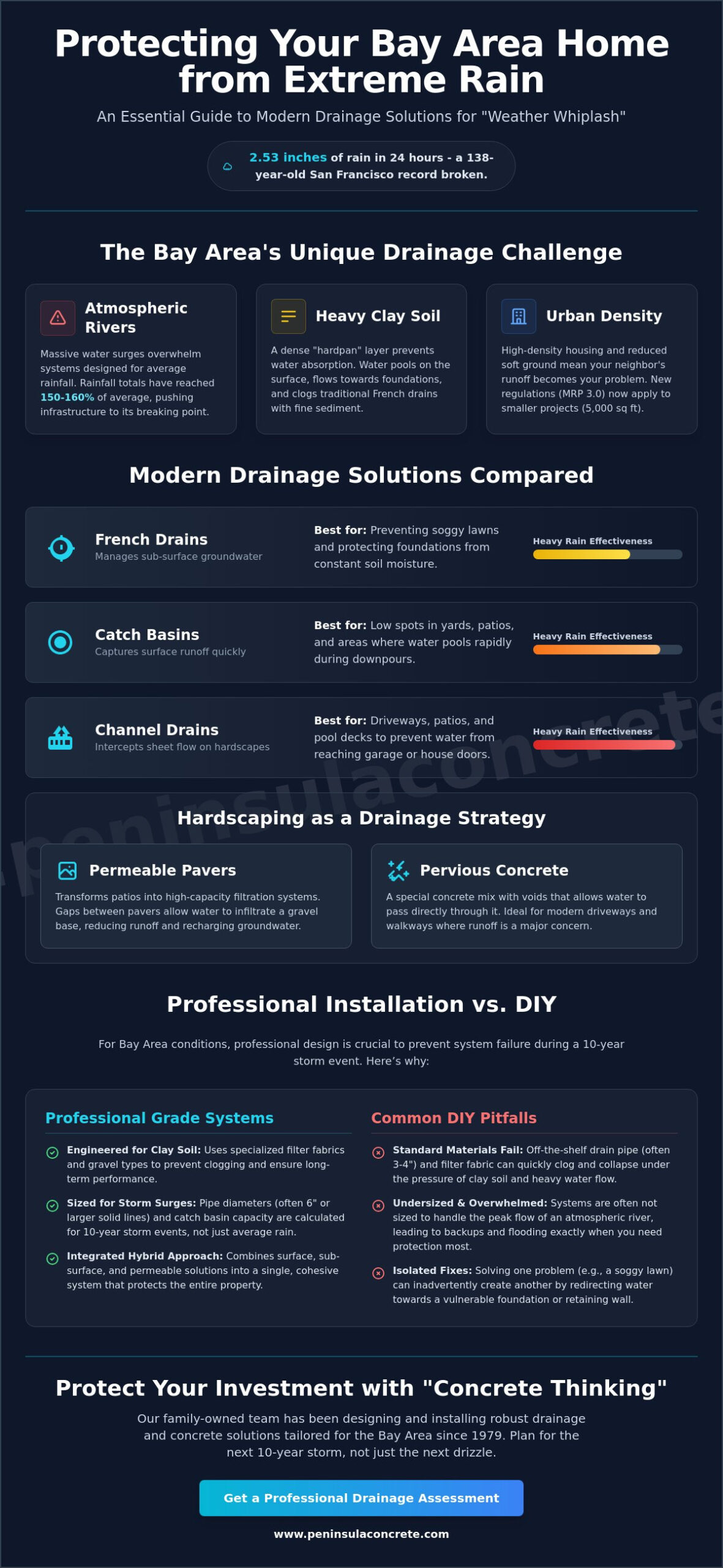
In the winter of 2025-2026, downtown San Francisco broke a 138-year-old record by recording 2.53 inches of rain in just 24 hours. For many local homeowners, this extreme weather turned backyards into swampy ponds and put immense pressure on foundation walls. If you’ve spent the last season watching water pool against your house or dealing with failing retaining walls, you need yard drainage solutions for heavy rain that go beyond simple surface fixes. Our family-owned team at Peninsula Concrete has been tackling these challenges since 1979, and we’ve seen how these atmospheric rivers can compromise properties without the right infrastructure.
We know how frustrating it is to have an unusable yard or worry about the long-term health of your foundation. You can protect your Bay Area property using professional-grade drainage strategies designed for the unique “weather whiplash” of our region. This guide explores how a multi-layered approach, combining permeable pavers with engineered French drains, keeps your landscape dry and functional. We’ll preview the specific technical solutions that handle massive water surges so your property remains a safe, high-value investment through every storm.
Key Takeaways
- Understand why Bay Area clay soil and atmospheric rivers cause standard drainage systems to fail during peak storm surges.
- Compare surface and sub-surface yard drainage solutions for heavy rain to determine which system best protects your home’s foundation.
- Learn how permeable pavers and pervious concrete transform your patio into a high-capacity filtration system that manages runoff on-site.
- Identify the critical drainage components needed to prevent hydrostatic pressure from damaging your retaining walls and property value.
- Discover why professional installation ensures your drainage system handles the extreme weather events that often overwhelm DIY projects.
Why Bay Area Yards Flood: The Heavy Rain Challenge
The San Francisco Peninsula presents a unique set of challenges for property owners. During the record-breaking winter of 2025-2026, rainfall totals reached 160% of average in San Jose and 150% at SFO. These aren’t just heavy showers; they’re massive surges of water that test the limits of every residential property. Finding effective yard drainage solutions for heavy rain requires understanding why our local environment is so prone to flooding. Standard systems designed for other climates simply can’t keep up with the volume of an atmospheric river hitting the Santa Cruz Mountains and the surrounding lowlands.
The Role of Clay Soil in San Francisco Peninsula Drainage
Most of the Peninsula sits on heavy clay soil that behaves differently than the sandy loam found in other parts of the country. This soil often forms a “hardpan” layer, a dense barrier that acts more like concrete than earth. When rain starts, the top inch of soil saturates almost instantly. Because the water can’t move downward, it begins to pool on the surface or flow toward your foundation. This creates immediate runoff that quickly overwhelms standard landscape grading.
A common mistake is installing a standard French drain without accounting for this clay density. Traditional French drains often fail in heavy clay because fine sediment particles eventually clog the filter fabric and gravel layers, stopping water from entering the pipe entirely. At Peninsula Concrete, we’ve seen many 2nd-generation homeowners deal with systems that worked for decades but failed during the intense surges of the last few years.
Atmospheric Rivers: Designing for the 10-Year Storm
We’ve seen a shift toward “weather whiplash” in Northern California. We go from extreme drought to recording 2.53 inches of rain in a single day, as San Francisco did in late 2025. Many older homes have 3-inch or 4-inch drain pipes that were never sized to handle these surges. When an atmospheric river hits, these pipes reach maximum capacity within minutes, causing water to back up into the yard or crawlspace. Our team focuses on “Concrete Thinking,” which means planning for these 10-year storm events rather than just average rainfall.
Local regulations are catching up to this reality. As of July 1, 2023, the Municipal Regional Stormwater Permit (MRP 3.0) lowered the threshold for requiring stormwater treatment measures on projects from 10,000 to 5,000 square feet. High-density housing on the Peninsula leaves very little “soft” ground for water to escape. This density creates a scenario where your neighbor’s runoff becomes your problem. Identifying critical failure points like undersized catch basins or blocked exit lines is the first step in protecting your property from the $70 billion in potential flood damage estimated for our region this century.
Top Yard Drainage Solutions for Heavy Rain Compared
Choosing the right setup depends entirely on where your water is coming from. If your lawn stays soggy for days after the clouds clear, you likely have a groundwater problem. If you see rivers forming across your patio during a downpour, you’re dealing with surface water issues. Effective yard drainage solutions for heavy rain often require a combination of both to handle the intense volume seen in recent Bay Area winters. Since 1979, we’ve found that a “one size fits all” approach leads to failure when the first atmospheric river of the season hits.
French Drains vs. Catch Basins: Choosing Your Weapon
French drains are designed to intercept groundwater before it reaches your foundation or turns your lawn into a marsh. They use perforated pipes buried in a bed of gravel to pull moisture from the earth and move it away. In contrast, catch basins are structural boxes with grates that sit at low points to swallow surface runoff instantly. For many Peninsula properties, we recommend a hybrid approach. This involves connecting multiple catch basins to a solid trunk line while running a separate French drain to manage soil saturation levels. A dry well is an underground structural chamber that collects large volumes of stormwater and allows it to slowly infiltrate the surrounding soil, making it an ideal solution for managing runoff on space-constrained local lots.
Channel Drains for Driveways and Patios
Driveways often act as massive funnels, directing thousands of gallons of water toward your garage or front door. Heavy-duty channel drains, also known as trench drains, are essential for these areas. When we install concrete driveways, we integrate these drains at the threshold to ensure water is diverted before it can enter your home. You can choose between durable plastic grates for pedestrian areas or industrial-strength metal grates that withstand the weight of heavy vehicles. These systems work best when they align with the EPA’s Soak Up the Rain guidelines, which emphasize managing water on-site to protect our local Bay ecosystem.
Scaling your system is the most critical step. Many local systems fail because they use standard 3-inch pipes that simply can’t handle the surge of a major storm. Upgrading to a 4-inch or 6-inch smooth-wall PVC pipe provides significantly more capacity and is less likely to clog than cheap corrugated tubing. Where that water goes is just as important as how you catch it. Whether you discharge to the street or a designated bioswale, the exit point must remain clear of debris. Check your basins every October before the rainy season begins to ensure everything is ready. If you’re unsure if your current system is sized correctly for your property, you can always ask our team to evaluate your drainage layout during a site visit.
Hardscaping as a Drainage Strategy: Permeable Solutions
Traditional hardscaping often creates runoff problems by sealing the ground with impermeable surfaces. Modern yard drainage solutions for heavy rain take a different approach by transforming your driveway or patio into a functioning filtration system. Permeable pavers allow water to pass through specialized joints into a deep stone reservoir hidden beneath the surface. This system slows the water’s velocity and allows it to soak into the ground over time rather than rushing toward your foundation. Pervious concrete offers a similar industrial-strength solution. It features a porous structure that can swallow several gallons of water per minute, making it ideal for the intense surges we see on the Peninsula.
Integrating these materials does more than just move water. It helps reduce the “heat island” effect in high-density Bay Area neighborhoods. Dark, solid surfaces absorb and radiate heat, but permeable systems stay cooler and allow the earth underneath to breathe. Beyond the environmental performance, these solutions offer significant aesthetic benefits over traditional plastic drains. You get the high-end look of natural stone or brick masonry while performing a critical utility function for your property’s safety.
The Power of Interlocking Paver Systems
When our team installs interlocking pavers, we build an engineered, multi-layered base. This isn’t a simple bed of sand; it’s a stack of open-graded aggregates that acts as a temporary holding tank during a storm. While traditional concrete driveways produce nearly 100% runoff, a properly installed permeable system can reduce that figure to almost zero during standard rainfall. These systems are unsurpassed in strength and flexibility. They can handle the shifting clay soils of the San Francisco Peninsula without the unsightly cracking often seen in solid slabs.
Homeowners often pair these hardscapes with natural filtration areas to meet local stormwater requirements. For those looking to manage patio overflow sustainably, resources like the Oregon Rain Garden Guide provide excellent blueprints for directing water into bio-retention zones. This combination keeps your property compliant with modern regulations while ensuring your landscape remains functional even after a week of heavy rain.
Integrating Drainage into New Patio Designs
We don’t rely solely on the surface material to do the work. A professional patio design includes sub-surface piping hidden beneath the stone finishes. We create invisible slopes that guide water away from the house at a precise grade, ensuring that even during a record-breaking atmospheric river, water moves toward a safe discharge point. This level of “Concrete Thinking” is what protects a home’s long-term value.
We recently completed a project for a homeowner in San Mateo whose basement flooded every winter due to poor patio grading. By replacing their old, cracked concrete with a permeable paver system and integrated channel drains, we eliminated the pooling against their foundation entirely. Their yard stayed dry and usable even during the record-breaking deluges of early 2026. This integrated approach is a staple of our quality work since 1979, providing a permanent fix rather than a temporary patch.
Managing Foundation and Retaining Wall Water Pressure
Hydrostatic pressure is the primary cause of structural failure for residential hardscaping on the Peninsula. When our heavy clay soil becomes saturated during an atmospheric river, the weight of the water trapped behind a structure can increase exponentially. Water weighs approximately 62.4 pounds per cubic foot. Without adequate yard drainage solutions for heavy rain, this weight exerts massive force against your home’s foundation and backyard barriers. We’ve spent decades repairing walls that bowed or collapsed because they were built as “dams” rather than managed filtration systems.
Identifying failure before a total collapse is essential for protecting your property value. You should look for specific warning signs during the next storm. Efflorescence, which appears as white, powdery salt deposits on the face of the stone or concrete, indicates that water is pushing through the material rather than draining around it. Other red flags include visible bowing in the center of the wall, new cracks in the mortar, or soil pulling away from the top of the structure. If you notice these issues, it’s time to address the “behind-the-wall” mechanics.
Retaining Wall Drainage Essentials
A durable wall relies on what you can’t see. Every project we’ve handled since 1979 includes a dedicated drainage layer consisting of clean, angular gravel and a perforated pipe wrapped in filter fabric. This setup intercepts water and directs it to the ends of the wall or through integrated weep holes. These holes must be placed at the base of the wall every few feet to provide immediate pressure relief. If your current wall lacks these features, it’s a ticking clock. You should consult professional retaining wall contractors before a slight lean becomes a costly structural failure.
Foundation Protection Strategies
Protecting your home’s foundation starts with managing “negative grade,” where the ground slopes toward your house instead of away from it. We often use swales and berms to redirect water naturally. A swale is a shallow, lined channel that catches runoff and guides it to a safe discharge point, while a berm acts as a small earthen levee to block water from sensitive areas. These solutions are highly effective for managing the 150% to 160% above-average rainfall totals we’ve seen in San Jose and Oakland recently.
Downspout diversion is the simplest and most overlooked fix for foundation puddling. Extending your downspouts at least 5 to 10 feet away from the house prevents water from “mining” the soil under your footings. To ensure long-term safety, it’s critical to maintain a minimum 6-inch vertical clearance between the finished soil grade and the start of your home’s siding or stucco. This gap prevents moisture from wicking into your wall framing and protects against pest infestations. If you’re concerned about the water pressure building up against your property, contact us for a professional drainage assessment to protect your home’s structural integrity.
Professional Drainage Installation with Peninsula Concrete
Quality work since 1979 isn’t just a tagline for us; it’s the standard we’ve lived by for over four decades. As a local, 2nd-generation, family-owned business, we understand the specific environmental pressures facing homes on the San Francisco Peninsula. We’ve built a reputation for honesty and high-quality work by treating every drainage project as a critical piece of property infrastructure. When the next atmospheric river hits, you shouldn’t have to wonder if your system will hold. You should have the confidence that comes from professional-grade engineering.
DIY yard drainage solutions for heavy rain often fail because they don’t account for the massive volume of water our region receives during peak storm events. A homeowner might install a simple surface drain, but without professional site grading, that water often just moves from one problem area to another. Cheap, corrugated piping is another common failure point; it frequently clogs with silt or collapses under the weight of our heavy clay soil. We use rigid, smooth-wall PVC and engineered filtration layers to ensure your system remains clear and functional for decades.
Our process begins with a comprehensive site evaluation. We don’t just look at where the puddles are; we analyze the entire topography of your lot. From planning and precise site grading to the final installation of catch basins and discharge lines, we handle every detail. This thorough approach ensures your project meets the stringent standards of the Municipal Regional Stormwater Permit (MRP 3.0) and local municipal codes. We take your project from the planning stage to total success, protecting your home’s foundation and your property’s value.
The Peninsula Concrete Advantage
We bring a unique set of skills to every job by combining concrete masonry expertise with complex drainage engineering. This “Concrete Thinking” approach means we don’t just solve a water problem; we enhance your property’s aesthetics and utility. We integrate high-capacity drainage into every landscape construction project we undertake. Whether we’re installing a new paver patio or a structural retaining wall, the drainage system is built into the foundation of the design rather than added as an afterthought.
Start Your Drainage Project Today
The record-breaking rainfall of early 2026 proved that many older drainage systems are no longer adequate for our changing climate. Preparing your yard for the next season requires a proactive plan and a team you can trust. During a professional site consultation, we’ll identify your property’s specific vulnerabilities and provide a clear, factual recommendation for a long-term solution. Don’t wait for the next storm to discover a leak or a failing wall. Contact Peninsula Concrete for a professional drainage assessment and ensure your home is ready for whatever the weather brings.
Protect Your Bay Area Property from the Next Storm
Managing atmospheric rivers requires more than moving water away from your lawn; it requires integrated systems that handle the 160% above-average rainfall totals seen in cities like San Jose recently. Throughout this guide, we’ve explored how permeable hardscaping, engineered French drains, and pressure-relieving retaining walls work together to prevent structural damage. Implementing professional yard drainage solutions for heavy rain is the most effective way to safeguard your foundation against the unique “hardpan” clay soil found across the Peninsula.
Our team at Peninsula Concrete has been delivering quality work since 1979. As a local, 2nd-generation family-owned business, we take pride in our “Concrete Thinking” approach to complex drainage challenges. We’ve helped homeowners protect their investments through decades of California weather cycles, and we’re ready to do the same for you. Don’t wait for the next record-breaking storm to find the weak points in your landscape. Start your drainage project today with Peninsula Concrete Contractors to ensure your property remains dry, safe, and functional for years to come.
Frequently Asked Questions
How much rain can a standard French drain handle before it fails?
A standard 4-inch French drain pipe can typically handle approximately 100 gallons of water per minute when installed with a 1% slope. Failure usually occurs when the system is overwhelmed by the massive volume of an atmospheric river or if the filter fabric becomes clogged with fine clay particles. We recommend larger 6-inch smooth-wall PVC pipes for high-volume areas to ensure your yard drainage solutions for heavy rain remain effective during record-breaking surges.
Do I need a permit for yard drainage installation in the Bay Area?
You generally need a permit for drainage work that affects the public right-of-way or involves significant grading. In San Mateo County, the fee for a new drainage facility permit is $740 as of May 2026. Additionally, the Municipal Regional Stormwater Permit (MRP 3.0) requires specific treatment measures for projects creating or replacing over 5,000 square feet of impervious surface. Local city ordinances in Palo Alto or San Jose may also require a professional grading plan from a licensed professional.
Can permeable pavers really handle heavy California downpours?
Permeable pavers are engineered to handle intense California downpours by infiltrating up to 100 inches of rain per hour through specialized joints. The multi-layered stone base underneath acts as a reservoir, holding the water until it can naturally soak into the ground. This system is significantly more effective than solid concrete, which produces 100% runoff during the extreme surges we saw in the winter of 2025-2026.
What is the best way to stop water from pooling on my concrete patio?
Installing a heavy-duty channel drain at the lowest point of the slope is the most reliable way to stop water from pooling on a concrete patio. These trench drains capture surface runoff before it can reach your foundation and direct it into a dedicated discharge line. If the patio has settled over time, we often integrate these drains with professional regrading to ensure water moves away from the home at a consistent 2% slope.
How often should I clean my yard’s catch basins and channel drains?
You should inspect and clean your catch basins and channel drains at least twice a year to prevent system failure. The most critical cleaning should happen in October before the first winter rains arrive to remove summer debris and leaves. A second check in mid-winter ensures that silt from early storms hasn’t reduced the capacity of your pipes. Regular maintenance prevents the sediment buildup that often causes yard drainage solutions for heavy rain to back up during peak flow.
What happens if my yard drainage system discharges onto a neighbor’s property?
Discharging concentrated water onto a neighbor’s property can lead to significant legal liability and property damage disputes. California follows the “Civil Law Rule,” which generally holds that you are responsible for damage caused by altering the natural flow of surface water. Professional installation ensures your system discharges safely into a designated bioswale, dry well, or the street curb according to local municipal engineering standards.
Is it better to have a dry well or a French drain for clay soil?
A French drain is usually more effective for the heavy clay soil found on the Peninsula because it intercepts groundwater over a long distance. Dry wells require deep, permeable soil layers to function correctly; however, they can work in clay if they are deep enough to reach more porous sub-strata. For many local properties, we install a hybrid system that uses French drains to collect moisture and a high-capacity trunk line to move it to a safe exit point.
How do I know if my retaining wall needs a new drainage system?
Your retaining wall needs a new drainage system if you see white salt deposits called efflorescence or visible bowing in the center of the structure. These signs indicate that hydrostatic pressure is building up behind the wall because water has no clear path to escape. Other red flags include soil sinking directly behind the wall or water weeping through cracks in the masonry rather than through designated weep holes at the base of the structure.