
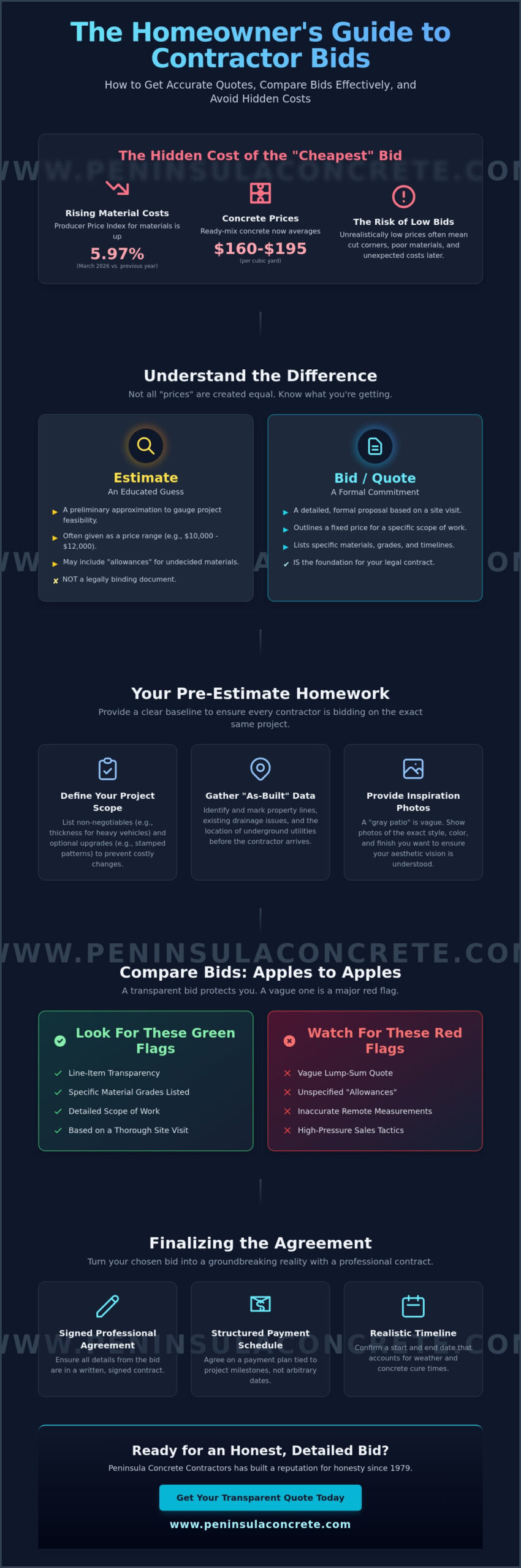
The cheapest bid you receive is often the most expensive one you’ll ever pay for. It is frustrating to look at three different quotes and see price gaps of thousands of dollars, especially when you are worried about hidden costs appearing halfway through your new driveway or patio project. With the Producer Price Index for construction materials hitting 354.99 in March 2026, a 5.97% increase from the previous year, every dollar in your budget needs to be accounted for. You deserve to know if a price is fair or if a contractor is simply cutting corners on quality materials like ready-mix concrete, which now averages between $160 and $195 per cubic yard.
Learning how to get contractor estimates that are accurate and transparent is the best way to start your project with financial confidence. At Peninsula Concrete Contractors, we’ve built a reputation for honesty since 1979, and we know that a true estimate accounts for your site’s unique constraints rather than just giving a flat rate. This guide will teach you the exact steps to solicit, compare, and verify bids. You’ll learn how to spot red flags in a line-item estimate and how to ensure you’re comparing “apples to apples” so your project budget remains predictable from the first scoop of dirt to the final pour.
Key Takeaways
- Understand the vital difference between a preliminary ballpark estimate and a formal, fixed-price bid to keep your budget secure.
- Prepare for success by defining your project scope and identifying property lines or drainage issues before the contractor arrives.
- Learn how to get contractor estimates that prioritize site-specific details like sub-base quality rather than relying on inaccurate remote measurements.
- Compare bids effectively by insisting on line-item transparency and specific material grades to avoid the risks of a vague lump-sum quote.
- Secure a professional agreement with a structured payment schedule and a realistic timeline that accounts for local weather and concrete cure times.
Estimate, Bid, or Quote? Understanding Construction Pricing Language
The vocabulary of construction often feels like a foreign language to homeowners. Confusion usually starts before the first shovel hits the dirt because people use the terms “estimate” and “bid” interchangeably. They aren’t the same thing. Understanding these nuances is the first step in learning how to get contractor estimates that actually protect your bank account and your property. A professional contractor uses these terms as distinct stages in a project’s lifecycle. An estimate is your starting point; it’s a preliminary figure based on a quick conversation or a rough sketch. It helps you decide if a project is feasible before anyone spends hours on detailed site measurements or engineering plans.
Why Estimates Are Not Legally Binding
Think of an estimate as an educated guess rather than a final bill. Since 1979, we’ve seen how early-stage numbers can shift once a craftsman sees the actual site conditions. A Cost estimate is a preliminary approximation that helps you gauge the financial scope of your vision. Contractors often provide a price range, such as $10,000 to $12,000, to account for unknowns like soil stability or hidden drainage issues. Many estimates also include “allowances.” These are placeholders for materials where the final choice hasn’t been made. For example, you might have an allowance for a specific style of stone masonry. Because these numbers are approximations, they aren’t legally binding. They serve as a guide for your planning phase rather than a commitment to a final price.
When an Estimate Becomes a Formal Bid
A formal bid or quote is where the guesswork ends. This document is a written proposal that outlines every specific detail of the job. It moves beyond verbal promises to a structured commitment that protects both the homeowner and the business. When you are researching how to get contractor estimates, look for contractors who transition from a rough number to a detailed bid after a thorough site visit. A professional bid includes a clear scope of work, specific material grades, and a projected timeline. If you’re looking for an interlocking concrete paver system, the bid should list the specific manufacturer and pattern. A fixed-price bid is a written commitment to complete a clearly defined scope of work for a specific, predetermined dollar amount. This document becomes the foundation of your contract, ensuring the price you see is the price you pay.
The Homeowner’s Homework: Preparing for an Accurate Estimate
Accuracy in pricing isn’t a one-way street. Before you start reaching out to professionals, you need to provide a clear baseline for your vision. When homeowners ask how to get contractor estimates that don’t balloon mid-project, the answer lies in the quality of the initial information provided. You should gather “as-built” data like property line markers, existing drainage problems, and the location of underground utilities. Providing inspiration photos is also vital; a “gray patio” can mean anything from basic broom-finish concrete to a high-end interlocking concrete paver system. Clear visual cues help you Select The Right General Contractor who understands your aesthetic expectations and technical requirements.
Creating Your Project Scope Document
A scope document lists your non-negotiables. If your driveway must support heavy truck traffic, that requires a thicker sub-base and specific reinforcement. Identifying optional upgrades like colored concrete or stamped patterns early prevents expensive change orders later. With the Producer Price Index for construction materials rising 5.97% between March 2025 and March 2026, locking in these details early is essential for budget stability. A well-defined scope ensures that every contractor is bidding on the exact same work, which is the only way to truly understand how to get contractor estimates that are comparable. It separates your “dream list” from the functional requirements of the site.
Bay Area Specifics: Permits and Soil
In our region, the ground under your feet matters as much as the concrete on top. Bay Area adobe and clay soils are expansive. They swell and shrink with moisture, which requires specific engineering for foundations and retaining walls to prevent premature cracking. You must also account for local regulations. For example, if you are planning a sidewalk repair in Redwood City, you’ll need to follow city-specific encroachment permits. Projects exceeding 50 cubic yards of earth movement often trigger a grading permit, which adds time and cost to your initial estimate. If you’re ready to move from a dream to a blueprint, start your project today by letting our experienced team evaluate your site’s specific soil and drainage needs.
The Site Visit: How to Evaluate a Contractor’s Expertise
A physical site visit is the most critical step in learning how to get contractor estimates that reflect reality. If a contractor offers a firm price based on a Google Earth satellite image, consider it a major red flag. Concrete and masonry work depends on the invisible: soil compaction, slope, and sub-surface conditions. A satellite cannot see the subtle 2% grade required to move water away from your foundation or the soft spots in your yard. At Peninsula Concrete Contractors, we’ve built a reputation for honesty since 1979 by showing up in person to identify these technical challenges before the first shovel hits the dirt.
During the walkthrough, observe if the contractor is performing a “Quality Test.” They should be looking closely at your existing sub-base and drainage patterns. A seasoned craftsman won’t just ask what you want; they will explain the “why” behind their technical choices. This communication check is vital. If they can’t explain why a specific reinforcement is necessary for your soil type, they might be cutting corners to lower their bid. Our team takes pride in this transparency, helping you take your project from planning to success with grounded, professional advice.
Technical Questions Every Homeowner Should Ask
Don’t be afraid to get into the weeds with technical details. Your questions should force the contractor to demonstrate their local expertise and commitment to quality work. Use these specific queries to vet their process:
- “How deep will you excavate for the sub-base?” A standard driveway usually requires 4 to 6 inches of compacted aggregate to prevent settling.
- “What type of reinforcement are you quoting?” Ask if they use rebar or wire mesh. Rebar provides significantly better structural strength for heavy vehicle traffic.
- “How will you handle water runoff and existing drainage systems?” Improper grading can lead to standing water or foundation damage.
Observing the Contractor’s Process
Watch the professional’s behavior during the visit. Accurate bids require physical measurements with a tape measure or laser level rather than “eyeballing” the yard. They must also identify logistical hurdles. Are there narrow gates that limit equipment size? Are there low-hanging power lines or delicate landscaping in the path? Identifying access constraints during the estimate prevents surprise surcharges for specialized small-footprint equipment later. This attention to detail is what separates a 2nd-generation, family-owned business from a fly-by-night operation. When you understand how to get contractor estimates based on physical data, you eliminate the “guesswork” that leads to project delays.
Comparing Estimates: How to Spot ‘Apples to Oranges’ Discrepancies
The Hidden Costs of Concrete and Hardscaping
Cheap bids often look attractive because they exclude the “unpleasant” parts of the job. Demolition and haul-away fees are frequently left out of initial quotes, leaving you with a pile of old concrete and a massive bill at the end. If your project requires retaining wall construction, the estimate must clearly account for engineering and permit fees. We also prioritize site protection, such as covering your lawn and neighbors’ driveways. These logistical steps take time and materials, but they prevent thousands of dollars in collateral damage to your property.
Evaluating Warranty and Insurance
A professional estimate should come with proof of legitimacy. You must verify a contractor’s status with the Contractors State License Board (CSLB) and ensure they carry active workers’ comp insurance. A “guy with a truck” might be cheaper, but if an injury occurs on your property, you could be held liable. While many new companies offer a standard one-year warranty, a 40+ year heritage is the most reliable guarantee you can find. We’ve built a reputation for honesty and high-quality work since 1979, which means we’ll be here to stand by our craft long after the project is finished. If you want a bid that covers every detail without the fluff, contact Peninsula Concrete Contractors today for a professional evaluation.
Finalizing the Agreement: From Estimate to Groundbreaking
The final step in your journey of how to get contractor estimates is turning a paper quote into a binding legal agreement. This is where you lock in the details that prevent project creep and financial stress. A professional contract shouldn’t feel like a mere formality; it is a roadmap for your success. Choosing a local, 2nd-generation company ensures that the person who signs the contract is the same one accountable for the finished product. At Peninsula Concrete, we’ve built a reputation for honesty since 1979, and that starts with a transparent agreement that leaves no room for ambiguity.
The Ideal Payment Schedule
Your payment schedule is your primary lever for quality control. In California, the law is very specific: a contractor can only ask for a down payment of 10% of the total project price or $1,000, whichever is less. If a company asks for 50% upfront before any equipment arrives, it’s a major red flag. Progress payments should always be tied to specific, verifiable milestones. For a new driveway, this might include a payment after the excavation and sub-base compaction are complete. You should always hold the final payment until you’ve completed a thorough walkthrough and every item on the “punch list” is finished to your satisfaction.
Setting Realistic Project Expectations
Before the crews arrive, a pre-construction meeting is essential for aligning expectations. Construction is naturally messy. You’ll deal with noise, dust, and heavy equipment moving through your property. A dedicated project manager will walk you through the logistics, such as where equipment will be staged and how long your driveway will be out of commission. Concrete requires patience for proper durability. While you can usually walk on a new surface after 24 hours, you’ll need to wait at least 7 days before driving a standard vehicle on it. Full structural strength isn’t reached until the 28-day mark. Our goal is to take your project from “Concrete Thinking” to a durable, beautiful reality with zero surprises. Now that you know how to get contractor estimates with confidence, you’re ready to start your project today.
Start Your Project with Financial Confidence
You now have a blueprint for navigating the bidding process without the fear of hidden costs or mid-project surprises. Successful hardscaping depends on technical precision, from the specific structural reinforcement of your sub-base to the drainage slope that protects your home’s foundation. By mastering how to get contractor estimates that are detailed and transparent, you’ve moved from a simple vision to an actionable, professional plan. You don’t have to guess if a bid is fair when you have the data to compare material specs and labor guarantees side-by-side.
Choosing an A+ rated, 2nd-generation, family-owned business means you are investing in a legacy of accountability. We take pride in our local roots and have provided Quality Work Since 1979. We are ready to help take your project from the planning phase to a beautiful, finished reality. Request Your Professional Estimate from Peninsula Concrete Today to secure a predictable budget and a durable result. Your home is your most valuable asset; let’s build something that stands the test of time.
Frequently Asked Questions
How many estimates should I get for my project?
You should aim to collect at least three written estimates for any major concrete or masonry project. This number provides a clear baseline to identify the regional average for labor and materials. If you only get two bids, you won’t know which one represents the fair market value. Having three or more quotes allows you to spot outliers and understand the price variations in the local market.
Are contractor estimates usually free in the Bay Area?
Most reputable contractors provide free initial estimates for standard residential projects like driveways or patios. However, if your project requires complex engineering, formal architectural drawings, or a detailed drainage plan, the contractor might charge a consultation fee. This fee is often credited back to your total project cost if you choose to move forward with that company.
Why is there such a huge price difference between my three estimates?
Large price gaps usually stem from differences in material specifications, labor expertise, and project scope inclusions. One contractor might exclude demolition and haul-away fees, while another includes them as a line item. When you are learning how to get contractor estimates, always check the concrete strength. A bid using 4,000 PSI concrete will naturally cost more than one using a 2,500 PSI mix.
Can a contractor charge more than their original estimate?
A contractor cannot increase the price of a fixed-price bid unless you agree to a formal change order for additional work. However, most contracts include a “hidden conditions” clause. This allows for price adjustments if the crew discovers unforeseen issues once excavation begins, such as buried utility lines or unstable soil that requires extra compaction. Always keep a 10% to 20% contingency fund to cover these surprises.
How long is a contractor’s estimate valid for?
Most estimates are valid for 30 days from the date they are issued. Construction material costs are highly volatile; the Producer Price Index for materials rose 5.97% between March 2025 and March 2026. Because cement and steel prices fluctuate monthly, contractors cannot guarantee a price indefinitely. If you wait several months to sign a contract, you should expect the professional to provide a refreshed quote based on current market rates.
What should I do if I receive an estimate that is way over my budget?
You should ask the contractor to review the scope of work for potential cost-saving alternatives. You might switch from premium interlocking pavers to a high-quality broom-finish concrete to reduce material expenses. Another option is to phase the project by completing the essential drainage and foundation work now and adding decorative masonry elements later. A professional will help you prioritize functional needs over aesthetic upgrades to meet your budget.
Is a verbal estimate binding in California?
No, a verbal estimate is not legally binding in California. The state requires a written Home Improvement Contract for any residential project exceeding $500 in value. Relying on a handshake or a verbal promise leaves you with zero legal protection if the price increases or the quality of work is poor. Knowing how to get contractor estimates means insisting on a signed, dated document that outlines every project detail.
What documents should be attached to a final contractor bid?
A final bid should include a detailed scope of work, a site plan, and a specific payment schedule. You should also receive proof of a valid CSLB license and active workers’ compensation insurance. Professional contractors will often include a “Notice to Owner” regarding mechanics liens and a copy of their liability insurance certificate. These documents verify the company’s legitimacy and ensure you aren’t held liable for accidents on your property.