
Most homeowners treat backyard maintenance like a scheduled oil change, but sealing your patio isn’t actually a calendar event. Determining how often to seal concrete patio surfaces is a diagnostic response to your home’s unique environment and chemistry. You might feel uncertain about which product was applied years ago or fear that over-sealing will lead to those dreaded white spots. It’s natural to feel caught between conflicting DIY advice and the high standards of seasoned craftsmen who have served the Peninsula for generations.
This 2026 guide clarifies the precise timeline you need by looking at wear-and-tear indicators rather than just the date. You’ll discover how our local climate affects sealer longevity and why California’s strict 100 g/L VOC limits for masonry sealers change your maintenance strategy. We’ll walk through the simple “Water Test” to check your current protection and provide a multi-year plan. This ensures you know exactly when to handle the job yourself and when to call in a professional to protect your home’s legacy and long-term value.
Key Takeaways
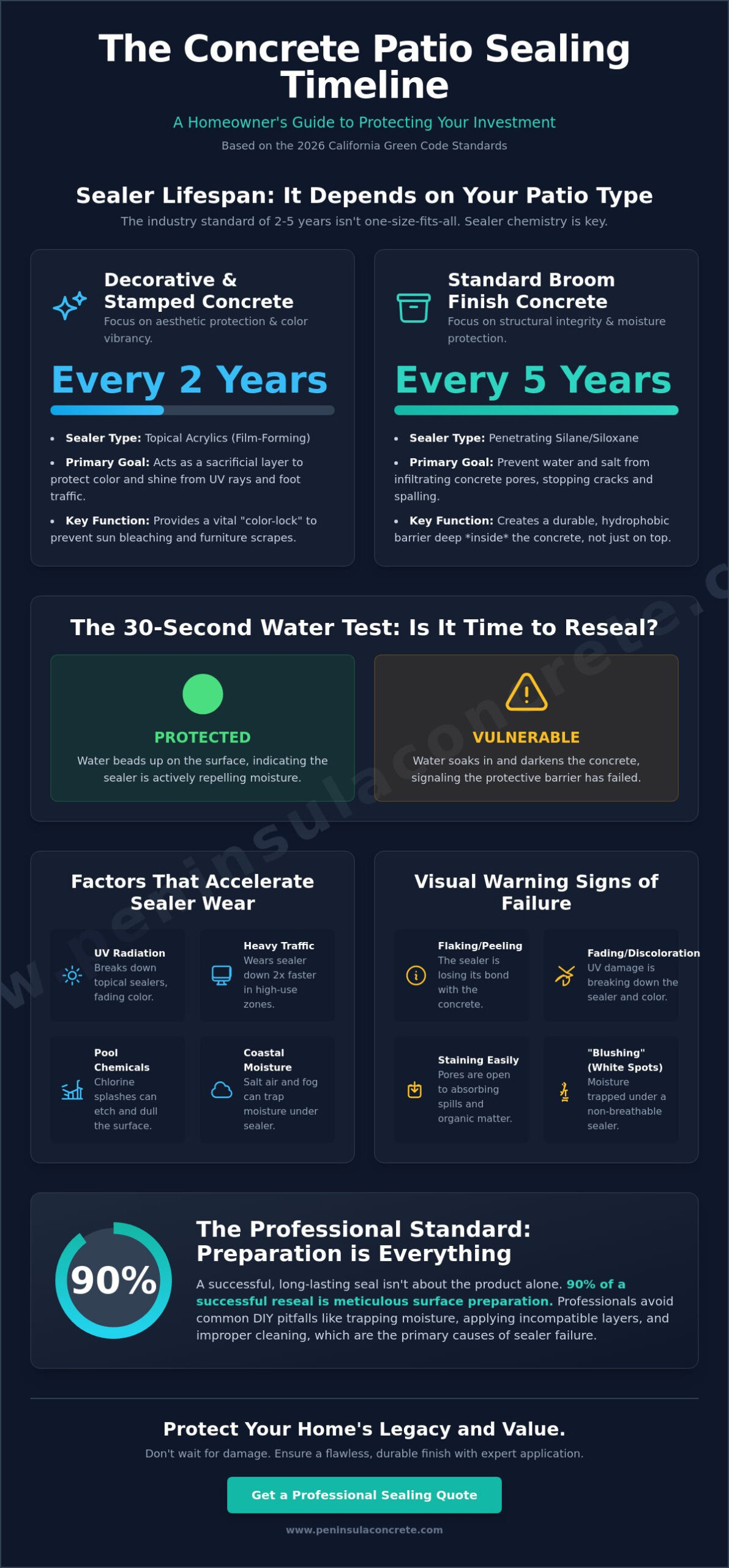
- While the industry standard for how often to seal concrete patio areas is every two to five years, your actual schedule depends on the specific sealer chemistry used.
- Master the 30-second “Water Bead” test to accurately diagnose whether your concrete is still protected or vulnerable to moisture damage.
- Identify the visual warning signs of sealer failure, such as flaking or delamination, before they lead to permanent surface degradation.
- Contrast the short-term shine of acrylic sealers with the multi-year longevity of penetrating silane treatments to build a sustainable maintenance plan.
- Understand why expert surface preparation is responsible for 90% of a successful reseal and how to avoid common DIY pitfalls like blushing and white spots.
The Standard Timeline: How Often Should You Seal Concrete?
Determining how often to seal concrete patio areas is less about a fixed date and more about the specific needs of your surface. While the general industry standard suggests a window of every 2 to 5 years, this range is broad for a reason. Relying on a “set it and forget it” calendar often leads to premature failure because it ignores the environmental reality of your specific backyard. A patio in a shaded, damp corner of the Peninsula faces different challenges than one baked in the constant California sun.
We distinguish between aesthetic resealing and structural protection. Aesthetic sealing is about maintaining a specific look, such as a high-gloss finish or vibrant color. Structural sealing is far more critical. It prevents water and salt from infiltrating the pores of the material. By understanding concrete as a porous, breathing substance, you can see why maintaining this barrier is vital for preventing cracks and spalling over the long term. If you wait until you see physical damage, the cost of repair will far exceed the cost of maintenance.
The 2026 standards for VOC-compliant sealers have also shifted the landscape for homeowners. As of January 1, 2026, the California Green Code limits VOCs to 100 g/L for masonry sealers. These modern, eco-friendly formulas are safer for your family and the environment, but they behave differently than the solvent-heavy products of the past. High-quality professional grade sealers now focus on advanced polymer chains that offer better UV resistance, even with lower chemical emissions. This means your maintenance schedule might stay the same, but the product performance has actually improved.
The 2-Year Rule for Decorative and Stamped Concrete
Stamped concrete requires more frequent attention to maintain its premium appearance. These surfaces often use topical color releases or acid stains that live near the surface. Without a fresh coat of sealer every 24 months, the California sun can begin to bleach these colors. High-gloss acrylics act as a sacrificial layer, taking the brunt of foot traffic and weather so your concrete doesn’t have to. Film-forming sealers provide a vital color-lock function that prevents UV rays and furniture scrapes from stripping away the decorative finish.
The 5-Year Window for Standard Broom Finish Patios
Standard grey, broom-finished concrete can often go longer between treatments because you aren’t chasing a visual shine. Here, the goal is purely functional. We focus on moisture and salt protection rather than aesthetic depth. Penetrating sealers, such as silane or siloxane, work differently on these porous, non-decorative surfaces. Instead of sitting on top, they dive deep into the concrete to create a hydrophobic barrier from within. This internal protection is incredibly durable and typically only needs a refresh every 5 years to keep the structure sound.
Factors That Accelerate Your Patio’s Sealing Schedule
Sunlight is the primary enemy of a pristine patio finish. The intense UV radiation found across the San Francisco Peninsula acts like a slow-motion chemical burn on topical sealers, breaking down the polymer chains that provide that signature gloss. When homeowners ask how often you should reseal, they must first look at their shade coverage. An exposed south-facing patio will likely require a refresh a full year earlier than a North-facing surface protected by the house’s shadow. This degradation isn’t just visual; as the sealer thins, the concrete becomes vulnerable to staining from organic debris and spills.
Mechanical wear also plays a significant role, particularly in high-use outdoor kitchen areas. Dragging heavy wrought-iron furniture or the constant friction of foot traffic acts like sandpaper on your sealer. In these high-friction zones, the protective layer can wear off twice as fast as it does in the corners. Special considerations are also necessary for patios surrounding pool decks. Constant exposure to splashed chlorine and other pool chemicals can etch the surface of certain sealers, leading to a dull, hazy appearance that requires more frequent maintenance to keep the grip and color intact.
Coastal moisture presents its own set of challenges for local homeowners. Salt air and heavy morning fog can actually alter the pH levels on the surface of your concrete. If moisture gets trapped beneath a non-breathable sealer, it can lead to “blushing,” where the sealer turns a milky white and loses its bond. Maintaining a healthy concrete surface in these conditions requires a more vigilant eye on the integrity of the protective barrier.
Bay Area Micro-Climates and Concrete Wear
The Peninsula is famous for its micro-climates, and your concrete knows the difference between Redwood City and Pacifica. In hotter, drier inland areas, the focus is on UV protection. Along the coast, humidity levels dictate how often to seal concrete patio surfaces to prevent blistering. Heavy winter rains can also test the adhesion of your sealer. If your property sits on expansive clay soil, the resulting soil movement can create micro-cracks in the slab. These tiny openings allow water to bypass topical sealers, making the use of specialized penetrating sealers a smart choice for long-term structural health.
Usage Intensity: Patios vs. Walkways
Your interlocking concrete pavers often follow a different timeline than a solid slab because of the sand joints involved. While the pavers themselves are incredibly durable, the joint sand needs stabilization to prevent weed growth and erosion. High-traffic walkways generally see the sealer wear down in the center of the path, creating a “trail” effect. Pet traffic also introduces unique acids and abrasive claws that can shorten a sealer’s lifespan. If you notice water no longer beads in these high-use areas, it’s a clear indicator that the mechanical wear has surpassed the sealer’s limits. For those planning a new project, we offer expert installation of concrete driveways and patios designed to withstand these exact local pressures.
Sealer Types vs. Longevity: A Comparison Framework
The chemical makeup of your chosen sealer serves as the foundation for your entire maintenance plan. It’s the primary variable that dictates how often to seal concrete patio installations across the Peninsula. While we’ve discussed how sun and traffic accelerate wear, the “base” lifespan is determined by the sealer’s chemistry. Understanding the trade-off between a high-gloss aesthetic and long-term structural breathability helps you avoid the cycle of over-sealing, which often leads to unsightly white spots or “blushing.”
Acrylic Sealers: High Maintenance, High Reward
Acrylic sealers remain the gold standard for bay area concrete projects involving stamped patterns or decorative colors. These film-forming products typically offer a lifespan of 1 to 3 years. They act as a sacrificial shield, taking the brunt of UV rays and foot traffic to keep your patio’s color vibrant. A key benefit of certain acrylics is their re-emulsification property. This allows a new application to blend into the old layer without stripping everything back to bare concrete. However, you must watch for signs of UV yellowing or a brittle, “alligator skin” texture. These indicators tell you the sealer has lost its flexibility and can no longer protect the surface.
Penetrating Sealers: The Long-Term Structural Guard
If you prefer the natural look of stone or broom-finished concrete, penetrating sealers like silane or siloxane provide an “invisible” protector that lasts 5 to 7 years. These don’t sit on the surface. Instead, they travel deep into the concrete pores to create a permanent hydrophobic barrier. This chemical bond offers excellent protection against the heavy winter rains and coastal fog that can saturate a slab. Don’t fall for the “once a decade” myth. Even though these formulas are incredibly durable, we advise a professional checkup at the 5-year mark. Even the strongest chemical bonds can weaken in high-friction zones, and a simple refresh can prevent moisture from reaching the rebar.
The 2026 regulatory environment has shifted the market toward high-performance water-based formulas that impact how often to seal concrete patio surfaces. With California’s strict 100 g/L VOC limit for masonry sealers and 350 g/L for reactive penetrating sealers, the industry has moved away from high-odor solvents. These modern water-borne resins are incredibly durable and meet all local environmental standards. While heavy-duty epoxy and polyurethane coatings exist, they are generally reserved for commercial-grade needs or high-traffic driveways where extreme chemical resistance is required.
How to Tell It’s Time: The Professional Diagnostic Test
Relying on a calendar to decide how often to seal concrete patio surfaces is often inaccurate. A seasoned craftsman knows that the material itself will tell you when it’s vulnerable. Instead of guessing based on the last time you hired a contractor, you should use a series of diagnostic tests to evaluate the current state of your sealer’s integrity. These tests help you avoid the high costs of premature concrete failure while preventing the aesthetic disasters that come from over-application.
Visual cues are your first line of defense. Look for “whitening” or a cloudy, milky appearance. This often indicates that the sealer has lost its bond with the concrete, a process known as delamination. If you see the sealer flaking off in small scales, the protective film has already been breached. We also recommend a “Scratch Test” in high-traffic areas near your outdoor furniture. If a firm rub with a coin leaves a powdery white residue or a deep gouge, the polymer chains have likely become brittle from UV exposure and can no longer provide a flexible shield.
Performing the Water Test Correctly
The “Water Bead” test is the definitive way to check surface tension in 30 seconds. To perform this correctly, pour a small amount of water on several different areas of your patio. You must test both the high-traffic zones in the direct sun and the shaded areas near the perimeter. In a healthy system, the water will bead up into tight droplets, showing that the hydrophobic barrier is intact. If the water spreads out and the concrete begins to darken within seconds, your protection has vanished. When water creates a dark, damp spot immediately upon contact, it is a definitive indicator that the sealer has failed and moisture is infiltrating the concrete pores.
The Danger of Over-Sealing
Sealing every single year “just in case” is the most common mistake homeowners make. Concrete is a breathable material that must allow for moisture vapor transmission. If you apply too many layers of film-forming sealer, you effectively “choke” the slab. This trapped moisture has nowhere to go, which leads to the dreaded “blushing” or white spots mentioned earlier. Fixing a milky appearance caused by excessive layers usually requires a professional chemical strip to return the surface to its original state. If your diagnostic tests show that your surface is still beading water, leave it alone. If you discover that your protection is gone, we can help you restore the beauty and safety of your concrete driveways and patios with a professional-grade application.
Professional Sealing: The Peninsula Concrete Standard
While DIY kits are available at every home improvement store, professional application remains the gold standard for long-term durability. A seasoned team understands that the actual sealing is only a small fraction of the job. In fact, professional surface preparation accounts for 90% of a successful reseal. Without the proper cleaning and chemical balancing, even the highest quality product won’t bond correctly. This often leads to the flaking and cloudiness we discussed in previous sections. By hiring experts, you aren’t just paying for the liquid in the bucket; you’re investing in a process that extends the life of your patio by 30-50% compared to standard homeowner applications.
The equipment difference is equally significant. Homeowners typically rely on rollers, which can leave uneven layers and “puddles” in the textured areas of stamped concrete. We use high-pressure professional sprayers that atomize the sealer, ensuring a consistent, microscopic layer that penetrates deep into the pores. This precision allows us to customize sealer blends specifically for the San Francisco Peninsula climate. We adjust our formulas to account for the unique humidity levels and UV intensity of your specific neighborhood, ensuring the chemistry is perfectly balanced for your home’s micro-climate.
Our Multi-Step Restoration Process
A professional restoration begins with a deep clinical cleaning. We use industrial power washing and specialized chemical stripping to remove old, failed sealers and organic stains. This step is vital for those wondering how often to seal concrete patio surfaces, as it resets the concrete to a “thirsty” state. Once the surface is clean, we handle crack repair and joint stabilization. By addressing these structural issues before the new coat is applied, we prevent moisture from undermining the slab. Our precision application ensures even coverage across every square inch, providing a seamless barrier that resists salt, chemicals, and the California sun.
Protecting Your Investment Since 1979
Choosing the right partner for your home maintenance is about more than just a service; it’s about trust and local accountability. Working with a family-owned, multi-generational peninsula concrete contractors team gives you access to decades of site-specific knowledge. We’ve seen how local Bay Area soil and weather patterns affect concrete over forty years of service. This experience allows us to accurately diagnose your patio’s needs and provide a maintenance schedule that actually works. We take pride in our legacy of integrity and our deep roots in the community. Contact Peninsula Concrete Contractors for a professional patio evaluation today.
Protect Your Patio’s Legacy for the Decades Ahead
Maintaining your outdoor living space is a vital investment in your home’s long-term value. You’ve learned that deciding how often to seal concrete patio surfaces isn’t about following a generic calendar. It’s a diagnostic choice based on your specific micro-climate, foot traffic, and the sealer chemistry involved. Whether you’re performing a quick water test or identifying the first signs of UV wear, staying proactive prevents the high costs of structural repair and preserves the beauty of your masonry.
Since 1979, our family-owned team has served as specialists in both concrete and interlocking paver systems across the Peninsula. We understand the unique challenges our local environment poses to your stone and concrete. Don’t leave your home’s protection to chance or unproven DIY methods. Request a Free Estimate from the Bay Area’s Concrete Experts to ensure your patio remains a durable source of pride. We look forward to helping you preserve your home’s integrity with the dependable expertise of a seasoned craftsman.
Frequently Asked Questions
Can I seal my concrete patio too often?
Yes, you can certainly over-seal your concrete. Applying fresh layers before the previous coat has worn away prevents moisture vapor from escaping the slab. This leads to “blushing,” where trapped moisture turns the sealer a milky white color. If your patio still beads water during the diagnostic test mentioned earlier, you should wait another season before applying more product.
What is the best time of year to seal concrete in the Bay Area?
The ideal window for sealing in the Peninsula is between late spring and early autumn. You need at least 24 to 48 hours of dry weather with no heavy fog or marine layer moisture. Temperatures should ideally stay between 50 and 90 degrees Fahrenheit during the application and curing process to ensure the polymers bond correctly to the surface.
How long does it take for patio sealer to dry before I can move furniture back?
Most professional-grade sealers are dry to the touch within 4 to 12 hours. You can typically walk on the surface in clean shoes after 24 hours. However, you should wait a full 72 hours before sliding heavy wrought iron furniture or large planters back into place. Moving heavy items too early can cause “tracking” or permanent indentations in the fresh film.
Do I need to strip the old sealer before applying a new coat?
Stripping is necessary if the existing sealer is flaking, peeling, or turning white. If you are applying a fresh coat of the same acrylic product and the old layer is simply thin but still bonded, a deep cleaning is often sufficient. If you are switching from a film-forming sealer to a penetrating silane treatment, the old product must be completely removed to allow the new chemistry to reach the concrete pores.
How much does professional concrete patio sealing cost in 2026?
Professional sealing costs depend on the square footage of your space and the amount of preparation required to reset the surface. Factors like chemical stripping of failed products or extensive crack repair will influence the final investment. Because every project has unique diagnostic needs, we recommend a site-specific evaluation to determine the most effective treatment for your home’s micro-climate.
Will sealing my patio make it slippery when wet?
High-gloss topical sealers can become slick when wet, but this is easily managed with professional additives. We use specialized non-slip materials like Shark Grip that are mixed directly into the liquid sealer to provide traction without ruining the aesthetic. If slip resistance is your primary concern, penetrating sealers are a better choice as they protect the concrete without changing the surface texture at all.
Can I use a hardware store sealer, or should I buy professional-grade?
Professional-grade sealers are superior because they contain a higher percentage of solids and advanced polymer chains. Many products found at big-box retailers are diluted to make them easier for novices to apply, which often results in a shorter lifespan. Investing in a high-solids professional formula ensures that how often to seal concrete patio surfaces remains a task you only handle every few years rather than every season.
Does sealing concrete prevent it from cracking?
Sealing does not prevent structural cracks caused by soil movement or seismic activity. It does, however, prevent the surface-level spalling and “spiderweb” cracks caused by moisture expansion and salt crystallization. By keeping water out of the internal matrix of the slab, you significantly reduce the risk of the freeze-thaw cycles that eventually lead to larger structural failures.