
The dream of a backyard court is a classic one-the sound of a bouncing ball, friendly competition, and years of family fun. But when it comes to building a concrete basketball court, that dream can quickly get bogged down by practical questions. You might be wondering about the total cost, confused by technical terms like PSI and control joints, or simply unsure if the project is too complex for your space. It’s easy to feel overwhelmed before you even begin.
At Peninsula Concrete Contractors, we believe creating a durable, high-performance playing surface should be an exciting and rewarding project. With a heritage of quality work since 1979, we’ve poured our decades of experience into this guide to give you a clear, straightforward plan for success. We will walk you through the entire process, from establishing a realistic budget and understanding key design considerations to the step-by-step construction timeline. By the end, you’ll have the confidence and knowledge to build a court that provides a true bounce and a lifetime of memories.
Key Takeaways
- Understand how to properly plan your court’s size and location to maximize both your available space and your project budget.
- Learn why concrete is the superior material for outdoor courts and what critical construction stages ensure a high-performance, long-lasting surface.
- Discover the key factors that influence the total cost of a concrete basketball court, helping you create a realistic budget for your investment.
- Explore the finishing options, from professional-grade line painting to lighting, that transform a simple slab into your family’s favorite feature.
Planning Your Backyard Court: Size, Location, and Layout
Before any concrete is poured, the most critical work begins. Proper planning is the foundation of a successful project, ensuring your investment enhances your property and provides years of enjoyment. A well-planned concrete basketball court is more than just a slab; it’s an extension of your home designed for your specific needs, whether that’s serious practice for a budding athlete or casual family games on the weekend. Taking the time to consider every detail now will prevent costly changes and guarantee the final result meets your expectations.
Standard Basketball Court Dimensions
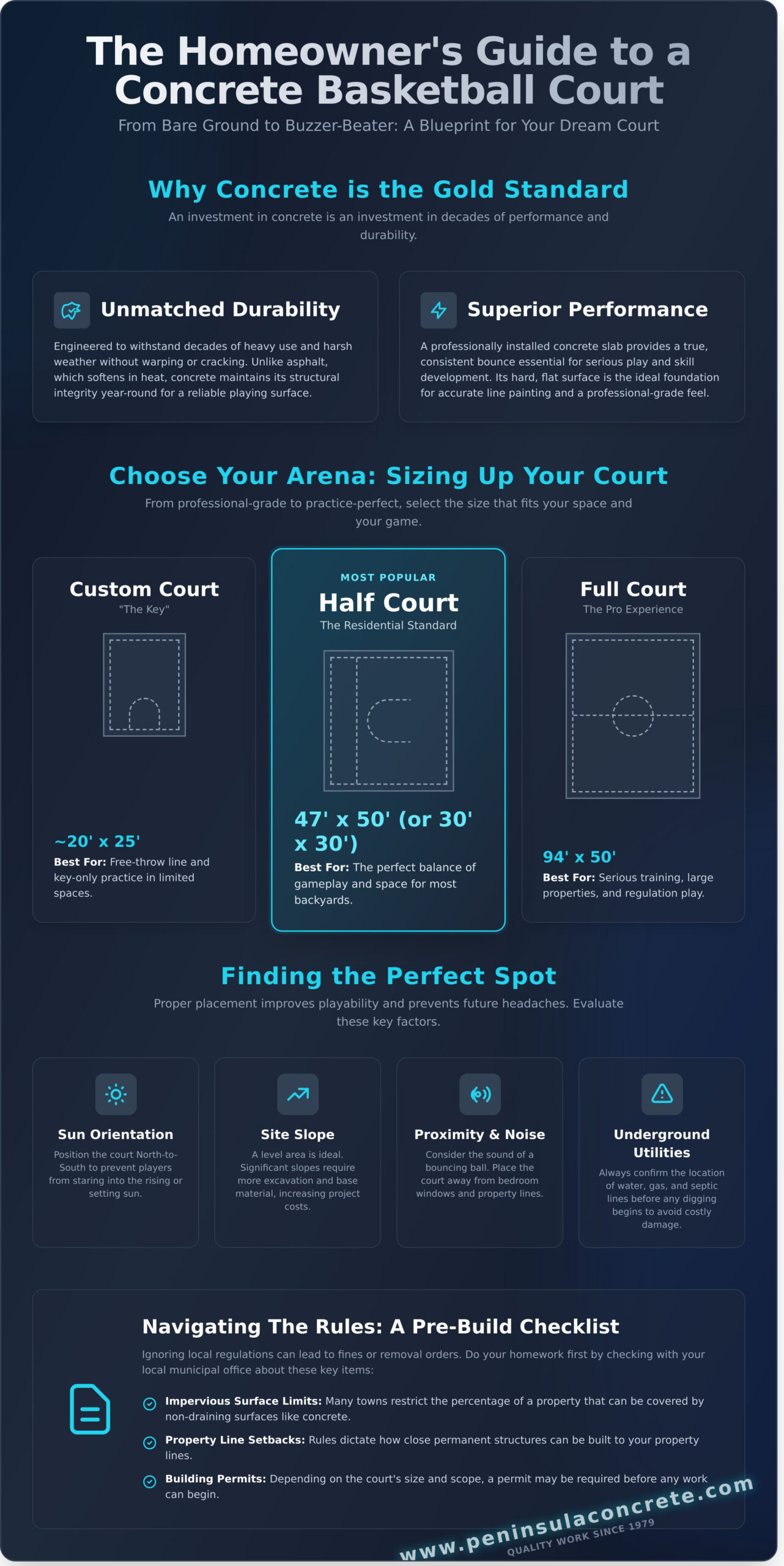
The right size for your court depends entirely on your available space and how you intend to use it. While a full-court is the professional standard, most residential projects use a half-court or custom layout to fit their property. Here are the common measurements to consider:
| Court Type | Typical Dimensions | Best For |
|---|---|---|
| Full Court | 94′ x 50′ (High School/NBA) | Large properties, serious training |
| Half Court | 47′ x 50′ (or smaller, e.g., 30’x30′) | The most popular residential choice |
| Custom Court | ~20′ x 25′ | Free-throw line or “key” only practice |
Choosing the Best Location on Your Property
Selecting the right spot involves more than just finding an open patch of grass. A thoughtful location choice will improve playability and minimize future issues. As experienced professionals, we advise evaluating these key factors:
- Sun Orientation: Position the court north-to-south if possible. This prevents players on either end from staring directly into the rising or setting sun.
- Site Slope: A level area is ideal. A significant slope requires more excavation and base material, which increases the overall project cost.
- Proximity and Noise: Consider the distance from your home and your neighbors. The sound of a bouncing ball travels, so placing the court away from bedroom windows and property lines is a good practice.
- Utilities: Before any digging, always confirm the location of underground utilities (water, gas, septic) and check for overhead power lines that could interfere with high shots.
Checking Local Regulations and Permits
Building a durable concrete basketball court means complying with local rules. Ignoring this step can lead to fines or even a demand to remove the structure. Be sure to check with your local municipal office about:
- Impervious Surface Limits: Many towns restrict the percentage of a property that can be covered by non-draining surfaces like concrete.
- Property Line Setbacks: Your city has rules dictating how close any permanent structure can be to your property lines.
- Building Permits: Depending on the size and scope of your court, a building permit may be required before work can begin.
Why Concrete is the Gold Standard for Outdoor Courts
When planning your home court, it’s crucial to understand that not all surfaces are created equal. While options like asphalt may seem appealing upfront, they lack the fundamental strength and performance of a professionally installed concrete slab. Concrete provides a superior foundation for both serious play and long-term value, making it the preferred base for everything from neighborhood half-courts to professional-grade athletic surfaces.
The initial investment in a high-quality concrete basketball court pays dividends for decades, offering a level of reliability and performance that other materials simply cannot match. It’s a commitment to quality from the ground up.
Unmatched Durability and Longevity
A properly poured and cured concrete slab is built to last. It is engineered to withstand decades of heavy use, intense gameplay, and the unique challenges of the Bay Area’s climate without cracking or warping. Unlike asphalt, which can soften in the summer heat and degrade more quickly under constant exposure to the elements, concrete maintains its structural integrity year after year, ensuring your court remains a dependable family asset.
Superior Performance and Ball Response
For any player serious about their game, consistency is key. Concrete delivers a hard, flat, and uniform surface that guarantees a true, predictable ball bounce every single time. Asphalt courts can develop soft spots, low spots that puddle, or divots over time, leading to frustratingly inconsistent play. A concrete court eliminates these variables, providing the reliable surface needed for effective practice, skill development, and fair competition.
Low Maintenance Requirements
Your time should be spent playing on the court, not constantly working on it. Concrete’s dense, non-porous surface requires minimal upkeep-typically just an occasional sweep or cleaning with a garden hose or pressure washer to remove debris. It resists weed growth and doesn’t require the periodic and costly resealing that asphalt courts demand every few years to prevent deterioration. This low-maintenance quality ensures your court is always ready for a game.
The Construction Process: From Bare Ground to Finished Slab
A high-performance concrete basketball court isn’t just poured; it’s meticulously built from the ground up. Each stage of the construction process is critical, and rushing a step will inevitably lead to problems like premature cracking, surface pooling, or an uneven playing field. This is where professional craftsmanship and the right equipment make all the difference, turning a complex project into a durable, long-lasting asset for your property.
Our proven process, refined since 1979, ensures your court is built for generations of play.
Step 1: Site Preparation, Grading, and Excavation
A flawless court starts with flawless groundwork. The process begins by clearing the designated area of all grass, roots, rocks, and topsoil. We then expertly grade the site, creating a precise, almost imperceptible slope (typically 1%) to ensure rainwater drains away properly. This is essential for preventing water damage and hazardous ice formation. Finally, we excavate the area to the exact dimensions and depth required for the sub-base and the concrete slab.
Step 2: Building Formwork and a Compacted Sub-base
With the site prepared, we construct strong wooden forms that act as a mold, ensuring clean edges and the correct court dimensions. Inside these forms, we lay and machine-compact a 4- to 6-inch layer of crushed gravel. This sub-base is the unsung hero of your court’s longevity. It creates a solid, stable foundation that provides crucial support, prevents the slab from settling over time, and helps mitigate cracking caused by ground movement.
Step 3: Pouring and Finishing the Concrete
This is where skill and timing are paramount. We pour a high-strength concrete mix evenly throughout the formwork. Our crew immediately gets to work screeding the concrete to a perfectly flat plane and then floating it to create a smooth, dense surface. For the final touch, we apply a light broom finish. This technique provides the ideal non-slip texture for athletic performance, offering excellent grip without being abrasive. It’s this commitment to quality that defines a professional court. Trust our 40+ years of experience. Get a free project estimate.
Key Technical Specifications Explained for Homeowners
When you hire a professional contractor, you’re paying for their expertise in the technical details that ensure a long-lasting, high-performance surface. Understanding these specifications helps you appreciate what goes into a quality installation and ask the right questions. These are the details that separate a weekend DIY project from a durable, professional-grade concrete basketball court built to last for generations.
Concrete Strength (PSI) and Mix Design
The strength of concrete is measured in Pounds per Square Inch (PSI), which indicates its ability to withstand compressive force. For an outdoor sport court that endures constant activity and weather changes, a weak mix won’t suffice. We recommend a mix design with:
- A strength of 3000 to 4000 PSI: This provides the durability needed to resist cracking and surface damage from play and the elements.
- Air-Entrainment: This process introduces microscopic air bubbles into the concrete, allowing moisture to expand during a freeze without damaging the slab-a critical feature for any outdoor concrete in climates with freezing temperatures.
Steel Reinforcement: Rebar vs. Wire Mesh
While concrete is incredibly strong under compression, it lacks tensile strength, meaning it can be brittle when pulled or bent. Steel reinforcement solves this. For a large slab like a basketball court, rebar (steel reinforcing bars) laid in a grid pattern provides far superior structural integrity than lighter wire mesh. Proper placement is key; the rebar must be elevated to sit in the middle of the concrete slab, not lying on the ground, to be effective.
Proper Slope for Drainage
Standing water is the enemy of any outdoor surface. It can lead to staining, surface degradation, and create a slippery, unsafe playing area. A professional installation ensures your court has a slight, consistent slope-typically 1%-to direct rainwater off the surface. Achieving this precise grade requires careful site preparation and expert finishing, ensuring your court drains properly without any noticeable slant during play.
Control Joints for Crack Management
It’s a fact: all concrete shrinks as it cures, which creates stress and leads to cracking. The key is to control where it cracks. A professional crew will cut straight, shallow grooves called control joints into the slab shortly after it’s poured. These planned weaknesses encourage the concrete to crack in a clean, straight line within the joint, preventing random, unsightly cracks from sprawling across your new court.
Finishing Your Court: From Lines to Lighting
A high-quality concrete slab is the foundation, but the finishing details are what transform it into a true basketball court. These final steps are where you can customize the look and feel to match your home and enhance playability. Proper planning is essential; integrating features like hoop sleeves and lighting conduits during the initial construction phase is far more efficient than adding them later. These elements complete the project, ensuring your court is ready for years of reliable enjoyment.
Painting Lines and Court Markings
To ensure your court lines last, we recommend specialized acrylic or epoxy paints designed for exterior concrete surfaces. These durable coatings resist fading from UV exposure and wear from gameplay. Before any paint is applied, the concrete must be thoroughly cleaned and prepared to guarantee strong adhesion. From a simple key and free-throw line to full regulation markings or even a custom family logo, precise painting provides a professional look and feel.
Optional High-Performance Surfacing
While a standard concrete finish is excellent, you can elevate your concrete basketball court with a performance surface installed directly over the slab. These options improve both safety and aesthetics, creating a premium playing experience. Two popular choices include:
- Acrylic Coatings: These multi-layer systems add vibrant, non-slip color and texture, providing better ball grip and a slight cushioning effect underfoot.
- Interlocking Sport Tiles: A premium choice, these tiles offer superior shock absorption to reduce stress on joints and provide excellent drainage, so your court dries quickly after rain.
Hoops, Lighting, and Accessories
For the best stability and a professional feel, an in-ground basketball hoop is the superior choice. The key to a successful installation is setting the anchor sleeve for the hoop post directly into the ground before the concrete is poured. Similarly, if you envision playing after sunset, planning for lighting is crucial. We can install electrical conduit under the court area during site preparation, making future light installation simple and seamless. These forward-thinking steps are the hallmark of a quality build.
These finishing touches are what make a court uniquely yours. With decades of experience, we ensure every detail is handled with precision. Contact Peninsula Concrete to discuss how we can bring your vision to life, from foundation to final free-throw line.
Budgeting for Your Concrete Basketball Court: Key Cost Factors
Understanding the investment required for a high-quality backyard court is the final step in your planning process. While every project is unique, we believe in providing a transparent look at what drives the cost. This section breaks down the key variables to help you prepare a realistic budget and understand where your investment goes when building a durable concrete basketball court that will last for decades.
A Typical Breakdown of Expenses
The total cost is a sum of several essential components. A professional project quote will typically itemize the following core expenses:
- Site Preparation: Labor costs for excavation, grading, and ensuring proper drainage to create a stable foundation.
- Material Costs: This includes the gravel base, steel rebar for reinforcement, and the high-strength concrete itself.
- Pouring & Finishing Labor: The skilled work of forming the slab, pouring the concrete, and applying a professional, non-slip finish.
- Additional Costs: Depending on your project, this can include local permits, basketball hoop installation, and custom court line painting.
Factors That Influence the Final Price
No two backyards are the same, which is why several factors can significantly influence your final project cost. Key considerations include:
- Court Size: A 30’x30′ half-court requires far less material and labor than a larger, regulation-sized playing surface.
- Site Accessibility: A yard with easy access for concrete trucks and heavy machinery will have lower labor costs than a difficult-to-reach site.
- Grading Requirements: A steeply sloped yard that requires extensive excavation or a retaining wall will be more expensive than a relatively flat area.
- Customizations: Adding features like multi-color paint schemes, custom logos, or specialized concrete finishes will increase the total investment.
Why a Professional Quote is Essential
An online cost calculator can provide a rough estimate, but it cannot replace a detailed, on-site evaluation. A reputable contractor provides a comprehensive quote that outlines the full scope of your project, from materials to labor. This process protects you from unexpected costs and ensures clear expectations are set from day one. As a family-owned business built on honesty since 1979, we know that a thorough plan is the foundation of a successful project.
Ready for a detailed, no-obligation quote for your new court? Contact Peninsula Concrete today.
Your Dream Court is Within Reach
Building your own backyard court is a rewarding project that adds value and endless enjoyment to your home. Success begins with thoughtful planning-from choosing the right size and location to understanding the core construction steps. A professionally installed concrete basketball court provides a durable, high-performance playing surface that will stand up to years of intense competition and family fun.
Turning this vision into a reality requires expertise and precision. For homeowners on the San Francisco Peninsula, partnering with a proven expert is the key to a flawless result. At Peninsula Concrete, we bring a heritage of quality to every project. As a 2nd-generation, family-owned business, we’ve been delivering exceptional workmanship with pride since 1979.
Ready to take the next step? Start planning your project with a trusted local expert. Request your free estimate today. We look forward to helping you build a space where memories will be made for generations to come.
Frequently Asked Questions
How thick should a concrete slab for a basketball court be?
For a standard residential basketball court, a 4-inch thick concrete slab is the industry recommendation. This provides ample strength and durability for regular play. To ensure long-term stability and prevent shifting, this slab must be poured over a properly compacted sub-base of gravel. For enhanced strength and crack resistance, we also recommend reinforcing the slab with steel rebar or a wire mesh grid. This foundation ensures your court will withstand years of use and weather.
How long does the concrete need to cure before we can play on it?
Patience is key for a durable, high-quality surface. While you can typically walk on the new concrete after 48 to 72 hours, we advise waiting at least 7 to 10 days before any light activity. For the concrete to reach its full strength and be ready for aggressive play, painting lines, or installing a hoop system, you should allow it to cure for a full 28 days. This complete curing process is critical for long-term performance.
Can you build a concrete court on a sloped yard?
Yes, building a court on a sloped yard is entirely possible with professional site preparation. The process involves excavation and grading to create a perfectly level and stable area for the court. Depending on the severity of the slope, a retaining wall may be necessary to hold the graded soil in place. Our experienced team can assess your property and engineer a solution that provides a safe, level playing surface, regardless of the initial terrain.
What is the difference in cost between a concrete and an asphalt basketball court?
Initially, an asphalt court may have a lower installation cost than a concrete court. However, concrete offers superior long-term value. It is a more durable, rigid, and lower-maintenance surface that provides a better ball bounce. While asphalt may require periodic and costly resurfacing and crack filling, a professionally installed concrete court is built to last for decades with minimal upkeep, making it a more cost-effective investment over the life of the court.
Will a concrete basketball court crack over time?
While all concrete has the potential to develop hairline cracks, a professionally installed concrete basketball court is designed to control and minimize this. We incorporate strategically placed control joints into the slab, which encourage any cracking to occur in a straight, clean line within the joint itself. Combined with a strong, compacted base and proper reinforcement, this technique prevents the random, structural cracks that can compromise the surface and ensure your court remains playable for years.
Do I need a drainage system for my backyard court?
Yes, proper drainage is essential for the longevity and safety of your court. A well-designed concrete basketball court should be installed with a subtle, consistent slope-typically around 1%-to direct rainwater off the playing surface and prevent pooling. For properties with significant drainage challenges, we may also recommend installing a French drain around the perimeter of the court. This ensures water is effectively channeled away, protecting the slab’s foundation from water damage and erosion.