
Choosing a contractor for your new concrete floor can feel overwhelming, especially in the competitive Bay Area market. You’re not just investing in a new surface; you’re placing your trust in a team to bring your vision to life without the nightmare of shoddy work, surprise costs, or confusing technical jargon. The key to a durable, beautiful result lies in finding reputable concrete floor installers who are transparent, experienced, and committed to quality from the very first conversation.
That’s why we’ve created this ultimate checklist-to give you complete peace of mind. As a family-owned business with a heritage of quality work, we believe every homeowner deserves to feel confident in their hiring decision. This guide equips you with the essential steps and questions to confidently vet local professionals, understand what to look for in a detailed quote, and choose a partner who will deliver a beautiful, long-lasting floor. Consider this your roadmap to a smooth, professional installation experience and a result you can depend on for decades.
Key Takeaways
- Start with a detailed project scope-including finish, color, and budget-to ensure you receive accurate and fair estimates.
- Learn the non-negotiable credentials to look for when vetting potential concrete floor installers, such as proper licensing and insurance.
- Use the on-site consultation as an interview to gauge an installer’s expertise, professionalism, and process.
- Before signing, understand how to properly check references and what critical details must be included in your contract to protect your investment.
Step 1: Pre-Hiring Homework: Defining Your Project Scope
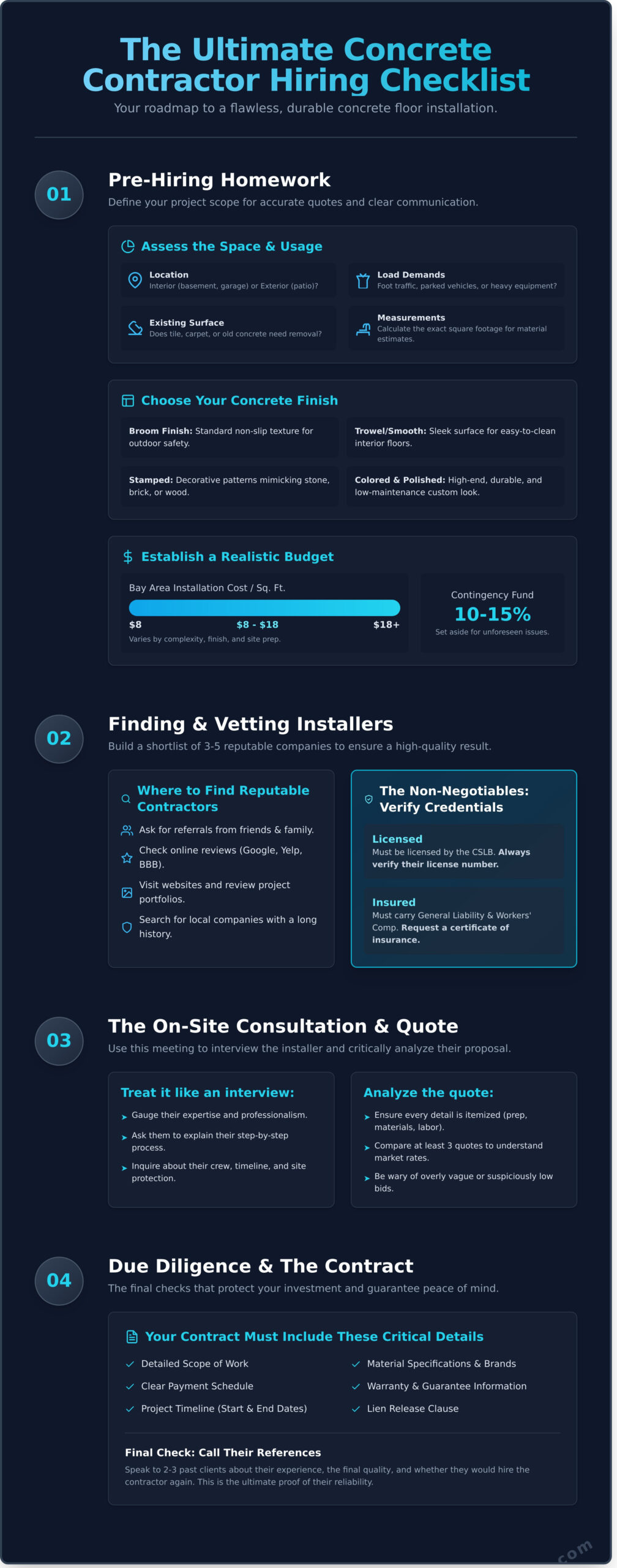
Before you begin contacting professional concrete floor installers, the most critical step is to clearly define the scope of your project. This initial homework does more than prepare you for a conversation; it empowers you as a client. A well-defined plan ensures you receive accurate, comparable quotes and helps establish a foundation of clear communication with your chosen contractor from day one. Taking the time to understand these key variables will lead to a smoother process and a final result that meets your expectations.
Assess the Space and Usage
Every successful concrete project begins with a detailed assessment of the intended area. Documenting these specifics is essential for any contractor to provide an accurate estimate. Start with these fundamental questions:
- Measurements: What is the exact square footage of the area? Accurate measurements are the basis for all material and labor calculations.
- Location: Is this an interior floor, like a basement or garage, or an exterior surface, such as a patio or walkway?
- Load Demands: What will the floor endure? Note whether it will support simple foot traffic, parked vehicles, or heavy-duty equipment.
- Existing Surface: Is there an old floor-like tile, carpet, or cracked concrete-that requires demolition and removal first?
Choose Your Concrete Finish
The finish determines both the look and function of your new floor. While a contractor can provide samples and guidance, having a preliminary idea is beneficial. Common options include:
- Broom Finish: A standard, non-slip texture created by dragging a broom over the surface. It’s a durable and safe choice for outdoor areas.
- Trowel/Smooth Finish: A sleek, smooth surface ideal for interior spaces like garages, workshops, and basements where easy cleaning is a priority.
- Stamped Concrete: A decorative option that uses patterns to mimic the appearance of stone, brick, wood, or tile for a high-end look.
- Colored & Polished Concrete: Custom aesthetics can be achieved with integral color, surface stains, or dyes. More complex finishes, like polishing, involve a multi-step mechanical process. Understanding what polished concrete is can help you decide if its durability and low-maintenance appeal are right for you.
Establish a Realistic Budget
A clear budget prevents surprises. In the Bay Area, new concrete floor installation costs typically range from $8 to $18 per square foot, depending on the complexity, finish, and site preparation required. Your total budget should account for every phase of the project: demolition, site prep, materials, and labor. As a best practice, we recommend setting aside a contingency fund of 10-15% to cover any unforeseen issues that may arise.
Step 2: Finding and Vetting Potential Concrete Installers
With your project plan in hand, the next step is to identify qualified professionals who can bring your vision to life. The goal is to move beyond a simple web search and build a shortlist of 3-5 reputable companies. A contractor’s history, credentials, and reputation are the most reliable indicators of the quality you can expect. Taking the time to vet candidates thoroughly is the best way to ensure a durable, high-quality result.
Where to Find Reputable Contractors
Finding trustworthy concrete floor installers starts with looking in the right places. A solid reputation is built over years of consistent, high-quality work in the community. Begin your search by:
- Asking for referrals from friends, family, or neighbors who have had similar work done.
- Searching for local companies with a long, established history in the Bay Area.
- Checking online reviews on trusted platforms like Google, Yelp, and the Better Business Bureau (BBB).
- Visiting their websites to look for professional project galleries that showcase their workmanship.
Crucial Question: Are They Licensed and Insured?
Never hire a contractor without verifying their credentials. In California, all contractors must be licensed by the Contractors State License Board (CSLB). You can and should verify their license number on the CSLB website. Furthermore, ensure they carry both general liability and workers’ compensation insurance. Ask for a certificate of insurance directly from their provider-do not just take their word for it. Following the official state licensing board checklist can help protect you. Hiring an uninsured contractor exposes you to significant financial risk if an accident or property damage occurs.
Review Their Portfolio and Experience
A picture is worth a thousand words, especially in concrete work. A reputable contractor will have an extensive portfolio of past projects. When reviewing their gallery, look for work similar to your own project and pay close attention to the details. Are the lines crisp and clean? Is the finish consistent and professional? An experienced team has the skill to deliver flawless results. A contractor with decades of experience has encountered and solved nearly every potential challenge, ensuring your project runs smoothly. Our family has provided quality work since 1979.
Step 3: The On-Site Consultation & Quote Analysis
Once you have a shortlist of potential contractors, the next step is the on-site consultation. This meeting is a critical diagnostic tool. Any reputable concrete floor installers will insist on visiting the site to assess the conditions firsthand. Never accept a quote given over the phone or via email without a physical inspection; it’s a clear sign of inexperience or a lack of professionalism.
This walkthrough is your opportunity to interview the contractor, gauge their expertise, and see if they are the right fit for your project. A confident, knowledgeable installer will welcome your questions and provide clear, direct answers.
Key Questions to Ask During the Walkthrough
A seasoned professional will be able to answer technical questions clearly, demonstrating their knowledge of established industry standards for concrete floors. Use this time to understand their process and ensure it aligns with best practices.
- Sub-base Preparation: How will you prepare, grade, and compact the sub-base to ensure proper, long-term support and prevent cracking?
- Concrete Mix: What concrete mix (measured in PSI) do you recommend for my specific application, and why is it the best choice?
- Reinforcement: Will you use rebar or wire mesh for reinforcement? What determines that choice for this project?
- Project Management: What is your process for managing the project? Can you provide a clear timeline from start to finish?
Deconstructing the Quote: What to Look For
The quality of the quote is just as important as the final price. A professional bid is a reflection of a professional operation. Insist on a detailed, itemized quote rather than a single lump sum. This transparency protects you and ensures there are no hidden costs later on.
Your quote should clearly specify:
- Costs for labor, materials, equipment, and any necessary permits.
- The exact concrete thickness and type of reinforcement being used.
- A clear payment schedule. Be wary of contractors who demand a large upfront deposit.
- Details on site cleanup and debris removal.
Why the Cheapest Quote is a Red Flag
While budget is always a factor, the lowest bid is often a warning sign. Extremely low prices are usually achieved by cutting corners on the most critical parts of the job. This can include inadequate sub-base preparation, using a cheaper and weaker concrete mix, or skipping essential reinforcement. It may also indicate the contractor is operating without proper licensing or insurance, putting you at significant financial risk.
Remember, quality concrete work is a long-term investment in your property. Paying a fair price for experienced concrete floor installers upfront prevents the headache and high cost of future repairs.
Step 4: Due Diligence: Checking References and Signing the Contract
You have reviewed the quotes and identified a preferred contractor for your project. Before you commit, completing these final verification steps is essential. This due diligence protects your investment, prevents misunderstandings, and ensures the project begins on a foundation of clear, mutual expectations. Remember, the contract is a legally binding document that outlines the entire scope of work, so a careful review is non-negotiable.
How to Effectively Check References
A reputable contractor will gladly provide references. Ask for 2-3 recent clients with projects similar in scope to yours. When you call, go beyond a simple “Did you like their work?” and ask targeted questions to get a clear picture of their experience:
- Was the team professional, communicative, and respectful of your property?
- Did the project finish on schedule and within the agreed-upon budget?
- Were there any unexpected issues, and if so, how did the contractor resolve them?
- Most importantly: Would you hire these concrete floor installers again without hesitation?
Anatomy of a Strong Construction Contract
A professional contract leaves no room for ambiguity. It is your primary tool for ensuring the job is done right. Before signing, verify that the document includes these critical components:
- Company Information: The contractor’s full name, business address, phone number, and state license number.
- Detailed Scope of Work: A complete description of the work, materials, and demolition, which should match your itemized quote exactly.
- Project Timeline: A clear start date and a projected completion date.
- Payment Schedule: A breakdown of costs and a schedule of payments tied to project milestones.
- Warranties and Guarantees: Specific details on the warranty covering both materials and labor.
- Lien Releases: A clause stating that you will receive lien waivers from subcontractors and suppliers upon final payment.
Final Decision and Next Steps
After reviewing the contract and speaking with references, trust your gut feeling. The best professional relationships are built on both proven expertise and good communication. Once you sign, be sure to get a copy for your records. Ask your chosen concrete floor installers to clarify any pre-construction steps you need to take, such as clearing furniture or providing access to the work area. A clear plan ensures a smooth start to a successful project.
With careful planning and a solid contract, you are ready to move forward with confidence. Ready for a professional quote? Start your project today.
Choose Your Bay Area Concrete Partner with Confidence
Choosing the right contractor for your project is a significant decision. By following this checklist-from defining your scope to thoroughly vetting candidates and checking references-you can confidently navigate the process of hiring professional concrete floor installers. The key is to prioritize clear communication, proven experience, and a commitment to quality craftsmanship at every step.
Since 1979, Peninsula Concrete Contractors has been the Bay Area’s trusted choice for high-quality concrete work. As a 2nd-generation, family-owned business, we are fully licensed, bonded, and insured, and proudly maintain an A+ rating with the Better Business Bureau. We believe in building lasting relationships through honesty and superior results.
When you’re ready to discuss your project with a team that has a heritage of excellence, we invite you to Get a Free, No-Obligation Estimate from Our Experienced Team.
Let us help you take the final step toward beautiful, durable concrete floors that will stand the test of time.
Frequently Asked Questions About Concrete Floor Installation
How much does it cost to install a concrete floor in the Bay Area?
The cost to install a new concrete floor in the Bay Area typically ranges from $8 to $18 per square foot. This price varies based on several key factors, including the amount of site preparation required, the thickness of the concrete slab, and the complexity of the finish. For example, a basic broom finish is more cost-effective than a decorative stamped or high-gloss polished finish. For an accurate, honest quote, it is always best to schedule a professional consultation.
How long does it take for a new concrete floor to cure and be ready for use?
A new concrete floor must cure properly to achieve its designed strength and durability. While you can typically allow for light foot traffic after 24 to 48 hours, we recommend waiting at least 7 days before placing heavy furniture or equipment on the surface. The concrete will continue to cure and harden for weeks, reaching its full compressive strength in approximately 28 days. Following a proper curing timeline is essential for a long-lasting, high-quality installation.
Can I install a concrete floor myself (DIY)?
While a DIY installation may seem like a way to save money, we strongly advise against it for most homeowners. Pouring a concrete floor requires specialized knowledge of sub-base preparation, proper concrete mixing, and expert finishing techniques. Mistakes can easily lead to uneven surfaces, excessive cracking, or poor durability, resulting in far more expensive repairs. Hiring professional concrete floor installers ensures the job is done right, providing a high-quality, level, and durable surface that lasts for decades.
What’s the difference between polished concrete and a standard smooth-finish floor?
A standard smooth-finish floor is achieved by using trowels to create a flat, even surface with a simple matte appearance. It is a durable and functional option. Polished concrete involves a more intensive mechanical process. After the concrete cures, the surface is ground down with progressively finer diamond abrasives to create a smooth, high-gloss finish. This not only provides a more refined, reflective look but also makes the floor denser and more resistant to stains.
My new concrete floor has small cracks. Is this normal?
Yes, it is normal to see small, hairline cracks in a new concrete floor. These are typically called shrinkage cracks and occur as the concrete cures and loses moisture. They do not usually affect the structural integrity of the floor. However, you should be concerned if you see cracks that are wide (larger than a credit card), are uneven in height from one side to the other, or continue to grow over time. A reputable contractor can assess any cracks you are concerned about.
What kind of maintenance does a concrete floor require?
Concrete floors are exceptionally durable and require minimal maintenance. For sealed interior floors, routine care involves sweeping or dust mopping to remove dirt and grit that can abrade the surface. Occasional cleaning with a damp mop and a pH-neutral cleaner is all that is needed. Depending on foot traffic, the protective sealer may need to be reapplied every few years to maintain its appearance and stain resistance. Your concrete floor installers can provide a specific care plan for your chosen finish.