
Choosing the right material for your new driveway, patio, or walkway is a significant decision for any Bay Area homeowner. You want a surface that is not only beautiful but will also withstand the test of time, avoiding the common pitfalls of cracking and shifting. Yet, with so many styles and patterns available, it’s easy to feel overwhelmed. If you’re seeking a proven solution that combines lasting durability with stunning design versatility, high-quality interlocking concrete pavers are the definitive answer.
For decades, homeowners have trusted pavers to create elegant and resilient outdoor living spaces. Unlike a solid slab of concrete, their unique system offers flexibility and strength, ensuring your investment remains pristine for years to come. In this guide, we draw on our family’s long-standing experience to provide you with all the essential information. You will discover the unmatched benefits of modern pavers, understand the professional installation process from start to finish, and gain the confidence to create an outdoor space you’ll be proud of.
Key Takeaways
- Understand why pavers offer superior long-term value and durability compared to options with lower upfront costs.
- Discover the wide range of paver styles and patterns available to perfectly complement your Bay Area home’s architecture.
- Learn the critical steps of a professional installation to ensure your new interlocking concrete pavers last for decades.
- See a clear, side-by-side comparison of pavers against traditional materials like poured concrete and asphalt.
What Are Interlocking Concrete Pavers? More Than Just Stones
Many homeowners think of pavers as simple decorative stones, but true interlocking concrete pavers are much more. They form a sophisticated, flexible pavement system engineered for exceptional durability. Unlike rigid surfaces like poured concrete or asphalt that can crack under pressure and shifting soil, an interlocking system consists of individual units that work together. To fully appreciate their design, it helps to understand what interlocking pavers are at a structural level. The secret to their strength lies not in the pavers themselves, but in the friction between them, created by fine jointing sand that transfers loads and stresses across the entire surface.
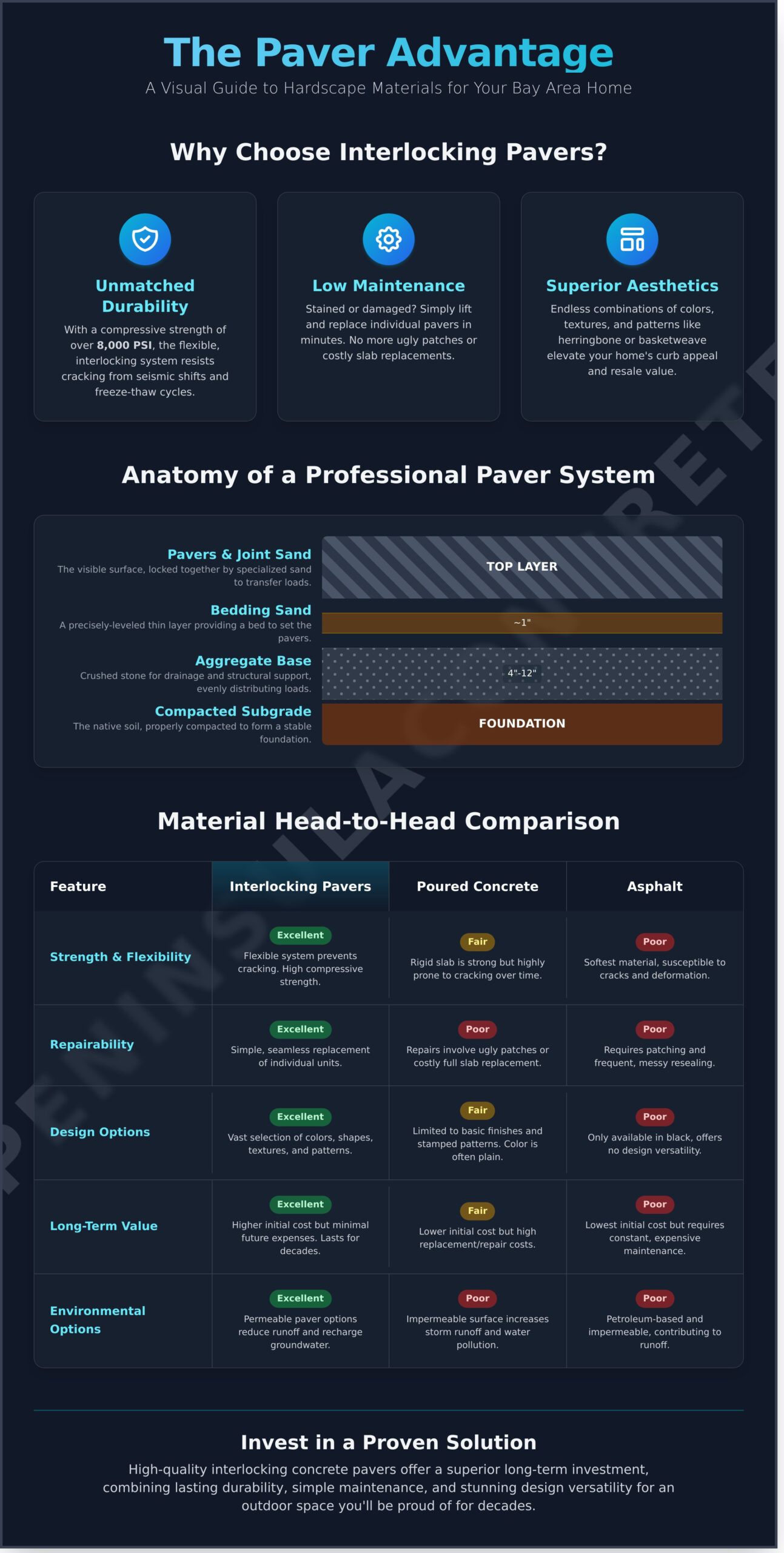
The Anatomy of a Paver System
A high-quality paver installation is built from the ground up. The longevity of your patio, walkway, or driveway depends on this complete system, where each layer serves a critical function:
- Excavation and Subgrade: The properly compacted native soil that forms the foundation.
- Aggregate Base: A layer of crushed stone that provides drainage and structural support, distributing loads evenly.
- Bedding Sand: A thin, precisely-leveled layer of sand that provides a bed for setting the pavers.
- Pavers, Edge Restraints, and Jointing Sand: The pavers themselves, held in place by sturdy edge restraints and locked together with specialized sand swept into the joints.
Interlocking vs. Architectural Slabs
Not all pavers are created equal. True interlocking pavers are at least 60mm (2 3/8″) thick, engineered to withstand the heavy loads of vehicle traffic, making them essential for driveways. In contrast, architectural slabs are thinner and designed primarily for aesthetic appeal on pedestrian surfaces like patios and walkways. Using slabs on a driveway can lead to cracking and failure, which is why choosing the right material for the application is critical for a durable, long-lasting hardscape.
Permeable vs. Non-Permeable Pavers
As an environmentally conscious choice, permeable pavers offer a fantastic solution to water management. Designed with wider joints filled with small, clean stones, they allow rainwater to pass through the surface and into the ground below instead of running off into storm drains. This advanced system helps reduce erosion, filter pollutants, and recharge local groundwater-a significant benefit that aligns with many Bay Area building codes and environmental goals.
The Core Benefits: Why Choose Pavers for Your Driveway or Patio
While surfaces like poured concrete or asphalt may present a lower initial cost, they often lead to frustrating and expensive problems down the road. A professionally installed paver system is a long-term investment in your property’s function and value. Homeowners who choose interlocking concrete pavers are choosing a solution built on three core pillars: unmatched durability, simple maintenance, and superior curb appeal.
Unmatched Strength and Durability
Unlike a rigid slab, a paver system is an engineered surface of individual, high-density units. Each paver typically possesses a compressive strength of 8,000 PSI or more, making it incredibly resilient to the heavy loads of daily vehicle traffic. More importantly, the interlocking system is flexible. It is designed to subtly shift with the earth, which prevents the cracking that plagues traditional concrete during freeze-thaw cycles or the Bay Area’s common seismic movements.
Low Maintenance and Easy Repairs
Forget the frustration of a large crack or a deep oil stain ruining your entire driveway. If a paver is ever damaged or stained, it can be individually lifted and replaced in minutes, seamlessly restoring your surface to its original beauty. This simple repairability, a key benefit of a system installed according to the industry’s official Professional Installation Process, is impossible with a monolithic concrete slab. For routine upkeep, simple sweeping and occasional washing are all that’s needed to keep your patio or driveway looking its best.
Superior Aesthetics and Curb Appeal
Your hardscape is one of the most prominent features of your home’s exterior. With pavers, your design possibilities are nearly limitless. You can choose from a vast catalog of colors, unique textures, and classic patterns like herringbone or basketweave to create a look that is entirely your own. This level of customization delivers an upscale, premium appearance that elevates your home’s curb appeal and can significantly increase its resale value, making it a wise and beautiful investment.
Designing Your Hardscape: A World of Paver Styles and Patterns
A paver installation is more than just a durable surface; it’s a foundational design element that defines your outdoor living space. The true beauty of interlocking concrete pavers lies in their incredible versatility. The right combination of shape, color, and pattern can dramatically enhance your home’s architectural character, whether you have a classic Craftsman in Palo Alto or a modern home in the San Jose hills. Choosing a style that complements your property is the key to creating a cohesive and high-value hardscape.
Popular Paver Shapes and Styles
The paver itself sets the tone for your entire project. Texture and shape are your primary tools for matching your home’s aesthetic. We help Bay Area homeowners select the perfect paver for their vision.
- Classic Styles: For a timeless, traditional feel, consider the old-world charm of Cobblestone or the clean lines of a brick-look paver. These are excellent choices for Tudor, Colonial, or Spanish-style homes.
- Modern Styles: Large format and linear pavers with smooth textures create a sophisticated, uncluttered look. Their clean lines and geometric feel are ideal for contemporary and mid-century modern architecture.
- Natural Look: If you prefer an organic aesthetic, textured pavers that mimic natural flagstone or slate provide a rustic elegance that blends seamlessly with gardens and landscapes, perfect for ranch-style homes.
Common Laying Patterns
How the pavers are arranged is just as important as the pavers themselves. The laying pattern impacts both the structural integrity and the visual flow of your patio, walkway, or driveway.
- Herringbone: This pattern’s V-shape creates an exceptionally strong interlock, making it a superior choice for driveways and other high-traffic areas where durability is paramount.
- Running Bond: Simple, classic, and effective. This linear pattern is a go-to for walkways and patios, creating a sense of length and movement.
- Basket Weave: By alternating pairs of pavers, this pattern creates a charming, textured look reminiscent of historic courtyards.
- Random or Ashlar: Using a mix of three or more paver sizes, this pattern creates a beautiful, natural appearance that breaks up repetition and feels more organic.
Adding Borders and Accents
The finishing details elevate a good project to a great one. A well-designed border acts like a picture frame, neatly defining the space and adding a polished, professional look. Using a contrasting color or a different paver style for the border creates strong visual interest. For a truly unique touch, we can integrate custom inlays or accent patterns to make your hardscape a one-of-a-kind feature. The possibilities offered by interlocking concrete pavers are nearly endless.
To see how these elements come together in finished projects, we invite you to browse our gallery. See examples of our paver projects for inspiration.
The Professional Installation Process: Quality Work from the Ground Up
A beautiful patio or driveway made from interlocking concrete pavers is more than just the surface you see. The real secret to a durable, long-lasting installation lies in the meticulous preparation work happening beneath. At Peninsula Concrete Contractors, our process is built on decades of experience, ensuring every project reflects our standard of “Quality Work Since 1979.” Here’s how we build your hardscape from the ground up for success.
Step 1: Planning and Excavation
A successful project starts with a solid plan. We begin by marking all utility lines for safety, outlining the project area, and carefully calculating the proper slope to direct water away from your home’s foundation. We then excavate the area to the correct depth, which varies based on soil conditions and whether the surface will support light pedestrian traffic or heavy vehicles.
Step 2: Base Preparation and Compaction
The compacted aggregate base is the single most important part of the installation. We lay a foundation of high-quality crushed stone in layers, or “lifts.” Each lift is graded and thoroughly compacted with professional equipment to create a dense, stable base that will not shift or settle over time. This unyielding foundation is what prevents your new pavers from sinking or becoming uneven.
Step 3: Setting, Cutting, and Compacting
With the base perfected, we lay down a uniform 1-inch layer of bedding sand and screed it to a precise, smooth level. The pavers are then carefully placed by hand in the desired pattern. We make exact cuts along the edges for a clean, finished look and install a durable edge restraint system to lock the perimeter in place and prevent any lateral movement.
Step 4: Jointing Sand and Final Compaction
To truly lock the system together, we sweep high-grade polymeric sand into every joint. When activated with water, this specialized sand hardens like a flexible mortar, creating a firm bond between the pavers that prevents weed growth and insect intrusion. A final pass with a plate compactor sets the pavers securely into the bedding sand and settles the joints for a flawless, durable finish.
This proven, step-by-step method is what separates a temporary hardscape from a lifetime investment. It’s the attention to detail in the unseen foundation that guarantees a beautiful, functional surface for decades. To ensure your project is built on a foundation of quality, contact the experts at Peninsula Concrete Contractors today.
Pavers vs. The Alternatives: A Head-to-Head Comparison
Choosing the right material for your driveway, patio, or walkway is a significant decision. While options like poured concrete and asphalt are common, it’s crucial to look beyond the initial price tag and consider long-term performance, durability, and aesthetics. As a family-owned business with experience since 1979, we believe in providing honest comparisons to help you make a decision your family will appreciate for decades to come.
To simplify your choice, here is a direct comparison of the most popular hardscape materials.
.comparison-table { width: 100%; border-collapse: collapse; margin: 2em 0; }
.comparison-table th, .comparison-table td { border: 1px solid #ddd; padding: 12px; text-align: left; }
.comparison-table th { background-color: #f2f2f2; font-weight: bold; }
.comparison-table tr:nth-child(even) { background-color: #f9f9f9; }
| Feature | Interlocking Pavers | Poured Concrete | Asphalt |
|---|---|---|---|
| Average Lifespan | 50+ Years | 20-30 Years | 15-20 Years |
| Maintenance | Low (occasional cleaning/sanding) | Can stain; requires sealing | Requires resealing every 3-5 years |
| Repairs | Simple; replace individual stones | Difficult; patching is obvious | Patching, crack filling, resurfacing |
| Aesthetics | Limitless designs, colors & textures | Limited finishes, prone to cracks | Utilitarian, basic black |
| Long-Term Value | Excellent; adds significant curb appeal | Good, but reduced by cracking | Fair; requires frequent upkeep |
Interlocking Pavers vs. Poured Concrete
The key difference lies in flexibility. A poured concrete slab is rigid and will inevitably crack with ground movement and freeze-thaw cycles. In contrast, the joints between interlocking concrete pavers allow for slight movement, preventing widespread damage. When a repair is needed, you simply replace the affected paver, leaving no unsightly patch. This durability and ease of maintenance provide a superior lifetime value, justifying the initial investment.
Interlocking Pavers vs. Asphalt
Asphalt is a practical choice for roads, but it lacks the durability and elegance required for a high-quality residential hardscape. It demands constant maintenance, including resealing every few years to prevent deterioration. Pavers offer a far longer lifespan and a premium appearance that enhances your home’s value. Furthermore, lighter-colored pavers remain significantly cooler under the summer sun than black asphalt, making them more comfortable for patios and pool decks.
For homeowners seeking the best combination of beauty, durability, and long-term value, the choice is clear. If you’re ready to invest in a hardscape solution built to last, our team is here to help. Contact Peninsula Concrete today to start your project with confidence.
Your Next Step to a Lasting, Beautiful Hardscape
Choosing the right material for your driveway, patio, or walkway is a significant decision. As we’ve detailed, interlocking concrete pavers stand out as the superior choice for Bay Area homeowners, offering an unmatched blend of strength, long-term value, and incredible design versatility. Unlike poured concrete that cracks or asphalt that degrades, a properly installed paver system provides a flexible, durable surface that enhances your home’s curb appeal for decades.
The key to unlocking these benefits lies in expert installation. At Peninsula Concrete Contractors, we bring a heritage of craftsmanship to every project. As a local, 2nd-generation, family-owned business, we’ve built our A+ Better Business Bureau rating on a foundation of trust and reliability. We don’t just lay pavers; we build lasting relationships with our clients through honest work and exceptional results.
Let us put our legacy of Quality Work Since 1979 to work for you. Start your project today. Get a free estimate from our family-owned team and take the first step toward the beautiful, durable hardscape you deserve.
Frequently Asked Questions
How much do interlocking concrete pavers cost to install in the Bay Area?
In the San Francisco Bay Area, homeowners can expect the professional installation of interlocking pavers to range from $25 to $45 per square foot. This price includes materials, labor, and site preparation. The final cost depends on factors such as the complexity of the design, the specific paver style and quality selected, and the existing condition of the installation site. For an accurate estimate based on your project’s unique requirements, we recommend a professional consultation.
How long will a paver driveway or patio last?
A properly installed and maintained paver driveway or patio is a long-term investment that can last 25 to 50 years, or even longer. The key to this durability is a high-quality installation with a properly compacted base. Unlike solid concrete slabs that can crack and require complete replacement, individual pavers can be easily repaired or replaced if one becomes damaged. This ensures your hardscape remains beautiful and functional for decades to come.
Do I need to seal my concrete pavers?
While not strictly required, sealing your concrete pavers is highly recommended to protect your investment. A quality sealant enhances the paver colors, provides protection against stains from oil and spills, and makes cleaning easier. It also helps to inhibit weed growth and prevent insect intrusion in the joints. For best results and lasting protection, we typically advise reapplying a sealant every 3 to 5 years, depending on the amount of foot traffic and sun exposure.
How do you prevent weeds from growing between pavers?
The most effective way to prevent weeds is through proper installation. A solid, compacted base and secure edge restraints are the foundation. We then fill the joints between the interlocking concrete pavers with polymeric sand. This special sand contains a binder that hardens when activated with water, creating a firm yet flexible joint. This hardened barrier effectively blocks weeds from sprouting and also deters ants and other insects from nesting between your pavers.
Can you install pavers over an existing concrete patio?
Yes, it is possible to install pavers over an existing concrete surface, a process known as an overlay. However, this is only recommended if the underlying concrete slab is in good structural condition, with no major cracks, heaving, or settling issues. The process involves laying a sand setting bed over the concrete before placing the pavers. An overlay can be a cost-effective solution, but a professional assessment of your existing patio is essential to ensure a durable, long-lasting result.
Are interlocking pavers slippery when wet?
Generally, interlocking concrete pavers are less slippery than poured concrete or many types of natural stone when wet. Their textured surfaces and the numerous joints between each paver work together to provide better traction and allow water to drain more effectively. Many paver styles are manufactured with a non-slip finish, making them an excellent and safe choice for pool decks, walkways, and other areas that are frequently exposed to moisture.